
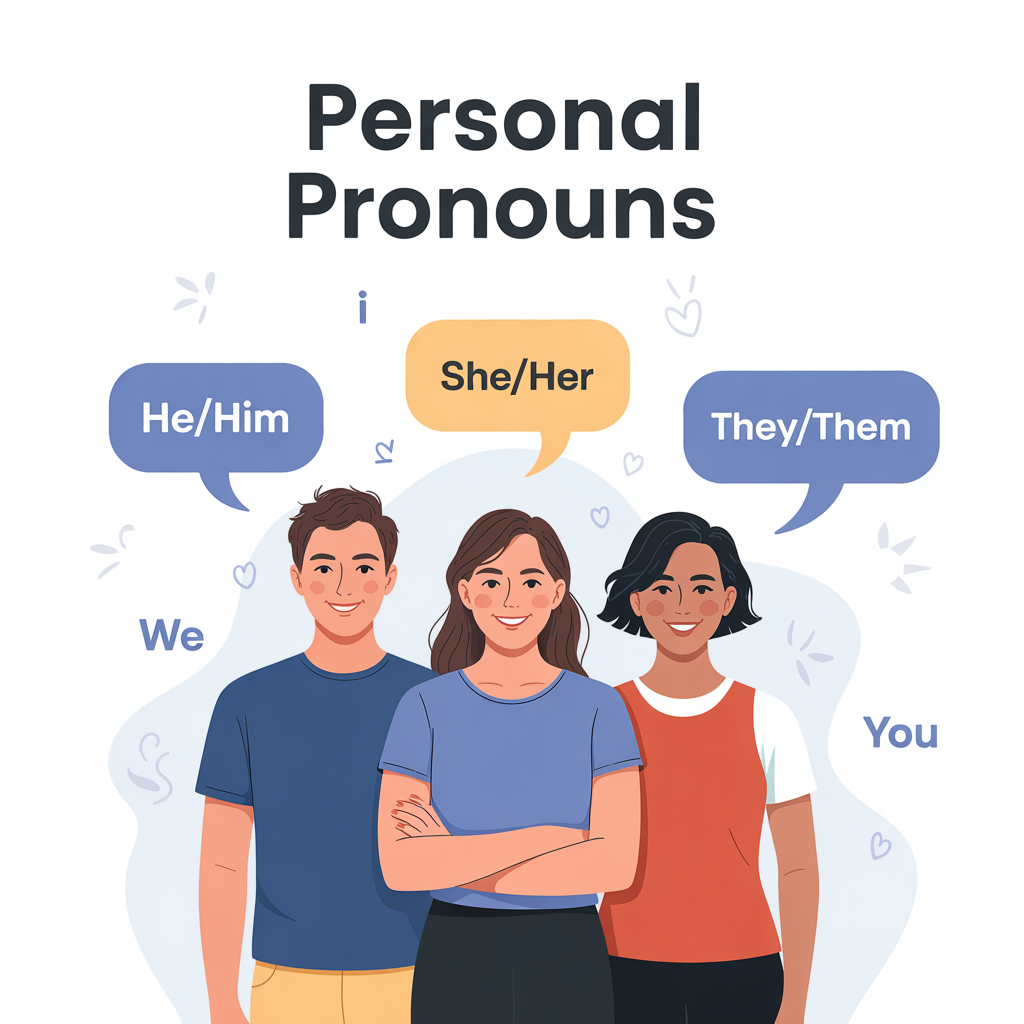
Language is one of the most powerful tools humans have — and at the heart of every sentence, there’s often a tiny word doing an enormous job. Personal pronouns like I, you, she, they, and we are the silent workhorses of communication. They let us talk about people, ourselves, and the world around us without repeating names over and over again. But what exactly are personal pronouns, and why do they matter so much — both grammatically and socially? This guide breaks it all down in a clear, straightforward way.
What Are Personal Pronouns?
A personal pronoun is a word that substitutes for a noun — specifically, one that refers to a person, group of people, or sometimes a thing or idea. Instead of repeating someone’s name every time you mention them, you use a pronoun to keep your speech or writing flowing naturally.
For example:
- Without pronouns: “Sarah went to the store. Sarah bought apples. Sarah brought the apples home.”
- With pronouns: “Sarah went to the store. She bought apples and brought them home.”
The second version is much smoother. That’s the core function of a personal pronoun — to replace nouns and make communication more efficient and natural.
Personal pronouns are part of a larger category called pronouns, which also includes reflexive pronouns, possessive pronouns, relative pronouns, and more. What makes personal pronouns distinct is that they specifically refer to particular people or things in a conversation.
Why Are Personal Pronouns Important?
Personal pronouns serve two major roles:
- Grammatical function: They allow sentences to flow without awkward repetition and help organize who is doing what in a sentence.
- Social and identity function: In modern usage, personal pronouns — particularly gender pronouns — have become an important part of how individuals express and communicate their identity.
Understanding personal pronouns is fundamental whether you’re learning English as a second language, studying grammar, or navigating today’s culturally aware conversations.
The Different Types of Personal Pronouns
Personal pronouns are not a one-size-fits-all tool. They change depending on three key factors: person, number, and case. Let’s explore each one.
1. Person: First, Second, and Third
Personal pronouns are categorized by grammatical person — meaning who or what they refer to relative to the speaker.
- First person: Refers to the speaker themselves. Singular: I, me. Plural: we, us.
- Second person: Refers to the person being spoken to. Both singular and plural: you.
- Third person: Refers to someone or something being talked about. Singular: he, him, she, her, it, they, them. Plural: they, them.
2. Number: Singular and Plural
Pronouns also change depending on whether they refer to one person or more than one.
- Singular: I, you, he, she, it, they (when referring to one person)
- Plural: we, you, they (when referring to multiple people)
Notice that you and they can be both singular and plural depending on context — something we’ll explore further below.
3. Case: Subject, Object, and Possessive
Case refers to the role a pronoun plays in a sentence — whether it’s the one doing the action, receiving the action, or showing ownership.
- Subject pronouns (nominative case): Used when the pronoun is the subject of a verb — the one doing the action. Examples: I, you, he, she, it, we, they.
→ “She wrote the letter.” - Object pronouns (objective case): Used when the pronoun is the object — the one receiving the action. Examples: me, you, him, her, it, us, them.
→ “The letter was written for her.” - Possessive pronouns: Show ownership or belonging. Examples: mine, yours, his, hers, its, ours, theirs.
→ “That book is mine.”
Note: Possessive adjectives like my, your, his, her, its, our, their are closely related but function differently — they come before a noun (“my book”), while possessive pronouns stand alone (“the book is mine“).
A Full Chart of Personal Pronouns in English
Here’s a comprehensive reference table to see how personal pronouns shift across person, number, and case:
| Person | Number | Subject | Object | Possessive Adjective | Possessive Pronoun |
|---|---|---|---|---|---|
| First | Singular | I | me | my | mine |
| First | Plural | we | us | our | ours |
| Second | Singular/Plural | you | you | your | yours |
| Third | Singular (masc.) | he | him | his | his |
| Third | Singular (fem.) | she | her | her | hers |
| Third | Singular (neutral) | it | it | its | — |
| Third | Singular/Plural | they | them | their | theirs |
| Third | Plural | they | them | their | theirs |
How to Use Personal Pronouns Correctly
Using the right pronoun in the right context might seem tricky at first, but once you understand the rules, it becomes second nature. Here are the key principles:
Match Subject and Verb Agreement
Subject pronouns must agree with the verb in number. This is especially important with third-person singular pronouns:
- “She runs every morning.” ✓
- “They run every morning.” ✓
- “She run every morning.” ✗
Use the Correct Case
A very common error is mixing up subject and object pronouns. The key question to ask is: Is the pronoun the doer or the receiver of the action?
- “She and I went to the market.” ✓ (both are subjects)
- “He gave the gift to her and me.” ✓ (both are objects)
- “He gave the gift to she and I.” ✗ (common mistake — “she” and “I” are subject pronouns, not object pronouns)
Tip: If you’re unsure, remove the other person and test the pronoun alone. Would you say “He gave the gift to I”? No — so “me” is correct.
Avoid Ambiguity
Make sure your pronoun clearly refers to the right noun. If the sentence is ambiguous, restate the noun for clarity.
- Ambiguous: “When John met Peter, he was nervous.” (Who was nervous — John or Peter?)
- Clear: “When John met Peter, John was nervous.”
Gender Pronouns and Identity: A Modern Perspective
In recent years, the conversation around personal pronouns has expanded well beyond grammar textbooks. Gender pronouns — especially in the context of LGBTQ+ identities — have become an important social and cultural topic.
He/Him, She/Her, and They/Them
Traditionally, English assigned pronouns based on binary gender:
- He/him/his — used for men and boys
- She/her/hers — used for women and girls
However, not everyone identifies within the binary of male or female. Many people — including non-binary, genderqueer, and genderfluid individuals — use different pronouns to reflect their identity.
The Singular “They”
One of the most widely accepted gender-neutral pronoun options in English is the singular “they.” This isn’t actually new — English speakers have used singular “they” for centuries when referring to an unknown or unspecified person.
- “Someone left their bag at the door.” (classic singular “they”)
- “Alex uses they/them pronouns. They are a graphic designer.” (modern gender-neutral use)
The American Psychological Association (APA), Merriam-Webster dictionary, and major style guides now officially recognize and support the singular “they” as grammatically correct.
Neopronouns
Beyond traditional pronouns, some individuals use neopronouns — newer pronoun sets that fall outside the conventional he/she/they framework. Examples include ze/hir, xe/xem, and ey/em. These are used by some people who feel that existing pronouns don’t fully capture their identity.
While neopronouns are not yet universally standard in formal writing, they are meaningful to those who use them and deserve respectful acknowledgment.
Why Pronouns Matter Beyond Grammar
Using someone’s correct pronouns is a fundamental act of respect. Research in psychology has consistently shown that using a person’s correct gender pronouns is linked to:
- Reduced anxiety and depression in transgender and non-binary individuals
- Higher levels of self-esteem and well-being
- A greater sense of belonging and safety in social environments
In workplaces, schools, and social settings, sharing and respecting pronouns has become an important part of inclusive communication.
Personal Pronouns in Different Contexts
In Formal Writing
In formal or academic writing, pronoun use follows stricter grammatical rules. The subject/object distinction is especially important, and first-person singular (I, me) is often avoided in scientific or academic papers to maintain an objective tone — though this varies by discipline and style guide.
In Business and Professional Settings
Many companies and organizations now include pronoun sharing in email signatures, name badges, and introductions. For example: “Hi, I’m Jamie (she/her).” This normalizes the conversation around gender identity and creates more inclusive environments.
In Everyday Conversation
Personal pronouns are so embedded in natural speech that we use them without thinking. From “I need coffee” to “Did you see her performance?” — they’re everywhere, making our communication faster, more fluid, and more human.
Common Mistakes to Avoid with Personal Pronouns
- Using “I” instead of “me” after a preposition: “Between you and me” (not “between you and I”).
- Using the wrong possessive: “Its color is beautiful” (not “It’s color”) — remember, its is the possessive; it’s is a contraction of “it is.”
- Assuming gender: Avoid assuming someone’s pronouns based on appearance. When in doubt, use “they” or simply ask.
- Mixing singular and plural unnecessarily: “Everyone should bring their own lunch” — here, singular “their” is perfectly acceptable and widely used.
- Reflexive pronoun misuse: “Please contact Sarah or me” (not “myself”) — reflexive pronouns like myself should only be used when the subject and object are the same person or for emphasis.
Personal Pronouns in Other Languages
English isn’t alone in having a rich pronoun system. Many languages around the world use personal pronouns, though they often work quite differently:
- Spanish: Has formal and informal second-person pronouns — tú (informal “you”) vs. usted (formal “you”).
- French: Similarly distinguishes tu (informal) from vous (formal/plural), and all nouns have grammatical gender that affects pronoun use.
- Japanese: Has multiple first-person pronouns (watashi, boku, ore) that convey different levels of formality and social context.
- Finnish and Turkish: Are gender-neutral by default — they use a single third-person pronoun that doesn’t distinguish between he, she, or they.
This cross-linguistic perspective shows that pronoun systems are deeply tied to culture, social structure, and identity — not just grammar.
Teaching and Learning Personal Pronouns
For those learning English as a second language (ESL) or teaching it to others, personal pronouns are typically one of the first grammar topics introduced. Here are a few strategies that work well:
- Use visual charts: A well-designed pronoun table (like the one above) helps learners see the full system at a glance.
- Practice substitution: Give learners sentences with nouns and ask them to replace them with the correct pronouns.
- Role-play conversations: Using pronouns naturally in dialogue speeds up internalization.
- Contextualize with culture: Discussing the social aspects of pronouns (especially gender-neutral usage) makes the topic more relevant and memorable.
Conclusion
Personal pronouns are small but mighty. They serve as the backbone of clear, efficient communication — allowing us to reference people and things without constant repetition. But beyond their grammatical role, personal pronouns carry real human significance. They reflect identity, culture, and the evolving nature of language itself.
Whether you’re a student mastering the basics, a writer polishing your prose, or someone exploring what it means to be respectful and inclusive in communication — understanding personal pronouns is essential. They’re not just about grammar rules. They’re about how we see, acknowledge, and speak to one another.
The next time you use “I,” “you,” or “they,” you’ll know there’s a lot more going on beneath the surface of those little words.
Frequently Asked Questions (FAQs)
What is the difference between subject and object pronouns?
Subject pronouns (I, he, she, they, we, you, it) are used when the pronoun is performing the action in a sentence. Object pronouns (me, him, her, them, us, you, it) are used when the pronoun is receiving the action. For example: “She called me” — “she” is the subject, “me” is the object.
Why do some people share their pronouns?
Sharing pronouns — such as saying “I use she/her” or including pronouns in an email signature — is a way to communicate how you wish to be referred to. It also helps normalize the practice so that people whose pronouns may not be obvious (such as non-binary individuals) don’t feel singled out when they need to specify theirs.
Is “they” correct as a singular pronoun?
Yes. Using “they” to refer to a single person is both grammatically accepted and widely used. It has centuries of precedent in English and is now officially recognized by major dictionaries and style guides, including Merriam-Webster and the APA.
What are neopronouns?
Neopronouns are newly coined pronoun sets — such as ze/hir, xe/xem, or ey/em — used by some individuals who find that traditional pronouns don’t reflect their gender identity. They’re not yet part of standard formal grammar, but they are meaningful to those who use them.
Are personal pronouns the same in all languages?
No. Pronoun systems vary widely across languages. Some languages (like Finnish or Turkish) are gender-neutral, while others (like Spanish or French) have gendered pronouns and even formal/informal distinctions. Some languages (like Japanese) have many first-person pronoun options based on social context.
What is a possessive pronoun vs. a possessive adjective?
A possessive adjective comes before a noun and modifies it (e.g., my bag, her book). A possessive pronoun stands alone and replaces the noun entirely (e.g., “That bag is mine,” “The book is hers”). The key distinction is whether the pronoun accompanies a noun or replaces it.