
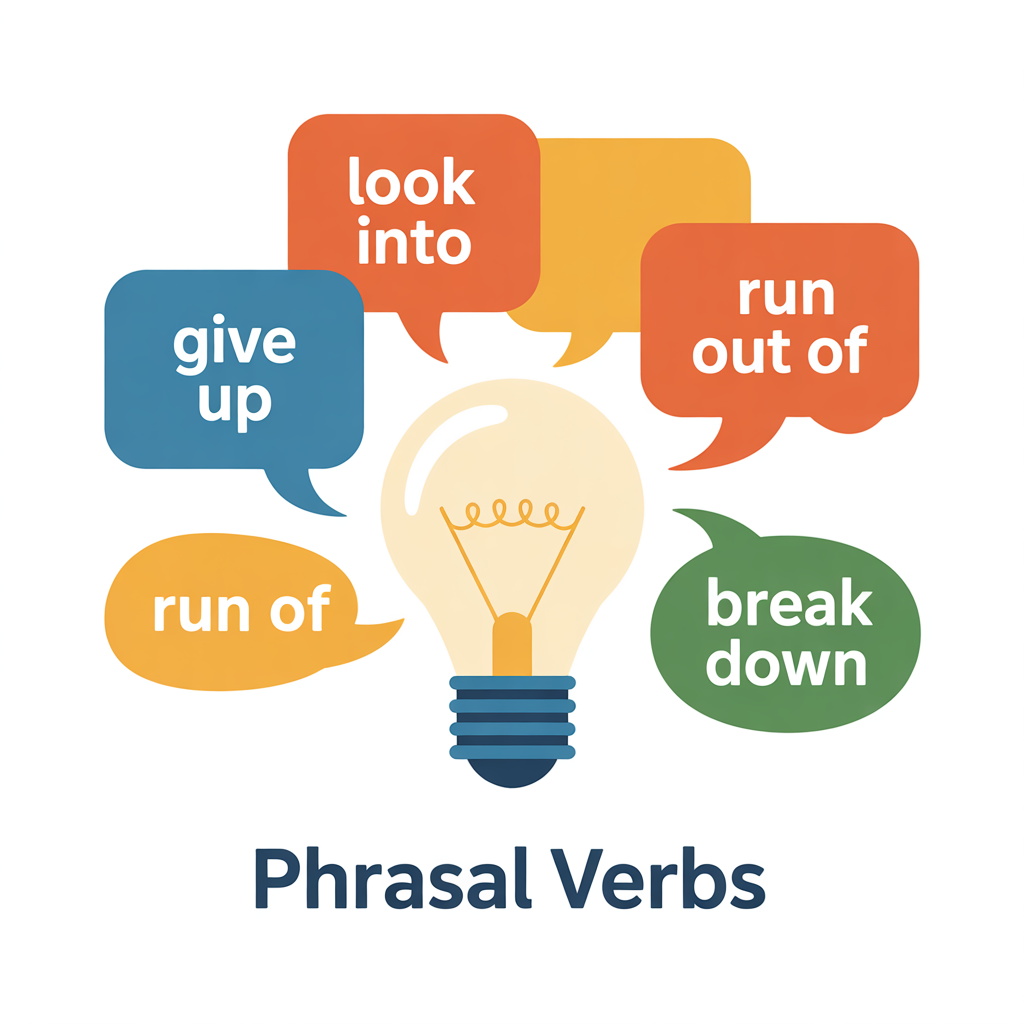
If you’ve ever been told to give up, asked someone to look into a problem, or heard a friend say they ran into an old classmate — you’ve already encountered phrasal verbs in action. These small but powerful word combinations are everywhere in the English language. Yet for many learners, they remain one of the most confusing and frustrating aspects of English grammar. So, what exactly are phrasal verbs, how do they work, and why do they matter so much? This guide breaks it all down in plain, practical terms.
What Are Phrasal Verbs?
A phrasal verb is a combination of a base verb and one or more particles — typically a preposition, an adverb, or both — that together create a meaning that is often completely different from the meaning of the original verb on its own.
For example:
- Look (verb) + up (adverb) = look up (to search for information)
- Give (verb) + up (adverb) = give up (to stop trying)
- Break (verb) + down (adverb) = break down (to stop functioning, or to lose emotional control)
Notice how the particle dramatically changes the meaning. You can “look” at something with your eyes, but “look up” means to research or find information. This shift in meaning is what defines a true phrasal verb and what makes them both fascinating and tricky to master.
Linguists and grammarians sometimes refer to phrasal verbs as multi-word verbs or compound verbs. They are a defining feature of informal spoken and written English, and native speakers use them constantly — often without even thinking about it.
Why Are Phrasal Verbs Important in English?
Understanding phrasal verbs isn’t just a grammar exercise. It’s a practical necessity for anyone who wants to communicate naturally in English. Here’s why they matter:
- They are extremely common in everyday speech. Native English speakers use phrasal verbs more often than formal single-word equivalents. Instead of saying “tolerate,” someone will say “put up with.” Instead of “investigate,” they say “look into.”
- They appear in movies, songs, podcasts, and conversations. If you’re watching an English-language TV show or listening to a podcast, you’ll hear dozens of phrasal verbs every episode.
- They are essential for sounding natural. Even if your grammar is perfect, overusing formal vocabulary in casual settings can make you sound stiff or unnatural.
- They are tested in English proficiency exams. Standardized tests like IELTS, TOEFL, and Cambridge exams regularly test knowledge of phrasal verbs because they reflect real-world English usage.
The Structure of a Phrasal Verb
To understand how phrasal verbs work, it helps to look at their basic building blocks. Every phrasal verb has at minimum two components:
1. The Base Verb
This is a standard action or state verb. Common verbs that frequently form phrasal verbs include: get, put, take, come, go, turn, make, look, run, bring, call, set, give, break, cut, work, fall.
2. The Particle
The particle is either a preposition (like at, for, in, into, on, off, out, through, up, down) or an adverb (which often looks the same as a preposition but functions differently). Common particles include: up, down, in, out, on, off, away, back, over, through, around.
Some phrasal verbs even take two particles. For example:
- Look forward to (to anticipate something with pleasure)
- Come up with (to think of an idea)
- Get along with (to have a good relationship with someone)
- Put up with (to tolerate something)
These are sometimes called three-word phrasal verbs or prepositional phrasal verbs.
Types of Phrasal Verbs
Phrasal verbs are categorized into different types based on whether they take an object and whether the parts can be separated. Understanding these categories is crucial for using phrasal verbs correctly in sentences.
1. Intransitive Phrasal Verbs
These phrasal verbs do not take a direct object. They express a complete idea on their own.
- She woke up early.
- The car broke down on the highway.
- He gave in after hours of negotiation.
Because there’s no object involved, you cannot separate these verbs — they always stay together.
2. Transitive Separable Phrasal Verbs
These phrasal verbs take a direct object, and crucially, the object can be placed either between the verb and the particle, or after the particle — giving you two grammatically correct options.
- Can you turn off the lights? / Can you turn the lights off?
- She looked up the word. / She looked the word up.
Important rule: When the object is a pronoun (him, her, it, them, me, us), it must go between the verb and the particle. You cannot say “turn off it” — you must say “turn it off.”
3. Transitive Inseparable Phrasal Verbs
These phrasal verbs also take an object, but the verb and particle cannot be separated. The object always comes after the complete phrasal verb.
- I came across an interesting article. (Not: “I came an interesting article across.”)
- She looks after her younger sister.
- They ran into trouble.
Most phrasal verbs that contain a preposition (rather than an adverb) as the particle tend to be inseparable.
4. Three-Word (or Ditransitive) Phrasal Verbs
These consist of a verb and two particles. They are always inseparable.
- I’m looking forward to the weekend.
- He finally came up with a solution.
- She can’t get along with her coworker.
Literal vs. Idiomatic Phrasal Verbs
One of the most important distinctions to understand is the difference between literal and idiomatic phrasal verbs.
Literal Phrasal Verbs
In some cases, the meaning of the phrasal verb is simply the combination of its parts — straightforward and logical.
- She walked in through the door. (She literally walked into a place.)
- He sat down on the chair. (He literally moved downward to sit.)
- The cat jumped off the table.
Idiomatic Phrasal Verbs
More commonly, phrasal verbs have an idiomatic meaning — one that cannot be guessed from the individual words alone. These are the ones that require learning and practice.
- Bring up = to raise a child or to mention a topic
- Kick the bucket = (idiomatic expression) to die — though note this is more of an idiom than a phrasal verb
- Let down = to disappoint someone (not to physically lower something)
- Put off = to postpone, or to make someone feel repelled
The idiomatic nature of phrasal verbs is precisely why they can be so challenging for non-native speakers. Context is everything.
How Phrasal Verbs Change Meaning with Different Particles
One of the most fascinating aspects of phrasal verbs is how dramatically the meaning changes when you swap out the particle. Consider the verb take:
- Take off — to leave the ground (a plane takes off), or to remove clothing (“Take off your shoes”), or to become suddenly successful (“Her career really took off.”)
- Take on — to accept a responsibility or challenge (“She took on more work.”)
- Take up — to start a new hobby or activity (“He took up painting.”)
- Take over — to assume control (“A new CEO took over the company.”)
- Take out — to remove something, or to go on a date with someone (“He took her out to dinner.”)
- Take in — to absorb information, or to deceive someone, or to offer shelter (“She was completely taken in by the scam.”)
This shows just how much work phrasal verbs do in English — and why learning them in context, rather than in isolation, is so important.
Most Common Phrasal Verbs in English
There are thousands of phrasal verbs in the English language, but a core group of high-frequency phrasal verbs covers the majority of everyday usage. Here are some of the most essential ones to know:
Phrasal Verbs for Daily Life
- Wake up — to stop sleeping
- Get up — to rise from bed or a seat
- Turn on / Turn off — to start or stop a device
- Pick up — to lift something, or to collect someone
- Put on / Take off — to dress or undress
- Run out of — to have no more of something
Phrasal Verbs for Communication
- Bring up — to mention a topic
- Call back — to return a phone call
- Point out — to direct attention to something
- Find out — to discover information
- Figure out — to solve or understand something
Phrasal Verbs for Work and Progress
- Set up — to organize or establish something
- Carry out — to complete a task
- Work out — to solve a problem, or to exercise
- Come up with — to think of an idea or solution
- Follow up — to check on progress or take further action
- Hand in — to submit work
Phrasal Verbs for Relationships and Emotions
- Get along with — to have a good relationship
- Break up — to end a romantic relationship
- Make up — to reconcile after a disagreement
- Let down — to disappoint someone
- Look up to — to admire or respect someone
- Look down on — to think you are better than someone
Tips for Learning and Mastering Phrasal Verbs
Learning phrasal verbs effectively requires strategy. Simply memorizing long lists rarely works. Here are proven approaches that make the process faster and more effective:
1. Learn Phrasal Verbs in Context
Always learn a new phrasal verb through example sentences that show how it’s actually used. A definition alone often isn’t enough because many phrasal verbs have multiple meanings depending on context.
2. Group Them by Base Verb or by Theme
Rather than learning random phrasal verbs, group them around a common verb (all the phrasal verbs with “get”) or around a theme (phrasal verbs related to travel, work, or relationships). This helps your brain build meaningful connections.
3. Notice Them in the Wild
Pay active attention to phrasal verbs when you read English articles, watch movies, listen to music, or have conversations. When you notice one you don’t know, write it down and look it up later.
4. Use Them in Your Own Writing and Speech
The fastest way to internalize a new phrasal verb is to use it. Try writing sentences or practicing conversations that incorporate new phrasal verbs you’ve learned. Active use builds retention far more effectively than passive review.
5. Use Spaced Repetition
Flashcard apps like Anki use spaced repetition algorithms to show you words just before you’re likely to forget them. This technique is scientifically proven to improve long-term vocabulary retention.
6. Don’t Try to Learn Everything at Once
There are literally thousands of phrasal verbs. Focus on the most common and useful ones first. Even knowing 100–200 high-frequency phrasal verbs will dramatically improve your fluency.
Phrasal Verbs vs. Prepositional Verbs: What’s the Difference?
This is a question that even many grammar teachers find tricky. The key difference lies in how the particle functions:
- In a phrasal verb, the particle is an adverb that modifies the verb and often changes its meaning fundamentally. The combination acts as a single semantic unit.
- In a prepositional verb, the preposition connects the verb to a noun phrase (object) and doesn’t change the core meaning of the verb as dramatically.
For example:
- “Look up the answer” — this is a phrasal verb. “Up” is an adverb that changes “look” into a new concept (to research).
- “Look at the painting” — this is a prepositional verb. “At” is a preposition that simply connects “look” with its object.
In practice, native speakers don’t consciously distinguish between these — but the distinction explains why some verb-particle combinations are separable and others are not.
Common Mistakes with Phrasal Verbs
Even advanced English learners make mistakes with phrasal verbs. Here are the most frequent errors to watch out for:
- Wrong word order with pronouns: Saying “turn off it” instead of “turn it off.” Pronouns must always go between the verb and particle in separable phrasal verbs.
- Separating inseparable phrasal verbs: Saying “I came across it an interesting fact” — this is incorrect. Inseparable phrasal verbs must stay together.
- Confusing similar phrasal verbs: “Give up” (to quit) vs. “give in” (to surrender or yield) vs. “give out” (to distribute or stop working). These are easily mixed up.
- Using phrasal verbs in overly formal contexts: In formal academic writing, single-word verbs (investigate, postpone, establish) are often preferred over their phrasal verb equivalents.
- Assuming the meaning is literal: “She blew him away” doesn’t mean she literally blew air at him — it means she impressed him greatly.
Phrasal Verbs in Formal vs. Informal English
An important nuance is that phrasal verbs tend to be more common in informal and conversational English, while formal English often prefers their single-word synonyms.
| Phrasal Verb (Informal) | Formal Equivalent |
|---|---|
| Find out | Discover / Ascertain |
| Put off | Postpone / Defer |
| Look into | Investigate / Examine |
| Bring about | Cause / Generate |
| Carry out | Execute / Conduct |
| Set up | Establish / Initiate |
| Come up with | Devise / Formulate |
This doesn’t mean phrasal verbs are “lesser” — in fact, some phrasal verbs (like “carry out” or “set up”) are perfectly acceptable in formal writing. The key is to read the context and match your vocabulary to the register of the situation.
Conclusion
Phrasal verbs are one of the most vibrant, versatile, and genuinely indispensable parts of the English language. They are verb-particle combinations that frequently carry idiomatic meanings, function as a single unit, and saturate everyday speech, writing, and media. Understanding what phrasal verbs are — how they’re structured, the different types, when to use them, and how to learn them efficiently — is a transformative step toward real English fluency.
Rather than seeing phrasal verbs as a confusing obstacle, think of them as a window into how English truly lives and breathes. Each time you master a new phrasal verb, you become slightly more fluent, more natural, and more confident in how you communicate. Start with the most common ones, practice them in context, and keep your eyes and ears open — because phrasal verbs are literally all around you, just waiting to be picked up.
Frequently Asked Questions (FAQs)
How many phrasal verbs are there in English?
Estimates vary, but most linguists suggest there are anywhere from 5,000 to over 10,000 phrasal verbs in English when you count all their different meanings and uses. The good news is that a working knowledge of the 200–500 most common phrasal verbs will cover the vast majority of real-world usage.
What’s the easiest way to remember phrasal verbs?
The most effective method is to learn phrasal verbs in full sentences and meaningful contexts rather than as isolated word pairs. Grouping them by theme or base verb, using them in conversation, and reviewing them through spaced repetition tools are all proven strategies.
Are phrasal verbs only used in spoken English?
No, phrasal verbs appear in both spoken and written English. They are more common in informal and conversational contexts but are also widely used in journalism, fiction, business communication, and even some academic writing. Formal academic writing tends to prefer Latinate single-word verbs, but this is not a universal rule.
Can a phrasal verb have more than one meaning?
Absolutely. Most high-frequency phrasal verbs have multiple meanings depending on context. For example, “take off” can mean a plane becoming airborne, removing an item of clothing, or a business or career experiencing rapid growth. Context always determines which meaning is intended.
Is “run out of” a phrasal verb or a different type of expression?
“Run out of” is a three-word phrasal verb (sometimes called a phrasal-prepositional verb). It follows the same principles as other phrasal verbs — the combined meaning (“to exhaust a supply of something”) differs from the literal meanings of “run,” “out,” and “of” separately.
Do I need to learn whether a phrasal verb is separable or inseparable?
Yes, ideally. Knowing whether a phrasal verb is separable or inseparable helps you use it grammatically correctly, especially when using pronouns. However, context and exposure will often teach you this naturally over time. A good learner’s dictionary will mark whether each phrasal verb is separable or not.