
You use them dozens of times a day without even thinking about it. This is delicious. That looks interesting. These are mine. Words like these are so common in everyday speech that most people never stop to ask: what exactly are they, and how do they work? The answer lies in a small but mighty category of grammar called demonstrative pronouns. Understanding them not only sharpens your writing — it gives you a clearer picture of how English organizes meaning, distance, and context.
What Is a Demonstrative Pronoun?
A demonstrative pronoun is a word used to point to or identify a specific noun — a person, place, thing, or idea — without actually naming it. Instead of repeating the noun, the demonstrative pronoun steps in to represent it, while also indicating whether that noun is near or far from the speaker, either physically or in terms of time and thought.
There are exactly four demonstrative pronouns in standard English:
- This
- That
- These
- Those
These four words carry a lot of information in a very compact form. Each one communicates:
- Distance: Is the noun close or far away?
- Number: Is the noun singular or plural?
Together, these two dimensions create a simple but powerful system for reference in English.
The Four Demonstrative Pronouns: A Quick Overview
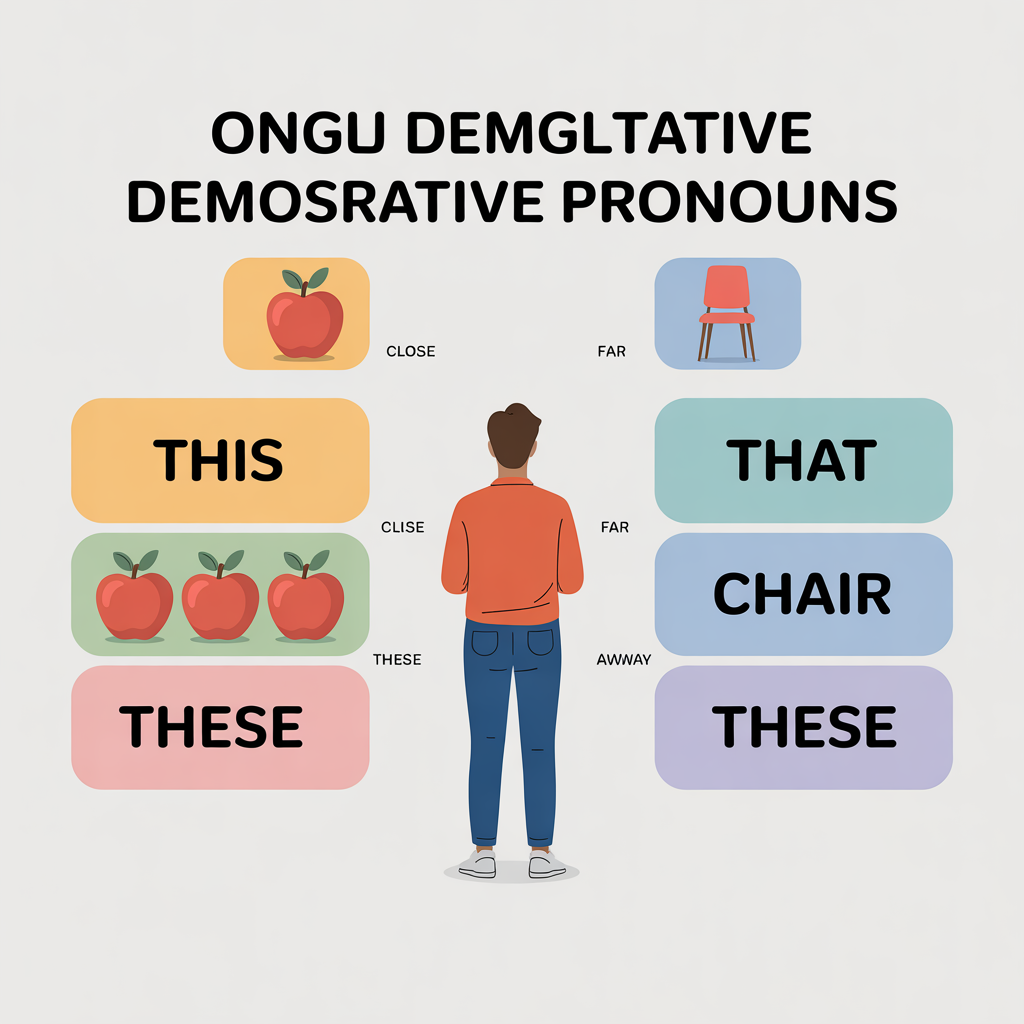
Here is how the four demonstrative pronouns break down by distance and number:
| Singular | Plural | |
|---|---|---|
| Near (close to the speaker) | This | These |
| Far (away from the speaker) | That | Those |
This grid is the foundation for understanding how demonstrative pronouns function. Let’s explore each one in depth.
This
This is a singular demonstrative pronoun that refers to something close to the speaker — physically nearby or just mentioned in the conversation.
- “This is the best coffee I’ve ever tasted.” (The coffee is right in front of the speaker.)
- “Can you believe this?” (Referring to something just said or currently happening.)
That
That is a singular demonstrative pronoun that refers to something farther away from the speaker — either physically distant or previously mentioned.
- “That is the mountain we climbed last summer.” (The mountain is visible but at a distance.)
- “I’ve always believed that.” (Referring to a point made earlier in the conversation.)
These
These is the plural form of this. It refers to multiple things that are close to the speaker.
- “These are the documents you requested.” (The documents are right here.)
- “These are my favorite shoes.” (The shoes are on the speaker’s feet or very nearby.)
Those
Those is the plural form of that. It refers to multiple things that are farther away from the speaker.
- “Those were the happiest days of my life.” (Referring to a distant time in the past.)
- “Can you pass me those?” (The items are across the table or room.)
Demonstrative Pronoun vs. Demonstrative Adjective: A Critical Distinction
This is where many learners get confused — and understandably so. The words this, that, these, and those can function in two different grammatical roles:
- As a demonstrative pronoun — when the word stands alone and replaces a noun.
- As a demonstrative adjective (also called a demonstrative determiner) — when the word modifies a noun that follows it.
The key test is simple: if the word is followed by a noun, it’s an adjective. If it stands alone, it’s a pronoun.
| Role | Example | Explanation |
|---|---|---|
| Demonstrative Pronoun | “This is delicious.” | This stands alone; it replaces the noun (the food). |
| Demonstrative Adjective | “This cake is delicious.” | This modifies cake; it doesn’t replace it. |
| Demonstrative Pronoun | “Those are beautiful.” | Those stands alone; it replaces the noun (the flowers). |
| Demonstrative Adjective | “Those flowers are beautiful.” | Those modifies flowers; it describes them directly. |
This distinction matters in grammar analysis, but in everyday communication, both uses are natural and correct.
How Demonstrative Pronouns Work: Physical vs. Psychological Distance
The concept of “distance” in demonstrative pronouns goes beyond just physical space. Demonstrative pronouns express three types of distance:
1. Physical Distance
This is the most obvious use. This and these refer to things nearby; that and those refer to things further away.
- “Hand me this.” (Right in front of you.)
- “Look at that over there.” (Farther away.)
2. Temporal (Time) Distance
Demonstrative pronouns can indicate whether something is close or distant in time.
- “This has been a great week.” (The week is current, ongoing, and close.)
- “Those were simpler times.” (The times are in the distant past.)
3. Psychological or Emotional Distance
Speakers can use demonstrative pronouns to signal how they feel about something — closeness can suggest warmth or engagement, while distance can signal disapproval, detachment, or formality.
- “This is what I love about summer.” (Warm, engaged tone.)
- “That was a terrible idea.” (Distancing from a bad memory or someone else’s idea.)
This psychological dimension is subtle, but it’s part of why native speakers instinctively reach for that when criticizing something and this when embracing it.
The Role of Demonstrative Pronouns in Sentences
Demonstrative pronouns can play several roles in a sentence’s structure. Here are the most common ones:
As the Subject
The demonstrative pronoun acts as the subject of the verb.
- “This is exactly what I needed.”
- “Those belong to my sister.”
As the Object
The demonstrative pronoun receives the action of the verb.
- “I’ll take this.”
- “She prefers those.”
After a Preposition
Demonstrative pronouns can follow prepositions to complete a prepositional phrase.
- “We haven’t talked about that.”
- “He’s not happy with these.”
As a Predicate Nominative
The pronoun follows a linking verb and renames the subject.
- “The best option is this.”
- “My top choices are these.”
Common Usage Patterns and Examples in Context
To really understand demonstrative pronouns, it helps to see them in realistic, varied contexts.
In Daily Conversation
- “Is this yours?” — Asking about something nearby.
- “Did you hear about that?” — Referring to news just shared.
- “These are on sale today.” — Pointing to items in the store.
- “Those were the instructions I gave.” — Referring to previously stated directions.
In Formal Writing
- “The study presented three findings. These suggest a significant correlation.”
- “Several policies were proposed last year. Those have since been revised.”
Notice how in formal writing, demonstrative pronouns often refer back to ideas or concepts mentioned in a previous sentence. This is called anaphoric reference — pointing back to something already introduced.
In Questions
- “What is this?”
- “Where did those come from?”
In Exclamations
- “This is incredible!”
- “Now that was a performance!”
Demonstrative Pronouns in Other Languages
If you’re learning English or studying linguistics, it’s worth noting that most world languages have their own demonstrative pronoun systems. Some are more complex than English, featuring three levels of distance rather than two (near, mid-distance, and far). For example:
- Spanish: esto/eso/aquello (this / that / that over there) — three levels.
- Japanese: kore/sore/are (near speaker / near listener / far from both) — three levels.
- French: ceci/cela — two levels, similar to English.
English keeps it simple with a two-way distance contrast, making it relatively straightforward for learners to master.
Common Mistakes with Demonstrative Pronouns
Even proficient English speakers make a few recurring errors with demonstrative pronouns. Here are the most common ones to avoid:
Mistake 1: Unclear Reference
The noun that a demonstrative pronoun points to should always be clear from context. Vague pronoun references confuse readers.
- Unclear: “She spoke to her manager, and this caused problems.” (What caused problems — the manager? The conversation?)
- Clear: “She spoke to her manager, and this conversation caused problems.” (Here, this works as a demonstrative adjective to clarify.)
Mistake 2: Confusing “This” and “That” in Phone or Distance Contexts
There’s a cultural/situational convention in English: when answering the phone or identifying yourself, you use this (even though you’re “far” from the other person in one sense).
- “Hello, this is Dr. Johnson speaking.” ✓
- “Hello, that is Dr. Johnson speaking.” ✗
Mistake 3: Using Demonstrative Pronouns for People (Except in Introductions)
In English, it’s generally considered impolite to use demonstrative pronouns to refer directly to people — unless you’re introducing someone or it’s clear from context.
- Acceptable (introduction): “This is my colleague, Samantha.”
- Less polite (pointing): “That over there is my boss.” (Sounds dismissive or rude.)
Mistake 4: Number Agreement
Make sure your demonstrative pronoun matches the number of the noun it replaces.
- Incorrect: “These is wrong.”
- Correct: “These are wrong.”
Demonstrative Pronouns and Cohesion in Writing
One of the most valuable functions of demonstrative pronouns — especially in academic, professional, and journalistic writing — is their ability to create cohesion. They serve as logical bridges between sentences and paragraphs, guiding the reader from one idea to the next.
For example:
“Scientists discovered a new species of deep-sea fish in the Pacific Ocean. This marks the first significant marine discovery in the region in over a decade.”
The word this here avoids repetition, maintains flow, and signals that the new sentence is directly connected to the previous one. Without it, the writing would feel choppy and disconnected.
In longer documents, that and those often refer back to earlier sections of text, helping readers recall and connect previous information:
“Chapter Two outlined three core theories. Those will now be tested against current data.”
Tips for Using Demonstrative Pronouns Effectively
- Always ensure the reference is clear. The noun your demonstrative pronoun replaces should be obvious to the reader, either from context or from a nearby sentence.
- Use this/these for immediacy and relevance. When you want to draw attention to something current, important, or emotionally close, these are your words.
- Use that/those for distance and reference. When looking back at something already discussed, or signaling emotional detachment, that and those do the job well.
- Don’t overuse them. Over-reliance on demonstrative pronouns can make writing feel vague or monotonous. Occasionally naming the noun directly adds clarity and variety.
- Read your writing aloud. If a sentence sounds awkward when you hit a demonstrative pronoun, it may be because the reference isn’t clear. Rework it.
Summary: What Makes Demonstrative Pronouns Special
Demonstrative pronouns are a small but remarkably expressive part of the English language. With just four words — this, that, these, those — speakers can:
- Replace a noun entirely while keeping meaning intact.
- Signal physical, temporal, or psychological distance.
- Create smooth, coherent flow in both speech and writing.
- Express subtle emotional attitudes toward people, ideas, and things.
Their simplicity is deceptive. Beneath those four short words lies a sophisticated system of reference, distance, and meaning that speakers navigate naturally, and that writers can use with great intentionality.
Conclusion
So, what is a demonstrative pronoun? At its core, it is a pointing word — a linguistic finger that says “look here” or “look there.” It replaces a noun, conveys distance, expresses number, and shapes the tone and coherence of language in ways both obvious and subtle. Whether you’re crafting a polished essay, preparing for an English exam, or simply curious about how language works, understanding demonstrative pronouns gives you a sharper, more confident command of English grammar. The next time you say “this is great” or “those were the days,” you’ll know exactly what grammatical work those little words are doing — and why they matter.
Frequently Asked Questions (FAQs)
What are the 4 demonstrative pronouns in English?
The four demonstrative pronouns in English are this (singular, near), that (singular, far), these (plural, near), and those (plural, far). Each one indicates both the number and relative distance of the noun it replaces.
What is the difference between a demonstrative pronoun and a demonstrative adjective?
The same words — this, that, these, those — can work as either pronouns or adjectives depending on how they’re used. When one of these words stands alone and replaces a noun, it’s a demonstrative pronoun (e.g., “This is mine.”). When it directly modifies a noun that follows it, it’s a demonstrative adjective (e.g., “This book is mine.”).
Can demonstrative pronouns refer to people?
Yes, but with some social constraints. It’s perfectly natural to use demonstrative pronouns to introduce someone (“This is my friend, Mark.”). However, using them to point at or describe a person in other contexts can come across as impolite or dismissive, so it’s generally best avoided in those situations.
What is an example of a demonstrative pronoun in a sentence?
Here are four simple examples, one for each demonstrative pronoun: “This is my favorite restaurant.” / “That was a brilliant film.” / “These are freshly baked.” / “Those were his exact words.”
How do demonstrative pronouns help with writing cohesion?
Demonstrative pronouns act as connecting bridges between sentences by referring back (or forward) to nouns or ideas without repeating them. This keeps writing flowing smoothly, avoids unnecessary repetition, and helps readers track the logical connections between ideas.
Is “it” a demonstrative pronoun?
No. It is a personal pronoun, not a demonstrative pronoun. While it can also replace a noun, it doesn’t carry the sense of pointing or distance that defines demonstrative pronouns. The demonstrative pronouns in English are exclusively this, that, these, and those.