
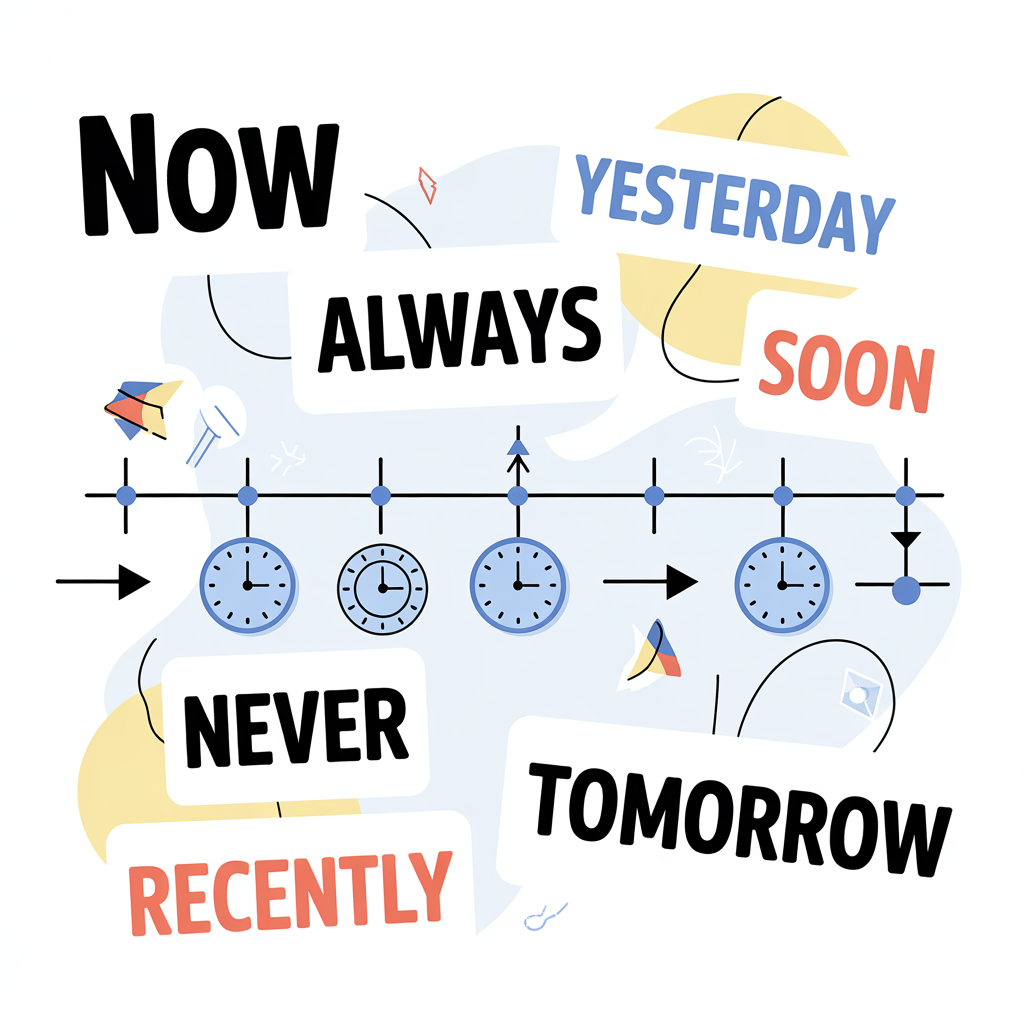
If you’ve ever said “I’ll call you later” or “She always arrives on time,” you’ve already used adverbs of time — probably without even thinking about it. These small but mighty words do an important job: they tell us when something happens, how often it occurs, and how long it lasts. Understanding adverbs of time is one of those grammar fundamentals that quietly improves everything about the way you communicate in English.
This guide breaks down exactly what adverbs of time are, how they’re categorized, where to place them in a sentence, common mistakes to avoid, and plenty of real-world examples to make it all stick.
What Are Adverbs of Time?
An adverb of time is a word or phrase that modifies a verb, adjective, or another adverb to indicate when an action happens, how frequently it occurs, or for how long it continues. Like all adverbs, they add detail and precision to a sentence without changing its core meaning.
Consider these two sentences:
- She called.
- She called yesterday.
The second sentence is far more informative. The adverb of time “yesterday” anchors the action in time and gives the listener or reader something concrete to hold onto.
Adverbs of time answer questions like:
- When? — now, then, yesterday, soon, today
- How often? — always, never, rarely, frequently, sometimes
- How long? — briefly, all day, for a week, temporarily
Types of Adverbs of Time
Adverbs of time aren’t a one-size-fits-all category. They fall into three main subcategories, each serving a distinct purpose.
1. Adverbs of Definite Time
These adverbs refer to a specific, identifiable point in time. They answer the question “exactly when?” and leave no ambiguity about the timeframe.
Common examples:
- today
- yesterday
- tomorrow
- now
- then
- last night
- next week
- recently
- soon
Example sentences:
- I have a dentist appointment tomorrow.
- The package arrived yesterday.
- She is now the head of the department.
2. Adverbs of Indefinite Time
These adverbs describe when something happens in a general or vague sense. They don’t pin the action to a specific moment but rather hint at a general timeframe.
Common examples:
- already
- yet
- still
- just
- lately
- recently
- soon
- before
- eventually
Example sentences:
- Have you eaten yet?
- She has already finished her homework.
- He just walked in the door.
- Things will get better eventually.
3. Adverbs of Frequency
These are perhaps the most commonly discussed subset of adverbs of time. They tell us how often something happens — whether it’s a constant habit or a rare occurrence.
Adverbs of frequency can be split into two groups:
Definite Frequency (Specific)
These state a clear, countable frequency.
- daily
- weekly
- monthly
- hourly
- twice a day
- three times a week
- every year
Example sentences:
- The newsletter is sent out weekly.
- She takes her medication twice a day.
- We review the budget every quarter.
Indefinite Frequency (General)
These indicate how often something happens in a more approximate way, typically placed on a scale from 100% to 0%.
| Adverb | Approximate Frequency |
|---|---|
| always | 100% |
| usually / normally | ~80–90% |
| often / frequently | ~70% |
| sometimes | ~50% |
| occasionally | ~30% |
| rarely / seldom | ~10% |
| never | 0% |
Example sentences:
- He always locks the door before leaving.
- They sometimes go hiking on weekends.
- I rarely eat fast food anymore.
- She never misses a deadline.
Where to Place Adverbs of Time in a Sentence
Placement is where many learners — and even experienced writers — run into trouble. The good news is there are clear patterns to follow, depending on the type of adverb of time you’re using.
Position of Definite Time Adverbs
These are the most flexible. They can appear at the beginning or end of a sentence, but rarely in the middle.
- End of sentence (most common): We visited the museum yesterday.
- Beginning of sentence (for emphasis): Tomorrow, we’ll discuss the results.
When two time expressions appear together, the more specific one typically comes first:
- She arrived at 8 o’clock in the morning. ✅
- She arrived in the morning at 8 o’clock. ❌ (awkward)
Position of Indefinite Time Adverbs (already, yet, still, just)
These typically go in the middle of the sentence — specifically between the subject and the main verb, or after an auxiliary verb.
- I have already sent the email.
- She is still waiting for an answer.
- He has just returned from his trip.
Yet is special — it almost always goes at the end of the sentence in questions and negatives:
- Has he arrived yet?
- I haven’t finished it yet.
Position of Adverbs of Frequency
Indefinite frequency adverbs follow clear and consistent placement rules:
- Before the main verb: She always drinks coffee in the morning.
- After the verb “to be”: He is never late.
- Between an auxiliary verb and the main verb: They have often discussed it.
Definite frequency adverbs (daily, weekly, etc.) usually go at the end of the sentence:
- The report is updated monthly.
- We meet every Friday.
Adverb of Time Phrases and Clauses
Adverbs of time aren’t always single words. They can also appear as phrases or clauses.
Adverbial Time Phrases
A group of words (without a subject and verb) that functions as an adverb of time:
- in the morning
- at the end of the day
- for three hours
- since last Monday
- during the holidays
Examples in sentences:
- She prefers to exercise in the morning.
- He worked for three hours without a break.
- I haven’t seen her since last Monday.
Adverbial Time Clauses
A full clause (with a subject and verb) introduced by a subordinating conjunction that tells us when something happens:
- when — Call me when you arrive.
- while — She read while he cooked dinner.
- before — Brush your teeth before you go to bed.
- after — After the meeting ended, everyone left quickly.
- as soon as — I’ll let you know as soon as I hear back.
- until — We waited until the rain stopped.
- since — He’s been happy since he got the promotion.
Common Mistakes to Avoid
Even fluent speakers make errors with adverbs of time. Here are the most frequent ones — and how to fix them.
Mistake 1: Placing frequency adverbs in the wrong position
- ❌ She drinks coffee always in the morning.
- ✅ She always drinks coffee in the morning.
Mistake 2: Confusing “already,” “yet,” and “still”
- Already is used in positive statements and questions to indicate something happened sooner than expected: “I’ve already eaten.”
- Yet is used in negatives and questions: “I haven’t eaten yet.”
- Still emphasizes that something is continuing or hasn’t changed: “I’m still hungry.”
Mistake 3: Using “always” in the wrong tense context
- “Always” works with habitual actions (simple present, simple past). It sounds unnatural with progressive tenses unless used for dramatic effect or criticism.
- ❌ She is always going to the gym. (sounds critical or sarcastic)
- ✅ She always goes to the gym on Sundays.
Mistake 4: Double negatives with “never”
- ❌ I don’t never eat meat.
- ✅ I never eat meat. / I don’t eat meat.
Adverbs of Time in Different Tenses
Certain adverbs of time are closely associated with specific verb tenses. Knowing these pairings can sharpen your grammar significantly.
| Tense | Common Adverbs of Time |
|---|---|
| Simple Present | always, usually, often, sometimes, never, every day |
| Simple Past | yesterday, last week, ago, then, in 2010 |
| Simple Future | tomorrow, soon, next week, in the future, later |
| Present Perfect | already, yet, just, recently, ever, never, since, for |
| Past Perfect | already, yet, just, before, previously, by then |
| Present Continuous | now, at the moment, currently, right now |
Examples by tense:
- Simple Past: She left two hours ago.
- Present Perfect: Have you ever been to Tokyo?
- Simple Future: They’ll be here soon.
- Present Continuous: He’s studying right now.
Quick Reference: Most Common Adverbs of Time
Here’s a handy list organized by function for easy reference:
Referring to the Past
- yesterday, last night, last year, ago, previously, formerly, recently, earlier, before, once
Referring to the Present
- now, currently, at the moment, today, right now, at present, still
Referring to the Future
- tomorrow, soon, later, next week, eventually, in a moment, shortly, in the future
Expressing Frequency
- always, usually, often, sometimes, occasionally, rarely, seldom, never, daily, weekly, monthly
Expressing Duration or Sequence
- for, since, until, while, during, throughout, immediately, finally, first, then, afterward, previously
Why Adverbs of Time Matter in Communication
You might wonder: does grammar like this really matter in everyday life? The answer is absolutely yes — and here’s why.
Adverbs of time are essential for:
- Telling stories clearly. Without time markers, your narrative loses structure. “He arrived, they talked, she left” tells us nothing about sequence or timing.
- Writing professional emails. Phrases like “I will send this by end of day” or “we spoke last Tuesday” eliminate confusion about timelines.
- Academic writing. Expressing when events occurred or how frequently phenomena happen is essential for clarity and precision.
- Everyday conversation. Whether you’re making plans, sharing news, or describing your routine, time adverbs are always in use.
They are the invisible scaffolding of time in language — you don’t always notice them, but remove them and everything collapses into confusion.
Conclusion
Adverbs of time are a fundamental building block of the English language. They help speakers and writers anchor events in time, communicate habits and routines, and describe the duration and sequence of actions. Whether you’re using a single word like “now” or a full clause like “as soon as the results come in,” you’re giving your language clarity, rhythm, and meaning.
The key takeaways are simple:
- Adverbs of time answer when, how often, and how long.
- They come in three main types: definite time, indefinite time, and frequency.
- Placement matters — especially for frequency adverbs, which go before the main verb (but after “to be”).
- They can be single words, phrases, or full clauses.
- Pairing the right adverb with the right tense keeps your English sounding natural and precise.
Once you start noticing adverbs of time in the language around you — in books, conversations, news articles, and emails — you’ll realize just how often you’re already using them correctly. The goal now is to use them with intention.
Frequently Asked Questions (FAQs)
What is the difference between an adverb of time and an adverb of frequency?
An adverb of frequency is actually a type of adverb of time. “Adverb of time” is the broader category that covers when something happens, how long it lasts, and how often it occurs. Adverbs of frequency (like always, never, sometimes) specifically answer the question “how often?”
Can a single word be both an adverb of time and another type of word?
Yes. Many words function as adverbs of time in some contexts but as other parts of speech in others. For example, “daily” can be an adverb (“She exercises daily”), an adjective (“a daily routine”), or even a noun (“the morning daily”). Context determines the role.
Is “soon” an adverb of time?
Yes. “Soon” is a very common adverb of indefinite time. It indicates that something will happen in the near future without specifying exactly when. Example: “The doctor will see you soon.”
Where should I put the adverb of time if I have both a place and a time adverb in one sentence?
The standard order is: Subject + Verb + Object + Place + Time. For example: “She studied at the library yesterday.” Time expressions generally come last, though they can be moved to the front of the sentence for emphasis.
Are adverb phrases of time treated the same as single-word adverbs of time?
Functionally, yes. A phrase like “in the morning” works the same way as a single adverb like “now” — both modify the verb by telling us when the action takes place. The placement rules are similar, though phrases tend to appear at the beginning or end of a sentence rather than in the middle.