
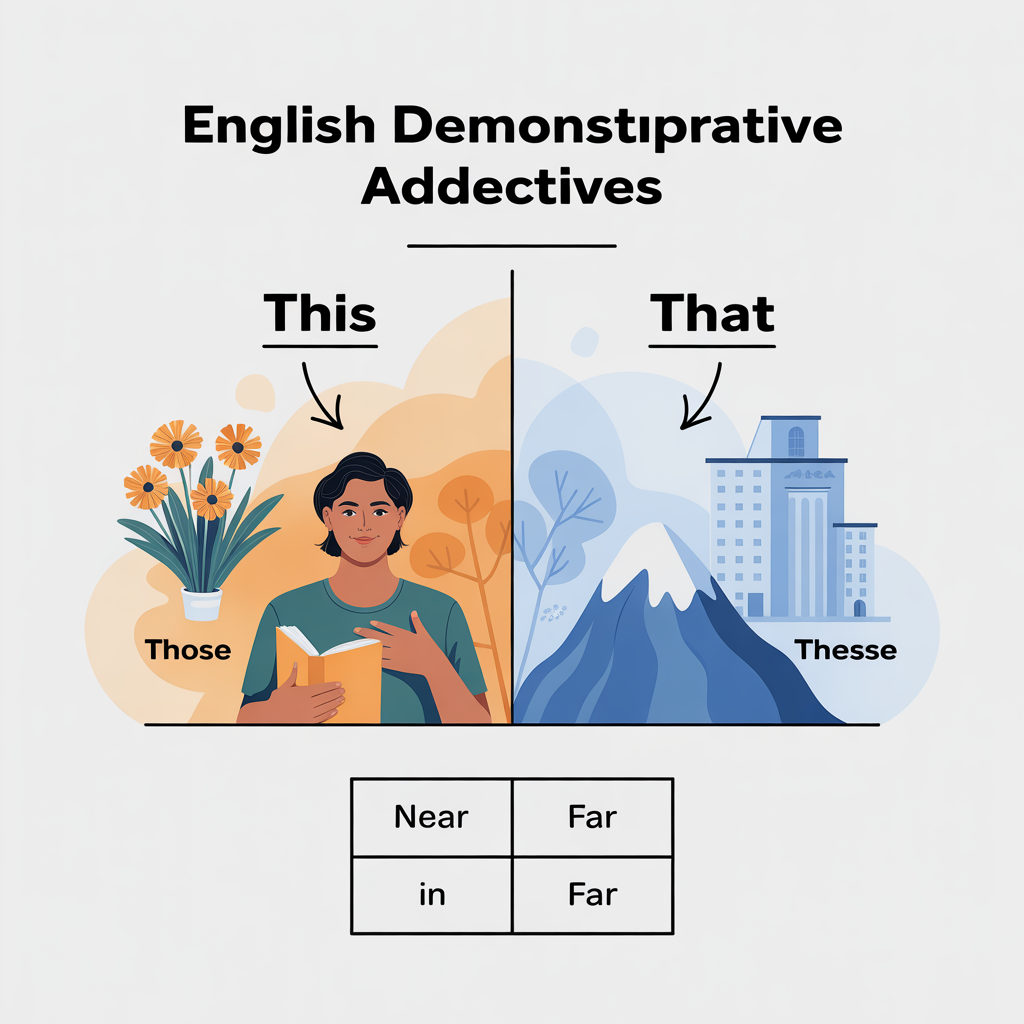
Every time you say “this book” or “those shoes,” you’re using a demonstrative adjective without even thinking about it. These small but powerful words do something remarkable: they point. They tell your listener or reader exactly which person, place, or thing you mean — whether it’s right in front of you or far across the room. If you’ve ever wondered what demonstrative adjectives are, how they work, and why they matter, you’re in exactly the right place. This guide breaks it all down in plain, clear language — with plenty of real-world examples to make everything click.
What Are Demonstrative Adjectives?
A demonstrative adjective is a word that modifies a noun by pointing to a specific person, place, or thing. It answers the question: Which one?
In English, there are exactly four demonstrative adjectives:
- This
- That
- These
- Those
Each one signals either proximity (how close something is) or number (whether you’re talking about one thing or more than one). They always appear directly before the noun they describe.
For example:
- “Hand me this pen.” — You’re pointing to a specific pen nearby.
- “I don’t like those chairs.” — You’re referring to specific chairs that are farther away.
Without demonstrative adjectives, we’d constantly have to describe which item we mean. They make communication faster, clearer, and more natural.
Demonstrative Adjectives vs. Demonstrative Pronouns: What’s the Difference?
This is one of the most common points of confusion for English learners — and it’s worth clearing up right away.
The words this, that, these, and those can function as both adjectives and pronouns. The key difference is simple:
- When the word modifies a noun (appears before it), it’s a demonstrative adjective.
- When the word replaces a noun (stands alone), it’s a demonstrative pronoun.
| Role | Example | Explanation |
|---|---|---|
| Demonstrative Adjective | I want that jacket. | “That” modifies the noun “jacket.” |
| Demonstrative Pronoun | I want that. | “That” stands alone, replacing a noun. |
| Demonstrative Adjective | These cookies are delicious. | “These” modifies the noun “cookies.” |
| Demonstrative Pronoun | These are delicious. | “These” replaces a noun entirely. |
The grammatical function — not the word itself — determines its category. Always look at how the word is being used in the sentence.
The Four Demonstrative Adjectives Explained
Let’s look at each demonstrative adjective in detail, including when and how to use it correctly.
1. This
This is used with singular nouns that are nearby — physically close to the speaker in space, or close in time (like the present moment).
- “This coffee is too hot.” (The coffee is right in front of you.)
- “I love this song.” (The song is playing right now.)
- “This idea could work.” (Referring to an idea just mentioned.)
2. That
That is used with singular nouns that are farther away — at a distance in space, or further back in time.
- “Look at that mountain.” (The mountain is in the distance.)
- “That was a great vacation.” (Referring to a past event.)
- “Who is that person?” (Someone not immediately next to you.)
3. These
These is the plural form of “this.” It’s used with plural nouns that are nearby.
- “These flowers are beautiful.” (The flowers are close to you.)
- “Can you check these reports?” (Reports on your desk right now.)
- “These days, everything is digital.” (Referring to the present period.)
4. Those
Those is the plural form of “that.” It’s used with plural nouns that are farther away.
- “Those buildings are historical landmarks.” (Buildings in the distance.)
- “Those were the best years of my life.” (A distant time in the past.)
- “I’ve never liked those rules.” (Rules referenced earlier in conversation.)
How to Choose the Right Demonstrative Adjective
Choosing the correct demonstrative adjective comes down to two simple questions:
Question 1: Is the noun singular or plural?
- Singular → use this or that
- Plural → use these or those
Question 2: Is the noun near or far?
- Near (in space or time) → use this (singular) or these (plural)
- Far (in space or time) → use that (singular) or those (plural)
Here’s a simple reference chart:
| Singular | Plural | |
|---|---|---|
| Near | This | These |
| Far | That | Those |
Master this two-by-two grid and you’ll never second-guess yourself again.
Demonstrative Adjectives in Sentences: Real-World Examples
Seeing demonstrative adjectives in context is the best way to internalize how they work. Here are examples across different situations and topics:
Everyday Conversation
- “Can you pass me that salt shaker?”
- “These shoes are killing my feet.”
- “This weather is unpredictable.”
- “I can’t believe those prices have gone up again.”
Work and Professional Settings
- “Please review this proposal before the meeting.”
- “Those deadlines are not negotiable.”
- “These data points support our conclusion.”
- “That strategy didn’t work last quarter.”
Academic and Formal Writing
- “This study examines the effects of sleep deprivation.”
- “These findings suggest a need for further research.”
- “That theory has since been disproven.”
- “Those arguments, while compelling, lack empirical support.”
Talking About Time
Demonstrative adjectives aren’t just about physical distance. They also indicate temporal distance — how close or far something is in time.
- “This year has been challenging.” (The current year — near in time)
- “That summer changed everything.” (A summer long ago — far in time)
- “These months have flown by.” (Recent months — near in time)
- “Those days are gone forever.” (Distant past — far in time)
Common Mistakes with Demonstrative Adjectives
Even native English speakers sometimes slip up with demonstrative adjectives. Here are the most frequent errors — and how to avoid them.
Mistake 1: Using “Them” Instead of “Those”
In informal or dialectal speech, some people say “them books” or “them people.” This is grammatically incorrect in standard English.
- ❌ “Look at them clouds.”
- ✅ “Look at those clouds.”
Mistake 2: Mismatching Number
Using a singular demonstrative with a plural noun (or vice versa) is a common error, especially for English learners.
- ❌ “This books are interesting.”
- ✅ “These books are interesting.”
- ❌ “Those idea is brilliant.”
- ✅ “That idea is brilliant.”
Mistake 3: Overusing “This” for Everything
Some writers default to “this” for all references, even when talking about distant or past things. Using “that” or “those” when appropriate adds precision and clarity to your writing.
- Less precise: “This event took place centuries ago.”
- More precise: “That event took place centuries ago.”
Mistake 4: Confusing Demonstrative Adjectives with Demonstrative Pronouns
Remember: a demonstrative adjective must always be followed by a noun. If there’s no noun after it, it’s functioning as a pronoun instead.
- “This problem is serious.” → Demonstrative adjective (modifies “problem”)
- “This is serious.” → Demonstrative pronoun (no noun follows)
Demonstrative Adjectives in Different Languages: A Brief Comparison
If you’re learning English as a second language, you may find it helpful to know that demonstrative adjectives exist in virtually every language — though they work differently.
- Spanish has three levels of distance: este/esta (near), ese/esa (medium distance), and aquel/aquella (far). English only has two levels: near and far.
- French uses ce/cet/cette (singular) and ces (plural) and can add -ci (here) or -là (there) for added precision.
- Japanese has a three-tier system: kono (near speaker), sono (near listener), and ano (far from both).
English keeps it simple with just four words — but precision still matters.
Why Demonstrative Adjectives Matter in Writing and Communication
You might wonder: are these really that important? The answer is yes — for several reasons.
1. They Add Clarity
Demonstrative adjectives eliminate ambiguity. Instead of saying “Give me the book,” which might be unclear if there are several books nearby, “Give me this book” or “Give me that book” points to exactly the right one.
2. They Create Cohesion in Writing
In essays, articles, and reports, demonstrative adjectives help writers refer back to previously mentioned ideas without repetition. “This theory,” “these findings,” and “those conclusions” keep writing tight and connected.
3. They Reflect Attitude and Tone
Interestingly, the choice of “this” vs. “that” can signal how a speaker feels about something. “This idea” sounds engaged and present. “That idea” can sound more detached, skeptical, or dismissive. Writers and speakers often use this distinction deliberately.
4. They Are Fundamental to English Grammar
Mastering demonstrative adjectives is a foundational step for anyone learning English. They appear constantly in spoken and written language — and using them correctly signals a strong command of the language.
Quick Practice: Test Your Understanding
Fill in the blank with the correct demonstrative adjective (this, that, these, or those):
- “_______ apple in your hand looks fresh.” → This (singular, near)
- “I remember _______ old neighborhood from my childhood.” → That (singular, far in time)
- “_______ documents on the table need your signature.” → These (plural, near)
- “Did you see _______ birds flying over the lake?” → Those (plural, far)
- “I’ve been waiting for _______ moment my whole life.” → This (singular, present/near)
How did you do? If you got all five, you’ve got a solid grasp of demonstrative adjectives!
Summary: Key Takeaways
- Demonstrative adjectives (this, that, these, those) point to specific nouns and answer the question “Which one?”
- They indicate both number (singular vs. plural) and proximity (near vs. far).
- This = singular + near | That = singular + far
- These = plural + near | Those = plural + far
- They differ from demonstrative pronouns in that they always precede and modify a noun.
- They can indicate proximity in time as well as physical space.
- Using them correctly adds clarity, precision, and cohesion to both spoken and written English.
Demonstrative adjectives are small words with a big job. Once you understand how they work, you’ll notice them everywhere — and you’ll use them more confidently in your own speech and writing. Grammar doesn’t have to be intimidating. With tools like these (see what we did there?), it can actually be quite fascinating.
Frequently Asked Questions
Are demonstrative adjectives the same as demonstrative pronouns?
No. The words are the same (this, that, these, those), but their function differs. A demonstrative adjective modifies a noun that follows it (e.g., “this car”). A demonstrative pronoun stands alone in place of a noun (e.g., “this is mine”). Context determines the role.
Can demonstrative adjectives be used to refer to abstract ideas?
Absolutely. Demonstrative adjectives are commonly used to refer to abstract concepts, ideas, or situations — not just physical objects. For example: “This decision will affect everyone,” or “Those concerns are valid.”
Is there a demonstrative adjective for medium distance?
Not in standard English. English only has two distances: near (this/these) and far (that/those). Some other languages, like Spanish and Japanese, have a three-tier system, but English speakers rely on context to bridge the gap.
Can “this” and “that” be used as adverbs?
Yes, in informal speech, “this” and “that” can be used as adverbs of degree. For example: “I didn’t expect it to be this difficult” (meaning “so” or “to this extent”). However, this usage is different from their role as demonstrative adjectives, which always modify nouns.
Do demonstrative adjectives agree with the noun’s gender?
In English, no. Unlike many languages (such as French or Spanish), English demonstrative adjectives do not change form based on the grammatical gender of the noun. You use the same “this,” “that,” “these,” and “those” regardless of whether the noun is masculine, feminine, or neuter.