
If you’ve ever said “I always drink coffee in the morning” or “She rarely goes to the gym,” you’ve already used adverbs of frequency — probably without even thinking about it. These small but mighty words are among the most commonly used tools in the English language, and mastering them can make your speech and writing sound natural, precise, and fluent. In this guide, we’ll break down exactly what adverbs of frequency are, how they work, where to place them, and how to avoid the most common mistakes learners make.
What Are Adverbs of Frequency?
An adverb of frequency is a type of adverb that tells us how often an action happens. It modifies a verb, adjective, or another adverb by indicating the regularity or frequency of an event — whether it happens all the time, sometimes, or almost never.
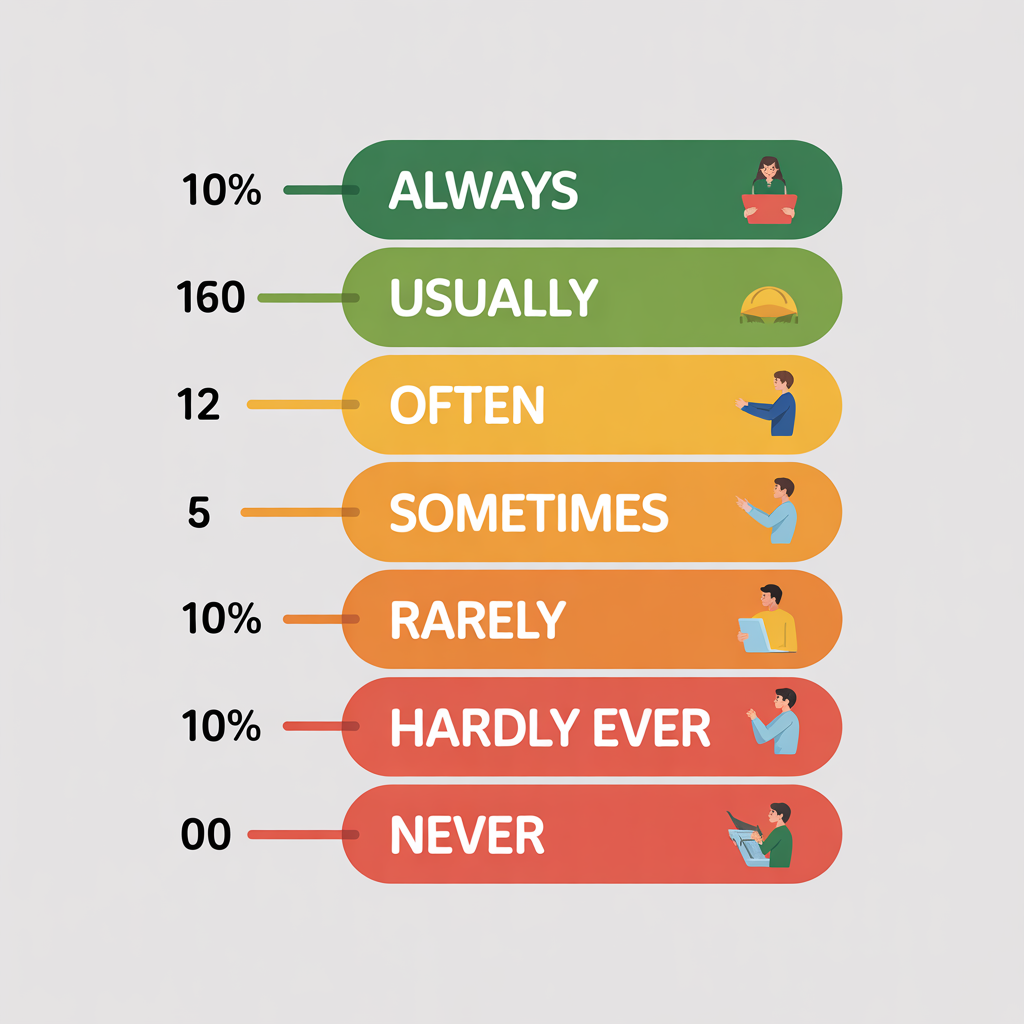
Think of them as a scale from 100% (always happening) down to 0% (never happening). They answer the question: “How often does this happen?”
For example:
- “I always brush my teeth before bed.” → 100% of the time
- “He sometimes forgets his keys.” → About 50% of the time
- “They never eat fast food.” → 0% of the time
In each case, the adverb of frequency gives the listener or reader a clear picture of how regularly an action occurs.
Types of Adverbs of Frequency
Adverbs of frequency generally fall into two broad categories: definite and indefinite. Understanding the difference will help you use them more accurately.
1. Indefinite Adverbs of Frequency
These adverbs express a general, approximate sense of how often something happens. They don’t give an exact number or time. This is the group most people refer to when they talk about adverbs of frequency in grammar lessons.
Here is a full frequency scale from highest to lowest:
| Adverb | Approximate Frequency | Example Sentence |
|---|---|---|
| Always | 100% | She always arrives on time. |
| Almost always | ~95% | He almost always checks his email in the morning. |
| Usually / Generally | ~80% | I usually take the bus to work. |
| Often / Frequently | ~70% | They often go hiking on weekends. |
| Sometimes | ~50% | We sometimes watch movies on Friday nights. |
| Occasionally | ~30% | She occasionally visits her grandparents. |
| Rarely / Seldom | ~10% | He rarely eats sweets. |
| Hardly ever / Almost never | ~5% | I hardly ever watch TV. |
| Never | 0% | They never drink alcohol. |
2. Definite Adverbs of Frequency
These adverbs are much more specific. They tell you exactly how often something happens, often with a clear time reference.
Common examples include:
- Daily — “She exercises daily.”
- Weekly — “The team meets weekly.”
- Monthly — “We pay rent monthly.”
- Yearly / Annually — “They visit Paris yearly.”
- Hourly — “The buses run hourly.”
- Once a week — “He calls his mom once a week.”
- Twice a month — “I go to the dentist twice a year.”
- Every day — “I read every day.”
- Every other week — “They have meetings every other week.”
Unlike indefinite adverbs, definite adverbs of frequency are usually placed at the beginning or end of a sentence, not in the middle.
Where to Place Adverbs of Frequency in a Sentence
This is where many English learners — and even some native speakers — get confused. The position of an adverb of frequency in a sentence depends on the type of adverb and the structure of the sentence.
Rule 1: Before the Main Verb
For indefinite adverbs of frequency, the most common position is directly before the main verb.
- I always drink tea in the morning. ✅
- She never takes the stairs. ✅
- They often travel together. ✅
Rule 2: After the Verb “To Be”
When the main verb is to be (am, is, are, was, were), the adverb of frequency comes after it.
- He is always late. ✅
- She was rarely happy at her old job. ✅
- They are usually very friendly. ✅
A very common mistake is placing the adverb before “to be”:
- He always is late. ❌
Rule 3: Between an Auxiliary Verb and the Main Verb
When a sentence contains an auxiliary (helping) verb such as can, will, have, should, or must, the adverb of frequency goes between the auxiliary and the main verb.
- You should always wear a seatbelt. ✅
- She has never been to Japan. ✅
- He can usually fix the problem quickly. ✅
Rule 4: At the Beginning or End of a Sentence
Both definite and indefinite adverbs of frequency can appear at the start or end of a sentence for emphasis or stylistic variation. However, indefinite adverbs like “always” and “never” sound unnatural at the end and are almost never used there. Adverbs like “sometimes,” “usually,” and “often” are more flexible.
- Sometimes, I forget where I put my keys. ✅
- I forget where I put my keys sometimes. ✅
- Daily, she checks the news. ✅
- She checks the news daily. ✅
Adverbs of Frequency in Questions and Negatives
In Questions
In questions, adverbs of frequency follow the same rules — they come after the auxiliary verb or after “to be.”
- Do you often work overtime? ✅
- Is she always this quiet? ✅
- Have you ever visited Rome? ✅
Note: “Ever” is a special adverb used in questions and negative sentences to ask about any frequency at all.
In Negative Sentences
In negative sentences, adverbs of frequency maintain their usual position.
- I don’t usually eat breakfast. ✅
- She doesn’t often go out. ✅
Important: Never, rarely, seldom, and hardly ever are already negative in meaning, so you should NOT use them with “not” — that creates a double negative.
- I never go there. ✅
- I don’t never go there. ❌ (double negative)
Common Mistakes to Avoid
Even advanced learners trip up on adverbs of frequency. Here are the most frequent errors and how to correct them:
Mistake 1: Placing the adverb after the main verb
- I drink always coffee. ❌
- I always drink coffee. ✅
Mistake 2: Placing the adverb before “to be”
- She always is busy. ❌
- She is always busy. ✅
Mistake 3: Using a double negative
- He doesn’t never call back. ❌
- He never calls back. ✅
Mistake 4: Confusing “already” with “always”
“Already” refers to something that happened sooner than expected, not frequency. These two words are not interchangeable.
- She has already finished the report. (sooner than expected) ✅
- She always finishes the report on time. (habitual) ✅
Adverbs of Frequency vs. Expressions of Frequency
It’s worth noting that not all frequency information comes from single adverb words. Expressions of frequency are phrases that perform the same function but are usually placed at the beginning or end of a sentence.
Examples of frequency expressions:
- Once in a while
- From time to time
- Every now and then
- On a regular basis
- Now and again
- Every so often
For example:
- “Every now and then, we go for a long walk in the countryside.”
- “From time to time, the system crashes unexpectedly.”
These expressions add variety and nuance to your language and are especially useful in more formal or literary writing.
Using Adverbs of Frequency with Different Tenses
Adverbs of frequency are most commonly associated with the simple present tense because they describe habits and routines. However, they can be used with other tenses too.
Simple Present (Habits and routines)
- She usually wakes up at 6 a.m.
- We rarely eat out.
Simple Past (Past habits)
- He always walked to school as a child.
- They sometimes went camping in the summer.
Present Perfect (Life experience)
- I have never skied before.
- Have you ever tried sushi?
Future (Expected habits)
- I will always love you.
- She will probably be late.
Why Adverbs of Frequency Matter
You might wonder: why dedicate so much attention to a handful of small words? The answer is simple — precision. Without adverbs of frequency, your sentences become flat, ambiguous, and harder to understand.
Compare these two sentences:
- “I go to the gym.” (How often? Once a year? Every day?)
- “I regularly go to the gym — about four times a week.” (Crystal clear.)
In both spoken and written English, adverbs of frequency help you:
- Describe habits and routines naturally
- Set expectations in professional communication
- Add personality and rhythm to your writing
- Avoid misunderstandings in day-to-day conversations
Quick Reference Summary
Here’s a concise recap of the key rules:
- Position: Before the main verb, after “to be,” between auxiliary and main verb
- Types: Indefinite (always, sometimes, never) and definite (daily, weekly, once a week)
- Negative words: Never, rarely, seldom, and hardly ever — don’t combine with “not”
- Questions: Use “ever” for yes/no frequency questions
- Tenses: Most common with simple present, but usable across all tenses
Conclusion
Adverbs of frequency are a foundational building block of English grammar. They are small, easy to learn, and incredibly powerful. Whether you’re telling someone you always wash your hands before dinner or that you rarely get enough sleep, these words help you communicate habits, patterns, and routines with clarity and confidence.
The key to using them well is remembering where they go in a sentence — before the main verb, after “to be,” and between an auxiliary and a main verb. Practice placing them in different sentence structures, and they’ll quickly become second nature in your English communication.
Keep using them, and you’ll always sound more fluent — and you’ll never have to think twice about them again.
Frequently Asked Questions (FAQs)
What is the difference between adverbs of frequency and adverbs of time?
Adverbs of frequency answer “How often?” (always, sometimes, rarely), while adverbs of time answer “When?” (yesterday, soon, last week, now). For example, “I called him yesterday” uses an adverb of time, while “I often call him” uses an adverb of frequency.
Can adverbs of frequency come at the beginning of a sentence?
Yes, but not all of them do so naturally. Adverbs like sometimes, usually, often, occasionally, and frequently can appear at the beginning of a sentence for emphasis. However, always and never sound unnatural at the start of a regular statement (though “Never have I seen…” is a formal/literary inversion).
Is “ever” an adverb of frequency?
Yes, “ever” functions as an adverb of frequency, but it is mainly used in questions, negative sentences, and conditionals to ask about any occurrence at all. Example: “Have you ever been to Spain?” or “If you ever need help, just ask.”
What is the most common adverb of frequency?
According to most frequency analyses of English, “usually,” “always,” and “often” are among the most commonly used adverbs of frequency in everyday spoken and written English.
Do adverbs of frequency work with all verb tenses?
Yes. While they are most strongly associated with the simple present tense for habitual actions, adverbs of frequency can be used with the simple past, present perfect, and future tenses as well.