
If you’ve ever wondered what makes English grammar so flexible and expressive, noun clauses are a big part of the answer. A single clause can act as a subject, an object, or even a complement — all without changing a single word. Understanding noun clauses unlocks a deeper level of language comprehension and helps you write and speak with far greater precision. Whether you’re a student, a teacher, or simply someone who loves language, this guide will walk you through everything you need to know.
What Is a Noun Clause?
A noun clause is a dependent clause (also called a subordinate clause) that functions as a noun within a sentence. Just like a regular noun, it can serve as the subject, object, or complement of a sentence. However, unlike a single word, a noun clause contains both a subject and a verb, making it a full clause embedded inside a larger sentence.
Let’s break that down with a simple comparison:
- Regular noun: The truth surprised everyone.
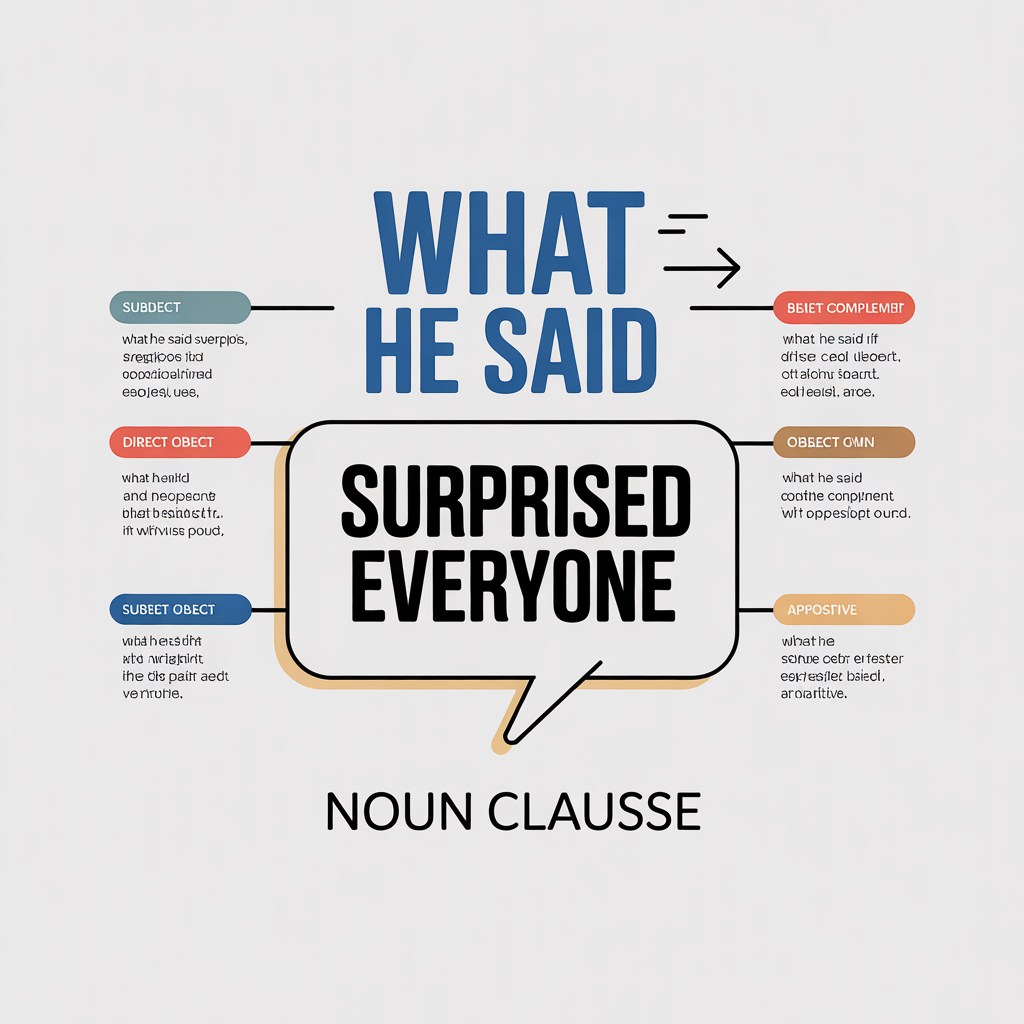
- Noun clause: What he said surprised everyone.
In both sentences, the underlined part plays the same grammatical role — the subject of the verb “surprised.” The only difference is that the second example is not just a word but an entire clause with its own subject (“he”) and verb (“said”).
This substitution ability is the defining feature of a noun clause: wherever you can place a noun, you can place a noun clause.
Key Characteristics of a Noun Clause
Before diving into types and examples, it helps to understand the core properties that define a noun clause:
- It is dependent: A noun clause cannot stand alone as a complete sentence. It depends on the main clause to make full sense.
- It contains a subject and a verb: Unlike a phrase, a clause has both of these elements.
- It functions as a noun: It can be replaced by a pronoun like “it,” “something,” or “this.”
- It is introduced by specific words: These are called subordinating conjunctions or relative pronouns, which we’ll cover in detail below.
Words That Introduce Noun Clauses
Noun clauses are almost always introduced by a specific set of words. Recognizing these words is one of the easiest ways to spot a noun clause in the wild. These introductory words fall into several categories:
That
The word “that” is the most common introducer of noun clauses. It often signals a statement or fact being reported.
- I believe that honesty is the best policy.
- She knows that the meeting was cancelled.
Note: In informal writing and speech, “that” is often omitted: “I believe honesty is the best policy.” The noun clause is still present — it’s just implied.
Wh- Words (Who, Whom, Whose, What, Which, When, Where, Why, How)
These words introduce noun clauses that express uncertainty or indirect questions. They are sometimes called embedded questions because they turn a direct question into a clause.
- What you said made me think.
- Nobody knows why she left.
- He asked where the library was.
- Tell me how you solved the problem.
Whether / If
These words introduce noun clauses that express a choice between two possibilities or an indirect yes/no question.
- I’m not sure whether he will come.
- She asked if the store was open.
Whoever, Whatever, Whichever, Whenever, Wherever, However
These compound words introduce noun clauses that carry a generalized or open-ended meaning.
- Whoever finishes first wins the prize.
- You can choose whatever you like.
The Five Main Functions of Noun Clauses
The real power of a noun clause lies in its versatility. It can fill almost any role that a noun fills in a sentence. Here are the five primary functions, each with clear examples:
1. Subject of the Sentence
The noun clause acts as the main subject — the “who” or “what” the sentence is about.
- What she decided changed everything.
- That he passed the exam was a relief.
- How you treat others reflects your character.
Test: You can replace the noun clause with “it”: “It changed everything.” ✓
2. Direct Object
The noun clause receives the action of the main verb. This is probably the most common function of a noun clause in everyday language.
- She doesn’t understand why he left.
- I know what you did last summer.
- He told me that the flight was delayed.
3. Subject Complement (Predicate Nominative)
The noun clause follows a linking verb (like “is,” “was,” “seems,” “becomes”) and renames or describes the subject.
- The problem is that no one listened.
- The truth is what matters most.
- My biggest fear is that I will fail.
4. Object of a Preposition
The noun clause serves as the object following a preposition. This is a slightly more advanced use.
- She was focused on what the teacher was saying.
- Pay attention to whatever he mentions.
- I’m interested in how this works.
Important note: A noun clause introduced by “that” cannot normally follow a preposition directly. You would not say “She was focused on that he was speaking.”
5. Appositive
An appositive noun clause renames or explains a preceding noun, adding detail to it.
- The idea that we could fail never crossed his mind.
- The fact that she arrived late was noticed by everyone.
- Her belief that practice makes perfect kept her going.
Noun Clause vs. Adjective Clause vs. Adverb Clause
Noun clauses are one of three types of dependent clauses. Knowing the difference between them is essential for accurate grammatical analysis.
| Feature | Noun Clause | Adjective Clause | Adverb Clause |
|---|---|---|---|
| Function | Acts as a noun | Modifies a noun | Modifies a verb, adjective, or adverb |
| Introduced by | that, what, who, whether, how, etc. | who, whom, whose, which, that | because, although, when, if, since, etc. |
| Question it answers | What? Who? (acting as subject/object) | Which one? What kind? | When? Why? How? Under what condition? |
| Example | I know what you mean. | The man who called left a message. | She left because she was tired. |
The key test: Can you replace it with “it” or “something”? If yes, it’s likely a noun clause. If the clause modifies a noun, it’s an adjective clause. If it tells when, why, or how the action happens, it’s an adverb clause.
Noun Clause vs. Noun Phrase
Students sometimes confuse noun clauses with noun phrases. The distinction is straightforward but important:
- A noun phrase is a group of words centered on a noun, without a subject-verb pair. Example: “the tall building on the corner.”
- A noun clause is a group of words that includes a subject and a verb. Example: “where the tall building stands.”
If you can identify both a subject and a predicate (verb) inside the group of words, you’re looking at a clause, not a phrase.
Common Mistakes with Noun Clauses
Even advanced English learners make predictable errors when forming or identifying noun clauses. Here are the most frequent ones — and how to avoid them:
Mistake 1: Using Question Word Order in an Embedded Question
When a question becomes a noun clause (an indirect or embedded question), the word order changes from question form to statement form.
- ❌ I don’t know where is she. (question word order)
- ✅ I don’t know where she is. (statement word order)
- ❌ Can you tell me what time is it?
- ✅ Can you tell me what time it is?
Mistake 2: Confusing “Whether” and “That” After Verbs of Uncertainty
- ❌ I’m not sure that he will come or not.
- ✅ I’m not sure whether he will come or not.
Use “whether” when there’s a binary choice or yes/no uncertainty. Use “that” when you’re reporting a statement of fact.
Mistake 3: Writing the Noun Clause as a Standalone Sentence
Because a noun clause contains a subject and a verb, it can look like a complete sentence. But it’s not — it’s dependent and cannot stand alone.
- ❌ What he decided. This surprised her. (fragment)
- ✅ What he decided surprised her. (complete sentence)
Mistake 4: Omitting “That” When It Causes Ambiguity
While “that” is often optional, leaving it out can sometimes cause confusion about where the noun clause begins.
- Ambiguous: She said her friend was lying. (Was it “her friend” who was lying, or is “her friend was lying” the noun clause?)
- Clearer: She said that her friend was lying.
Noun Clauses in Formal vs. Informal English
Noun clauses appear in both formal writing and everyday conversation, but how they’re used can differ:
- In formal writing: The full noun clause is typically retained. “It is essential that all participants submit their forms on time.”
- In informal speech: The word “that” is often dropped. “I think you’re right.” (instead of “I think that you are right.”)
- In academic or professional writing: Noun clauses that function as subjects are often delayed to the end of the sentence using an anticipatory “it” to avoid a heavy-sounding opening.
For example:
- Heavy: That employees feel valued is important for productivity.
- Smoother: It is important for productivity that employees feel valued.
This structure — using “it” as a placeholder subject — is known as the extraposed subject and is extremely common in academic English.
More Real-World Examples of Noun Clauses
Seeing noun clauses in context helps cement the concept. Here is a wider range of examples across different sentence structures:
As Subject:
- Whether we leave now or later doesn’t really matter.
- How the accident happened remains unclear.
- That children learn through play is well-documented.
As Direct Object:
- Nobody knew what the future held.
- She admitted that she had made a mistake.
- The report shows how the data was collected.
As Subject Complement:
- The surprising thing is that she never complained.
- His only wish was that his family would be safe.
As Object of a Preposition:
- The debate was about whether funding should be increased.
- Give credit to whoever deserves it.
As Appositive:
- The assumption that prices would fall proved wrong.
- There is no evidence that the drug is safe.
How to Identify a Noun Clause: A Step-by-Step Approach
When you’re analysing a sentence and suspect a noun clause, follow these simple steps:
- Look for a subordinating word — that, what, who, whether, how, where, when, why, whoever, whatever, etc.
- Check for a subject and a verb within the group of words following that subordinating word.
- Determine its grammatical role — is the entire group acting as a subject, object, or complement?
- Try the substitution test — replace the suspected clause with a pronoun like “it” or “something.” If the sentence still makes grammatical sense, you’ve found a noun clause.
Example:
“She appreciated what her team had accomplished.”
- Subordinating word: what
- Subject + verb inside: her team had accomplished ✓
- Grammatical role: direct object of “appreciated”
- Substitution: “She appreciated it.” ✓ → It’s a noun clause.
Why Noun Clauses Matter for Writing and Communication
Understanding noun clauses is not just about passing grammar tests. Here’s why they genuinely matter:
- They add sophistication to writing. Using noun clauses allows you to pack more information into fewer sentences, which is a hallmark of mature, polished writing.
- They enable indirect speech. Reporting what someone said, thought, or believed almost always requires a noun clause. “He mentioned that the project was on track.”
- They allow for nuance. Instead of stating facts bluntly, noun clauses let you express uncertainty, belief, hope, and doubt with precision. “I’m not certain whether this is the right decision.”
- They improve reading comprehension. Recognising noun clauses helps you parse complex sentences in academic texts, legal documents, and literature more easily.
Conclusion
A noun clause is one of the most powerful tools in the English language. It’s a dependent clause that steps into the shoes of a noun, playing roles as a subject, object, complement, or appositive — all while containing its own subject and verb. Introduced by words like that, what, whether, how, and whoever, noun clauses allow speakers and writers to express ideas with remarkable depth and flexibility.
The key takeaways are simple: look for a subordinating word, check for a subject-verb pair inside the clause, and ask whether the whole group is performing the job of a noun. Once you can reliably do that, you’ll find noun clauses everywhere — in novels, news articles, academic papers, and everyday conversation. Mastering them is one of the most rewarding steps you can take toward true English fluency.
Frequently Asked Questions (FAQs)
What is the difference between a noun clause and a relative clause?
A relative clause (also called an adjective clause) modifies a noun that comes before it. A noun clause, by contrast, is the noun — it replaces a noun entirely rather than describing one. For example: “The book that she recommended“ uses a relative clause to describe “the book,” while “I know what she recommended“ uses a noun clause as the direct object of “know.”
Can a noun clause be the subject of a sentence?
Yes, absolutely. “What you eat every day determines your health” is a perfect example where the noun clause “what you eat every day” serves as the subject of the main verb “determines.”
Is “that” always required in a noun clause?
No. The word “that” is often optional, especially in spoken English and informal writing. “I think [that] you’re right” is correct both ways. However, keeping “that” is recommended in formal writing or when its absence might create ambiguity.
What is an extraposed noun clause?
An extraposed noun clause is one that has been moved to the end of the sentence, with “it” acting as a placeholder subject at the beginning. For example: “It is clear that communication has broken down“ — here, the noun clause is extraposed to avoid the front-heavy “That communication has broken down is clear.”
How do I tell a noun clause from an adverb clause?
Ask what role the clause plays. An adverb clause modifies a verb, adjective, or adverb and answers questions like “when?”, “why?”, or “how?” It cannot be replaced by “it” or “something.” A noun clause, on the other hand, fills a noun slot and can be replaced by a pronoun. For instance: “She called when I was sleeping“ — “when I was sleeping” modifies the verb “called” (adverb clause). But “I know when she called“ — here “when she called” is the object of “know” (noun clause).