
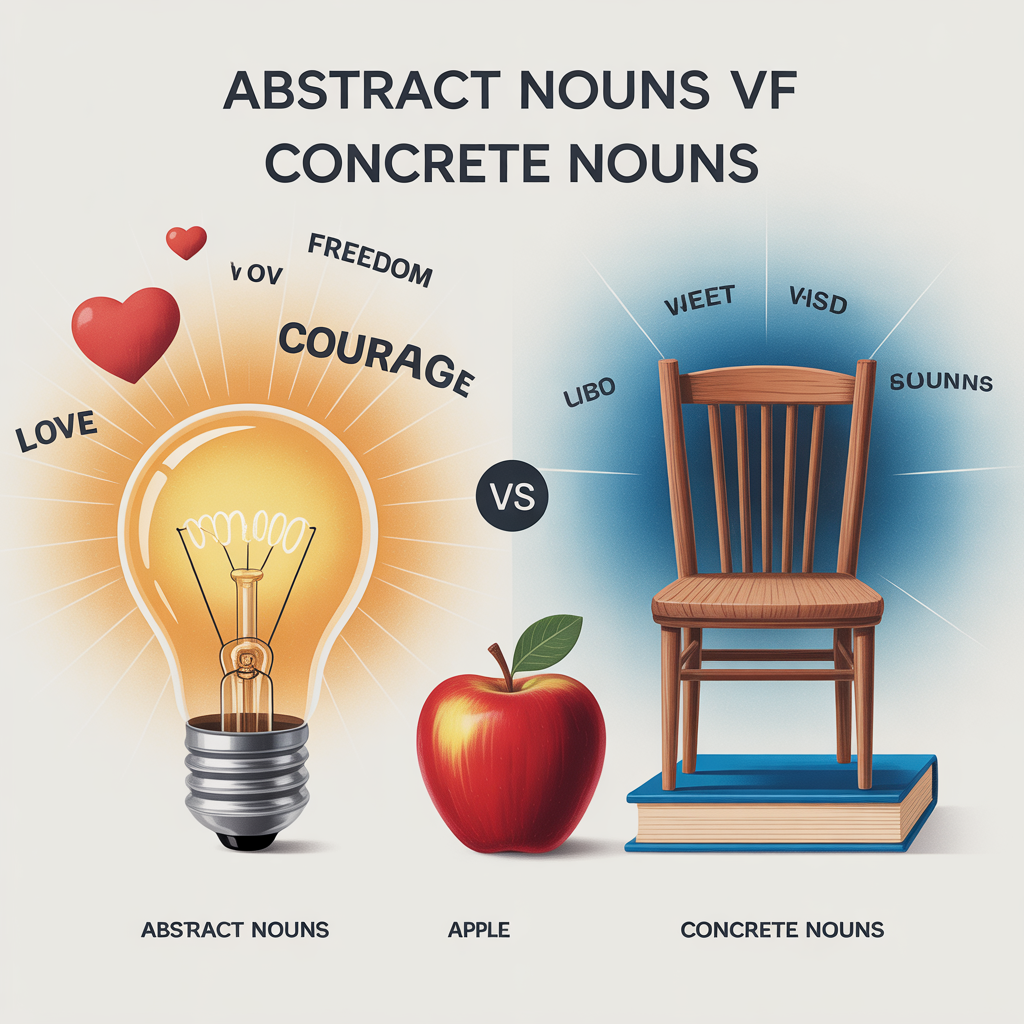
Language is a remarkable tool. It lets us talk about things we can see, touch, and hold — but also things we can only feel. Words like love, freedom, and justice carry enormous meaning, yet you cannot photograph them or place them in a box. These words belong to a special category in English grammar called abstract nouns. Understanding what they are, how they work, and how to use them well can sharpen your writing, deepen your comprehension, and give you a much stronger command of the English language.
What Is an Abstract Noun?
An abstract noun is a noun that refers to an idea, quality, emotion, concept, or state of being — something that exists in the mind or as a concept rather than as a physical, tangible object. You cannot experience an abstract noun with your five senses. You cannot see it, hear it, smell it, taste it, or touch it.
Compare these two sentences:
- “She held a rose in her hand.” — Rose is a concrete noun. You can see and touch it.
- “She felt deep love for him.” — Love is an abstract noun. It exists as an emotion, not an object.
This single distinction — tangible vs. intangible — is the defining feature of an abstract noun.
Abstract Nouns vs. Concrete Nouns: What’s the Difference?
To truly understand abstract nouns, it helps to compare them directly with their opposite: concrete nouns.
| Feature | Concrete Noun | Abstract Noun |
|---|---|---|
| Can you see it? | Yes | No |
| Can you touch it? | Yes | No |
| Examples | dog, chair, apple, stone | happiness, courage, truth, childhood |
| Exists in… | The physical world | The mind or as a concept |
A concrete noun is something with a physical form — a book, a tree, a city. An abstract noun is the idea, feeling, or quality attached to experience — knowledge, growth, culture. Both types are equally important for clear and expressive communication.
Categories of Abstract Nouns
Abstract nouns are not all the same. They can be grouped into several meaningful categories based on what kind of intangible concept they represent.
1. Emotions and Feelings
These are perhaps the most commonly recognized abstract nouns. They describe inner states that humans experience but cannot physically demonstrate.
- Love
- Anger
- Joy
- Fear
- Grief
- Jealousy
- Excitement
2. Ideas and Concepts
These abstract nouns represent thoughts, beliefs, or frameworks that exist in the intellectual or philosophical realm.
- Democracy
- Justice
- Theory
- Philosophy
- Belief
- Ideology
3. Qualities and Characteristics
These nouns name attributes or traits — things that describe what something or someone is like, rather than what they are.
- Bravery
- Honesty
- Intelligence
- Generosity
- Patience
- Wisdom
4. States and Conditions
These describe a particular condition or circumstance that something or someone is in.
- Chaos
- Peace
- Poverty
- Wealth
- Freedom
- Slavery
5. Events and Processes
These refer to things that happen over time but do not have a physical form themselves.
- Education
- Progress
- Revolution
- Evolution
- Migration
6. Measurements and Units (When Used Abstractly)
Some nouns that are typically concrete can become abstract depending on how they’re used. For example, time and distance can be abstract when discussed as concepts rather than specific measured quantities.
- Time
- Speed
- Distance
50 Common Abstract Noun Examples
Here is a broad reference list of abstract nouns you’ll encounter in everyday English:
- Ability
- Ambition
- Anger
- Beauty
- Belief
- Bravery
- Capitalism
- Care
- Charity
- Childhood
- Compassion
- Confidence
- Courage
- Culture
- Curiosity
- Death
- Democracy
- Dignity
- Dreams
- Education
- Empathy
- Envy
- Ethics
- Failure
- Faith
- Fame
- Freedom
- Friendship
- Gratitude
- Grief
- Growth
- Happiness
- Hope
- Humor
- Imagination
- Intelligence
- Justice
- Knowledge
- Love
- Loyalty
- Memory
- Morality
- Peace
- Power
- Pride
- Respect
- Sadness
- Success
- Trust
- Wisdom
How Are Abstract Nouns Formed?
One of the most useful skills in English grammar is learning how to create abstract nouns from other word types. Many abstract nouns are formed by adding a suffix to a verb, adjective, or another noun.
From Verbs
Add suffixes like -tion, -ment, -ance, -ence, -al:
- Educate → Education
- Achieve → Achievement
- Perform → Performance
- Exist → Existence
- Refuse → Refusal
From Adjectives
Add suffixes like -ness, -ity, -ance, -ty:
- Happy → Happiness
- Brave → Bravery
- Kind → Kindness
- Loyal → Loyalty
- Curious → Curiosity
From Other Nouns
Add suffixes like -hood, -ship, -dom:
- Child → Childhood
- Friend → Friendship
- King → Kingdom
- Brother → Brotherhood
Understanding these patterns helps you recognize and form abstract nouns in unfamiliar contexts, which is a powerful skill for both reading and writing.
Abstract Nouns in Sentences: Real Examples
Seeing abstract nouns in context makes them much easier to understand. Here are examples showing how they function in everyday sentences:
- “The courage she showed during the crisis inspired everyone around her.”
- “Without trust, no relationship can truly thrive.”
- “His ambition drove him to work sixteen-hour days.”
- “Freedom means different things to different people.”
- “The beauty of the sunset left them speechless.”
- “She struggled with a deep sense of loneliness after moving to a new city.”
- “Knowledge is power — but only when it’s applied.”
- “The joy on the child’s face was impossible to ignore.”
Notice how in each of these sentences, the abstract noun carries significant emotional or intellectual weight. They communicate meaning that would be difficult to express any other way.
Can Abstract Nouns Be Plural?
Yes — but only some of them, and context matters greatly.
Some abstract nouns can take a plural form when referring to specific instances or varieties of the concept:
- “She had many fears.” (specific individual fears)
- “Their joys were simple but genuine.”
- “He shared his beliefs openly.”
However, many abstract nouns are uncountable (mass nouns) and do not typically take a plural form:
- ✗ “She showed many courages.” → ✓ “She showed great courage.”
- ✗ “They pursued happinesses.” → ✓ “They pursued happiness.”
- ✗ “We need more wisdoms.” → ✓ “We need more wisdom.”
The general rule: if the abstract noun can be experienced as separate, countable instances, it may be pluralized. If it’s treated as a general concept or quality, keep it singular.
Abstract Nouns With Articles: “A,” “An,” and “The”
Another area where learners often struggle is using articles with abstract nouns. Here’s how it works:
- No article (general concept): “Courage is rare.” / “Love conquers all.”
- Definite article “the” (specific instance): “The courage he showed saved lives.”
- Indefinite article “a/an” (one type or instance): “She had a happiness about her that was contagious.”
When an abstract noun is used in a general, philosophical sense, it typically stands alone without an article. When it refers to something specific, “the” is added to signal that specificity.
Why Are Abstract Nouns Important in Writing?
Abstract nouns are the backbone of nuanced, meaningful communication. Here’s why they matter so much:
They Convey Depth of Meaning
Writing that uses only concrete nouns describes the surface of experience. Abstract nouns allow writers to explore the meaning behind that experience. “He ran away” is factual. “He ran from his fear” is profound.
They Enable Discussion of Big Ideas
Philosophy, politics, ethics, psychology, and religion all rely heavily on abstract nouns. Without them, you cannot discuss morality, argue for justice, or explore consciousness.
They Create Emotional Resonance
Skilled authors use abstract nouns to connect with readers on an emotional level. Words like grief, longing, wonder, and despair evoke powerful feelings precisely because they point to universal human experiences.
They Make Prose More Elegant
Rather than describing every emotional detail with action verbs and adjectives, a well-placed abstract noun can do the work of an entire sentence. “The silence between them held years of regret” communicates complex emotion efficiently and beautifully.
Common Mistakes With Abstract Nouns (And How to Fix Them)
Even proficient English speakers make errors with abstract nouns. Here are the most frequent mistakes and how to avoid them:
Mistake 1: Overusing Abstract Nouns (Nominalization)
One of the most common mistakes in formal writing is turning perfectly good verbs into abstract nouns — a habit known as nominalization. It makes writing feel heavy and bureaucratic.
- Weak: “The consideration of the proposal took place at the meeting.”
- Better: “They considered the proposal at the meeting.”
- Weak: “We made a decision to proceed.”
- Better: “We decided to proceed.”
Mistake 2: Making Uncountable Nouns Plural
As discussed above, treating uncountable abstract nouns as plural is a common grammatical error. Stick to singular forms for nouns like information, advice, knowledge, and courage.
Mistake 3: Vague or Empty Abstractions
Writing that relies too heavily on abstract nouns without concrete grounding becomes vague and unconvincing. The best writing grounds abstract nouns in concrete detail.
- Vague: “He showed great courage.”
- Grounded: “He showed great courage — standing alone in front of the crowd, hands trembling, voice steady.”
Abstract nouns gain power when paired with specific, vivid examples.
Abstract Nouns in Academic, Literary, and Everyday English
In Academic Writing
Academic English depends heavily on abstract nouns. Concepts like analysis, methodology, theory, evidence, interpretation, and implications are the scaffolding of scholarly prose. Mastering abstract nouns is essential for writing strong essays, research papers, and reports.
In Literature and Poetry
Great literature uses abstract nouns with extraordinary precision. Shakespeare’s works are filled with them — ambition in Macbeth, jealousy in Othello, grief in Hamlet. Poets especially rely on abstract nouns to crystallize complex emotional experiences into a single word.
In Everyday Speech
We use abstract nouns constantly without even thinking about it. Phrases like “I need some space,” “show a little respect,” or “let’s find some common ground” are peppered throughout daily conversation. Recognizing them helps you understand the layers of meaning in ordinary communication.
A Quick Summary: Key Facts About Abstract Nouns
- Definition: A noun that names something intangible — an idea, emotion, quality, state, or concept.
- Cannot be perceived through the five physical senses.
- Opposite of concrete nouns, which name tangible, physical things.
- Categories include: emotions, ideas, qualities, states, events, and processes.
- Often formed by adding suffixes like -ness, -ity, -tion, -ship, -hood to other words.
- Some can be pluralized; others are uncountable.
- Use articles (a, an, the) according to whether the noun is general or specific.
- Essential for nuanced, meaningful, and emotionally resonant communication.
Conclusion
Abstract nouns are one of the most powerful tools in the English language. They allow us to name what cannot be seen — to speak about love, justice, hope, and courage as naturally as we speak about tables and trees. Understanding what abstract nouns are, how they are formed, and how to use them correctly unlocks a new dimension of expressive and analytical writing.
The key is balance. Use abstract nouns with intention. Pair them with concrete details. Avoid nominalization that drains energy from your writing. And above all, appreciate the fact that language gives us words for the invisible — for all the things that matter most in human life.
Next time you write about kindness, loss, or ambition, you’ll know exactly what kind of word you’re working with — and how to use it well.
Frequently Asked Questions About Abstract Nouns
Is “time” an abstract noun?
Yes, in most contexts, time is considered an abstract noun. While we can measure time, the concept itself has no physical form. When used philosophically (e.g., “Time is precious”), it functions as an abstract noun.
Is “music” an abstract noun?
This is a great debate in grammar. Music is often classified as an abstract noun because music as a concept — melody, harmony, rhythm — cannot be held or physically touched. However, a physical recording or instrument that produces music is concrete. Most grammarians treat music as abstract when referring to the art form itself.
Can a word be both abstract and concrete?
Yes! Some words shift depending on context. Light can be concrete (the light from a lamp) or abstract (the light of understanding). Shadow can be a physical phenomenon or a metaphor for doubt and uncertainty. Context always determines the classification.
Are proper nouns ever abstract?
Not typically. Proper nouns name specific people, places, or organizations — most of which are concrete. However, some proper nouns associated with ideas (e.g., “Democracy,” “Communism”) blur this line slightly.
How do I know if a noun is abstract?
Ask yourself: Can I physically experience this with my senses? If you cannot see, hear, smell, taste, or touch it — it’s abstract. If you can, it’s concrete. When in doubt, ask: “Can I take a photo of it?” If yes, it’s likely concrete.
Are abstract nouns used more in formal or informal writing?
Both, but in different ways. Formal academic and professional writing leans more heavily on abstract nouns (e.g., methodology, implications, representation). Informal speech also uses them constantly, but through more emotionally immediate words like love, fear, happiness.