
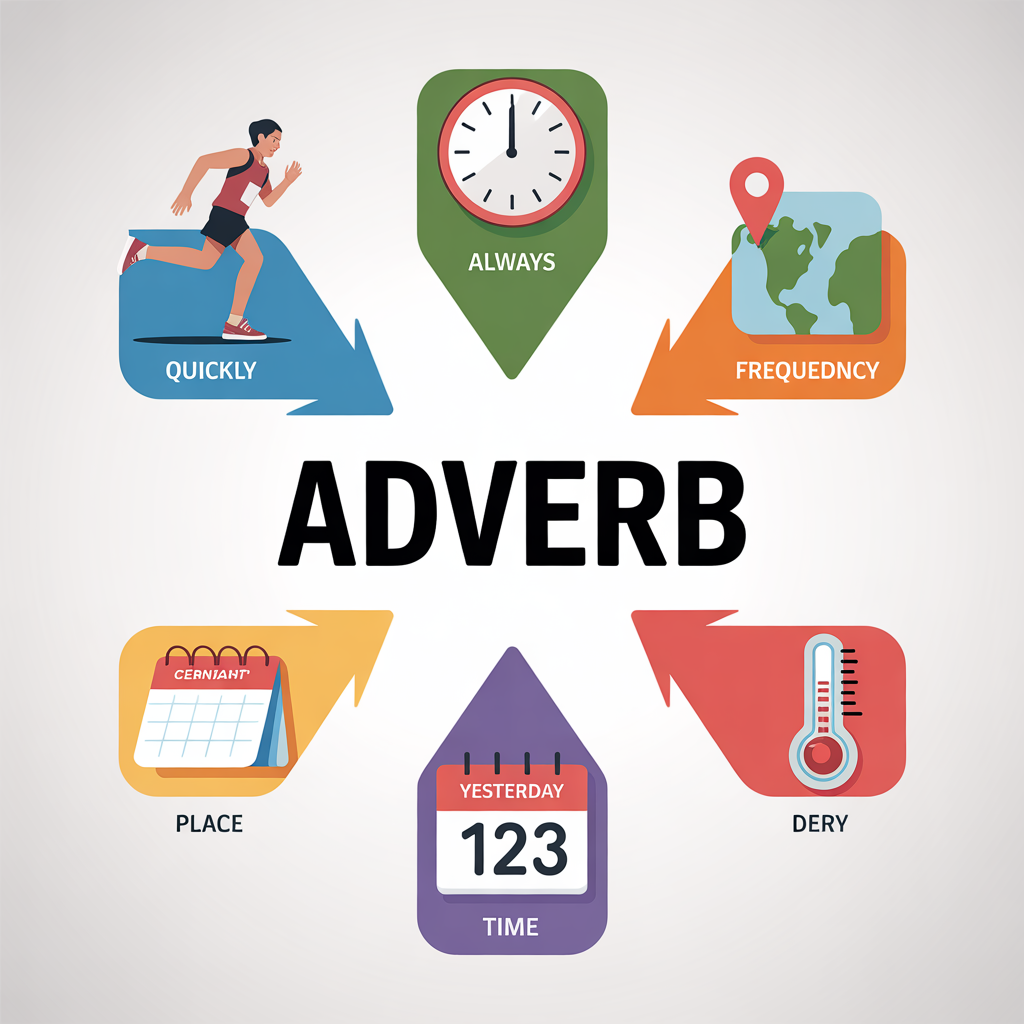
If you’ve ever described how fast someone ran, where a book was placed, or how often you exercise, you’ve already used an adverb — probably without even realizing it. Adverbs are one of the most flexible and widely used parts of speech in the English language. Yet they’re often misunderstood, overused, or confused with adjectives. This comprehensive guide breaks down exactly what an adverb is, how it functions, and how to use it correctly and confidently in your writing and speech.
What Is an Adverb? The Core Definition
An adverb is a word that modifies — that is, describes or gives more information about — a verb, adjective, another adverb, or even an entire sentence. Its primary job is to answer questions like:
- How? (She sang beautifully.)
- When? (He arrived yesterday.)
- Where? (They searched everywhere.)
- How often? (I rarely eat fast food.)
- To what degree? (The coffee is extremely hot.)
In short, adverbs provide the context and detail that make language precise and vivid. Without them, sentences would be flat, vague, and often confusing.
The word “adverb” comes from the Latin adverbium, meaning “added to the verb.” While the name suggests adverbs only modify verbs, their role in modern English grammar is far broader than that.
How to Identify an Adverb
One of the easiest clues for spotting an adverb is the suffix “-ly”. Many adverbs are formed by adding “-ly” to an adjective:
- quick → quickly
- careful → carefully
- loud → loudly
- sudden → suddenly
However, not all adverbs end in “-ly,” and not all words ending in “-ly” are adverbs (for example, friendly, lovely, and cowardly are adjectives). So relying solely on the “-ly” rule can lead you astray.
A better approach is to ask: What word is being modified, and what question does this word answer? If it answers how, when, where, how often, or to what extent, it’s almost certainly an adverb.
What Can an Adverb Modify?
This is where adverbs truly stand out from other parts of speech. They’re remarkably versatile in what they can describe.
1. Adverbs Modifying Verbs
This is the most common use. The adverb tells us more about the action performed by the verb.
- She runs fast. (How does she run?)
- He spoke quietly. (How did he speak?)
- They left immediately. (When did they leave?)
2. Adverbs Modifying Adjectives
Here, the adverb typically expresses degree or intensity — often these are words like very, quite, extremely, or incredibly.
- The movie was incredibly boring.
- She looked absolutely stunning.
- It’s a fairly simple concept.
3. Adverbs Modifying Other Adverbs
Adverbs can even “stack,” with one modifying another to add greater precision.
- He drives quite recklessly.
- She finished the test surprisingly quickly.
4. Adverbs Modifying Entire Sentences (Sentence Adverbs)
Some adverbs comment on an entire clause or sentence rather than a single word. These are often placed at the beginning of a sentence and separated by a comma.
- Fortunately, no one was injured in the accident.
- Honestly, I don’t know the answer.
- Surprisingly, the team won the championship.
Types of Adverbs
Adverbs are typically classified by the type of information they provide. Understanding these categories makes it much easier to use them correctly.
1. Adverbs of Manner
These describe how an action is performed. They are among the most common adverbs and frequently end in “-ly.”
- She danced gracefully.
- He answered the question honestly.
- The dog barked loudly.
- They worked hard. (Note: “hard” here is an adverb, not “hardly,” which means “barely.”)
2. Adverbs of Time
These tell us when something happens or for how long. They often appear at the beginning or end of a sentence.
- I’ll call you tomorrow.
- Recently, she moved to a new city.
- He has already finished his homework.
- We stayed there for a while.
3. Adverbs of Place
These indicate where an action takes place or the direction of movement.
- Please come here.
- She looked everywhere for her keys.
- He moved forward cautiously.
- The children played outside.
4. Adverbs of Frequency
These describe how often something occurs. They are commonly placed before the main verb but after auxiliary (helping) verbs.
- She always arrives on time.
- He never eats breakfast.
- They often go hiking on weekends.
- I sometimes forget where I put my phone.
- We rarely see each other anymore.
5. Adverbs of Degree
These express the intensity or extent of an action, adjective, or another adverb. Common examples include very, quite, almost, too, enough, barely, and extremely.
- The food was too spicy for me.
- She is almost ready.
- He was barely awake during the lecture.
- The project is nearly complete.
6. Adverbs of Certainty and Doubt
These express the speaker’s level of confidence about what they’re saying.
- She will definitely pass the exam.
- He is probably still at work.
- I’m certainly not going to accept that offer.
- They possibly forgot about the meeting.
7. Interrogative Adverbs
These are used to form questions: where, when, why, and how.
- Where did you go last night?
- When will the results be announced?
- Why did she leave early?
- How does this machine work?
8. Relative Adverbs
These introduce relative clauses. The main relative adverbs are where, when, and why.
- This is the place where we first met.
- Do you remember the day when we went camping?
- I don’t understand the reason why he quit.
9. Conjunctive Adverbs
These connect two independent clauses and show the relationship between them. Common examples include however, therefore, moreover, nevertheless, consequently, and furthermore. They are typically preceded by a semicolon and followed by a comma.
- The weather was terrible; however, we still had a great time.
- She studied all night; therefore, she aced the test.
- He is talented; moreover, he is incredibly hardworking.
Adverb Placement in a Sentence
Where you place an adverb can significantly change the meaning or emphasis of a sentence. While English allows considerable flexibility, some general rules apply.
Adverbs of Frequency
These almost always go before the main verb but after auxiliary verbs (like is, are, have, will, can):
- She never complains. (before main verb)
- He has always been kind. (after auxiliary “has”)
- They are often late. (after “are”)
Adverbs of Manner
These typically follow the verb or the object of the verb:
- He completed the task efficiently.
- She smiled warmly.
Adverbs of Time and Place
These are most flexible and can often appear at the beginning or end of a sentence:
- Yesterday, I saw an incredible sunset.
- I saw an incredible sunset yesterday.
The “Squinting Modifier” Problem
Placing an adverb in the wrong position can create ambiguity. A squinting modifier is an adverb that could modify either the word before it or the word after it, making the sentence unclear.
- Ambiguous: “Students who study often get good grades.” (Does “often” modify “study” or “get”?)
- Clear: “Students who often study get good grades.”
- Clear: “Students who study get good grades often.”
Adverbs vs. Adjectives: A Common Source of Confusion
One of the most frequent grammar mistakes in English is using an adjective where an adverb is required, and vice versa. Here’s a clear breakdown of the difference:
- Adjectives modify nouns and pronouns. They describe what something is.
- Adverbs modify verbs, adjectives, and other adverbs. They describe how, when, where, or to what degree.
Consider these two sentences:
- “She is a careful driver.” (careful = adjective modifying the noun “driver”)
- “She drives carefully.” (carefully = adverb modifying the verb “drives”)
A very common error is saying “I feel badly” when you mean “I feel bad.” After a linking verb (such as feel, look, seem, appear, taste, smell, sound), you should use an adjective — not an adverb — because the adjective describes the subject, not the action.
- ❌ “The soup smells wonderfully.”
- ✅ “The soup smells wonderful.”
- ❌ “He looked nervously.” (if you mean his appearance)
- ✅ “He looked nervous.”
Flat Adverbs: When “-ly” Is Optional
Some adverbs have two acceptable forms — one with “-ly” and one without. These are called flat adverbs (also known as bare adverbs). The forms without “-ly” were historically standard but are now considered informal in many contexts.
| Flat Adverb | “-ly” Form | Example (flat) |
|---|---|---|
| fast | — | She runs fast. |
| hard | hardly (different meaning!) | He works hard. |
| late | lately (different meaning!) | She arrived late. |
| straight | straightly (rare) | Go straight ahead. |
| deep | deeply (different nuance) | Dig deep. |
Note that hard/hardly and late/lately have very different meanings — they are not interchangeable.
The Comparative and Superlative Forms of Adverbs
Just like adjectives, many adverbs can be compared. There are three degrees:
- Positive: She runs fast.
- Comparative (comparing two): She runs faster than her brother.
- Superlative (comparing three or more): She runs the fastest of anyone on the team.
For one-syllable adverbs (like fast, hard, late), add -er for comparative and -est for superlative.
For longer adverbs ending in “-ly,” use more/most or less/least:
- She speaks more clearly than her colleague.
- He arrived most promptly of all the guests.
Some adverbs have irregular comparative forms:
- well → better → best
- badly → worse → worst
- little → less → least
- much → more → most
Common Mistakes When Using Adverbs
Knowing what to avoid is just as valuable as knowing what to do. Here are the most frequent adverb errors:
1. Double Negatives
In standard English, using two negative adverbs together is grammatically incorrect.
- ❌ “I don’t know nothing.”
- ✅ “I don’t know anything.” or “I know nothing.”
2. Overusing “Very” and “Really”
While these are legitimate adverbs of degree, overusing them weakens your writing. Instead, choose a stronger, more specific word.
- Weak: “He was very angry.”
- Stronger: “He was furious.”
- Weak: “She ran really fast.”
- Stronger: “She sprinted.”
3. Confusing “Good” and “Well”
Good is an adjective; well is an adverb (with one exception: “well” can be an adjective meaning “in good health”).
- ❌ “She sings good.”
- ✅ “She sings well.”
- ✅ “She is a good singer.”
4. Misplacing “Only”
The adverb only should be placed directly before the word it modifies. Misplacing it changes the meaning entirely.
- “Only she told him the truth.” (She was the only person who told him.)
- “She only told him the truth.” (She didn’t do anything else — just told him.)
- “She told only him the truth.” (She told no one else.)
Adverb Phrases and Adverb Clauses
Adverbs don’t always appear as single words. They can also function as phrases or clauses.
Adverb Phrases
A group of words without a subject and verb that functions as an adverb.
- “She spoke in a very soft voice.” (How did she speak?)
- “He left without saying goodbye.” (How/under what circumstances?)
Adverb Clauses
A group of words that includes a subject and verb and functions as an adverb. Adverb clauses are introduced by subordinating conjunctions such as because, although, when, if, since, unless, while.
- “She smiled when she saw the results.” (When?)
- “Because it was raining, we cancelled the picnic.” (Why?)
- “Although he was tired, he kept working.” (Under what condition?)
Why Adverbs Matter in Writing
Used thoughtfully, adverbs are powerful tools. They allow writers to:
- Add nuance and precision — “She reluctantly agreed” paints a very different picture than “She agreed.”
- Establish tone and mood — Adverbs like suddenly, frantically, or serenely instantly set the emotional atmosphere.
- Show time and sequence — Words like first, then, finally, meanwhile help structure a narrative.
- Express certainty or probability — Essential in academic writing, journalism, and everyday communication.
That said, many writing coaches advise using adverbs sparingly in creative writing. The famous author Stephen King once wrote, “The road to hell is paved with adverbs.” His point: a well-chosen verb or adjective is usually more powerful than a weak word propped up by an adverb.
The lesson? Use adverbs intentionally, not habitually. Ask yourself: Can a better word replace this verb + adverb combination?
Quick Reference: Adverb Summary Table
| Type | Question Answered | Examples |
|---|---|---|
| Manner | How? | quickly, softly, hard, well |
| Time | When? How long? | yesterday, soon, already, yet |
| Place | Where? Where to? | here, outside, everywhere, away |
| Frequency | How often? | always, never, often, seldom |
| Degree | How much? To what extent? | very, too, quite, almost, barely |
| Certainty | How sure? | definitely, probably, certainly |
| Interrogative | Forms questions | where, when, why, how |
| Relative | Introduces clauses | where, when, why |
| Conjunctive | Connects clauses | however, therefore, moreover |
Conclusion
An adverb is far more than just a word ending in “-ly.” It’s a grammatical powerhouse that modifies verbs, adjectives, other adverbs, and even entire sentences — giving your language depth, clarity, and precision. From telling us when and where something happened, to expressing how intensely a feeling was felt, adverbs shape the way we communicate ideas every single day.
Understanding the different types of adverbs, how to position them correctly, and when to replace them with stronger word choices will make you a more effective communicator — whether you’re writing an essay, crafting a story, or simply having a conversation. The key is balance: use adverbs purposefully and you’ll find they elevate your language rather than clutter it.
Frequently Asked Questions (FAQs)
Is “not” an adverb?
Yes. Not (and its contraction n’t) is classified as an adverb of negation or degree. It modifies verbs, adjectives, and other adverbs to express negation: “She is not happy.” “He did not finish.”
Can a noun function as an adverb?
Yes, in certain cases. When a noun answers an adverbial question like “when” or “how long,” it functions as an adverb. For example: “She worked all day.” Here, “day” modifies the verb “worked” and answers “how long.” These are called adverbial nouns or noun adjuncts.
What is the difference between “hard” and “hardly”?
Hard as an adverb means “with great effort or intensity” (He works hard.). Hardly means “barely” or “almost not” (She hardly slept last night.). They are completely different in meaning and not interchangeable.
What is a “conjunctive adverb,” and how is it different from a regular adverb?
A conjunctive adverb (like however, therefore, consequently) connects two independent clauses and shows the logical relationship between them. Unlike coordinating conjunctions (and, but, or), conjunctive adverbs are typically preceded by a semicolon. They still technically function as adverbs because they modify the clause that follows them.
Can an adverb come before a noun?
Generally, no — that’s the role of an adjective. However, some adverbs of degree can appear before noun phrases in informal usage, such as “quite the hero” or “rather a surprise.” These are considered special constructions rather than standard adverb use.
Are adverbs always single words?
No. Adverbs can be single words (quickly), adverb phrases (in a calm voice), or adverb clauses (because she was tired). All three function the same way grammatically — they modify verbs, adjectives, adverbs, or sentences.