
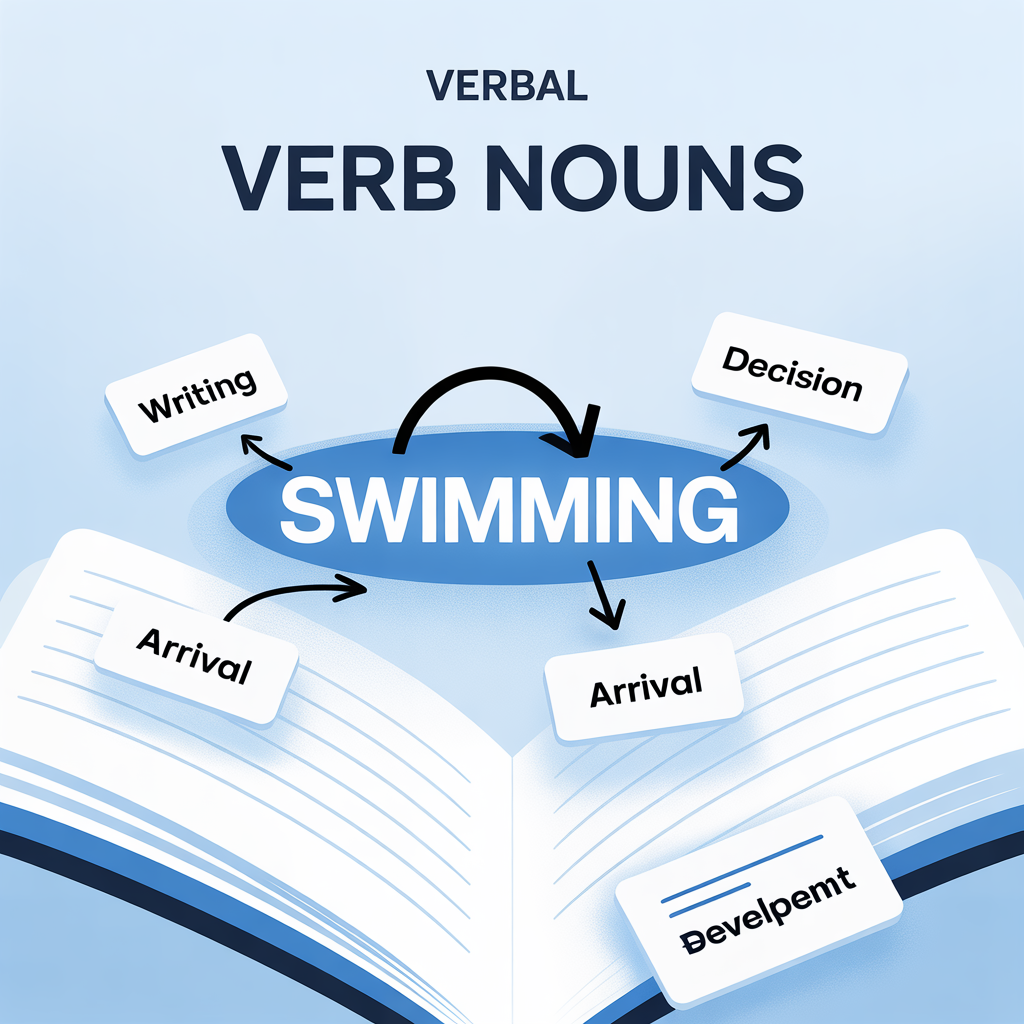
What Are Verbal Nouns?
You’ve probably seen words like swimming, writing, or destruction and wondered exactly what grammatical category they fall into. Verbal nouns are one of the most fascinating — and often misunderstood — features of English grammar. They sit at the crossroads between verbs and nouns, borrowing qualities from both worlds. Understanding them sharpens your writing, improves your grammar accuracy, and helps you make sense of why certain sentence structures feel natural while others do not. This guide breaks down everything you need to know about verbal nouns: what they are, how they work, how they differ from similar forms, and how to use them with confidence.
What Is a Verbal Noun?
A verbal noun is a noun that is derived from a verb. It names an action, process, or state — but functions grammatically as a noun rather than a verb. In other words, it looks like it came from a verb (because it did), but in a sentence, it behaves exactly like any other noun.
Consider these examples:
- The swimming was exhausting. (subject of the sentence)
- She enjoys the reading of classic novels. (object of a preposition)
- The destruction of the building shocked everyone. (subject of the sentence)
- His arrival surprised the team. (subject of the sentence)
In each case, a word rooted in verbal meaning — swimming, reading, destruction, arrival — is doing the work of a noun. That’s the essence of a verbal noun.
Where Do Verbal Nouns Come From?
Verbal nouns are formed through a process called nominalization — converting a verb into a noun. English has several ways of doing this, which is why verbal nouns come in different forms.
1. The -ing Form
The most familiar verbal noun in English is made by adding -ing to the base form of a verb:
- swim → swimming
- write → writing
- run → running
- paint → painting
Example sentences:
- The running of the marathon took hours.
- Good writing requires practice.
2. Suffixes That Create Verbal Nouns
Many verbal nouns are formed with specific suffixes attached to a verb stem. Common ones include:
- -tion / -sion: decide → decision; create → creation; discuss → discussion
- -ment: develop → development; announce → announcement; achieve → achievement
- -al: arrive → arrival; approve → approval; refuse → refusal
- -ance / -ence: perform → performance; prefer → preference; exist → existence
- -age: break → breakage; drain → drainage; use → usage
- -ure: fail → failure; close → closure; press → pressure
- -ery / -ry: discover → discovery; rob → robbery
3. Zero Derivation (Conversion)
Some verbal nouns look identical to their source verbs. This is called zero derivation or conversion. The word doesn’t change shape; only its grammatical role changes:
- He made a walk through the park. (noun; the verb is “walk”)
- The run lasted twenty minutes. (noun; the verb is “run”)
- She gave a shout. (noun; the verb is “shout”)
Verbal Noun vs. Gerund: What’s the Difference?
This is the question that trips up even advanced English learners. Verbal nouns and gerunds both end in -ing, both come from verbs, and both function as nouns. So are they the same thing?
Not exactly. The distinction is subtle but important — and it has real consequences for how you structure a sentence.
The Gerund
A gerund is an -ing form that functions as a noun but retains verb-like properties. Specifically, it can:
- Take a direct object
- Be modified by an adverb
- Have its own subject (in the possessive form)
Examples:
- Swimming the river was dangerous. (Swimming takes “the river” as a direct object — verb-like behavior)
- Carefully reading the document helped. (Modified by the adverb “carefully”)
- I appreciate his helping us. (Has its own possessive subject)
The Verbal Noun (with -ing)
When the -ing form acts as a full noun, it behaves more like a typical noun. It can:
- Take a determiner (a, the, this, his)
- Be modified by an adjective
- Take a prepositional phrase with of instead of a direct object
- Be used in the plural
Examples:
- The swimming of the river was dangerous. (Note: “the river” is introduced by “of”)
- Her careful reading of the document helped. (Modified by the adjective “careful”)
- The meetings ran too long. (Used in the plural — a gerund cannot be pluralized)
- A good understanding of grammar is essential. (Preceded by an article + adjective)
Quick Comparison Table
| Feature | Gerund | Verbal Noun (-ing) |
|---|---|---|
| Can take a direct object | Yes | No (uses “of” phrase instead) |
| Can be modified by an adverb | Yes | No (uses adjective) |
| Can take an article (a, the) | Rarely / awkward | Yes |
| Can be pluralized | No | Yes (sometimes) |
| Example | Carefully writing the letter | The careful writing of the letter |
Important note: In everyday usage, especially in American English, the boundary between gerunds and verbal nouns is often blurred. Many grammarians use the terms interchangeably when referring to -ing forms. The distinction matters most in formal writing and in advanced grammar analysis.
Verbal Noun vs. Infinitive: Another Key Comparison
Both verbal nouns and infinitives (to + verb) can act as nouns in a sentence. For example:
- Running is good for your health. (verbal noun as subject)
- To run is good for your health. (infinitive as subject)
Both sentences are grammatically correct, but they carry slightly different nuances:
- Verbal nouns tend to feel more concrete or habitual — they refer to an activity in a general sense.
- Infinitives often feel more abstract or specific — they point to a particular instance or potential action.
In formal writing, verbal nouns with suffixes (like development, approval, creation) are preferred over gerunds or infinitives because they sound more authoritative and polished.
How Verbal Nouns Function in a Sentence
Like any noun, verbal nouns can occupy multiple positions in a sentence:
As the Subject
- The approval of the proposal took weeks.
- Swimming every morning improves cardiovascular health.
As the Object of a Verb
- She enjoys painting.
- They discussed the development of new policies.
As the Object of a Preposition
- He left without saying goodbye.
- We were impressed by his performance.
As a Subject Complement (Predicate Noun)
- Her greatest talent is writing.
- The first step is planning.
As an Appositive
- His hobby, painting, brings him joy.
Verbal Nouns in Formal vs. Informal English
The choice between a verbal noun and other forms can signal whether writing is formal or informal.
In formal writing — academic essays, business reports, legal documents — nominalized verbal nouns (formed with suffixes) are very common. They create a more impersonal, authoritative tone:
- Instead of: We decided quickly.
- Formal: A quick decision was made.
- Instead of: The company failed to deliver.
- Formal: The company’s failure to deliver was noted.
In informal writing and speech, people lean toward gerunds or active verb constructions because they feel more natural and direct.
A word of caution: overusing nominalized verbal nouns can make writing feel heavy and bureaucratic — a style sometimes called “nominalization overload.” Good writers balance nominalization with active, verb-driven sentences.
Common Verbal Nouns You Use Every Day
You encounter verbal nouns constantly without realizing it. Here are some high-frequency examples grouped by their formation:
-ing Verbal Nouns
- Thinking — Critical thinking is a valuable skill.
- Teaching — Teaching requires patience.
- Learning — The learning of new languages takes time.
- Building — The building of trust is gradual.
-tion / -sion Verbal Nouns
- Education — Education is the key to opportunity.
- Celebration — The celebration lasted all evening.
- Permission — She asked for permission to leave early.
- Confusion — The instructions caused confusion.
-ment Verbal Nouns
- Management — Good management improves team morale.
- Encouragement — His encouragement meant everything to her.
- Improvement — Continuous improvement is essential.
-al Verbal Nouns
- Survival — Survival in the wild demands skill.
- Withdrawal — The withdrawal of troops was announced.
- Retrieval — Data retrieval was instant.
Verbal Nouns in Other Languages (A Brief Note)
The concept of verbal nouns exists across many languages, though the forms differ. In Arabic, the verbal noun (called maṣdar) is one of the most important grammatical concepts. In Irish Gaelic, verbal nouns are the standard way to express ongoing action — functioning the way present participles do in English. In Latin and Greek, the gerundive and verbal noun systems were elaborate and highly systematic.
This universality underscores a fundamental truth about language: humans in all cultures need a way to transform actions into concepts — to talk about “the doing” as much as “the doer.”
Tips for Using Verbal Nouns Correctly
Here are some practical guidelines to help you use verbal nouns with precision:
- Use “of” instead of a direct object: Say the reading of the report, not the reading the report.
- Use an adjective, not an adverb, to modify a verbal noun: Say the careful writing, not the carefully writing.
- Pair with articles and determiners freely: Verbal nouns accept a, the, his, their naturally.
- Don’t confuse them with present participles: Running down the street (participle, modifying a noun or showing action) vs. Running is healthy (verbal noun / gerund, subject of the sentence).
- Pluralize when appropriate: Verbal nouns made with suffixes often take plurals — decisions, achievements, meetings. The -ing verbal noun can be pluralized too in certain contexts — the comings and goings.
- Avoid overusing them in casual writing: Too many nominalizations make text feel stiff and impersonal. When writing for a general audience, favor clear, active sentences.
Why Understanding Verbal Nouns Matters
Verbal nouns matter for several very practical reasons:
- Academic writing: Essays and research papers rely heavily on verbal nouns for formal tone and conceptual precision.
- Business communication: Reports, proposals, and emails use nominalized verbs constantly — implementation, assessment, coordination.
- Language learning: If you’re learning English as a second language, recognizing verbal nouns helps you decode complex sentences and build a wider vocabulary.
- Grammar tests: Standardized tests like the IELTS, TOEFL, GMAT, and SAT regularly test knowledge of verbal forms, including gerunds and verbal nouns.
- Literary analysis: Understanding verbal nouns helps you analyze an author’s style choices — why they chose the destruction instead of destroying, for instance.
Conclusion
Verbal nouns are a cornerstone of English grammar — elegant, versatile, and deeply practical. They allow speakers and writers to transform actions into concepts, giving language its remarkable flexibility. Whether they take the form of an -ing word like running, a suffixed noun like development, or a zero-derived noun like run, they all share the same core function: naming what a verb describes.
Understanding the difference between verbal nouns, gerunds, and participles isn’t just a grammar exercise — it’s a tool that makes you a clearer thinker and a stronger communicator. The next time you write a sentence like “The careful planning of the project ensured its success,” you’ll know exactly why it works — and why it works so well.
Frequently Asked Questions About Verbal Nouns
Is a gerund the same as a verbal noun?
Not exactly. Both are -ing forms functioning as nouns, but a gerund retains verb properties (it can take a direct object and be modified by an adverb), while a verbal noun functions more like a full noun (it takes determiners, adjectives, and “of” phrases). In practice, many grammarians use the terms loosely as synonyms.
Can a verbal noun be made plural?
Yes, in many cases. Verbal nouns formed with suffixes — like decisions, achievements, or arrivals — pluralize freely. Some -ing verbal nouns can also be pluralized in fixed expressions (comings and goings, the workings of the mind), though this is less common.
What’s the difference between a verbal noun and a present participle?
Both end in -ing, but they serve entirely different roles. A present participle functions as an adjective or is used with “be” to form progressive tenses (the running water, she is running). A verbal noun functions as a noun (Running is healthy). The key test: can you replace the word with a noun like “activity” or “thing”? If yes, it’s likely a verbal noun.
Are verbal nouns more formal than other verb forms?
Generally, yes — especially those formed with suffixes like -tion, -ment, and -al. Academic, legal, and business writing tends to rely on these forms heavily. Using too many of them in casual writing can make your prose feel dry or overly bureaucratic.
How do I identify a verbal noun in a sentence?
Ask three questions: (1) Does the word come from a verb? (2) Does it name an action, process, or state? (3) Is it functioning grammatically as a noun (subject, object, complement)? If the answer to all three is yes, you’re looking at a verbal noun.