
Every sentence you speak or write is built on a foundation of words that name things — people, places, ideas, and objects. These words have a special name in grammar: nouns. Whether you’re a student learning English for the first time, a writer polishing your craft, or simply someone curious about how language works, understanding nouns is one of the most important steps you can take. This guide will walk you through everything you need to know — from the basic definition to the many types of nouns, how they function in sentences, and common mistakes to avoid.
What Is a Noun? The Basic Definition
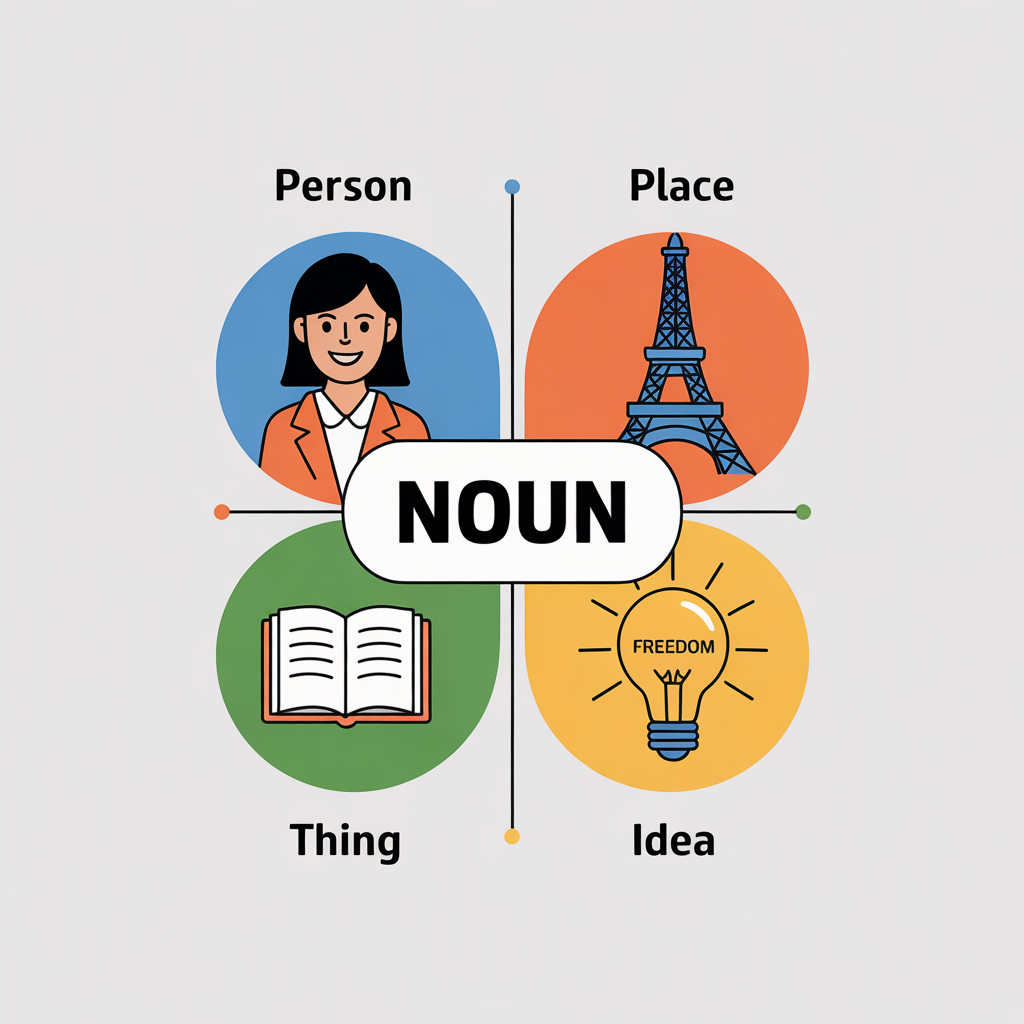
A noun is a word that names a person, place, thing, or idea. It is one of the eight traditional parts of speech in English grammar, and it is arguably the most fundamental one. Almost every sentence contains at least one noun, which tells us who or what the sentence is about.
Here are some simple examples to illustrate the concept:
- Person: teacher, Maria, doctor, child
- Place: city, Paris, school, ocean
- Thing: book, car, apple, telephone
- Idea/Concept: freedom, love, happiness, justice
In the sentence “The dog chased the ball in the park,” all three bolded words are nouns. They identify the subject, the object, and the location — three roles that nouns can play in a single sentence.
Why Are Nouns So Important in English?
Nouns are the anchors of language. Without them, sentences would have no clear subject and no way to refer to the world around us. They work hand in hand with verbs (which describe actions), adjectives (which describe nouns), and other parts of speech to create meaningful communication.
In terms of grammar, nouns serve several critical functions:
- They act as the subject of a sentence (who or what does the action).
- They act as the object of a sentence (who or what receives the action).
- They serve as the complement (renaming or describing the subject).
- They can be the object of a preposition in a prepositional phrase.
For example:
- “The chef cooked dinner.” — “chef” is the subject.
- “She loves music.” — “music” is the direct object.
- “He is a writer.” — “writer” is the subject complement.
- “We walked to the store.” — “store” is the object of the preposition “to.”
The Main Types of Nouns
Not all nouns are the same. English grammar classifies nouns into several types, each with its own rules and characteristics. Understanding these categories will make you a more precise and confident communicator.
1. Common Nouns
A common noun is a general name for a person, place, or thing. It does not refer to a specific individual — it refers to a category. Common nouns are not capitalized unless they appear at the beginning of a sentence.
Examples: country, river, woman, phone, building, animal
“The river runs through the city.”
2. Proper Nouns
A proper noun names a specific, one-of-a-kind person, place, or organization. Proper nouns are always capitalized, regardless of where they appear in a sentence.
Examples: Amazon River, New York, Google, Albert Einstein, Monday
“Amazon was founded by Jeff Bezos in Seattle.”
3. Concrete Nouns
A concrete noun refers to something that can be perceived through one or more of the five senses — something you can see, touch, hear, smell, or taste.
Examples: chair, coffee, rain, thunder, rose
“She could smell the coffee from across the room.”
4. Abstract Nouns
An abstract noun refers to something intangible — a concept, quality, emotion, or idea that cannot be directly experienced through the senses.
Examples: courage, democracy, envy, wisdom, time, beauty
“Courage is required to face your fears.”
5. Countable Nouns
A countable noun (also called a count noun) refers to things that can be counted individually. They have both singular and plural forms.
Examples: apple/apples, dog/dogs, idea/ideas, book/books
“She bought three books and two pens.”
6. Uncountable Nouns
An uncountable noun (also called a mass noun) refers to things that cannot be counted individually because they represent a substance, concept, or mass. They typically do not have a plural form and are not used with “a” or “an.”
Examples: water, information, rice, furniture, advice, knowledge
“Can you give me some advice?” — Not “an advice” or “advices.”
7. Collective Nouns
A collective noun refers to a group of people, animals, or things as a single unit. Even though a collective noun represents multiple individuals, it is often treated as a singular noun in American English.
Examples: team, flock, committee, herd, audience, family
“The team is ready for the game.”
8. Compound Nouns
A compound noun is made up of two or more words that combine to form a single noun with a new meaning. Compound nouns can be written as one word, hyphenated, or as two separate words.
Examples:
- One word: toothpaste, sunflower, notebook
- Hyphenated: mother-in-law, self-confidence, check-in
- Two words: post office, ice cream, swimming pool
9. Possessive Nouns
A possessive noun shows ownership or a relationship between two nouns. It is typically formed by adding an apostrophe and the letter “s” (‘s) to a singular noun, or just an apostrophe (‘) to a plural noun ending in “s.”
Examples:
- “The dog’s leash is red.” (singular possessive)
- “The teachers’ lounge is on the second floor.” (plural possessive)
10. Gerunds (Verbal Nouns)
A gerund is a verb form ending in -ing that functions as a noun in a sentence. It looks like a verb but plays the role of a noun.
Examples: swimming, reading, cooking, running
“Swimming is great exercise.” — Here, “swimming” is the subject of the sentence and functions as a noun.
How to Identify a Noun in a Sentence
Recognizing nouns becomes easier with practice. Here are some reliable strategies to identify them:
The “Name Test”
Ask yourself: “Does this word name a person, place, thing, or idea?” If yes, it’s likely a noun.
The Article Test
Try placing the articles “a,” “an,” or “the” before the word. If it sounds natural, the word is probably a noun. For example, “a book,” “the ocean,” “an idea” all work naturally.
The Plural Test
Most nouns can be made plural by adding -s or -es. If you can say “two ___,” the word is likely a noun: two dogs, two cities, two concepts.
Look for Common Noun Suffixes
Many nouns are built using recognizable suffixes. Spotting these endings can help you identify nouns quickly:
- -tion / -sion: education, permission, nation
- -ness: happiness, darkness, kindness
- -ment: government, development, agreement
- -ity: creativity, equality, possibility
- -er / -or: teacher, doctor, actor
- -ism: capitalism, realism, journalism
- -ance / -ence: performance, presence, confidence
Singular and Plural Forms of Nouns
Most English nouns form their plural by simply adding -s or -es. However, there are several irregular patterns you should know.
Regular Plurals
- Add -s: cat → cats, book → books, dog → dogs
- Add -es for words ending in -s, -sh, -ch, -x, -z: bus → buses, church → churches, box → boxes
- Words ending in consonant + y → change y to -ies: city → cities, baby → babies
- Words ending in -f or -fe → change to -ves: leaf → leaves, wife → wives
Irregular Plurals
Some nouns change their internal spelling when they become plural. These must be memorized:
- man → men
- woman → women
- child → children
- tooth → teeth
- foot → feet
- mouse → mice
- goose → geese
Nouns That Stay the Same
Some nouns have identical singular and plural forms:
- sheep → sheep
- deer → deer
- fish → fish (or fishes in some contexts)
- species → species
Nouns and Articles: Using “A,” “An,” and “The” Correctly
Nouns in English are closely linked to articles — the small words that introduce them. Using articles correctly is one of the most common challenges for English learners.
- A / An (Indefinite Articles): Used with singular countable nouns when referring to something non-specific or mentioned for the first time. Use a before consonant sounds and an before vowel sounds.
“She adopted a kitten.” / “He ate an apple.” - The (Definite Article): Used when both the speaker and listener know which specific thing is being referred to.
“She adopted a kitten. The kitten is very playful.” - No Article: Uncountable nouns and plural nouns used in a general sense often take no article.
“Water is essential for life.” / “Dogs are loyal animals.”
Common Mistakes People Make With Nouns
Even experienced writers make errors with nouns. Here are the most frequent mistakes and how to avoid them:
Mistake 1: Treating Uncountable Nouns as Countable
❌ “She gave me a great advice.”
✅ “She gave me great advice.” or “She gave me a great piece of advice.”
Mistake 2: Misusing Apostrophes With Possessives
❌ “The dog’s are playing.” (This is possessive, not plural!)
✅ “The dogs are playing.”
Mistake 3: Incorrect Plural Forms
❌ “There were three childs in the park.”
✅ “There were three children in the park.”
Mistake 4: Confusing Common and Proper Nouns
❌ “She studied at Harvard university.”
✅ “She studied at Harvard University.” (Proper nouns must be capitalized)
Nouns in Phrases: Noun Phrases Explained
A noun phrase is a group of words that functions as a noun in a sentence. It typically consists of a noun and any modifiers (articles, adjectives, or other words) that describe it.
Examples of noun phrases:
- “The tall woman in the red coat smiled at me.”
- “I love a quiet evening at home.”
- “Her brilliant idea changed everything.”
In each example, the entire bolded phrase works as a single noun unit in the sentence. Understanding noun phrases helps you write more descriptive, nuanced sentences.
Nouns vs. Other Parts of Speech: A Quick Comparison
Sometimes words can look similar but serve very different grammatical roles. Here’s how nouns differ from their closest relatives:
- Noun vs. Verb: A noun names something; a verb describes an action. “The run (noun) was exhausting.” vs. “She can run (verb) fast.”
- Noun vs. Adjective: A noun names; an adjective describes. “Gold (noun) is valuable.” vs. “She wore a gold (adjective) ring.”
- Noun vs. Pronoun: A noun is the actual name; a pronoun replaces it. “Maria (noun) called. She (pronoun) will visit tomorrow.”
Fun Facts About Nouns
- The word “noun” comes from the Latin word nomen, meaning “name.”
- English has more nouns than any other part of speech — they make up a significant portion of the vocabulary.
- Some words in English can be nouns, verbs, or adjectives depending on how they’re used — these are called zero-derivation or conversion words. For example: book (noun) vs. book (verb, as in “book a table”).
- In some languages, nouns are assigned grammatical gender (masculine, feminine, neuter). In English, nouns generally do not have grammatical gender, which makes English relatively simpler in this regard.
Conclusion
Understanding what a noun is — and how to use it correctly — is one of the most valuable foundations you can build in English grammar. Nouns are the building blocks of every sentence, giving language its ability to name and describe the world around us. From common and proper nouns to abstract, collective, and compound nouns, each type serves a unique purpose and adds a different layer of meaning to your communication.
Whether you’re learning English as a second language, helping a child with homework, or simply brushing up on grammar fundamentals, mastering nouns will make you a clearer, more confident communicator. Keep practicing, pay attention to how nouns are used in books and conversations, and don’t hesitate to revisit this guide whenever you need a refresher.
Frequently Asked Questions (FAQs)
What is a noun in simple terms?
A noun is a word that names a person, place, thing, or idea. Examples include “teacher,” “London,” “table,” and “happiness.” Nouns are one of the most important parts of speech in English grammar.
What are the 8 types of nouns?
The main types of nouns in English are: common nouns, proper nouns, concrete nouns, abstract nouns, countable nouns, uncountable nouns, collective nouns, and compound nouns. Some classifications also include gerunds and possessive nouns.
How do you identify a noun in a sentence?
To identify a noun, ask if the word names a person, place, thing, or idea. You can also try placing “a,” “an,” or “the” before the word — if it sounds natural, the word is likely a noun. Looking for common noun suffixes like -tion, -ness, -ment, and -ity also helps.
Can a noun also be a verb?
Yes! In English, many words can function as both nouns and verbs depending on their context. For example, “water” can be a noun (“I drank some water“) or a verb (“Please water the plants”). This phenomenon is called conversion or zero-derivation.
What is the difference between a concrete noun and an abstract noun?
A concrete noun refers to something tangible that you can perceive with your senses, such as “apple,” “rain,” or “music.” An abstract noun refers to an intangible concept, emotion, or quality, such as “love,” “freedom,” or “courage.”
Are gerunds nouns?
Yes, gerunds are verb forms ending in -ing that function as nouns in a sentence. For example, in the sentence “Running is good for your health,” the word “running” is a gerund acting as the subject — a noun role.