
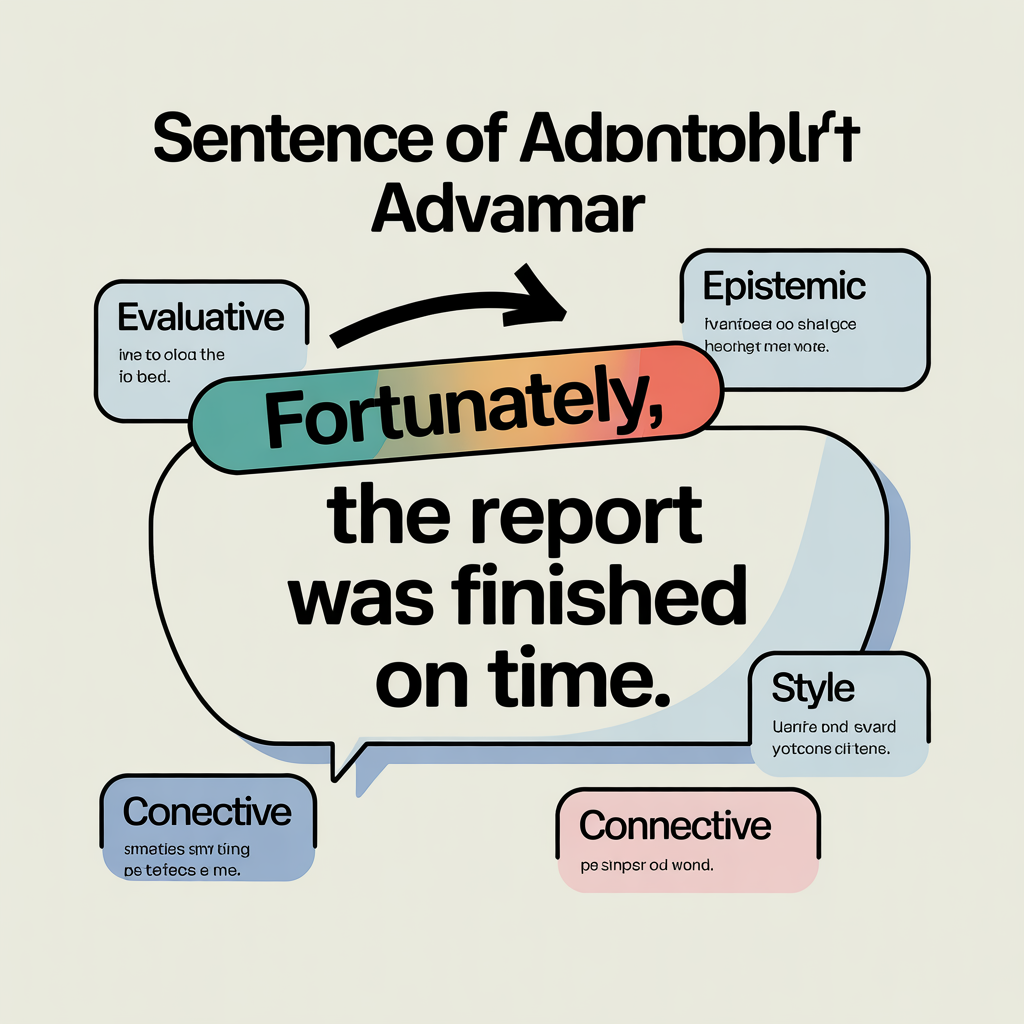
You’ve probably used them without even realizing it. Words like fortunately, honestly, clearly, and surprisingly — placed at the start of a sentence, set off by a comma — do something quite different from ordinary adverbs. They don’t describe how an action happens. Instead, they comment on the entire sentence. These are sentence adverbs, and once you understand them, you’ll notice them everywhere — in journalism, academic writing, everyday conversation, and persuasive essays.
This guide breaks down exactly what sentence adverbs are, how they work, how they differ from regular adverbs, and how to use them with confidence and precision.
What Is a Sentence Adverb?
A sentence adverb (also called a disjunct or sentential adverb) is an adverb that modifies an entire sentence or clause, rather than a single verb, adjective, or another adverb. It expresses the speaker’s or writer’s attitude, evaluation, or perspective on the statement being made.
In other words, a sentence adverb doesn’t answer the question “How was the action performed?” — it answers a broader question like “What do I think about this situation?” or “How does this statement relate to the overall context?”
Simple Examples
- Fortunately, no one was injured in the accident.
- Honestly, I have no idea what happened.
- Clearly, more research is needed on this topic.
- Surprisingly, the team won by a wide margin.
- Frankly, the results were disappointing.
In each case, the adverb doesn’t describe the verb or the action. It frames the entire statement from the speaker’s point of view — expressing surprise, sincerity, clarity, or relief.
Sentence Adverbs vs. Regular Adverbs: What’s the Difference?
This is where many learners — and even experienced writers — get confused. The same word can function as either a regular adverb or a sentence adverb, depending on its position and meaning. Understanding the distinction is crucial for using them correctly.
Regular Adverbs
A regular adverb modifies a specific verb, adjective, or another adverb within a sentence. It answers questions like how?, when?, where?, or to what extent?
Example: She spoke honestly during the interview.
Here, honestly modifies the verb spoke. It tells us how she spoke — in an honest manner.
Sentence Adverbs
A sentence adverb, by contrast, steps outside the action and comments on it from a higher level.
Example: Honestly, I don’t think she was telling the truth.
Here, honestly doesn’t describe how someone spoke. It signals the speaker’s sincerity — essentially saying, “To be honest with you, I don’t think she was telling the truth.”
A Side-by-Side Comparison
| Sentence | Function | What it modifies |
|---|---|---|
| He drove carefully. | Regular adverb | The verb “drove” |
| Carefully, he opened the envelope. | Could be either (context-dependent) | Could modify “opened” or the whole act |
| Fortunately, he arrived in time. | Sentence adverb | The entire proposition |
| She fortunately escaped unhurt. | Sentence adverb (embedded) | The entire clause |
The key test: Can the adverb be paraphrased as “It is [adjective] that…”? If fortunately can be rewritten as “It is fortunate that…”, it’s functioning as a sentence adverb.
How to Identify a Sentence Adverb
There are a few reliable methods to spot a sentence adverb in the wild.
1. The Paraphrase Test
Ask yourself whether the adverb can be expanded into a full phrase that expresses attitude or evaluation.
- Fortunately, the report was finished on time. → It is fortunate that the report was finished on time. ✅ Sentence adverb
- She finished the report quickly. → It is quick that she finished the report. ❌ Not a sentence adverb
2. Position in the Sentence
Sentence adverbs most commonly appear:
- At the beginning of a sentence, followed by a comma
- In the middle of a sentence, between commas
- At the end of a sentence, before a comma (less common)
Examples of all three positions:
- Surprisingly, the experiment yielded no results. (Beginning)
- The experiment, surprisingly, yielded no results. (Middle)
- The experiment yielded no results, surprisingly. (End)
3. Comma Usage
When a sentence adverb appears at the beginning of a sentence, it is almost always followed by a comma. This comma signals that the adverb is operating at the sentence level, not just modifying what immediately follows.
Types of Sentence Adverbs
Sentence adverbs can be grouped by the kind of meaning they add to a statement. Understanding these categories helps you choose the right word for the right purpose.
1. Evaluative Sentence Adverbs
These express the speaker’s judgment or emotional reaction to what is being said.
- Fortunately — expresses relief or positive outcome
- Unfortunately — expresses regret or a negative outcome
- Surprisingly — expresses unexpected information
- Remarkably — expresses admiration or notable quality
- Tragically — expresses sorrow
Example: Unfortunately, the deadline has already passed.
2. Stance Adverbs (Epistemic Adverbs)
These indicate how certain or confident the speaker is about the information.
- Certainly / definitely — high confidence
- Probably / presumably — moderate confidence
- Possibly / perhaps — low confidence or speculation
- Apparently — based on indirect evidence
- Evidently — based on what can be observed
Example: Apparently, the meeting has been rescheduled.
3. Style Adverbs (Manner of Speaking Adverbs)
These signal how the speaker is communicating, rather than evaluating the content itself.
- Frankly — “I am being frank with you”
- Honestly — “I am being honest with you”
- Bluntly — “I am saying this bluntly”
- Briefly — “I am summarizing briefly”
- Technically — “Strictly speaking, technically…”
Example: Frankly, I don’t think this plan will work.
4. Connective or Conjunctive Adverbs
These sentence adverbs link ideas between sentences or clauses, showing logical relationships like contrast, sequence, or cause and effect.
- However — contrast
- Therefore — result or conclusion
- Furthermore — addition
- Nevertheless — concession despite contrast
- Consequently — result
- Meanwhile — simultaneous time
Example: The budget was cut. Nevertheless, the project was completed successfully.
Note: Connective adverbs are sometimes classified as a separate subcategory, but they share the core feature of all sentence adverbs — they modify or comment on the whole statement, not a single word within it.
Common Sentence Adverbs in English
Here is a broader list of frequently used sentence adverbs organized by category, so you can recognize and use them confidently in your own writing.
Expressing Attitude or Evaluation
- Fortunately, unfortunately, luckily, unluckily
- Interestingly, surprisingly, remarkably, oddly
- Tragically, sadly, happily, disappointingly
- Conveniently, inconveniently, wisely, foolishly
Expressing Degree of Certainty
- Certainly, definitely, undoubtedly, clearly
- Probably, presumably, apparently, seemingly
- Possibly, perhaps, conceivably, supposedly
Expressing Manner of Speaking
- Frankly, honestly, bluntly, sincerely
- Technically, strictly speaking, broadly speaking
- Briefly, simply, generally, specifically
Connecting Ideas (Conjunctive Adverbs)
- However, nevertheless, nonetheless, yet
- Therefore, thus, consequently, hence
- Furthermore, moreover, additionally, besides
- Meanwhile, subsequently, afterward, finally
How to Use Sentence Adverbs Correctly
Sentence adverbs are incredibly useful tools, but they need to be used thoughtfully. Here are the key rules and best practices.
Rule 1: Always Use a Comma After a Sentence Adverb at the Beginning
When a sentence adverb opens a sentence, it must be followed by a comma. Without the comma, readers may misread the adverb as modifying the word that comes directly after it.
- ✅ Clearly, the data supports this conclusion.
- ❌ Clearly the data supports this conclusion. (ambiguous — is the data “clear”?)
Rule 2: Use Commas When the Adverb Is Embedded in the Sentence
If the sentence adverb appears in the middle of a sentence, it should be surrounded by commas to set it off from the rest of the clause.
Example: The results, surprisingly, contradicted all previous findings.
Rule 3: Don’t Overuse Them
It’s tempting to pepper your writing with words like basically, honestly, frankly, and clearly, but overuse weakens your writing. If every sentence is prefaced with an evaluative adverb, the emphasis disappears. Use them strategically to highlight genuinely important or unexpected information.
Rule 4: Watch Out for Ambiguity
Some words can function as either regular adverbs or sentence adverbs depending on placement. Always check whether your intended meaning is clear.
- Naturally, she responded well to the treatment. → The fact that she responded well is natural (sentence adverb).
- She naturally responded well to the treatment. → She responded in a natural way (could still be a sentence adverb — context matters).
Rule 5: Be Aware of Formal vs. Informal Registers
Some sentence adverbs suit formal academic or professional writing (consequently, nevertheless, furthermore), while others are more conversational (honestly, basically, frankly). Match your choice to the tone of your writing.
Sentence Adverbs in Academic and Formal Writing
In academic writing, sentence adverbs play a particularly important role. They help writers signal their stance, manage hedging (expressing uncertainty), and guide readers through complex arguments.
Hedging with Sentence Adverbs
Hedging means expressing uncertainty or caution — an essential skill in academic writing, where making overly strong claims without sufficient evidence is risky.
- Arguably, this approach represents the most efficient solution.
- Presumably, further testing will confirm these results.
- Apparently, the sample size was insufficient for reliable conclusions.
Signposting with Connective Adverbs
Connective sentence adverbs are the backbone of well-structured academic paragraphs. They act as signposts, helping the reader follow the logical flow of the argument.
- However, the findings must be interpreted with caution.
- Therefore, it can be concluded that the hypothesis was supported.
- Furthermore, the study identified several secondary effects.
Sentence Adverbs vs. Conjunctions: An Important Distinction
It’s easy to confuse sentence adverbs like however and therefore with coordinating conjunctions like but and so. The difference matters — especially in formal writing — because they follow different grammatical rules.
Conjunctions
Conjunctions directly join two clauses within a single sentence.
- I wanted to go, but I was too tired.
- She studied hard, so she passed the exam.
Connective Sentence Adverbs
Connective adverbs link two separate sentences (or two independent clauses separated by a semicolon). They cannot join clauses the way conjunctions can.
- ✅ I wanted to go. However, I was too tired.
- ✅ I wanted to go; however, I was too tired.
- ❌ I wanted to go, however I was too tired. (comma splice — a common grammar error)
This is one of the most common punctuation errors in English writing. Knowing that however is a sentence adverb — not a conjunction — helps you avoid the dreaded comma splice.
Real-World Examples of Sentence Adverbs in Use
Seeing sentence adverbs in authentic contexts helps solidify the concept. Below are examples drawn from different types of writing.
In News Writing
“Remarkably, the company reported record profits despite a global economic downturn.”
The adverb remarkably signals that the reporter finds this outcome notable or unexpected — it frames the whole statement.
In Academic Writing
“Consequently, the results suggest that early intervention may significantly improve long-term outcomes.”
Consequently links this sentence to previous evidence, showing that what follows is a logical result.
In Everyday Conversation
“Honestly, I wasn’t expecting the party to be so fun.”
Honestly signals the speaker’s sincerity and genuine surprise — it doesn’t describe any specific action.
In Persuasive Writing
“Clearly, more investment in public transportation is needed to reduce urban congestion.”
Clearly signals that the writer believes this conclusion is obvious and well-supported.
Why Sentence Adverbs Matter for Writers
Sentence adverbs are not just grammatical curiosities — they are powerful rhetorical tools. Here’s why they matter:
- They show your perspective. A sentence adverb communicates not just facts but your attitude toward those facts. This adds a human voice to your writing.
- They guide the reader’s interpretation. Words like surprisingly or unfortunately prime the reader to interpret what follows in a specific emotional frame.
- They improve text cohesion. Connective sentence adverbs (like however, therefore, furthermore) hold paragraphs and arguments together, making your writing flow logically.
- They signal precision and nuance. Epistemic adverbs like apparently or presumably show intellectual honesty — you’re acknowledging what you know, what you infer, and what remains uncertain.
Conclusion
Sentence adverbs are one of the most expressive tools in the English language. Unlike regular adverbs that describe individual actions, sentence adverbs step back and comment on the whole statement — expressing attitude, certainty, surprise, or logical connection. From fortunately and unfortunately to however and consequently, these words shape the tone, credibility, and coherence of your writing in subtle but powerful ways.
The key takeaways are simple:
- Sentence adverbs modify the entire sentence, not just a single word.
- They’re always set off by a comma when they appear at the start or middle of a sentence.
- They are not conjunctions — you can’t use however like you’d use but.
- Used well, they add voice, clarity, and logical flow to your writing.
Now that you know what sentence adverbs are, you’ll start spotting them — and using them — with a whole new level of intentionality. Undoubtedly, that’s a worthwhile skill to develop.
Frequently Asked Questions (FAQs)
Are sentence adverbs grammatically correct?
Yes, sentence adverbs are a well-established grammatical category in English. However, some sentence adverbs — particularly words like hopefully used to mean “it is hoped that” — were historically criticized by prescriptive grammarians. Modern linguists and most style guides today widely accept all sentence adverbs as correct and useful.
What is the difference between a sentence adverb and a conjunctive adverb?
A conjunctive adverb is a subtype of sentence adverb that connects two independent clauses or sentences and shows a logical relationship (contrast, result, addition, etc.). Examples include however, therefore, furthermore. All conjunctive adverbs are sentence adverbs, but not all sentence adverbs are conjunctive adverbs.
Can a sentence adverb appear at the end of a sentence?
Yes. While sentence adverbs most commonly appear at the beginning of a sentence, they can also appear in the middle or at the end. When placed at the end, they typically precede a comma. Example: The test went well, fortunately.
Is “however” a sentence adverb?
Yes. However is one of the most commonly used sentence adverbs. It functions as a connective (or conjunctive) adverb, signaling contrast between two statements. Because it is a sentence adverb and not a conjunction, it should not be used with only a comma to join two independent clauses — doing so creates a comma splice.
What is another name for a sentence adverb?
Sentence adverbs are also called disjuncts, sentential adverbs, or comment adverbs. In specific subgroups, they may also be called stance adverbs, epistemic adverbs (related to certainty), or conjunctive adverbs (when connecting ideas).
How do I know if “clearly” is a sentence adverb or a regular adverb?
Apply the paraphrase test. “Clearly, he made a mistake” can be rephrased as “It is clear that he made a mistake” — so clearly is a sentence adverb here. But in “She spoke clearly”, you cannot say “It is clear that she spoke” meaningfully in the same way — here clearly describes how she spoke, making it a regular adverb.