
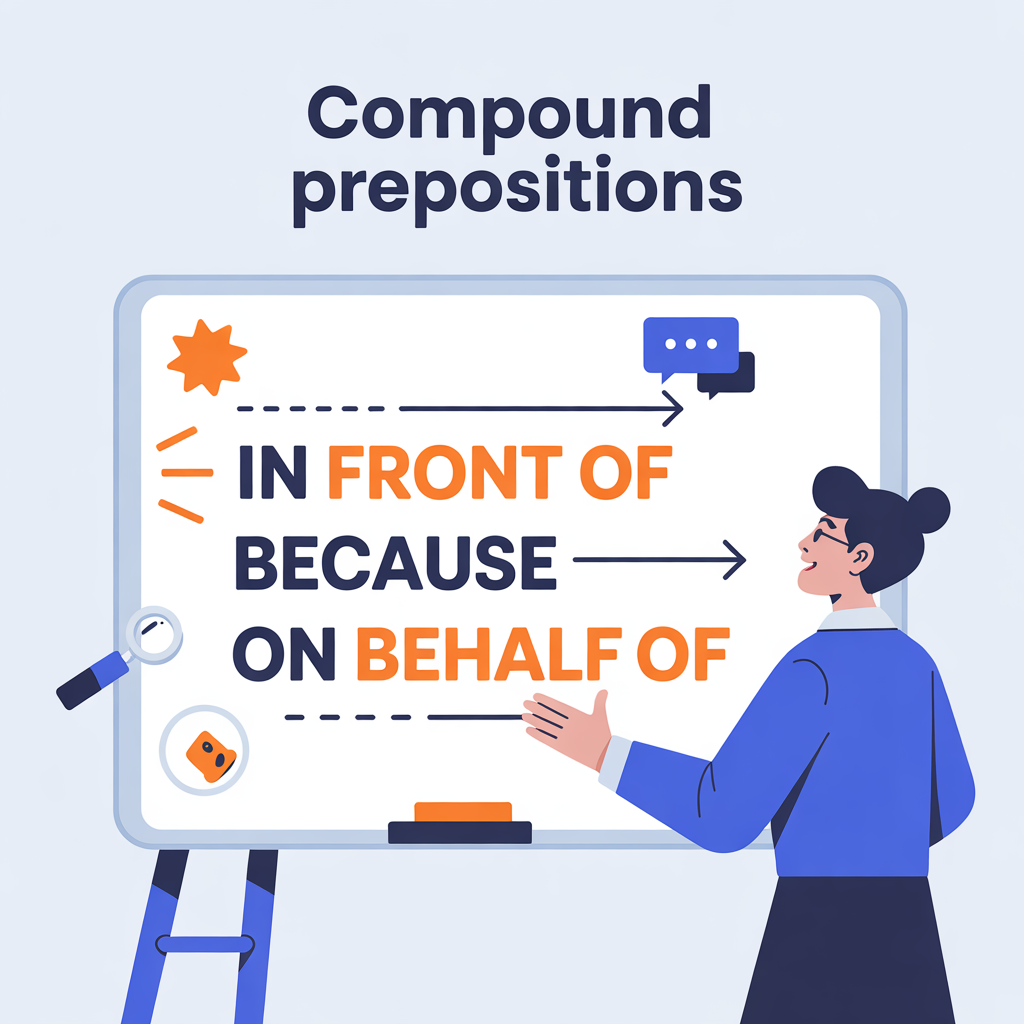
If you’ve ever written phrases like “in front of the building” or “on behalf of the team,” you’ve already used a compound preposition — you just may not have known it had a name. Compound prepositions are one of those grammar concepts that most people use naturally but rarely stop to examine. Understanding them can sharpen your writing, improve your grammar accuracy, and help you communicate more precisely in both formal and informal English.
What Is a Compound Preposition?
A compound preposition is a preposition that is made up of more than one word but functions as a single unit to show a relationship between a noun (or pronoun) and another part of the sentence. Unlike a simple preposition — such as on, in, at, or by — a compound preposition combines two or more words to express a more nuanced or specific relationship of place, time, direction, cause, or manner.
In essence, the multiple words work together as one grammatical unit. You cannot remove or rearrange the words without breaking the meaning entirely.
Simple preposition: She stood near the door.
Compound preposition: She stood in front of the door.
Both sentences describe a spatial relationship, but the compound version offers a much clearer picture of exactly where she was standing.
The Structure of Compound Prepositions
Compound prepositions are typically formed in one of three structural patterns:
1. Preposition + Noun + Preposition
This is the most common pattern. It combines two prepositions with a noun sandwiched between them:
- In front of — standing in front of the crowd
- In spite of — she succeeded in spite of the challenges
- On top of — a cherry on top of the cake
- By means of — transported by means of a conveyor belt
- In place of — use olive oil in place of butter
2. Preposition + Adjective + Preposition
A smaller group of compound prepositions uses an adjective as the middle element:
- Prior to — complete this prior to the meeting
- Due to — the delay was due to bad weather
- Near to — the hotel is near to the station
- Close to — we are close to finding a solution
3. Preposition + Determiner/Adverb + Preposition
Some compound prepositions are formed with an adverb or other function word at the center:
- As far as — walk as far as the river
- As well as — she is talented, as well as hardworking
- Up to — it is up to you to decide
- Out of — the car ran out of fuel
Why Are Compound Prepositions Important?
Compound prepositions do much more than add extra words to a sentence. Here is why they matter:
- Precision: Simple prepositions are broad. “Near the door” is vague compared to “in front of the door” or “just outside of the door.” Compound prepositions give you precision.
- Formality: Many compound prepositions elevate the register of writing. Phrases like “with regard to” or “on behalf of” are staples of formal and professional communication.
- Logical connection: Compound prepositions like “owing to,” “in spite of,” and “because of” express logical relationships — cause, concession, or condition — that simple prepositions cannot convey.
- Fluency: Mastering compound prepositions makes your English sound more natural and sophisticated, both in speech and in writing.
Common Compound Prepositions With Examples
Below is a comprehensive reference list of the most frequently used compound prepositions in English, grouped by the type of relationship they express.
Expressing Location or Position
| Compound Preposition | Example Sentence |
|---|---|
| In front of | The children played in front of the school. |
| In the middle of | There was a fountain in the middle of the square. |
| At the back of | The storage room is at the back of the building. |
| On top of | The files are on top of the cabinet. |
| At the side of | A small café sits at the side of the road. |
| Next to | She sat next to her best friend. |
| In between | He stood in between the two groups. |
Expressing Time
| Compound Preposition | Example Sentence |
|---|---|
| Prior to | Please submit your report prior to Friday. |
| In advance of | The team met in advance of the presentation. |
| At the time of | She was a student at the time of the discovery. |
| Up until | He worked there up until last year. |
| As of | As of January, new rules will apply. |
Expressing Cause or Reason
| Compound Preposition | Example Sentence |
|---|---|
| Because of | The game was cancelled because of rain. |
| Owing to | The delay was owing to a technical fault. |
| Due to | The flight was grounded due to fog. |
| On account of | She stayed home on account of illness. |
Expressing Contrast or Concession
| Compound Preposition | Example Sentence |
|---|---|
| In spite of | She finished the race in spite of her injury. |
| Despite of | Note: “Despite” is used alone — “despite of” is incorrect. Use “in spite of” or just “despite.” |
| Regardless of | Everyone is welcome, regardless of background. |
Expressing Purpose, Manner, or Reference
| Compound Preposition | Example Sentence |
|---|---|
| On behalf of | I am writing on behalf of the committee. |
| In accordance with | The decision was made in accordance with company policy. |
| With regard to | With regard to your application, we have an update. |
| By means of | The message was sent by means of a carrier pigeon. |
| For the sake of | He kept quiet for the sake of peace. |
| In favour of | The vote was in favour of the new proposal. |
| In addition to | In addition to his salary, he receives bonuses. |
| Instead of | Use a dictionary instead of guessing the meaning. |
Compound Prepositions vs. Simple Prepositions
To fully appreciate compound prepositions, it helps to compare them directly with their simpler counterparts.
- Simple prepositions are single words: at, in, on, by, for, with, from, to, of, through, over, under, about, against.
- Compound prepositions are multi-word units that act as a single preposition: in front of, on top of, because of, in addition to.
The key difference isn’t just in the number of words — it’s in the degree of specificity. Compare these pairs:
- He hid behind the wall. vs. He hid at the back of the wall.
- She stayed home for sickness. vs. She stayed home on account of sickness. (Note: the compound version sounds more natural here.)
- We did it for peace. vs. We did it for the sake of peace.
In each case, the compound preposition adds nuance, formality, or natural fluency that the simple preposition alone cannot achieve.
Compound Prepositions vs. Prepositional Phrases
This is a distinction that even many grammar enthusiasts get confused about, so let’s clarify it.
A prepositional phrase is the full unit that includes the preposition plus its object (a noun, pronoun, or noun phrase). For example:
- “On the table” is a prepositional phrase — “on” is the preposition, and “the table” is its object.
- “In front of the table” is also a prepositional phrase — but here, “in front of” is the compound preposition, and “the table” is the object.
So a compound preposition is the multi-word preposition itself, while a prepositional phrase is the compound preposition plus the noun or noun phrase it governs. The compound preposition is a component within a prepositional phrase.
Common Mistakes With Compound Prepositions
Even fluent English speakers make errors with compound prepositions. Here are the most frequent ones to watch out for:
1. Adding unnecessary words
Some people say “in spite of the fact that” when they mean “although” or “even though.” While grammatically valid, it can make writing unnecessarily wordy. Aim for the most concise option unless you need the formality.
2. Confusing “due to” and “because of”
Traditionally, “due to” modifies a noun (it is an adjectival phrase): “The delay, due to weather, was frustrating.” Meanwhile, “because of” modifies a verb (adverbial): “The match was cancelled because of rain.” In modern usage, these lines are often blurred, but being aware of the distinction strengthens formal writing.
3. Using “despite of” instead of “despite” or “in spite of”
“Despite of” is a common non-native English error. The correct forms are either “despite” (a single preposition) or “in spite of” (a compound preposition). Never use “despite of.”
- ✅ She passed despite her nerves.
- ✅ She passed in spite of her nerves.
- ❌ She passed despite of her nerves.
4. Omitting words from the compound
Compound prepositions only work as a unit. Dropping part of them creates confusion:
- ❌ She sat front of the stage. (Missing “in”)
- ✅ She sat in front of the stage.
5. Overusing them in informal writing
Phrases like “with reference to,” “in connection with,” and “with respect to” are perfectly appropriate in formal letters or reports, but using them excessively in casual writing can sound stiff and unnatural.
Compound Prepositions in Formal and Professional English
Compound prepositions are especially important in formal, academic, and business writing. They are the backbone of professional correspondence and legal documents. Here are some of the most important ones to recognize and use in professional contexts:
- With reference to: With reference to your letter dated 15 May…
- In connection with: I am writing in connection with the recent audit.
- On behalf of: On behalf of the board, I extend our sincere thanks.
- In accordance with: In accordance with your request, please find the attached document.
- As a result of: As a result of the investigation, three employees were suspended.
- In the event of: In the event of an emergency, please follow the evacuation procedure.
- With respect to: With respect to the proposed changes, we have several concerns.
Mastering these forms will significantly improve your ability to communicate confidently in any professional environment.
How to Identify a Compound Preposition in a Sentence
When you’re reading or editing text and want to identify a compound preposition, follow this simple test:
- Look for a multi-word phrase that connects a noun or pronoun to another element of the sentence.
- Check if it can be replaced by a single simple preposition — even if the meaning changes slightly. If yes, it’s likely functioning as a compound preposition.
- Try removing one of the words. If the meaning collapses or sounds grammatically wrong, the words are operating together as a single unit.
Example: “She acted on behalf of the entire class.”
- Can you replace it with a simple preposition? Partially — “for” works, though it loses formality.
- Can you remove one word? “She acted on of the class” or “She acted behalf of the class” — both fail. ✅ It’s a compound preposition.
Quick Reference: 40+ Compound Prepositions at a Glance
Here is a handy summary list of commonly used compound prepositions in English:
- According to
- Ahead of
- Along with
- Apart from
- As a result of
- As far as
- As for
- As of
- As per
- As well as
- At the back of
- At the side of
- At the time of
- Because of
- By means of
- By virtue of
- Close to
- Due to
- For the sake of
- In accordance with
- In addition to
- In advance of
- In between
- In connection with
- In favour of
- In front of
- In lieu of
- In place of
- In spite of
- In the event of
- In the middle of
- Instead of
- Near to
- Next to
- On account of
- On behalf of
- On top of
- Out of
- Owing to
- Prior to
- Regardless of
- Up to
- With reference to
- With regard to
- With respect to
Conclusion
A compound preposition is a multi-word unit — typically formed by combining prepositions, nouns, adjectives, or adverbs — that functions as a single preposition in a sentence. From everyday phrases like “instead of” and “out of” to formal expressions like “in accordance with” and “on behalf of,” compound prepositions are woven into the fabric of English at every level.
Understanding them doesn’t just help you label grammar correctly — it helps you write more precisely, communicate more professionally, and express meaning with greater clarity. Whether you’re drafting a business email, writing an academic essay, or simply polishing your everyday English, knowing your compound prepositions gives you a genuine edge.
The next time you write “due to the circumstances” or “in addition to everything else,” you’ll know exactly what grammatical tool you’re using — and why it works so well.
FAQs About Compound Prepositions
What is the difference between a compound preposition and a simple preposition?
A simple preposition is a single word (e.g., in, on, at, by), while a compound preposition is made up of two or more words that work together as one unit (e.g., in front of, because of, on behalf of). Compound prepositions typically express more specific or nuanced relationships than simple prepositions can.
Is “because of” a compound preposition?
Yes. “Because of” is a compound preposition made up of two words that together express a causal relationship. Example: “The match was postponed because of rain.”
Is “in spite of” one word or three?
“In spite of” is written as three separate words, but it functions as a single compound preposition expressing concession or contrast. It should never be written as one word or hyphenated.
Can compound prepositions start a sentence?
Yes, compound prepositions can and often do begin sentences, especially in formal writing. Example: “In addition to the financial report, the board also reviewed the audit.” This is a perfectly correct and common structure.
How many compound prepositions are there in English?
There is no single official count, as English is an evolving language. However, most grammar references identify between 40 and 80 commonly used compound prepositions. The list grows further when you include regional, archaic, and specialised formal variants.
Is “next to” a compound preposition?
Yes. “Next to” is a widely used compound preposition that expresses proximity or position. Example: “She sat next to the window.” It consists of the adjective “next” and the preposition “to” working together as a single prepositional unit.