
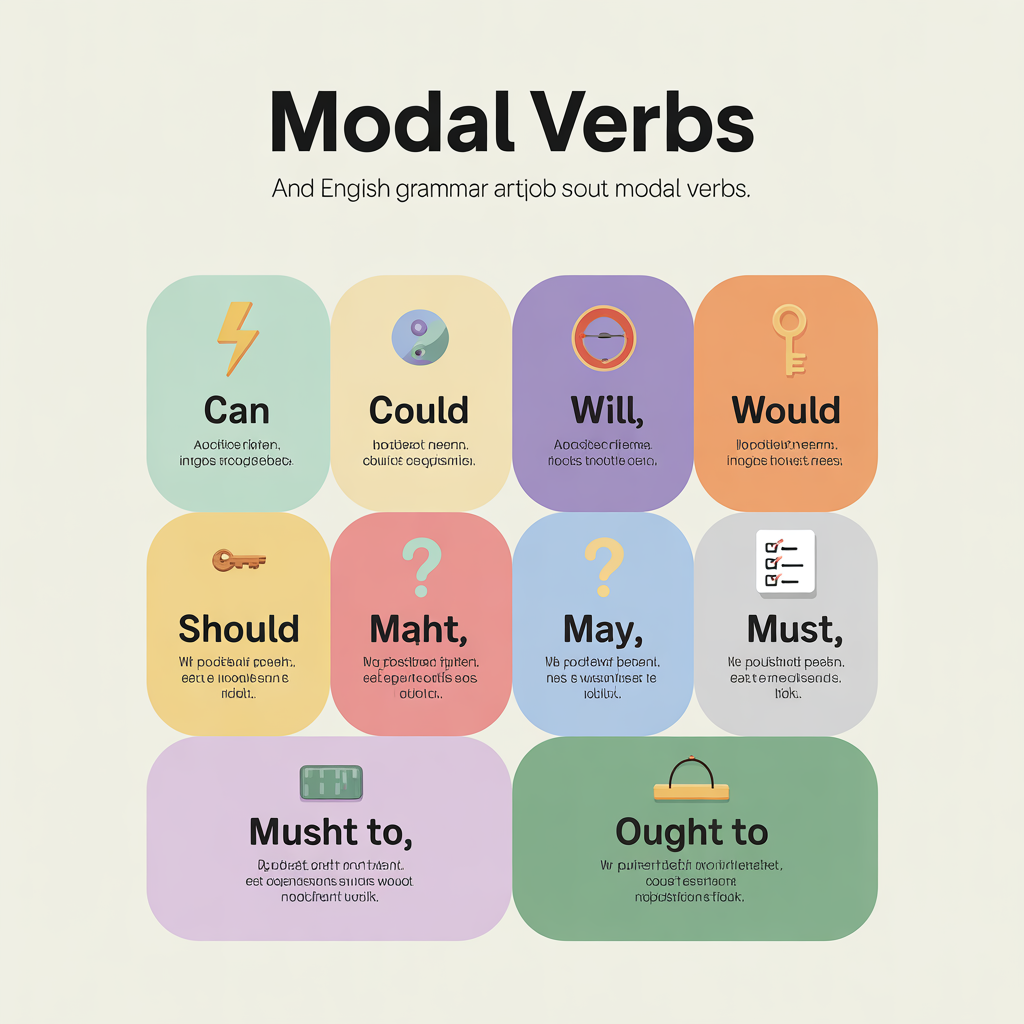
If you’ve ever said “You should try this” or “I can help you,” you’ve already used a modal verb — probably without even thinking about it. Modal verbs are some of the most frequently used words in the English language, yet many learners struggle to fully understand how they work and why they matter. This guide breaks down everything you need to know about modal verbs: what they are, how they function, when to use them, and the mistakes most people make along the way.
What Is a Modal Verb?
A modal verb is a type of auxiliary (helping) verb that expresses necessity, possibility, permission, ability, or intention. Unlike regular verbs, modal verbs don’t describe a specific action on their own. Instead, they work alongside a main verb to add a layer of meaning — telling us how likely something is, whether it’s allowed, or whether someone is capable of doing it.
Think of modal verbs as “attitude words.” They reveal the speaker’s perspective on the action being described.
- “She can speak three languages.” → Ability
- “You must wear a seatbelt.” → Obligation
- “It might rain later.” → Possibility
- “May I come in?” → Permission
Each sentence uses a modal verb paired with a base form verb (speak, wear, rain, come) to communicate something specific about the action.
The 10 Core Modal Verbs in English
English has a well-defined set of 10 primary modal verbs. These are sometimes called “pure modals” or “central modals.” You’ll want to memorize all of them:
- Can
- Could
- Will
- Would
- Shall
- Should
- May
- Might
- Must
- Ought to
Some grammar sources also include semi-modal verbs (also called “marginal modals”), which behave similarly but have slightly different grammatical rules. These include: need to, have to, used to, dare, had better, and be able to.
Key Characteristics of Modal Verbs
What makes modal verbs stand out from other verbs? They follow a unique set of grammatical rules that set them apart from regular verbs entirely.
1. They Are Always Followed by a Base Verb
Modal verbs never stand alone as the main verb. They must be paired with the base form (infinitive without “to”) of another verb.
- ✅ “He can swim.”
- ❌ “He can swimming.”
- ❌ “He can to swim.”
The only exception is ought to, which does take “to” before the base verb: “You ought to apologize.”
2. They Do Not Change for Subject Agreement
Regular verbs in English change their endings based on the subject (he runs, she talks, it works). Modal verbs do not follow this rule. The form stays the same for all persons.
- “I can help.”
- “He can help.” (NOT “he cans help”)
- “They can help.”
3. They Form Questions and Negatives Without “Do”
When forming questions or negatives with regular verbs, you typically need the auxiliary “do/does/did.” Modal verbs skip this step entirely.
- Question: “Can you help me?” (NOT “Do you can help me?”)
- Negative: “You shouldn’t do that.” (NOT “You don’t should do that.”)
4. They Have No Infinitive, Gerund, or Participle Forms
You cannot say “to can,” “musting,” or “willd.” Modal verbs are defective verbs — they lack the full range of forms that other verbs have. To express these meanings in different tenses or structures, English uses alternative constructions like be able to (for can) or have to (for must).
What Do Modal Verbs Express? (The 5 Core Functions)
Understanding the meaning behind modal verbs is where things get truly interesting — and where many learners find themselves confused. Each modal verb can carry multiple meanings depending on context. Here are the five main categories:
1. Ability
Modal verbs used: can, could, be able to
These express what someone is capable of doing.
- “She can play the piano beautifully.” (present ability)
- “He could run a mile in under five minutes when he was younger.” (past ability)
2. Permission
Modal verbs used: can, could, may, might
These are used to ask for or grant permission.
- “Can I use your charger?” (informal request)
- “May I be excused?” (formal request)
- “You may leave when you’re done.” (granting permission)
3. Possibility and Probability
Modal verbs used: may, might, could, should, must, will, would
These express how likely something is to happen or be true.
- “It might snow tonight.” (weak possibility — ~30–40%)
- “It may snow tonight.” (moderate possibility — ~50%)
- “It should be fine.” (reasonable expectation — ~70–80%)
- “It must be cold outside — everyone’s wearing a coat.” (logical deduction — ~90%+)
4. Obligation, Necessity, and Advice
Modal verbs used: must, have to, should, ought to, shall, need to
These communicate duties, requirements, and recommendations.
- “You must submit your application by Friday.” (strong obligation — external or internal requirement)
- “You should drink more water.” (advice or recommendation)
- “You ought to call your parents more often.” (moral obligation)
5. Willingness, Offers, and Requests
Modal verbs used: will, would, shall, can, could
These are used to make offers, requests, or express willingness.
- “I will carry that for you.” (willingness/offer)
- “Would you like some coffee?” (polite offer)
- “Could you pass the salt, please?” (polite request)
- “Shall I open the window?” (offer — more formal/British English)
Modal Verbs in the Past Tense
One of the trickier aspects of modal verbs is expressing past meaning. Since most modals don’t have a simple past form, English uses the structure:
modal verb + have + past participle
This structure is known as a perfect modal or modal perfect.
- “She must have forgotten about the meeting.” (logical deduction about the past)
- “He could have warned us.” (past possibility that didn’t happen)
- “You should have called before coming.” (past advice/regret)
- “They might have left already.” (uncertain past possibility)
These constructions add significant expressive power to the language, allowing speakers to reflect on past events with different levels of certainty or judgment.
Modal Verbs and Politeness: A Cultural Dimension
In English, choosing the right modal verb is not just a grammar exercise — it’s a matter of social tone and politeness. Generally speaking:
- More formal/polite: could, would, may, might, ought to
- Less formal/direct: can, will, must, should
Compare these requests:
- “Give me the report.” (direct, possibly rude)
- “Can you give me the report?” (casual, acceptable)
- “Could you give me the report?” (polite)
- “Would you mind giving me the report?” (very polite, formal)
Understanding this spectrum is crucial, especially in professional or cross-cultural communication settings.
Semi-Modal Verbs: What Are They?
Alongside the 10 core modals, English also uses a group of semi-modal (or quasi-modal) verbs that function similarly but behave differently in terms of grammar. The most common ones include:
- Have to — necessity/obligation (“I have to finish this tonight.”)
- Need to — necessity (“You need to rest.”)
- Be able to — ability (“She is able to lift 100kg.”)
- Used to — past habit (“He used to smoke, but quit years ago.”)
- Had better — strong advice/warning (“You had better apologize.”)
- Dare — courage/challenge (“How dare you say that?”)
Semi-modals do require “to” before the base verb and sometimes conjugate for tense or subject, unlike true modals.
Common Mistakes with Modal Verbs
Even advanced English learners make recurring errors with modal verbs. Here are the most common ones — and how to fix them:
Mistake 1: Adding “to” after the modal
- ❌ “You must to go now.”
- ✅ “You must go now.”
(Exception: ought to, have to, need to, be able to)
Mistake 2: Using the wrong verb form after a modal
- ❌ “She can sings well.”
- ✅ “She can sing well.”
Mistake 3: Stacking two modal verbs
- ❌ “He might could help.” (dialectal English — avoid in standard writing)
- ✅ “He might be able to help.”
Mistake 4: Confusing “must” and “have to” in negatives
- “You mustn’t do that.” → Prohibition (it is forbidden)
- “You don’t have to do that.” → No obligation (but you can if you want)
These two negatives have completely different meanings — a common source of misunderstanding.
Mistake 5: Overusing “will” for all future meanings
- ❌ “It will perhaps rain.” (awkward)
- ✅ “It might rain.” or “It could rain.”
Quick Reference: Modal Verbs at a Glance
| Modal Verb | Primary Uses | Example |
|---|---|---|
| Can | Ability, permission (informal) | “I can drive.” / “Can I go?” |
| Could | Past ability, polite request, possibility | “Could you help me?” |
| Will | Future, willingness, prediction | “I will call you.” |
| Would | Polite request, conditional, past habit | “Would you like tea?” |
| Shall | Offers, formal future (British English) | “Shall we dance?” |
| Should | Advice, expectation, obligation | “You should sleep more.” |
| May | Formal permission, possibility | “May I ask a question?” |
| Might | Weak possibility, past possibility | “It might work.” |
| Must | Strong obligation, logical deduction | “You must wear a helmet.” |
| Ought to | Moral duty, expectation | “You ought to apologize.” |
Why Are Modal Verbs So Important?
Modal verbs are not just a grammar topic to tick off a list. They are fundamental to natural, nuanced communication in English. Here’s why they matter so much:
- They express what we really mean. Without modals, we lose the ability to express degrees of certainty, politeness, or obligation. Every conversation would sound blunt and unnatural.
- They are everywhere. Modal verbs appear constantly in everyday speech, workplace emails, academic writing, legal texts, and literature.
- They prevent misunderstandings. Knowing the difference between “you must leave” (you are required to) and “you might want to leave” (a gentle suggestion) can prevent real-world miscommunication.
- They reflect cultural norms. Choosing the appropriate modal signals your social awareness, formality level, and respect for others — especially important in professional and multicultural settings.
How to Practice Modal Verbs Effectively
Knowing the rules is one thing. Using modals naturally in speech and writing takes consistent practice. Here are some strategies that work:
- Keep a modal verb journal. Each day, write 2–3 sentences using different modal verbs in different contexts.
- Listen actively. Watch English-language films, podcasts, or news, and pay attention to how native speakers use modals in conversation.
- Rewrite sentences. Take a direct sentence and practice making it more polite or expressing different degrees of certainty using different modals.
- Focus on pairs. Study modals that are commonly confused together, such as can/could, may/might, and must/have to.
- Use them in real communication. Don’t wait until you feel “ready.” Start using modals in your daily English conversations and emails immediately.
Conclusion
Modal verbs are small words with enormous expressive power. Whether you’re asking for a favor, giving advice, making a prediction, or expressing certainty, modal verbs are the tools that let you communicate meaning with precision and social grace.
The 10 core modal verbs — can, could, will, would, shall, should, may, might, must, and ought to — each carry specific functions and nuances. Mastering them is not about memorizing rules in isolation, but about understanding the attitudes and relationships between people that these words reflect.
Start paying attention to modal verbs in everything you read and hear. You’ll quickly find that they are not just grammar concepts — they are the quiet backbone of everyday English expression.
Frequently Asked Questions (FAQs)
What is the easiest way to identify a modal verb?
Look for words that come directly before a base verb and add meaning such as possibility, ability, or obligation — without changing form based on the subject. If the verb stays the same whether the subject is “I,” “he,” or “they,” and it doesn’t add an “-s” or “-ed,” it’s likely a modal verb.
Are modal verbs the same as auxiliary verbs?
Modal verbs are a subset of auxiliary verbs. All modal verbs are auxiliaries, but not all auxiliary verbs are modals. The primary auxiliaries in English are “be,” “have,” and “do,” which serve grammatical functions (forming tenses, questions, passives). Modal auxiliaries, on the other hand, add meaning about possibility, obligation, ability, and so on.
Can a single modal verb have more than one meaning?
Yes — and this is one of the most important things to understand about modal verbs. For example, “can” can express ability (“I can swim”), permission (“Can I leave?”), and possibility (“That can’t be right”). Context is everything when interpreting which meaning is intended.
What is the difference between “must” and “have to”?
Both express obligation, but there’s a subtle distinction. Must often implies an internal obligation — a rule the speaker imposes on themselves or others. Have to often implies an external obligation — a rule from outside. In the negative, they mean entirely different things: “mustn’t” means something is forbidden, while “don’t have to” means something is not required.
Do modal verbs work in all tenses?
Modal verbs themselves don’t conjugate for tense in the traditional sense. However, you can express past meaning using the modal + have + past participle structure (e.g., “she could have called”). For future and other tense expressions, English uses alternative constructions like be able to or be going to.
Is “ought to” a modal verb?
Yes, ought to is classified as one of the 10 core modal verbs in English. It expresses moral duty or expectation. Unlike other modals, it does retain “to” before the base verb: “You ought to be more careful.”