
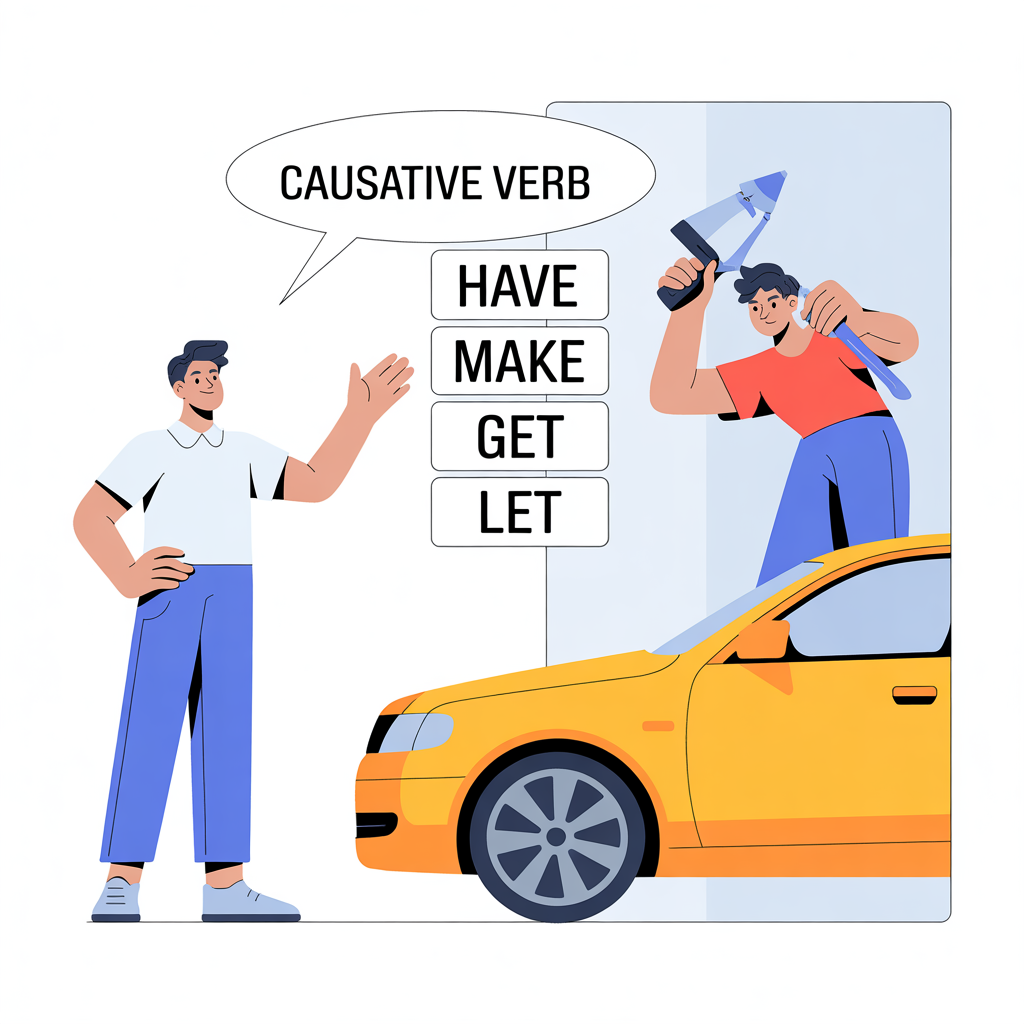
What Is a Causative Verb?
Have you ever told someone to do something for you — and then needed to explain that situation in English? That’s exactly where causative verbs come in. A causative verb is a special type of verb that shows one person or thing causing another person or thing to do or experience something. Instead of doing the action yourself, you arrange, request, or force someone else to carry it out. Understanding causative verbs is one of those game-changing moments in English grammar — once you grasp the concept, you’ll start noticing them everywhere.
The Core Definition of a Causative Verb
At its simplest, a causative verb expresses the idea of causing an action to happen rather than directly performing it. The subject of the sentence doesn’t do the action themselves — they make, have, get, help, or let someone else do it.
Consider the difference between these two sentences:
- “I cut my hair.” — You did it yourself.
- “I had my hair cut.” — Someone else did it for you (a hairdresser, presumably).
The verb had in the second sentence is the causative verb. It signals that the subject (I) caused the action (cutting) to happen, but did not perform it directly.
Causative verbs are part of a broader grammatical category called catenative verbs — verbs that link to other verbs to form longer chains of meaning. But causatives are unique because they specifically encode the relationship between an agent (the causer) and a doer (the one who performs the action).
Why Causative Verbs Matter in English
Causative verbs are not a niche topic tucked away in advanced grammar books. They appear constantly in everyday speech, business communication, academic writing, and professional contexts. Knowing how to use them correctly allows you to:
- Accurately describe arrangements and delegations
- Explain services you receive from others
- Express authority, permission, or obligation
- Sound more natural and fluent in English
Misusing causative structures is a common mistake among English learners — and it can sometimes change your meaning entirely. Mastering them is a significant step toward near-native fluency.
The Main Causative Verbs in English
English has several key causative verbs, each with its own nuance, grammatical structure, and level of formality. The four most important ones are:
1. MAKE
Make is one of the strongest causative verbs. It implies force, compulsion, or a strong influence. The subject causes something to happen, sometimes without the other person’s willing agreement.
Structure: make + object + base verb (infinitive without "to")
Examples:
- The teacher made the students rewrite their essays.
- The sad movie made her cry.
- His boss made him work overtime every weekend.
Notice that “make” carries a sense of obligation or emotional compulsion. You’re not asking — you’re causing it to happen, sometimes regardless of the other person’s preference.
In passive constructions, “make” is followed by the full infinitive (with “to”):
- The students were made to rewrite their essays.
2. HAVE
Have is perhaps the most widely used causative verb. It suggests arranging for someone to do something — often in a professional or service context. There is usually an implied agreement; you’re commissioning the action rather than forcing it.
Structure (active): have + object (person) + base verb
Structure (passive — thing receives the action): have + object (thing) + past participle
Examples:
- I had my mechanic check the brakes. (Person does the action)
- I had my brakes checked. (Thing is the object; past participle used)
- She had the report translated into French.
- They had their house painted last summer.
The “have + thing + past participle” pattern is especially important. It communicates that a service was performed on something you own or are responsible for.
3. GET
Get is more informal than “have” and often implies persuasion, effort, or overcoming some resistance to make something happen. In casual speech, it’s extremely common.
Structure (active): get + object (person) + to + base verb
Structure (passive): get + object (thing) + past participle
Examples:
- She finally got her brother to help with the move.
- I can’t get this printer to work.
- He got his passport renewed just in time.
- We need to get the roof fixed before winter.
The key difference from “have”: “get” uses “to + infinitive” when the object is a person, while “have” uses the bare infinitive. This is a common point of confusion for learners.
4. LET
Let expresses permission. The subject allows or permits the other person to do something. Unlike “make,” there is no compulsion — the subject is simply not preventing the action.
Structure: let + object + base verb (infinitive without "to")
Examples:
- Her parents let her stay out until midnight.
- The manager let the team leave early on Friday.
- Don’t let the children run near the pool.
“Let” does not have a standard passive form. Instead, we use “allow” or “permit” in passive constructions:
- She was allowed to stay out until midnight.
5. HELP
Although sometimes debated in its classification, help is widely regarded as a semi-causative verb. It means assisting someone in completing an action. It has a flexible structure, accepting either the bare infinitive or the full infinitive.
Structure: help + object + (to) + base verb
Examples:
- Can you help me carry these boxes?
- She helped him to prepare for the interview.
- The tutorial helped students understand the concept.
Both forms are grammatically acceptable, though the bare infinitive tends to sound more natural in American English, while British English speakers may prefer the “to” form.
Summary Table: Causative Verb Structures at a Glance
| Causative Verb | Structure with Person | Structure with Thing | Nuance |
|---|---|---|---|
| Make | make + person + base verb | — | Force / compulsion |
| Have | have + person + base verb | have + thing + past participle | Arrangement / service |
| Get | get + person + to + base verb | get + thing + past participle | Persuasion / effort |
| Let | let + person + base verb | — | Permission |
| Help | help + person + (to) + base verb | — | Assistance |
Causative Verbs vs. Passive Voice: What’s the Difference?
One of the most common points of confusion is distinguishing causative structures from the passive voice. They can look similar, especially with “have” and “get.”
Compare:
- Passive: “My car was repaired.” — Focus is on the event; who did it is unclear or unimportant.
- Causative: “I had my car repaired.” — The subject (I) arranged for the repair to happen. There is a clear agent behind the action.
The causative structure always implies that the subject is responsible for initiating or arranging the action — even if they didn’t physically do it. The passive voice simply describes what happened to the subject or object, often without implying the subject had any role in making it happen.
Negative Causatives and Questions
Forming negatives and questions with causative verbs follows standard English auxiliary patterns.
Negative forms:
- She didn’t let him leave early.
- I couldn’t get the technician to respond.
- They didn’t have the contract reviewed in time.
Question forms:
- Did you have your eyes tested recently?
- Can you get someone to fix this?
- Why did the teacher make the class redo the assignment?
The causative verb itself doesn’t change its core structure in negative or interrogative forms — only the auxiliary verbs shift.
Common Mistakes to Avoid
Even advanced learners trip over causative verbs. Here are the most frequent errors to watch out for:
Mistake 1: Using “to” after “make” or “let”
- ❌ She made him to clean the room.
- ✅ She made him clean the room.
Mistake 2: Forgetting “to” after “get” (when the object is a person)
- ❌ I got the plumber fix the pipe.
- ✅ I got the plumber to fix the pipe.
Mistake 3: Using base verb instead of past participle with things
- ❌ I had my laptop repair.
- ✅ I had my laptop repaired.
Mistake 4: Confusing “make” (force) with “let” (permit)
- ❌ The teacher let students stay after class as punishment. (implies they wanted to stay)
- ✅ The teacher made students stay after class as punishment.
Causative Verbs in Different Tenses
Causative verbs work across all standard English tenses. The causative verb itself changes form; the second verb follows its usual causative structure.
- Present simple: She has her nails done every two weeks.
- Past simple: He had his apartment renovated last year.
- Present perfect: They have had the system upgraded.
- Future (will): I will get the report proofread before the meeting.
- Modal verbs: You should have your blood pressure checked regularly.
Real-World Examples of Causative Verbs in Context
Seeing causative verbs in realistic contexts helps cement understanding:
In everyday life:
- “I’m going to get my phone screen replaced this weekend.”
- “She had the furniture delivered to her new apartment.”
- “They let their kids choose the movie.”
In a business context:
- “The CEO had the legal team review the contract.”
- “We need to get the website redesigned before the product launch.”
- “The manager made the entire team attend the training session.”
In formal/academic writing:
- “The government had the policy revised following public pressure.”
- “The study had participants complete a series of questionnaires.”
Other Verbs That Function as Causatives
Beyond the core four, several other verbs carry causative meaning in specific contexts:
- Allow / permit / enable: These carry a permissive causative sense similar to “let.” “The new software allows users to automate tasks.”
- Force / require / cause / compel: These are stronger causatives, similar to “make.” “The law requires companies to disclose financial records.”
- Ask / tell / order / persuade: These introduce a directive causative. “The doctor told him to rest for a week.”
- Keep: A continuative causative. “The noise kept me awake all night.”
- Leave: Can imply a resulting state. “The experience left her feeling inspired.”
While these verbs don’t fit the narrow “core causative” definition in every grammar textbook, they all share the fundamental idea of one entity influencing the actions or states of another.
Causative Verbs in Other Languages
It’s worth noting that causative structures are a universal linguistic feature — they exist in virtually all human languages, though they’re expressed differently. In some languages (like Japanese, Turkish, and Hindi), causativity is expressed through verb morphology — adding a suffix to the verb itself. In English, it’s handled through separate causative verbs rather than inflection.
This is useful context for language learners: if you’re translating from your native language, be careful not to apply the causative logic of your language directly onto English. The structures may differ significantly.
Tips for Mastering Causative Verbs
Learning causative verbs is much easier when you follow a structured approach:
- Memorize the structure for each verb separately. Don’t group “have,” “get,” “make,” and “let” together and assume they work the same way — they don’t.
- Practice with real-life scenarios. Think about things you arrange for others to do (dry cleaning, repairs, services) and construct sentences using “have” and “get.”
- Focus on the object type. Ask yourself: is the object a person or a thing? That determines whether you use a base verb or a past participle.
- Read and listen actively. Notice causative verbs in news articles, podcasts, and conversations. The more you encounter them naturally, the more intuitive they become.
- Do targeted exercises. Error correction exercises are especially effective for spotting and fixing the common mistakes outlined above.
Conclusion
A causative verb is a verb that expresses the idea of one person or thing causing another to perform an action or experience a state. The core causative verbs in English — make, have, get, let, and help — each carry different shades of meaning, from force and compulsion to permission and assistance. Each also follows its own grammatical structure, making it important to learn them individually rather than as a single rule.
Once you internalize these patterns, you’ll find that causative verbs are not just a grammar topic to memorize — they’re a practical, everyday tool that makes your English more precise and expressive. Whether you’re describing a service arrangement, issuing an instruction, or granting permission, causative verbs give you exactly the right language to do it.
Frequently Asked Questions (FAQs)
What is the difference between “make” and “have” as causative verbs?
Make implies force or compulsion — the subject causes the action without necessarily having the other person’s agreement. Have implies a professional arrangement or request — the subject organizes for someone to do something, usually in a service context. For example: “The boss made him work late” (he had no choice) vs. “She had the plumber fix the leak” (she arranged the service).
What is the difference between “get” and “have” as causative verbs?
Have is more neutral and formal; get is more informal and often implies some effort or persuasion was needed. Structurally, “have” uses the bare infinitive (have someone do), while “get” uses the full infinitive (get someone to do).
Do causative verbs always need two objects?
Causative verb sentences typically involve a subject, a causative verb, an object (the person or thing affected), and a second verb (the action being caused). When a thing is the object with “have” or “get,” you use a past participle. However, the structure can be condensed in context: “I had it done” is perfectly clear without specifying who performed the action.
Is “let” the same as “allow” in causative grammar?
They share similar meaning (permission), but they differ grammatically. Let is followed by the bare infinitive: “Let him go.” Allow is followed by the full infinitive: “Allow him to go.” Also, “let” has no passive form, while “allow” does: “He was allowed to go.”
Are causative verbs the same as passive voice?
No, though they can look similar. The passive voice describes what happened to a subject or object without implying the subject arranged it. A causative construction specifically implies the subject caused or arranged the action. Compare: “My car was repaired” (passive — just states a fact) vs. “I had my car repaired” (causative — I arranged it).
Can causative verbs be used in all tenses?
Yes. Causative verbs work in all standard English tenses and with modal verbs. The causative verb itself changes tense; the second verb follows the appropriate causative structure for that verb. For example: “I had my teeth cleaned” (past), “I’m getting my teeth cleaned” (present continuous), “I will have my teeth cleaned” (future).