
You see them every day — on street signs, in book titles, on your morning coffee cup. Proper nouns are everywhere in the English language, yet many people are surprisingly unsure about exactly what makes a noun “proper.” Is it always capitalized? Can a phrase be a proper noun? What happens when a proper noun becomes so commonly used it feels ordinary? These are surprisingly deep questions hiding behind a seemingly simple grammar concept. This guide breaks it all down — clearly, thoroughly, and with plenty of real-world examples — so you’ll never second-guess a capital letter again.
What Is a Proper Noun? The Core Definition
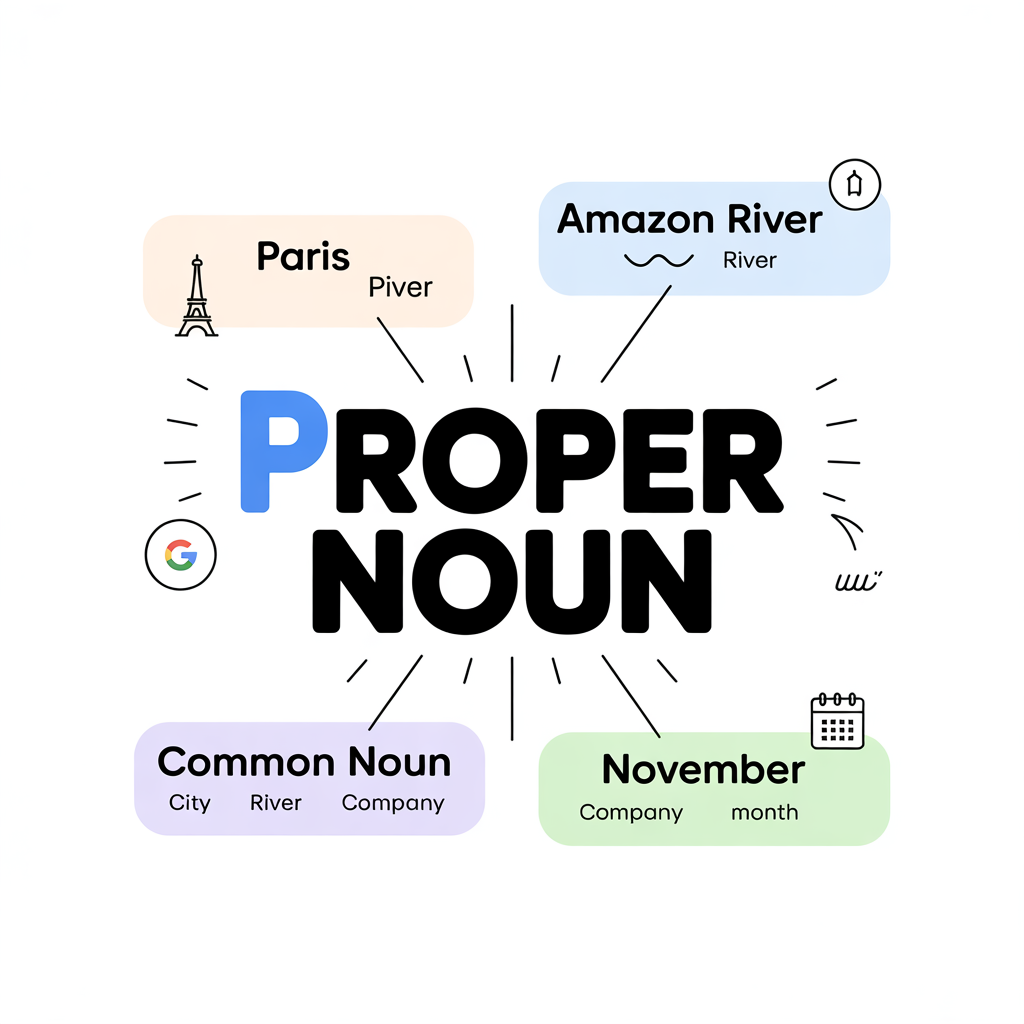
A proper noun is a specific name used to identify a particular person, place, organization, or thing. Unlike a common noun, which refers to a general category, a proper noun points to one unique, individual entity.
The most important rule: proper nouns are always capitalized, regardless of where they appear in a sentence.
Here’s the clearest way to see the difference:
| Common Noun (general) | Proper Noun (specific) |
|---|---|
| city | Paris |
| dog | Buddy |
| river | Amazon River |
| company | Apple Inc. |
| month | November |
Notice how the common nouns describe a type of thing, while the proper nouns name a specific, one-of-a-kind instance of that thing. That specificity is the key to understanding proper nouns.
Proper Nouns vs. Common Nouns: Understanding the Key Difference
The distinction between proper nouns and common nouns is foundational to English grammar. Let’s explore it a bit further before diving into categories and examples.
- Common nouns are general. They name a class of people, places, things, or ideas: teacher, mountain, car, happiness.
- Proper nouns are specific. They name a unique individual within that class: Ms. Rodriguez, Mount Everest, Tesla, Buddhism.
A helpful mental test: Ask yourself, “Could I replace this with a different member of the same group and it would still make sense?” If yes, it’s likely a common noun. If the name is irreplaceable — if changing it would change the entire meaning — it’s a proper noun.
“I visited a museum last weekend.” → Common noun (any museum would fit)
“I visited the Louvre last weekend.” → Proper noun (only one Louvre exists)
Categories of Proper Nouns (With Examples)
Proper nouns span a remarkably wide range of categories. Understanding these categories helps you recognize and capitalize them correctly in your writing.
1. Names of People
Any specific individual’s first name, last name, or full name is a proper noun.
- First names: Albert, Maria, James
- Last names: Einstein, Curie, Baldwin
- Full names: Nelson Mandela, Frida Kahlo, Leonardo da Vinci
- Nicknames used as a name: Bono, Sting, Drake
Note: Titles like President, Doctor, or Professor become proper nouns when used directly before a name (e.g., President Lincoln) but are common nouns when used alone (e.g., the president).
2. Names of Places
Geographic locations with specific names are classic proper nouns.
- Countries: Brazil, Japan, Egypt
- Cities: New York, Tokyo, Nairobi
- States/Provinces: California, Ontario, Bavaria
- Mountains: Mount Kilimanjaro, the Alps
- Rivers: the Nile, the Mississippi River
- Oceans and Seas: the Pacific Ocean, the Mediterranean Sea
- Streets: Baker Street, Fifth Avenue
- Landmarks: the Eiffel Tower, the Great Wall of China
3. Names of Organizations and Institutions
When a company, government body, school, or other organization has a specific official name, that name is a proper noun.
- Companies: Google, Samsung, Nike
- Universities: Harvard University, the University of Oxford
- Government agencies: the FBI, the United Nations, NASA
- Non-profits: the Red Cross, Doctors Without Borders
- Sports teams: the Chicago Bulls, FC Barcelona
4. Days of the Week, Months, and Holidays
This category surprises some learners, but the names of specific days, months, and holidays are all proper nouns in English.
- Days: Monday, Friday, Sunday
- Months: January, August, December
- Holidays: Christmas, Thanksgiving, Diwali, Eid al-Fitr
Note: Seasons (spring, summer, autumn, winter) are not usually capitalized unless they are part of a proper name (e.g., the Spring Festival).
5. Languages and Nationalities
The names of languages and words describing nationalities or ethnic groups are proper nouns.
- Languages: Spanish, Mandarin, Swahili, English
- Nationalities: French, Nigerian, Thai, Brazilian
- Ethnic and cultural groups: Aztec, Viking, Māori
6. Religions and Religious Texts
Specific religions, their adherents, and sacred texts are capitalized as proper nouns.
- Religions: Christianity, Islam, Hinduism, Buddhism
- Adherents: Christian, Muslim, Hindu, Buddhist
- Sacred texts: the Bible, the Quran, the Torah, the Bhagavad Gita
- Deities: Allah, Vishnu, Zeus (specific gods by name)
7. Historical Events, Periods, and Documents
Named historical events and eras are treated as proper nouns.
- Events: World War II, the French Revolution, the Boston Tea Party
- Periods: the Renaissance, the Industrial Revolution, the Middle Ages
- Documents: the Magna Carta, the Declaration of Independence, the Treaty of Versailles
8. Brands and Trademarks
Brand names are proper nouns, which is why they’re always capitalized — even in casual conversation.
- Coca-Cola, Levi’s, YouTube, Instagram, Band-Aid, Kleenex
This last group raises an interesting linguistic phenomenon we’ll explore shortly — when brand names become so common they start being used as generic terms.
9. Titles of Works
The titles of books, films, songs, paintings, and other creative works are proper nouns. Standard capitalization rules apply (major words are capitalized).
- Books: To Kill a Mockingbird, Pride and Prejudice
- Films: Inception, The Lion King
- Songs: Bohemian Rhapsody, Imagine
10. Names of Planets, Stars, and Celestial Bodies
Astronomically named bodies are proper nouns when referred to by their official names.
- Mars, Venus, Jupiter, the Milky Way, Andromeda, Orion Nebula
Note: The sun and the moon can be written in lowercase when used informally, but Sun and Moon are capitalized in scientific and astronomical contexts.
The Capitalization Rule: Why It Matters
The defining grammatical feature of a proper noun is capitalization. This isn’t just a stylistic choice — it’s a functional signal that tells the reader, “This word refers to something specific and unique.”
Consider these two sentences:
- “We need to find a doctor.” — Any doctor will do.
- “We need to call Dr. Chen.” — One specific person.
Or these:
- “She studied at a university in England.” — Generic institution.
- “She studied at the University of Cambridge.” — A specific, prestigious institution.
The capital letter is a quick, efficient way to pack a lot of meaning into a single word. It signals specificity without requiring extra words of clarification.
Multi-Word Proper Nouns (Proper Noun Phrases)
Many proper nouns consist of more than one word. These are sometimes called proper noun phrases or proper names. The rules for capitalization remain consistent — every significant word in the name is capitalized.
Examples of multi-word proper nouns:
- New Zealand
- The White House
- The Great Barrier Reef
- Golden Gate Bridge
- World Health Organization
- Martin Luther King Jr.
The key is that the entire phrase functions as the name of one specific thing, so it’s treated as a single proper noun unit.
When Proper Nouns Become Common Nouns: “Genericide”
Here’s where things get genuinely fascinating. Sometimes, a proper noun becomes so widely used that it starts to function as a common noun. Linguists call this process appelativization or, more popularly, genericide.
Classic examples:
- Kleenex (a brand) → kleenex (any facial tissue)
- Google (a company) → to google (to search online)
- Xerox (a brand) → to xerox (to photocopy)
- Jacuzzi (a brand) → jacuzzi (any whirlpool bath)
- Escalator (originally trademarked) → now a fully generic common noun
When a word completes this journey into generic use, it typically loses its capital letter. Escalator is now fully lowercase. Google is still very much a proper noun as a company name, but “to google something” is increasingly written lowercase in informal contexts.
This process shows that the line between proper and common nouns can shift over time — language is always evolving.
Common Mistakes with Proper Nouns (and How to Avoid Them)
Even experienced writers make errors with proper nouns. Here are the most frequent pitfalls:
Mistake 1: Capitalizing Common Nouns That Sound Formal
Just because a word sounds important doesn’t make it a proper noun. Words like government, president, river, university, and church are common nouns unless they’re part of a specific official name.
- ❌ The President spoke to the Nation about the Economy.
- ✅ The president spoke to the nation about the economy.
- ✅ President Biden addressed the nation. (Here “President” is part of the name.)
Mistake 2: Forgetting to Capitalize Languages and Nationalities
This is a particularly common error for people who speak languages other than English (in many languages, nationalities and languages are not capitalized).
- ❌ She speaks french and arabic fluently.
- ✅ She speaks French and Arabic fluently.
Mistake 3: Inconsistent Capitalization of Titles
Remember: titles are proper nouns when used before a name, common nouns when used alone.
- ✅ We contacted Professor Huang about the research.
- ✅ We contacted the professor about the research.
Mistake 4: Forgetting Days and Months
- ❌ The meeting is scheduled for tuesday, march 14th.
- ✅ The meeting is scheduled for Tuesday, March 14th.
Mistake 5: Over-Capitalizing Directions
Cardinal directions (north, south, east, west) are common nouns when used as directions but proper nouns when they name a specific region.
- ✅ Drive north for three miles. (direction)
- ✅ She grew up in the South. (a specific cultural/geographic region)
Proper Adjectives: The Close Relative of Proper Nouns
When a proper noun is used to modify another noun, it becomes a proper adjective. These are also capitalized.
- France (proper noun) → French cuisine (proper adjective)
- Shakespeare (proper noun) → Shakespearean drama (proper adjective)
- Freud (proper noun) → Freudian slip (proper adjective)
- Victorian era (named after Queen Victoria)
Understanding proper adjectives helps you see that the “proper” family extends beyond nouns — specificity and capitalization go hand in hand across multiple word types.
Proper Nouns in Different Contexts
In Academic Writing
Academic writing demands precision with proper nouns. Correctly naming researchers, institutions, theories, and historical events (all potential proper nouns) is essential for credibility and clarity. Misuse of capitalization can suggest carelessness or lack of familiarity with the subject.
In Business Writing
Proper nouns are critical in business communication. Getting a company name, person’s name, or product name wrong — including incorrect capitalization — can come across as unprofessional or even offensive. Always double-check the official capitalization style of brand names (note that some brands use unconventional capitalization: iPhone, eBay, adidas).
In Creative Writing
Fiction writers invent proper nouns constantly — character names, imaginary cities, fictional organizations, made-up languages. These follow the same rules: they’re capitalized because they name specific, unique entities within the world of the story. (Hogwarts, Middle-earth, Narnia, Wakanda)
Quick Reference: Proper Noun Checklist
When deciding whether to capitalize a noun, ask yourself these questions:
- Is it the specific name of one particular person, place, or thing? If yes, capitalize it.
- Could you replace it with another member of the same general category without losing essential meaning? If yes, it’s probably a common noun.
- Is it a day, month, holiday, language, or nationality? Capitalize it.
- Is a title being used before a person’s name? Capitalize it.
- Is it a direction word or a regional name? Capitalize only if it names a specific region.
- Is it a season? Generally do not capitalize unless part of an official name.
Conclusion
A proper noun is, at its heart, a name — a specific, individual label for one particular person, place, thing, or idea. Its defining characteristic is capitalization, which serves as a visible signal of that specificity. From the names of people and countries to brands, holidays, languages, and historical events, proper nouns are woven into virtually every sentence we write and speak.
Understanding the distinction between proper nouns and common nouns isn’t just a grammar exercise. It’s about communicating with precision and respect — honoring the specific identity of people, places, and things rather than lumping them into vague categories. Whether you’re writing an email, an essay, a novel, or a social media post, getting your proper nouns right makes your writing sharper, clearer, and more credible.
The good news? With the categories, rules, and examples covered in this guide, you now have everything you need to use proper nouns with confidence.
Frequently Asked Questions (FAQs)
Is “Mom” a proper noun?
It depends on how it’s used. When used as a name or direct address — “I asked Mom for help” — it functions as a proper noun and is capitalized. When used with a possessive or article — “I asked my mom for help” — it’s a common noun and is not capitalized.
Are seasons proper nouns?
No. The four seasons — spring, summer, autumn/fall, winter — are common nouns in standard English and are not capitalized in regular sentences. The exception is when a season is part of an official proper name, such as the Spring Festival or a specific event title.
Is “internet” a proper noun?
This is one of the most debated capitalization questions in modern English. Traditionally, Internet was capitalized as it referred to one specific global network. However, widespread usage has shifted, and most major style guides now accept internet in lowercase. It’s an example of a word in transition.
Can a proper noun be plural?
Yes. Proper nouns can be made plural when referring to multiple instances. For example: “There are two Davids in my class” or “The Smiths are coming to dinner.” They remain capitalized even in the plural form.
Is “God” a proper noun?
When referring to the deity of a monotheistic religion as a proper name — “I believe in God” — it is treated as a proper noun and capitalized. When used generically — “the ancient Greeks worshipped many gods” — it is a common noun and written in lowercase.
What is the difference between a proper noun and a proper name?
The terms are often used interchangeably, but technically, a proper name refers to the full name of a specific entity (which may be multiple words), while a proper noun is the grammatical category that includes those names. All proper names consist of proper nouns, but a proper noun can also be a single word within a larger proper name.