
If you have ever explained why something happened in a sentence, chances are you have already used a subordinating conjunction of reason — even if you did not know it had that name. These small but powerful words are the grammatical glue that connects a cause to its effect, helping readers understand the logic behind your ideas. Whether you are a student brushing up on grammar, a writer aiming for clearer prose, or simply someone who loves understanding how language works, this guide will walk you through everything you need to know.
Understanding Conjunctions: A Quick Foundation
Before diving into subordinating conjunctions of reason specifically, it helps to understand the broader family they belong to.
A conjunction is a word that connects clauses, phrases, or words within a sentence. There are three main types:
- Coordinating conjunctions – Connect two independent clauses of equal rank (e.g., for, and, nor, but, or, yet, so — remembered by the acronym FANBOYS).
- Correlative conjunctions – Work in pairs to connect elements (e.g., either…or, neither…nor, not only…but also).
- Subordinating conjunctions – Connect a dependent (subordinate) clause to an independent (main) clause, establishing a specific relationship between the two.
Subordinating conjunctions cover a wide range of relationships, including time (when, after, before), condition (if, unless), contrast (although, even though), and — the focus of this article — reason or cause.
What Is a Subordinating Conjunction of Reason?
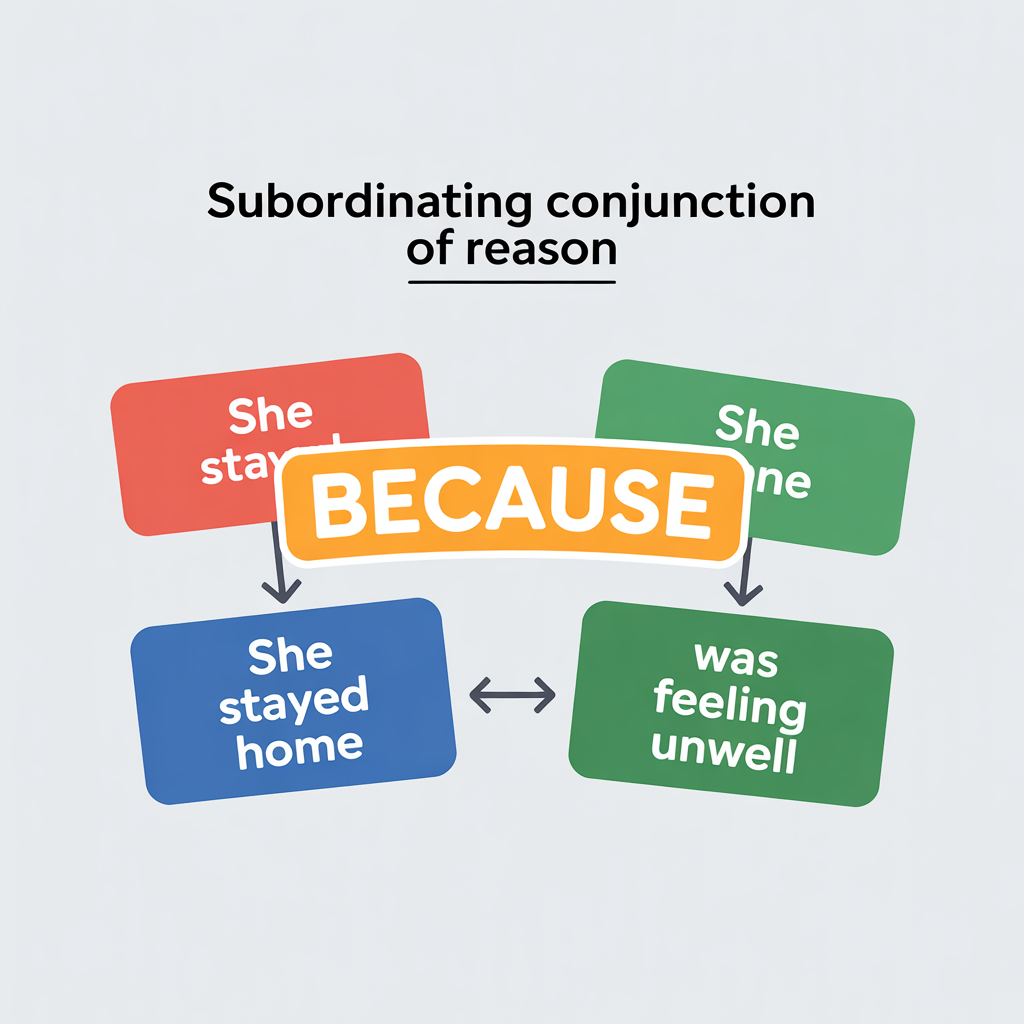
A subordinating conjunction of reason is a word or phrase that introduces a subordinate clause explaining why something in the main clause happens or is true. In other words, it signals a cause-and-effect relationship, where the subordinate clause is the cause and the main clause is the result.
Put simply: the subordinating conjunction of reason answers the question “Why?”
Here is the basic structure:
[Main clause] + [subordinating conjunction of reason] + [subordinate clause]
OR
[Subordinating conjunction of reason] + [subordinate clause], + [main clause]
Example:
- She stayed home because she was feeling unwell.
- Because she was feeling unwell, she stayed home.
In both sentences, the word because introduces the reason (she was feeling unwell) for the action in the main clause (she stayed home).
The Most Common Subordinating Conjunctions of Reason
English has several subordinating conjunctions of reason. Each carries a slightly different nuance, and choosing the right one can significantly affect the tone and clarity of your writing.
1. Because
Because is the most direct and commonly used subordinating conjunction of reason. It introduces a clause that provides a clear, specific explanation for the main clause. It is neutral in tone and works in nearly every context — formal, informal, spoken, or written.
- He failed the exam because he did not study.
- We canceled the trip because the weather was dangerous.
Key point: “Because” typically introduces new, important information the listener or reader did not already know.
2. Since
Since introduces a reason that is already known or assumed to be known by the listener or reader. It carries a tone of “given that” or “seeing that.” It is slightly more formal than “because” and often implies that the reason is background knowledge rather than new information.
- Since you have already read the report, we can skip the summary.
- He took a taxi since the buses had stopped running.
Important note: “Since” can also function as a conjunction of time (meaning “from a point in the past until now”), so context is crucial. “Since I moved here, I have been happy” uses “since” as a time conjunction, not a reason conjunction.
3. As
As is similar to “since” in that it introduces a reason that the speaker treats as already known or evident. It tends to be more formal and literary in tone. Like “since,” it can also introduce clauses of time, comparison, or manner, so clarity in context matters.
- As the deadline was approaching, the team worked through the night.
- She brought an umbrella as it had been raining all week.
Key difference from “because”: “As” and “since” suggest the reason is a background or contextual fact; “because” presents the reason as the primary new information.
4. Now That
Now that introduces a reason linked to a new or recent development. It implies “given the new situation that…” and is often used to explain a change or updated course of action.
- Now that she has graduated, she can focus on her career.
- We can celebrate now that the hard work is done.
5. Seeing That / Seeing As
Seeing that and seeing as (sometimes written as “seeing as how” in informal speech) are used to present a reason as obviously evident or logically clear from observation. They are more informal and conversational.
- Seeing that it was already midnight, we decided to head home.
- Seeing as you are the expert, maybe you should lead the presentation.
6. Given That
Given that introduces a reason in a formal or academic tone. It presents the subordinate clause as an established premise or acknowledged condition.
- Given that resources are limited, we must prioritize carefully.
- It is surprising that she succeeded, given that the odds were against her.
7. Inasmuch As / Insofar As
These are highly formal, often used in legal, academic, or official writing. They mean “to the extent that” and introduce a reason with a slight qualifier — suggesting the reasoning applies within a specific scope.
- The contract is valid inasmuch as all parties have signed it.
- The policy is fair insofar as it treats all employees equally.
How Subordinating Conjunctions of Reason Work Grammatically
Understanding the grammar behind these conjunctions helps you use them correctly and avoid common errors.
The Dependent Clause Cannot Stand Alone
When you add a subordinating conjunction to a clause, that clause becomes dependent — it can no longer function as a complete sentence on its own.
- Complete sentence: She left early. ✅
- Fragment: Because she was tired. ❌ (on its own, this is incomplete)
- Complete sentence: She left early because she was tired. ✅
Writing “Because she was tired.” as a standalone sentence is a sentence fragment — one of the most common grammar mistakes in English.
Flexible Word Order
One of the useful features of subordinating conjunctions is that the subordinate clause can come either before or after the main clause. However, when the subordinate clause comes first, it must be followed by a comma.
- He was nervous because it was his first interview. (no comma needed)
- Because it was his first interview, he was nervous. (comma required)
The Subordinate Clause Modifies the Main Clause
Grammatically speaking, the reason clause acts as an adverbial clause — it modifies the verb or the entire main clause by explaining the reason behind it. This is why subordinating conjunctions of reason are sometimes called adverbial conjunctions of reason.
Subordinating Conjunctions of Reason vs. Other Connectors of Reason
It is worth distinguishing subordinating conjunctions of reason from other words that also express reason or cause, as they work differently grammatically.
vs. Coordinating Conjunction “For”
The word for (as in “He was cold, for the wind was strong”) can also express reason. However, it is a coordinating conjunction, not a subordinating one. It connects two independent clauses of equal weight and is considered quite formal or literary in modern usage.
vs. Conjunctive Adverbs: Therefore, Consequently, Thus
Words like therefore, consequently, thus, and as a result express a logical consequence but work differently. They are conjunctive adverbs that connect two independent clauses, usually with a semicolon or by starting a new sentence.
- She studied hard; therefore, she passed the exam.
Notice that “therefore” introduces the result, not the reason — the opposite direction of a subordinating conjunction of reason.
vs. Prepositions: Because of, Due to, Owing to
Phrases like because of, due to, and owing to express reason but are prepositions, not conjunctions. They are followed by a noun phrase, not a full clause.
- She stayed home because of her illness. (noun phrase: “her illness”)
- She stayed home because she was ill. (full clause: “she was ill”)
Choosing the Right Subordinating Conjunction of Reason
Knowing when to use each word is a mark of polished writing. Here is a practical guide:
| Conjunction | Best Used When… | Register |
|---|---|---|
| Because | The reason is the most important new information | Neutral / all contexts |
| Since | The reason is already known or implied | Slightly formal |
| As | The reason is obvious or contextually evident | Formal / literary |
| Now that | The reason is a new or recent development | Neutral |
| Seeing that | The reason is clearly observable | Informal / conversational |
| Given that | The reason is a formal premise or condition | Formal / academic |
| Inasmuch as | The reason applies within a specific scope | Very formal / legal |
Common Mistakes to Avoid
Even experienced writers make errors with these conjunctions. Here are the most frequent pitfalls:
Mistake 1: Writing a Sentence Fragment
Using a subordinating conjunction without attaching it to a main clause creates an incomplete sentence.
- ❌ Because the project was delayed.
- ✅ The client was frustrated because the project was delayed.
Mistake 2: Confusing “Since” (Time) vs. “Since” (Reason)
Make sure the meaning is clear from context. If there is ambiguity, use “because” for reason and “ever since” for time.
- Ambiguous: Since he moved, things changed. (Time? Reason?)
- Clear: Because he moved, things changed. (Reason)
- Clear: Ever since he moved, things have changed. (Time)
Mistake 3: Missing the Comma After a Fronted Clause
When the subordinate clause comes first, always place a comma after it.
- ❌ Since you are here we should start.
- ✅ Since you are here, we should start.
Mistake 4: Using “Because” After “The Reason Is”
The phrase “The reason is because” is considered redundant and grammatically awkward. Use “that” instead.
- ❌ The reason he left is because he was bored.
- ✅ The reason he left is that he was bored.
Real-World Examples Across Different Contexts
Seeing these conjunctions used in varied real-world contexts brings their function to life.
Academic Writing
- Given that the sample size was small, the results should be interpreted with caution.
- The experiment was repeated because the initial results were inconsistent.
Business Communication
- The meeting has been rescheduled since the key stakeholders are unavailable on Friday.
- Now that the budget has been approved, the project can move forward.
Everyday Conversation
- I grabbed a coat seeing as it looked cloudy outside.
- She did not call back because her phone was dead.
Literature and Formal Writing
- As the night grew colder, the travelers quickened their pace.
- The law shall be upheld inasmuch as it serves justice.
Why Mastering Subordinating Conjunctions of Reason Matters
You might wonder: does this level of grammatical detail really matter? The answer is yes — for several important reasons.
- Clarity of thought: Cause-and-effect reasoning is at the heart of logical communication. Using the right conjunction makes your argument or explanation instantly clear.
- Writing quality: Overusing “because” when “since” or “given that” would be more precise is a sign of a developing writer. Mastering variety elevates your prose.
- Academic and professional success: Essays, reports, legal documents, and business proposals all rely heavily on well-constructed reason clauses.
- Language learning: For ESL learners, understanding these distinctions is a key step toward fluency and natural-sounding English.
Quick Reference Summary
Here is a condensed overview of everything covered:
- A subordinating conjunction of reason introduces a dependent clause that explains why the action in the main clause occurs.
- The most common ones are: because, since, as, now that, seeing that, given that, inasmuch as.
- The dependent clause cannot stand alone — it must be attached to a main clause.
- When the dependent clause comes first, use a comma to separate it from the main clause.
- Each conjunction carries a different nuance and register — choosing wisely improves precision and tone.
- They differ from coordinating conjunctions (like for), conjunctive adverbs (like therefore), and prepositional phrases (like because of).
Conclusion
Subordinating conjunctions of reason are small words that carry significant weight. They do not just connect sentences — they reveal the logic, motivation, and causality behind ideas. From the everyday versatility of because to the formal precision of given that or inasmuch as, each one has its place in the rich toolkit of English grammar.
Understanding these conjunctions — how they work, when to use them, and what mistakes to avoid — gives you greater control over your writing and speaking. Whether you are crafting a research paper, writing an email, or simply explaining why you were late for dinner, the right subordinating conjunction of reason will always make your message clearer, sharper, and more convincing.
Frequently Asked Questions (FAQs)
What is the difference between “because,” “since,” and “as” as subordinating conjunctions of reason?
All three introduce a reason, but with different nuances. Because presents the reason as the primary new information. Since implies the reason is already known or assumed. As is the most formal of the three and also suggests the reason is evident from context. In general speech and writing, “because” is the safest and most common choice.
Can a sentence start with “because”?
Yes, a sentence can start with “because,” but the subordinate clause it introduces must be followed by a main clause. Starting with “because” and then stopping is a sentence fragment. Example: Because it was raining, we stayed inside. ✅
Is “for” a subordinating conjunction of reason?
No. “For” (when used to express reason) is a coordinating conjunction, not a subordinating one. It connects two independent clauses of equal status and is quite formal or literary in modern English. Example: He paused, for something had caught his eye.
What is the difference between a subordinating conjunction of reason and a conjunctive adverb like “therefore”?
A subordinating conjunction of reason (like because) introduces the cause, while a conjunctive adverb like therefore introduces the result. Additionally, subordinating conjunctions create a dependent clause, whereas conjunctive adverbs connect two independent clauses (usually with a semicolon).
Are “because of,” “due to,” and “owing to” subordinating conjunctions of reason?
No. These are prepositional phrases, not conjunctions. They are followed by a noun or noun phrase, not a full clause. “Because of the storm” vs. “because the storm was severe” — the latter uses the conjunction; the former uses the preposition.
How many subordinating conjunctions of reason are there in English?
The core group includes: because, since, as, now that, seeing that, seeing as, given that, inasmuch as, and insofar as. Some grammar resources may also include for the reason that and in that. The list is finite but offers enough variety to cover most communicative needs across all levels of formality.