
Every time you say “I wanted coffee, but the café was closed” or “You can have cake or pie,” you’re using one of the most essential tools in the English language — a coordinating conjunction. These small words do big work. They connect ideas, balance sentences, and help your writing flow naturally. Yet many people use them by instinct without ever fully understanding what they are or how they function. This guide will change that.
What Is a Coordinating Conjunction?
A coordinating conjunction is a word that connects two or more grammatically equal elements in a sentence. Those elements can be individual words, phrases, or entire independent clauses. The key idea is equality — a coordinating conjunction joins items that are on the same grammatical level, giving them equal weight and importance.
For example:
- Words: “She bought apples and oranges.”
- Phrases: “He ran through the park and across the bridge.”
- Independent clauses: “She studied hard, so she passed the exam.”
In contrast to subordinating conjunctions (which connect a main clause to a dependent clause, creating unequal relationships), coordinating conjunctions always link elements of the same type and importance. That’s what makes them “coordinating” — they coordinate rather than subordinate.
The FANBOYS: The 7 Coordinating Conjunctions in English
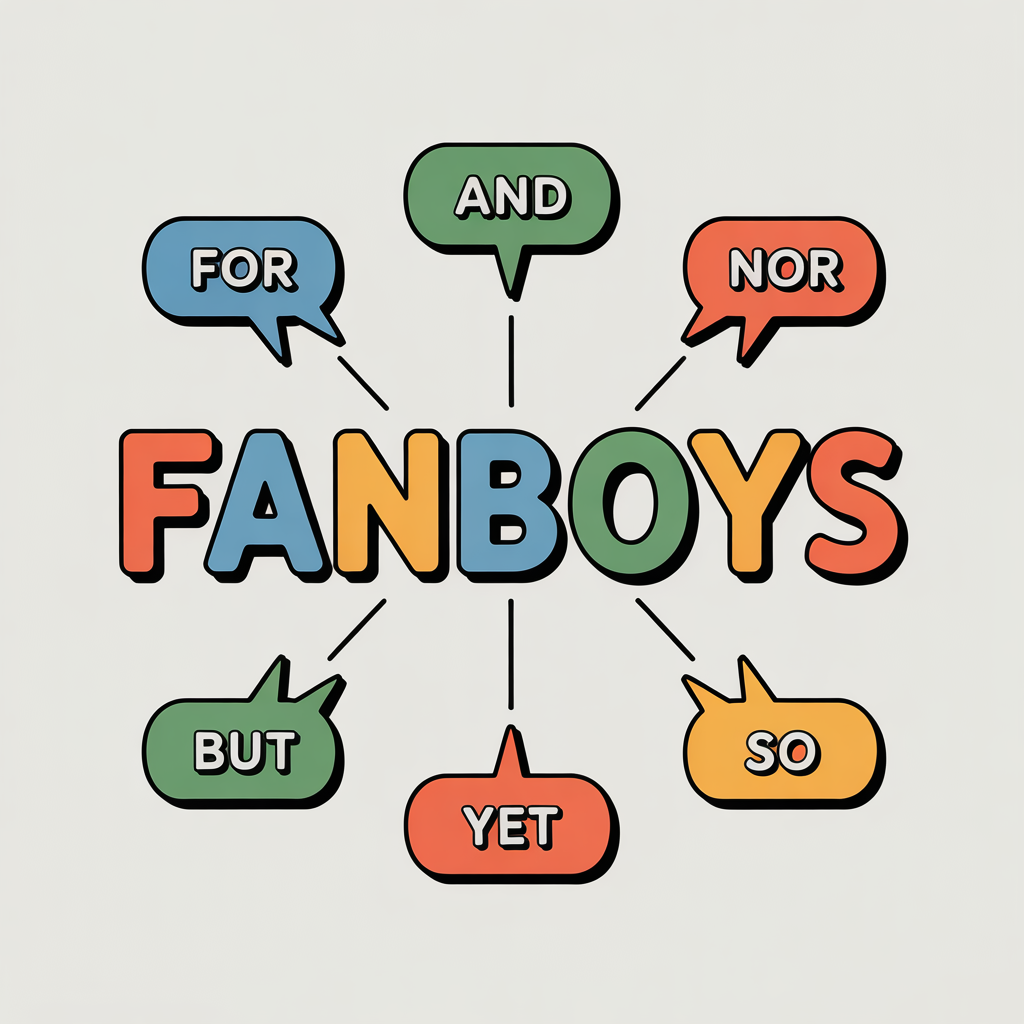
There are exactly seven coordinating conjunctions in English, and English teachers have long used the handy acronym FANBOYS to help students remember all of them:
- F — For
- A — And
- N — Nor
- B — But
- O — Or
- Y — Yet
- S — So
Each of these words serves a distinct purpose and carries a different logical relationship between the elements it connects. Let’s break them down one by one.
1. For — Expressing Reason or Cause
When used as a coordinating conjunction, for explains a reason or cause. It is more formal and literary in tone and is less common in everyday speech.
Example: “She stayed home, for she was feeling unwell.”
This is different from the preposition “for” (as in “I bought this for you”). As a conjunction, it introduces a reason — similar to “because,” but more formal.
2. And — Adding Information
And is the most commonly used coordinating conjunction. It simply adds one element to another, showing that both things exist together or happen in sequence.
Example: “Tom packed his bags and left the house.”
Example: “She is smart, talented, and hardworking.”
3. Nor — Adding a Negative Alternative
Nor connects two negative ideas. It’s typically used after a negative statement to add another negative statement. When “nor” joins two independent clauses, the subject and verb of the second clause are usually inverted.
Example: “He didn’t call, nor did he send a message.”
Example: “She eats neither meat nor fish.”
4. But — Showing Contrast or Exception
But expresses a contrast, contradiction, or exception between two elements. It sets up an opposition between ideas.
Example: “The movie was long, but it was entertaining.”
Example: “I wanted to help but didn’t know how.”
5. Or — Presenting an Alternative
Or presents a choice or alternative between two or more options. It signals that only one of the connected elements applies.
Example: “Would you like tea or coffee?”
Example: “You can stay here, or you can come with us.”
6. Yet — Showing Unexpected Contrast
Yet as a coordinating conjunction works similarly to “but,” indicating a contrast. However, it often carries a sense of surprise — something is true despite what you might expect.
Example: “The question was simple, yet no one could answer it.”
Example: “She trained for months, yet she didn’t win the race.”
7. So — Showing Result or Consequence
So indicates that the second clause is a result or consequence of the first. It shows a cause-and-effect relationship.
Example: “It was raining heavily, so we canceled the picnic.”
Example: “She finished all her work, so she could relax.”
How Coordinating Conjunctions Work: Grammar Rules
Understanding what coordinating conjunctions are is one thing. Using them correctly is another. Here are the core grammatical rules you need to know.
Rule 1: They Must Connect Grammatically Equal Elements
A coordinating conjunction should join things that are the same type — noun with noun, verb with verb, phrase with phrase, or clause with clause.
- ✅ “She sings and dances.” (verb + verb)
- ✅ “He is clever but careless.” (adjective + adjective)
- ❌ “She likes hiking and to swim.” (gerund + infinitive — mismatched)
Rule 2: Use a Comma Before a Coordinating Conjunction When Joining Independent Clauses
When a coordinating conjunction joins two independent clauses (complete sentences that could stand alone), place a comma before the conjunction. This is one of the most important punctuation rules in English writing.
- ✅ “She studied all night, but she still felt unprepared.”
- ❌ “She studied all night but she still felt unprepared.” (missing comma)
Important exception: If the two items being joined are short and closely related, the comma is sometimes omitted in informal writing — but it’s safer to include it, especially in formal contexts.
Rule 3: No Comma When Joining Simple Words or Short Phrases
When a coordinating conjunction connects just two words or short phrases (not full clauses), you generally do not need a comma.
- ✅ “He speaks English and French.”
- ✅ “She was tired but happy.”
Rule 4: The Oxford Comma in Lists
When listing three or more items, coordinating conjunctions (usually “and” or “or”) appear before the final item. Whether to use a comma before that final conjunction — the so-called Oxford comma or serial comma — is a matter of style.
- With Oxford comma: “I bought apples, oranges, and bananas.”
- Without Oxford comma: “I bought apples, oranges and bananas.”
In academic and professional writing, the Oxford comma is generally recommended because it prevents ambiguity.
Rule 5: Can You Start a Sentence with a Coordinating Conjunction?
You may have been taught never to start a sentence with “and,” “but,” or “so.” In formal grammar, there are good reasons for that rule — overuse of sentence-starting conjunctions can make writing choppy. However, it is not a grammatical error. Many great writers and style guides accept it, especially when used for emphasis or stylistic effect.
Example: “The results were unexpected. But they were undeniable.”
Use this technique sparingly and purposefully.
Coordinating Conjunctions vs. Other Types of Conjunctions
To truly understand coordinating conjunctions, it helps to see how they differ from the other two main types of conjunctions in English.
Coordinating vs. Subordinating Conjunctions
Subordinating conjunctions (such as because, although, while, since, unless, if, when) connect a dependent clause to a main clause. The dependent clause cannot stand alone as a complete sentence.
- Coordinating: “She worked hard, so she got promoted.” (two independent clauses)
- Subordinating: “Because she worked hard, she got promoted.” (“Because she worked hard” is dependent)
Coordinating vs. Correlative Conjunctions
Correlative conjunctions come in pairs and work together to connect equivalent elements. Common pairs include: either…or, neither…nor, both…and, not only…but also, whether…or.
- Coordinating: “She speaks French and Spanish.”
- Correlative: “She speaks both French and Spanish.”
Correlative conjunctions emphasize the connection more strongly and add rhetorical balance to a sentence.
Common Mistakes with Coordinating Conjunctions
Even experienced writers make errors with coordinating conjunctions. Here are the most frequent mistakes and how to fix them.
Mistake 1: Missing the Comma Before a Coordinating Conjunction
Forgetting the comma when joining two independent clauses creates a run-on sentence or a comma splice.
- ❌ “I love hiking but I hate camping.”
- ✅ “I love hiking, but I hate camping.”
Mistake 2: Using a Comma When No Comma Is Needed
Adding a comma before a conjunction that joins only two words or short phrases is unnecessary and disrupts reading flow.
- ❌ “She is smart, and kind.”
- ✅ “She is smart and kind.”
Mistake 3: Confusing “Yet” and “But”
While “yet” and “but” are similar, “yet” implies a stronger sense of unexpectedness or irony. Using them interchangeably can dilute the nuance of your writing.
Mistake 4: Mixing Up “For” the Conjunction and “For” the Preposition
“For” as a coordinating conjunction means “because” and connects two clauses. “For” as a preposition shows a relationship between things.
- Conjunction: “He left early, for he had a long drive ahead.”
- Preposition: “He bought flowers for his mother.”
Mistake 5: Parallel Structure Errors
Coordinating conjunctions require parallel structure — the joined elements must have the same grammatical form.
- ❌ “She likes reading, to cook, and going for walks.”
- ✅ “She likes reading, cooking, and going for walks.”
Coordinating Conjunctions in Different Contexts
In Academic Writing
Academic writing values precision and clarity. Coordinating conjunctions help build complex ideas from simpler ones without sacrificing readability. Using them well — especially to show logical relationships with “so,” “but,” and “for” — can strengthen arguments significantly. Just be mindful of not overusing “and,” which can lead to long, loose sentence chains.
In Everyday Speech
In spoken English, coordinating conjunctions are everywhere. “And,” “but,” and “or” in particular are among the most frequently used words in the English language. In casual conversation, strict punctuation rules don’t apply, but the logical relationships they create still matter.
In Creative Writing
Writers use coordinating conjunctions not just grammatically but stylistically. Starting a sentence with “And” or “But” can create dramatic effect. Repeating conjunctions in a list — a technique called polysyndeton — deliberately slows the reader down for emphasis: “She laughed and cried and laughed again.”
Quick Reference: FANBOYS at a Glance
| Conjunction | Function | Example |
|---|---|---|
| For | Explains a reason/cause | “She left, for she was tired.” |
| And | Adds information | “He laughed and clapped.” |
| Nor | Adds a negative alternative | “She won’t eat, nor will she drink.” |
| But | Shows contrast or exception | “It was cold, but sunny.” |
| Or | Presents a choice/alternative | “Run or hide.” |
| Yet | Shows unexpected contrast | “She trained hard, yet lost.” |
| So | Shows result/consequence | “It rained, so we stayed in.” |
Why Mastering Coordinating Conjunctions Matters
You might wonder: if these are just seven small words, why bother studying them in depth? The answer is that clarity and logical flow in writing depend heavily on how well you use conjunctions. Poor conjunction usage creates confusion, muddles relationships between ideas, and makes your writing feel clumsy. Mastering coordinating conjunctions means:
- Writing sentences that are easier to read and understand
- Expressing logical relationships (cause, contrast, addition) precisely
- Avoiding run-on sentences and comma splices
- Building more varied and sophisticated sentence structures
- Sounding more fluent and natural in both writing and speech
For ESL learners, these seven words are particularly worth memorizing, because they appear constantly in everyday English across every context — from text messages to academic papers.
Conclusion
A coordinating conjunction is a word that connects two or more grammatically equal elements — words, phrases, or independent clauses — in a sentence. There are exactly seven in English, remembered through the acronym FANBOYS: For, And, Nor, But, Or, Yet, So. Each one carries a distinct logical meaning, from addition (and) and contrast (but, yet) to alternatives (or), negation (nor), cause (for), and consequence (so).
Used correctly — with proper punctuation and parallel structure — these seven tiny words can dramatically improve the quality, clarity, and sophistication of your writing. Whether you’re crafting an academic essay, an email, or a creative story, understanding coordinating conjunctions gives you greater control over how your ideas connect and how your sentences feel to read.
The next time you write “I was nervous, but I gave the presentation anyway,” you’ll know exactly why that small word is doing such important work.
Frequently Asked Questions (FAQs)
What is the easiest way to remember the 7 coordinating conjunctions?
The best trick is the acronym FANBOYS, which stands for For, And, Nor, But, Or, Yet, So. Once you memorize FANBOYS, you’ll always know exactly which words count as coordinating conjunctions in English.
What is the difference between a coordinating conjunction and a subordinating conjunction?
A coordinating conjunction connects two grammatically equal elements (such as two independent clauses), giving them equal importance. A subordinating conjunction (like because, although, when, since) connects a dependent clause to a main clause, making one idea subordinate to the other.
Do you always need a comma before a coordinating conjunction?
Not always. A comma is needed when the coordinating conjunction joins two independent clauses (two complete sentences). If it’s connecting just two words or short phrases, no comma is needed.
Is it grammatically correct to start a sentence with “and” or “but”?
Yes, it is grammatically acceptable. While traditional grammar instruction discouraged it, modern style guides recognize that starting a sentence with “and” or “but” can be effective for emphasis or rhythm. Just don’t overuse it.
What is the difference between “yet” and “but” as coordinating conjunctions?
Both show contrast, but “yet” carries an additional sense of surprise or irony — something is true despite what would be expected. “But” is more neutral and simply signals a contrast or exception between two ideas.
Can coordinating conjunctions connect more than two items?
Yes. Coordinating conjunctions, particularly “and” and “or,” are regularly used to connect three or more items in a list. In these cases, the conjunction typically appears before the final item: “She bought apples, oranges, and bananas.”