
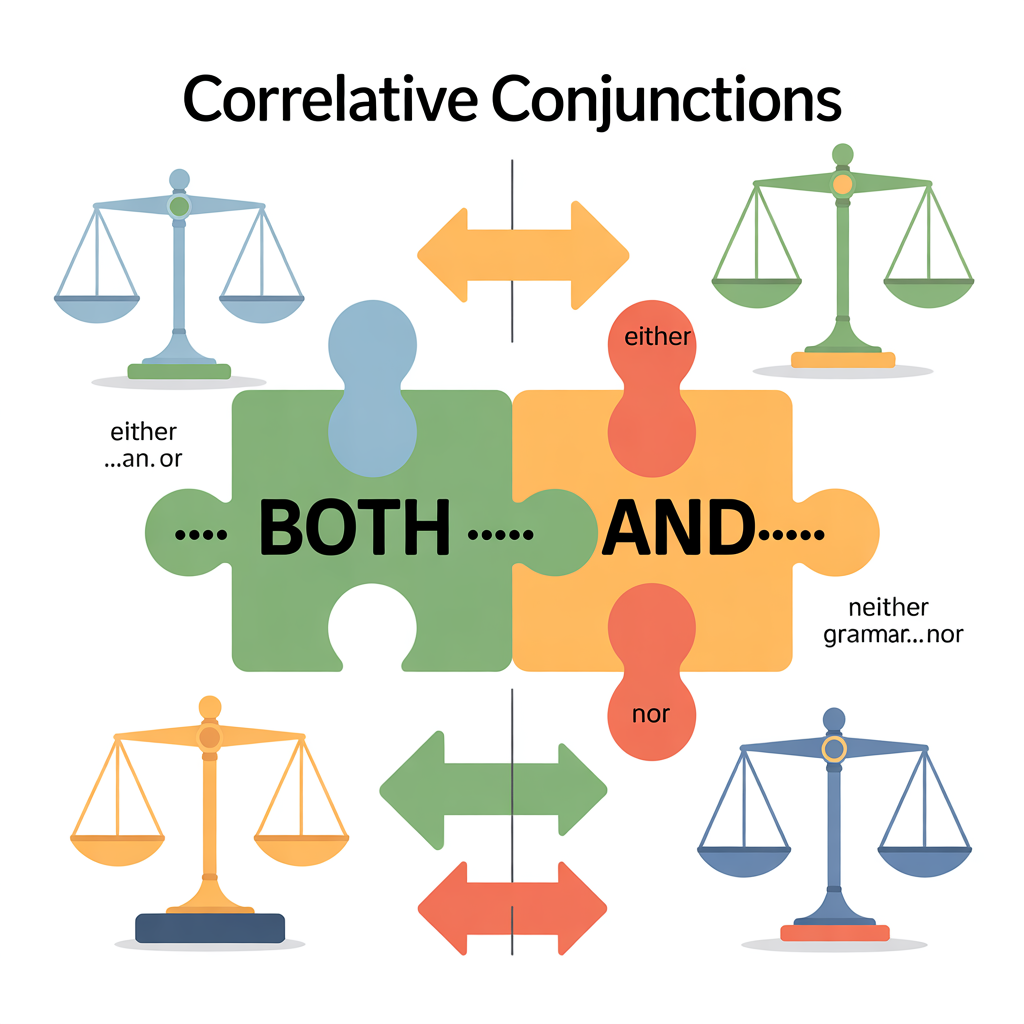
What Is a Correlative Conjunction?
If you’ve ever said “either you come with me, or I go alone” — congratulations, you’ve already used a correlative conjunction without even thinking about it. These two-part connectors are some of the most powerful tools in the English language, helping writers and speakers link ideas, balance sentence structures, and express relationships between thoughts with precision and style. Whether you’re a student brushing up on grammar or a professional looking to sharpen your writing, understanding correlative conjunctions is a small investment that pays enormous dividends in clarity and fluency.
The Basic Definition: What Is a Correlative Conjunction?
A correlative conjunction is a pair of words (or short phrases) that work together to connect two grammatically equal elements within a sentence. Unlike a regular conjunction — such as and, but, or so — a correlative conjunction always comes in a set of two parts, with each part placed in a different position in the sentence.
Think of them as a tag team: one part sets up the relationship, and the second part completes it. The two elements they connect must be parallel — meaning they should have the same grammatical form (both nouns, both verbs, both clauses, etc.).
Here is a straightforward example:
“She is both talented and hardworking.”
In this sentence, both…and is the correlative conjunction. It connects two adjectives — talented and hardworking — that are grammatically equal. Neither word stands alone to make the same statement; they work together as a unit to balance and emphasize both qualities equally.
Why Are They Called “Correlative”?
The word correlative comes from the Latin correlativus, meaning “having a mutual relation.” This etymology is perfectly descriptive. The two parts of a correlative conjunction have a mutual, dependent relationship — one part cannot do its job without the other. They correlate, or correspond, with each other across a sentence to create a balanced, meaningful connection.
This sets them apart from coordinating conjunctions (FANBOYS: for, and, nor, but, or, yet, so), which are single words, and from subordinating conjunctions (like because, although, since), which connect a dependent clause to a main clause. Correlative conjunctions occupy their own unique category because of this paired, symmetrical structure.
The Most Common Correlative Conjunction Pairs
English has a core set of widely used correlative conjunction pairs. Knowing these pairs — and how to use each one — is the foundation of mastering this grammatical concept.
1. Both…And
Used to emphasize that two things are true simultaneously. It adds to and reinforces both elements equally.
- “The new policy affects both employees and managers.”
- “She is both an artist and a scientist.”
2. Either…Or
Presents two alternatives or possibilities. It implies a choice between two options, though both cannot be true at the same time (or at least the speaker is presenting them as distinct choices).
- “You can either take the highway or use the back roads.”
- “Either the project gets approved or we start over.”
3. Neither…Nor
The negative counterpart of either…or. It indicates that not one nor the other of two things is true. This pair carries a strong negative connotation and is often used for emphasis.
- “Neither the director nor the producer attended the meeting.”
- “He is neither happy nor sad about the result.”
4. Not Only…But Also
Used to add extra emphasis by highlighting that something beyond what’s expected is also true. The second element is often the more surprising or important one.
- “She is not only a great writer but also a gifted speaker.”
- “The storm damaged not only the roof but also the foundation.”
5. Whether…Or
Used to introduce two alternatives, often within indirect questions or when expressing indifference between two outcomes.
- “Whether you agree or not, the decision has been made.”
- “I don’t know whether to laugh or cry.”
6. Such…That
Expresses a cause-and-effect relationship, indicating that something is so extreme that it results in a particular outcome.
- “The traffic was such a disaster that we missed the flight.”
- “He spoke with such passion that the audience was moved to tears.”
7. So…That
Similar to such…that, this pair also shows a result or consequence. The difference is that so modifies an adjective or adverb, while such modifies a noun.
- “The exam was so difficult that half the class failed.”
- “She ran so fast that no one could catch up.”
8. As…As
Used to make comparisons of equality, indicating that two things are equivalent in some quality or degree.
- “This new model is as efficient as the previous one.”
- “He is as dedicated as any athlete I’ve coached.”
9. The More…The More (and variants)
Expresses a proportional relationship between two elements, showing that as one thing increases, so does another.
- “The more you practice, the more confident you become.”
- “The harder she worked, the better the results.”
10. Hardly…When / Scarcely…When / No Sooner…Than
These pairs indicate that one event happened immediately after another. They are more formal and often used in literary or journalistic writing.
- “Hardly had he sat down when the alarm went off.”
- “No sooner had she opened the door than the phone rang.”
The Parallelism Rule: The Most Important Grammar Rule for Correlative Conjunctions
Here’s the single most important thing to understand about using correlative conjunctions correctly: parallel structure.
When you use a correlative conjunction pair, the grammatical elements on both sides of each part must be the same type. A noun must be paired with a noun, a verb phrase with a verb phrase, a clause with a clause, and so on. Violating this rule produces awkward, grammatically incorrect sentences.
Incorrect (not parallel):
- “She likes both swimming and to ride bikes.” ❌
Correct (parallel):
- “She likes both swimming and riding bikes.” ✓
- “She likes both to swim and to ride bikes.” ✓
In the incorrect version, swimming (a gerund) is paired with to ride (an infinitive). In the corrected versions, both elements match in form.
More examples of parallelism in action:
- Incorrect: “Not only did he lie but also his denial of wrongdoing.” ❌
- Correct: “Not only did he lie but also denied any wrongdoing.” ✓
- Incorrect: “Either you call me or a message should be sent.” ❌
- Correct: “Either you call me or you send a message.” ✓
Training your eye to spot and fix parallelism errors is one of the fastest ways to elevate your writing quality.
Subject-Verb Agreement with Correlative Conjunctions
Another area where writers commonly stumble is subject-verb agreement. When a correlative conjunction connects two subjects, which one determines whether the verb is singular or plural? The rules differ by pair.
Both…And → Always plural
When both…and connects two subjects, the verb is always plural.
- “Both the manager and the assistant are present.” ✓
Either…Or / Neither…Nor → Verb agrees with the nearer subject
This is the trickier rule. With either…or and neither…nor, the verb agrees with the subject that is closest to it (the subject right before the verb).
- “Neither the students nor the teacher was informed.” (teacher = singular → was) ✓
- “Neither the teacher nor the students were informed.” (students = plural → were) ✓
This rule is called the “proximity rule” or “rule of the nearest subject.” A practical tip: if following this rule creates an awkward sentence, try reordering the subjects so the plural one comes second.
Not Only…But Also → Verb agrees with the nearer subject
The same proximity rule applies here.
- “Not only the staff but also the CEO is responsible.” ✓
Correlative Conjunctions vs. Other Types of Conjunctions
To fully appreciate what makes correlative conjunctions unique, it helps to compare them with the other two major types of conjunctions in English.
| Type | Structure | Example | Function |
|---|---|---|---|
| Coordinating Conjunctions | Single word (FANBOYS) | and, but, or, nor, for, yet, so | Joins two equal elements |
| Subordinating Conjunctions | Single word/phrase | because, although, since, when | Joins a dependent clause to a main clause |
| Correlative Conjunctions | Paired words | both…and, either…or, not only…but also | Joins two equal elements with emphasis and balance |
The key differentiators for correlative conjunctions are their paired structure and the added emphasis and nuance they bring compared to a simple coordinating conjunction like and or or.
Why Use Correlative Conjunctions? The Benefits for Your Writing
Correlative conjunctions aren’t just a grammar technicality — they’re a powerful stylistic choice. Here’s why skilled writers reach for them:
- Balance and rhythm: They naturally create a balanced, symmetrical sentence structure that is pleasing to read and hear.
- Emphasis: Pairs like not only…but also and both…and amplify the importance of both connected elements.
- Clarity: By defining the exact relationship between two ideas (choice, contrast, addition, result), they eliminate ambiguity.
- Variety: Using these pairs breaks the monotony of a series of short, simple sentences and adds sophistication to your prose.
- Persuasive force: In rhetoric and argumentation, correlative conjunctions are excellent tools for making a point with structural impact — think political speeches, essays, and advertising copy.
Common Mistakes to Avoid
Even experienced writers make errors with correlative conjunctions. Watch out for these frequent pitfalls:
1. Breaking Parallelism
As discussed, the two connected elements must be in the same grammatical form. Always double-check that what comes after both and what comes after and are the same type of word or phrase.
2. Misplacing the First Part of the Pair
The placement of the first conjunction determines the scope of the parallel structure. Placing it too early or too late can change or obscure the meaning.
- Misplaced: “She both wants to visit Paris and London.” ❌ (both is too early)
- Correct: “She wants to visit both Paris and London.” ✓
3. Using Double Negatives with Neither…Nor
Because neither…nor is already negative, adding another negative word creates a double negative error.
- Incorrect: “Neither of them didn’t know the answer.” ❌
- Correct: “ of them knew the answer.” ✓
4. Confusing “Either…Or” with “Neither…Nor” in Negative Sentences
When the sentence is already negative (using not), use either…or, not neither…nor.
- Incorrect: “I don’t want neither coffee nor tea.” ❌
- Correct: “I don’t want either coffee or tea.” ✓
- Also correct: “I want neither coffee nor tea.” ✓
Correlative Conjunctions in Academic, Professional, and Creative Writing
The contexts where correlative conjunctions truly shine are varied. Understanding how to deploy them in specific settings will make your writing stand out.
Academic Writing
In essays and research papers, not only…but also is particularly useful for presenting multiple layers of evidence or argument. It signals that your analysis goes beyond the obvious.
- “The study found that the intervention was not only effective in reducing symptoms but also cost-efficient to implement at scale.”
Professional and Business Writing
In reports, proposals, and emails, both…and and either…or help frame choices and dual benefits with clarity.
- “Both the marketing team and the sales department need to align on the new strategy.”
Creative and Literary Writing
Authors use correlative conjunctions to build tension, draw contrasts, and create memorable rhythm. The the more…the more structure, for example, is a favourite in character development and narrative momentum.
- “The more he tried to forget her, the more her memory consumed him.”
Speeches and Rhetoric
Correlative conjunctions are staples of oratory. The balance they create makes lines feel weighty and quotable. Many famous speeches use not only…but also and both…and to build momentum.
Quick Reference: Correlative Conjunction Pairs at a Glance
| Pair | Primary Use | Quick Example |
|---|---|---|
| Both…and | Addition / Emphasis on two things | Both speed and accuracy matter. |
| Either…or | Choice between two options | Either we act now or we lose the chance. |
| Neither…nor | Negative — neither option applies | Neither plan was acceptable. |
| Not only…but also | Emphasis — adding a surprising second point | Not only is it affordable but also durable. |
| Whether…or | Two alternatives / indifference | Whether you stay or go is your choice. |
| Such…that | Cause and effect (with noun) | Such a mess that no one could work. |
| So…that | Cause and effect (with adjective/adverb) | So tired that she fell asleep instantly. |
| As…as | Comparison of equality | As smart as anyone in the room. |
| The more…the more | Proportional relationship | The more you read, the more you know. |
| No sooner…than | Immediate sequence of events | No sooner said than done. |
Conclusion
A correlative conjunction is a paired set of words that connects two grammatically equal elements in a sentence to show a specific relationship — whether that’s addition, choice, contrast, result, or comparison. Mastering them comes down to three core skills: knowing your pairs, maintaining strict parallel structure, and applying the correct subject-verb agreement rules.
Far from being an obscure grammar rule, correlative conjunctions are everyday tools used in academic papers, business communications, literature, and some of the most memorable speeches in history. Once you understand them, you’ll notice them everywhere — and once you use them correctly and deliberately, your writing will gain a new level of balance, emphasis, and sophistication.
The next time you want to connect two ideas with more punch than a simple and or or, reach for a correlative conjunction. Your sentences will be stronger for it.
FAQs About Correlative Conjunctions
What is the simplest definition of a correlative conjunction?
A correlative conjunction is a pair of words that work together to connect two equal parts of a sentence. Common examples include both…and, either…or, and not only…but also. The two parts always appear at different points in the sentence, and the elements they connect must be grammatically parallel.
How many correlative conjunctions are there in English?
There is no fixed official count, but most grammar resources identify between 8 and 12 common pairs in English. The most widely used are: both…and, either…or, neither…nor, not only…but also, whether…or, such…that, so…that, as…as, the more…the more, and no sooner…than.
What is the difference between a correlative conjunction and a coordinating conjunction?
A coordinating conjunction is a single word (like and, but, or) that joins two elements. A correlative conjunction is a pair of words that works together across a sentence to connect two equal elements. Correlative conjunctions carry more emphasis and require strict parallel structure.
Do correlative conjunctions always require parallel structure?
Yes, always. This is the fundamental grammatical rule for correlative conjunctions. The two connected elements must be the same grammatical type — both nouns, both verbs, both clauses, etc. Violating parallelism is the most common error writers make with these pairs.
What verb form do you use with “neither…nor”?
With neither…nor, the verb agrees with the subject that is closest to it. If the subject nearest to the verb is singular, use a singular verb. If it is plural, use a plural verb. This is known as the proximity rule or the rule of the nearest subject.
Can a correlative conjunction start a sentence?
Yes. Many correlative conjunction pairs can start a sentence, especially neither…nor, not only…but also, whether…or, and no sooner…than. When the first part begins a sentence, the word order in the first clause is often inverted (subject and auxiliary verb are flipped), particularly in formal writing: “No sooner had he arrived than the meeting started.”