
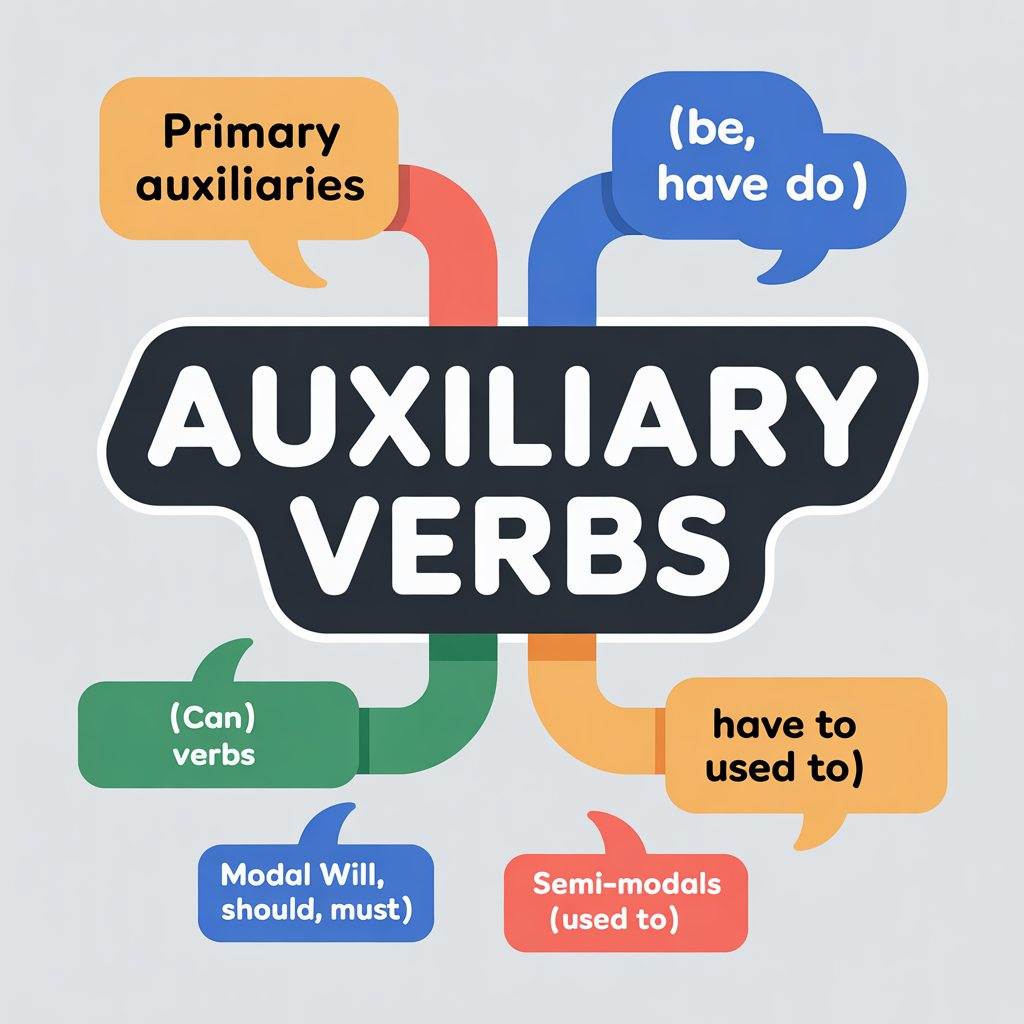
You use them dozens of times a day without even thinking about it. Auxiliary verbs are the small but mighty words that quietly hold English sentences together — shaping tense, forming questions, expressing possibility, and so much more. Whether you’re a student, a language learner, or simply someone who wants to sharpen their grammar, understanding auxiliary verbs is one of the most valuable steps you can take. This guide breaks it all down — clearly, thoroughly, and with plenty of real-world examples.
What Is an Auxiliary Verb?
An auxiliary verb — also called a helping verb — is a verb that works alongside a main verb to form a complete verbal phrase. On its own, a main verb carries the core meaning of the sentence. The auxiliary verb supports it by providing grammatical information such as:
- Tense (when the action happens)
- Aspect (whether the action is ongoing, completed, etc.)
- Voice (active or passive)
- Mood (possibility, necessity, permission, obligation)
- Negation and questions
Consider this simple example:
“She is running.”
Here, “running” is the main verb. “Is” is the auxiliary verb — it tells us the action is happening right now (present continuous tense). Remove the auxiliary, and the sentence loses its tense and clarity.
In short: auxiliary verbs don’t carry the primary meaning of the sentence — they shape how that meaning is expressed.
The Three Primary Auxiliary Verbs
English has three core auxiliary verbs. These are the workhorses of the language, used constantly across tenses, questions, and negative sentences.
1. “Be” (is, am, are, was, were, been, being)
The verb “be” is used as an auxiliary in two major contexts:
- Continuous (progressive) tenses: To show an action is ongoing.
Example: “They are studying for the exam.” - Passive voice: To show the subject receives the action rather than performs it.
Example: “The report was written by the team.”
2. “Have” (has, have, had)
The verb “have” is used to form perfect tenses, which describe actions completed at some point before now or before another event.
- Present perfect: “I have finished my homework.”
- Past perfect: “She had already left when he arrived.”
- Future perfect: “They will have completed the project by Friday.”
3. “Do” (do, does, did)
The verb “do” serves three important grammatical functions:
- Questions: “Do you understand the lesson?”
- Negation: “He does not agree with you.”
- Emphasis: “I do enjoy a good book.”
These three — be, have, do — are known as primary auxiliaries because they also function as main verbs. For example, “I am happy” uses “am” as a main verb (linking verb), not an auxiliary.
Modal Auxiliary Verbs: The Second Major Category
Modal auxiliary verbs (or simply modals) are a special group of auxiliary verbs. They express attitudes, possibilities, permissions, and obligations rather than tense. Unlike primary auxiliaries, modals never change form — they don’t add “-s,” “-ed,” or “-ing.”
Here are the core modal verbs in English:
| Modal Verb | Primary Use | Example |
|---|---|---|
| Can | Ability / Possibility | “She can speak French.” |
| Could | Past ability / Polite request / Possibility | “Could you help me?” |
| May | Possibility / Formal permission | “It may rain tonight.” |
| Might | Weaker possibility | “He might be late.” |
| Will | Future intention / Certainty | “I will call you tomorrow.” |
| Would | Conditional / Polite request | “Would you like some coffee?” |
| Shall | Future (formal) / Suggestions | “Shall we begin?” |
| Should | Advice / Expectation | “You should see a doctor.” |
| Must | Strong obligation / Logical deduction | “You must wear a seatbelt.” |
| Ought to | Moral obligation / Advice | “We ought to recycle more.” |
Modal verbs are always followed by the base form of the main verb (without “to”), with one exception: ought to.
Correct: “You must go now.” / Incorrect: “You must to go now.”
Semi-Modal (Marginal) Auxiliary Verbs
Between the primary auxiliaries and modal verbs, there is a smaller group sometimes called semi-modal or marginal modal verbs. These behave partly like modals and partly like regular verbs.
- Used to — Habitual actions or states in the past
“I used to walk to school every day.” - Need to — Necessity
“You need to submit the form today.” - Have to / Have got to — External obligation
“She has to finish the report by noon.” - Dare — Courage or challenge (mainly in questions and negatives)
“How dare you say that?”
These expressions are incredibly common in everyday English and worth mastering alongside the core auxiliaries.
Key Functions of Auxiliary Verbs
Understanding what an auxiliary verb is only goes so far. The real insight comes from understanding what it does. Here are the major functions auxiliary verbs perform:
1. Forming Tenses
Auxiliary verbs are essential for constructing most English tenses beyond the simple present and simple past.
- Present continuous: “He is reading a novel.”
- Past perfect: “They had arrived before us.”
- Future simple: “I will meet you there.”
2. Forming Questions (Interrogative Sentences)
In English, questions are typically formed by placing the auxiliary verb before the subject.
- “Are you coming to the party?”
- “Has she called yet?”
- “Can you open the window?”
3. Forming Negatives
Adding “not” after an auxiliary verb creates a negative sentence.
- “I am not sure about this.”
- “They did not attend the meeting.”
- “You should not skip breakfast.”
4. Building the Passive Voice
The passive voice is formed with “be” + past participle. Auxiliary verbs make this construction possible.
- Active: “The chef cooked the meal.”
- Passive: “The meal was cooked by the chef.”
5. Expressing Mood and Nuance
Modal auxiliary verbs allow speakers to add layers of meaning — certainty, doubt, permission, obligation — all in a single word.
- “It will rain.” (certainty)
- “It might rain.” (uncertainty)
- “It could rain.” (possibility)
6. Creating Emphasis
The auxiliary “do” can be used for emphasis even in affirmative sentences, often to contradict or stress a point.
- “I do care about what you think.”
- “She does work very hard.”
Auxiliary Verbs vs. Main Verbs: What’s the Difference?
One of the most common points of confusion is that the same word can function as either an auxiliary verb or a main verb depending on the sentence.
| Word | As a Main Verb | As an Auxiliary Verb |
|---|---|---|
| Be | “She is a doctor.” (describes a state) | “She is studying.” (forms continuous tense) |
| Have | “I have a car.” (shows possession) | “I have seen that film.” (forms perfect tense) |
| Do | “He does yoga every morning.” (main action) | “Does he run every morning?” (forms question) |
The key rule: When used as an auxiliary, the verb works with another verb. When used as a main verb, it stands alone as the central action or state.
How Auxiliary Verbs Work in Chains
Auxiliary verbs can be stacked — used in combination — to create more complex verb phrases.
- “She might have been sleeping.” (modal + perfect + continuous)
- “The project should have been completed last week.” (modal + perfect + passive)
- “He could have been chosen.” (modal + perfect + passive)
In these chains, the main verb always appears last, and each auxiliary tells us something specific about time, possibility, or voice.
Common Mistakes with Auxiliary Verbs
Even advanced English learners make errors with auxiliary verbs. Here are some of the most frequent ones to watch out for:
Mistake 1: Double Negatives
Incorrect: “I don’t know nothing.”
Correct: “I don’t know anything.” or “I know nothing.”
Mistake 2: Wrong Verb Form After a Modal
Incorrect: “You must to leave now.”
Correct: “You must leave now.” (Base form — no “to”)
Mistake 3: Using “Do” with Other Auxiliary Verbs
Incorrect: “Do she can drive?”
Correct: “Can she drive?” (Modal verbs form questions on their own)
Mistake 4: Omitting “Do” in Negatives
Incorrect: “I not like coffee.”
Correct: “I do not like coffee.”
Mistake 5: Confusing “Will” and “Would” in Conditionals
Incorrect: “If it rains, I will stay home.” (okay for real conditionals)
For hypothetical situations: “If it rained, I would stay home.”
Quick Reference: Auxiliary Verb Summary
| Category | Verbs Included | Main Role |
|---|---|---|
| Primary Auxiliaries | be, have, do | Form tenses, passive voice, questions, negatives |
| Modal Auxiliaries | can, could, may, might, will, would, shall, should, must, ought to | Express ability, possibility, permission, obligation |
| Semi-Modals | used to, need to, have to, dare | Habit, necessity, obligation, challenge |
Why Auxiliary Verbs Matter in Real Communication
Auxiliary verbs are not just grammar rules to memorize — they are tools for precision in communication. Consider how dramatically the meaning of a sentence shifts with a simple swap:
- “You must leave.” (obligation — no choice)
- “You should leave.” (advice — your decision)
- “You could leave.” (option — just a possibility)
- “You may leave.” (permission — you’re allowed to go)
Each sentence contains the same main verb — “leave” — but the auxiliary completely transforms the social and grammatical meaning. Mastering this subtle art separates good communicators from great ones.
Conclusion
An auxiliary verb is a helping verb that works alongside a main verb to build meaning — forming tenses, questions, negatives, the passive voice, and expressing nuance through modal meanings like possibility, ability, and obligation. English relies on three primary auxiliary verbs (be, have, do), a set of core modal verbs, and a handful of semi-modals that expand the language’s expressive range dramatically.
Understanding auxiliary verbs is not simply an academic exercise. It is the foundation of fluent, precise English — whether you’re writing an email, having a conversation, or crafting a compelling story. Every time you say “I have finished” instead of “I finished,” or “Could you help me?” instead of “You help me?”, you are using auxiliary verbs to communicate with clarity and natural grace.
Keep practicing, pay attention to how auxiliary verbs appear in the English around you, and you’ll find that these small words quickly become second nature.
Frequently Asked Questions (FAQs)
What is the difference between an auxiliary verb and a modal verb?
Modal verbs (can, should, must, etc.) are a subset of auxiliary verbs. All modal verbs are auxiliary verbs, but not all auxiliary verbs are modals. The primary auxiliaries (be, have, do) are distinct from modals because they also function as main verbs and are used to build tenses directly.
Can a sentence have more than one auxiliary verb?
Yes. English allows auxiliary verbs to be chained together. For example: “She should have been informed.” Here, “should,” “have,” and “been” are all auxiliary verbs working together, with “informed” as the main verb.
Is “will” always an auxiliary verb?
In modern English, yes — “will” functions exclusively as an auxiliary (modal) verb, not as a main verb. It always accompanies another verb: “I will call you.” (Note: “will” as a noun — meaning desire or a legal document — is completely unrelated.)
How do I identify an auxiliary verb in a sentence?
Look for a verb that appears before the main verb and adds grammatical information (tense, mood, voice). Ask yourself: Is there another verb in the phrase that carries the core meaning? If yes, the supporting verb is likely an auxiliary. For example, in “They were dancing,” “dancing” carries the meaning, and “were” is the auxiliary showing past continuous tense.
Are auxiliary verbs the same in all varieties of English?
The core auxiliaries are largely consistent across British, American, Australian, and other varieties of English. However, there are minor regional differences. For example, “shall” is more common in British English for first-person future, while American English overwhelmingly prefers “will.” Some informal regional dialects also use constructions like “used to could” or “might could,” though these are not standard.
Do auxiliary verbs have their own conjugations?
Yes — the primary auxiliaries be, have, and do conjugate based on person and number: am/is/are, has/have, does/do. Modal verbs, however, do not conjugate. They stay the same regardless of the subject: “She can drive” / “They can drive” — never “She cans drive.”