
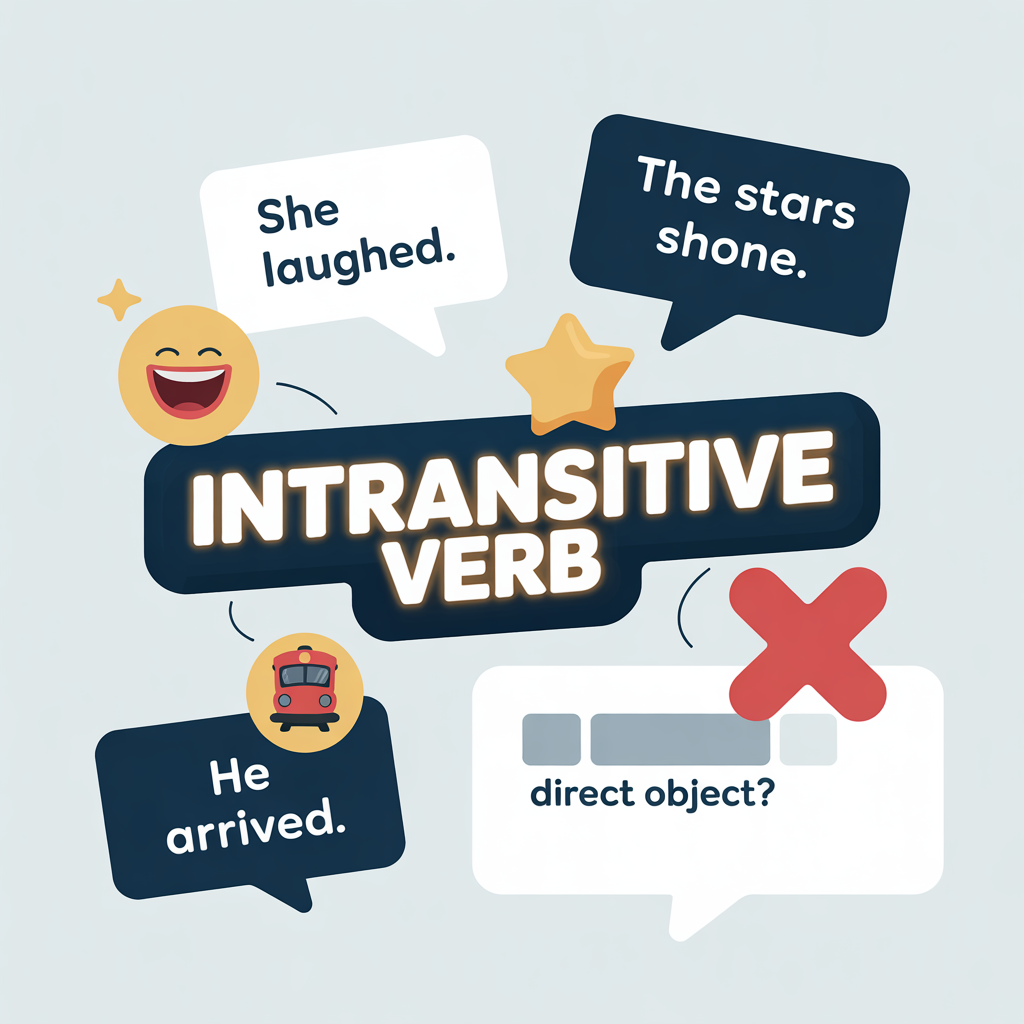
Every sentence you speak or write relies on a verb — the engine that drives meaning forward. But not all verbs work the same way. Some verbs demand an object to complete their meaning; others stand perfectly on their own. That second type is the intransitive verb, and understanding it is one of the most practical steps you can take toward writing clearer, stronger English. Whether you’re a student, a non-native speaker, or simply someone who wants to sharpen their grammar skills, this guide will give you everything you need to know.
What Is an Intransitive Verb?
An intransitive verb is a verb that does not require a direct object to complete its meaning. In other words, the action expressed by the verb begins and ends with the subject — nothing receives that action.
Consider this simple example:
- “The baby slept.”
There is no object here. You don’t need to ask “slept what?” or “slept whom?” The verb slept is complete all by itself. That makes it an intransitive verb.
This is the core definition you’ll find in virtually every grammar textbook: an intransitive verb is a verb that takes no direct object.
Quick Tip: A direct object is the noun or pronoun that receives the action of a verb. If you can answer “what?” or “whom?” after the verb, it has a direct object. If you can’t, the verb is likely intransitive.
Intransitive Verbs vs. Transitive Verbs: What’s the Difference?
To fully grasp what an intransitive verb is, it helps to place it side by side with its counterpart: the transitive verb.
- A transitive verb transfers action to a direct object. The object is necessary for the sentence to make sense.
- An intransitive verb expresses an action or state that is complete without any object.
| Type | Example Sentence | Direct Object? |
|---|---|---|
| Transitive | She kicked the ball. | Yes — “the ball” |
| Intransitive | She laughed. | No |
| Transitive | He wrote a letter. | Yes — “a letter” |
| Intransitive | He arrived. | No |
Notice that some verbs — like write — can be both transitive and intransitive depending on how they are used. More on that below.
Common Examples of Intransitive Verbs
Here is a collection of frequently used intransitive verbs in English, grouped by the type of meaning they express:
Movement and Physical Action
- run — “The children ran across the field.”
- jump — “The athlete jumped.”
- fall — “Leaves fall in autumn.”
- swim — “We swam for hours.”
- walk — “She walked slowly.”
- arrive — “The train arrived on time.”
States of Being and Natural Occurrence
- exist — “Problems exist everywhere.”
- happen — “Accidents happen.”
- appear — “A star appeared on the horizon.”
- disappear — “The fog disappeared.”
- die — “The old tree died last winter.”
Expression and Communication
- laugh — “Everyone laughed.”
- cry — “The child cried.”
- speak — “The professor spoke clearly.”
- shout — “He shouted.”
Sleep, Rest, and Biological Functions
- sleep — “The dog slept all day.”
- sit — “Please sit.”
- stand — “He stood by the window.”
- breathe — “She breathed deeply.”
How to Identify an Intransitive Verb in a Sentence
Identifying an intransitive verb is straightforward once you know the test to apply. Follow these two steps:
Step 1: Find the Verb
Locate the action word or state-of-being word in the sentence.
Step 2: Ask “What?” or “Whom?” After the Verb
If the question produces a meaningful answer that is part of the sentence, the verb is transitive. If the question produces no logical answer, the verb is intransitive.
Example 1: “The stars shone.”
- Shone what? — No answer. ✅ Intransitive.
Example 2: “She read the novel.”
- Read what? — “The novel.” ❌ Transitive.
Example 3: “The music played.”
- Played what? — No answer. ✅ Intransitive.
Intransitive Verbs Can Still Have Modifiers
One common misconception is that intransitive verbs must appear alone. In reality, they can — and often do — appear with adverbs, prepositional phrases, and other modifiers. These additions tell us how, when, where, or why the action occurred. They are not direct objects.
- “She slept soundly.” (adverb)
- “He arrived at noon.” (prepositional phrase)
- “The birds sang in the morning.” (prepositional phrase)
- “They ran very quickly.” (adverb phrase)
Notice that none of the italicized parts answer “what?” or “whom?” after the verb. They provide context but do not receive the action.
Verbs That Can Be Both Transitive and Intransitive
Here is where English gets genuinely interesting — and occasionally tricky. Many English verbs can function as either transitive or intransitive, depending entirely on how they are used in a sentence. Linguists call these ambitransitive verbs.
Let’s look at several important examples:
The Verb “Run”
- Intransitive: “She runs every morning.” (No object)
- Transitive: “She runs a successful business.” (Object: “a successful business”)
The Verb “Eat”
- Intransitive: “We ate at 6 p.m.” (No object)
- Transitive: “We ate dinner at 6 p.m.” (Object: “dinner”)
The Verb “Write”
- Intransitive: “She writes beautifully.” (No object)
- Transitive: “She writes poetry.” (Object: “poetry”)
The Verb “Sing”
- Intransitive: “He sang all evening.” (No object)
- Transitive: “He sang a lullaby.” (Object: “a lullaby”)
This dual nature is one reason why dictionaries mark verbs with abbreviations like v.i. (verb intransitive) and v.t. (verb transitive). Context is everything.
Intransitive Verbs and Linking Verbs: An Important Distinction
Some people confuse intransitive verbs with linking verbs. While both types do not take direct objects, they behave quite differently.
- A linking verb (such as be, seem, appear, become, feel, taste, smell, look) connects the subject to a subject complement — a word that describes or renames the subject.
- An intransitive verb expresses an action or occurrence that stands on its own.
Compare:
- “She seems tired.” — Linking verb. Tired is a subject complement (predicate adjective), not a direct object.
- “She slept.” — Intransitive action verb. No complement needed.
The key test: can you replace the verb with a form of be and still have the sentence make sense? If yes, it’s likely a linking verb. If no, it’s probably an action verb — which may be intransitive.
Why Does It Matter? The Real-World Importance of Intransitive Verbs
You might wonder: why do I need to know whether a verb is intransitive or not? The answer is more practical than it might seem.
1. Writing Clarity
Knowing that a verb is intransitive helps you avoid awkward or grammatically incorrect sentences. For example, die is an intransitive verb. You cannot say “She died her friend” — that’s not how the verb works. Understanding verb transitivity helps you construct grammatically sound sentences.
2. Avoiding Passive Voice Errors
Only transitive verbs can typically form passive voice constructions, because passive voice requires a direct object to become the subject. Intransitive verbs generally cannot be made passive.
- Transitive passive: “The letter was written by her.” ✅
- Intransitive (incorrect passive): “Sleep was slept by the cat.” ❌
3. Learning Foreign Languages
In many languages — including French, German, Italian, Japanese, and Spanish — whether a verb is transitive or intransitive affects the auxiliary verb used in compound tenses, pronoun agreement, and more. A strong understanding of transitivity in English makes learning these distinctions in other languages far easier.
4. Standardized Tests and Academic Writing
Exams like the SAT, GRE, TOEFL, and IELTS frequently test verb usage and sentence structure. Being able to identify and correctly use intransitive verbs gives you a measurable advantage.
Intransitive Verbs in Different Contexts and Registers
Intransitive verbs appear in every type of writing and speech, from casual conversation to formal literature. Understanding how they shift meaning across contexts enriches your command of the language.
In Literature and Poetry
Poets and literary writers frequently favor intransitive verbs for their sense of completeness and stillness. Verbs like gleam, hover, tremble, linger, and vanish carry emotional weight without needing objects to anchor them.
- “The candle flickered.”
- “He wept.”
In Scientific and Technical Writing
Technical writing also relies heavily on intransitive verbs to describe processes and phenomena.
- “The pressure increased.”
- “The solution crystallized.”
- “The cell divided.”
In Everyday Speech
Much of our everyday language uses intransitive constructions without us even noticing.
- “Wait!”
- “He snores.”
- “The phone rang.”
A Deeper Look: Ergative Verbs and Causative Constructions
For those who want to go a level deeper, it’s worth noting that some intransitive verbs belong to a special class called ergative verbs (sometimes called “labile” or “causative-inchoative” verbs in linguistics). These verbs can appear both transitively and intransitively, and interestingly, the subject of the intransitive form corresponds to the object of the transitive form.
- Transitive: “The chef melted the butter.” (Chef = agent; butter = object)
- Intransitive: “The butter melted.” (Butter = subject, but it’s the thing undergoing the action)
Other examples of ergative verbs include: open, close, break, grow, boil, freeze, move, change, stop.
This pattern is especially useful in scientific writing, cooking instructions, and procedural texts where you want to focus on the process rather than the agent causing it.
Quick Reference: Most Common Purely Intransitive Verbs in English
Some verbs in English are almost always intransitive — it is very rare (or impossible) to use them with a direct object. Memorizing these will serve you well:
- arrive — “We arrived late.”
- die — “The plant died.”
- fall — “Snow fell.”
- go — “They went home.”
- happen — “It happened suddenly.”
- laugh — “We laughed.”
- lie (recline) — “He lay on the couch.”
- rise — “The sun rises.”
- sleep — “The baby sleeps.”
- sneeze — “She sneezed.”
- swim — “Fish swim.”
- wait — “Please wait.”
- weep — “She wept quietly.”
- yawn — “He yawned.”
Conclusion
An intransitive verb is, at its heart, a verb that needs no direct object — it expresses a complete action or occurrence all on its own. From the simple act of sleeping to the beauty of a star appearing on the horizon, intransitive verbs form the backbone of natural, expressive English. Recognizing them, distinguishing them from transitive and linking verbs, and knowing when a verb can swing between both categories will make you a more confident and precise communicator. Grammar isn’t just a set of rules — it’s a toolkit. And understanding intransitive verbs gives you one more essential tool to use well.
Frequently Asked Questions (FAQs)
Can an intransitive verb ever have an object?
No. By definition, an intransitive verb does not take a direct object. However, it can have indirect objects in very rare constructions, and it can certainly be accompanied by adverbs and prepositional phrases that add meaning without acting as objects.
Is “be” an intransitive verb?
The verb be (and its forms: am, is, are, was, were) is classified as a linking verb, not an action verb. It connects a subject to its complement. While it doesn’t take a direct object (making it similar in that way to intransitive verbs), it belongs to its own category in traditional grammar.
What is the difference between an intransitive verb and a complete predicate?
A complete predicate refers to the verb plus all its modifiers and complements. An intransitive verb is a classification of the verb itself. An intransitive verb can form a complete predicate either alone (“She laughed.”) or with adverbial modifiers (“She laughed loudly at the joke.”).
Do intransitive verbs have passive forms?
Generally, no. Passive voice requires a direct object from the active form to serve as the subject of the passive sentence. Since intransitive verbs have no direct objects, they typically cannot be converted into passive voice. There are some unusual exceptions in informal speech (“The bed was slept in”), but these are not standard usage.
How do I know if a verb is transitive or intransitive in a dictionary?
Most dictionaries label verbs with abbreviations. Look for vi or v.i. (verb intransitive) and vt or v.t. (verb transitive). Many modern dictionaries also provide both listings for the same word to show its dual usage.