
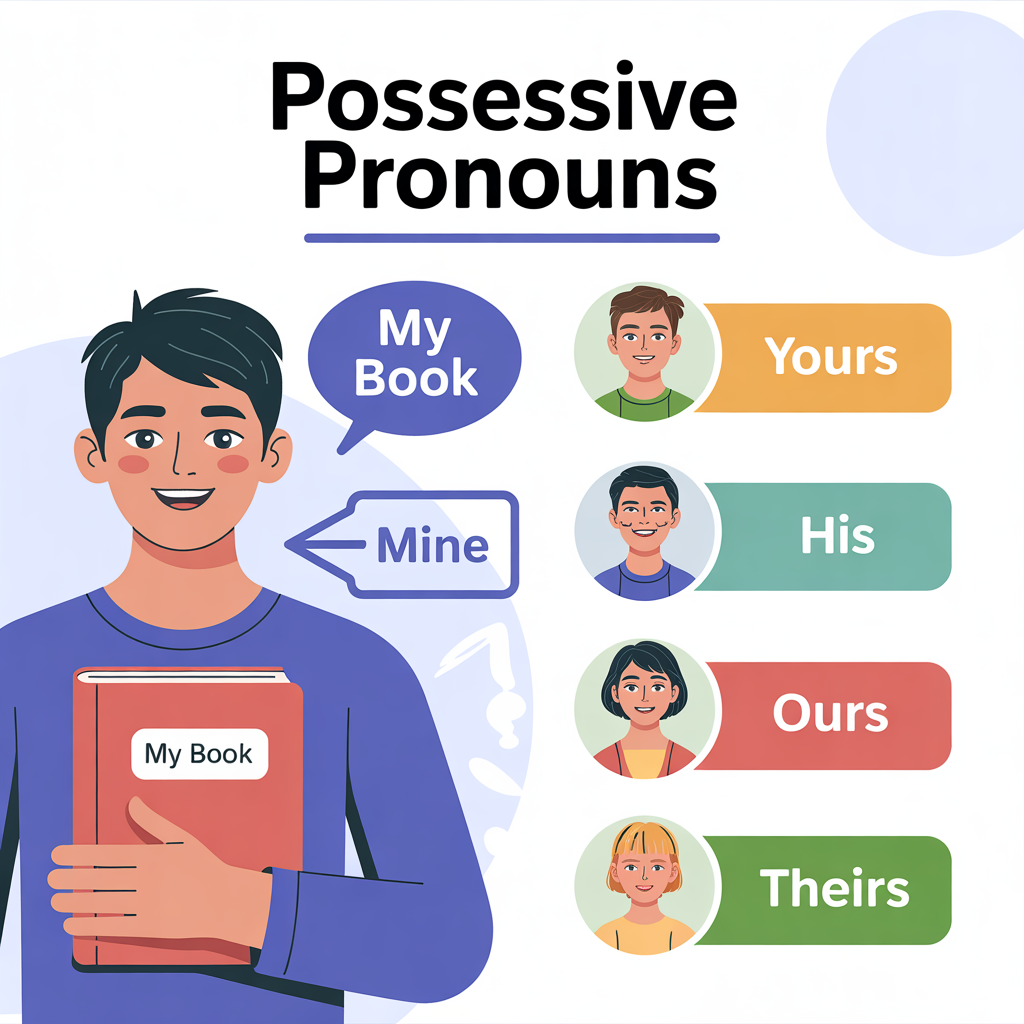
You use them every single day without thinking twice. “That book is mine.” “Is this bag yours?” “The decision was hers.” These small but powerful words — possessive pronouns — do a surprisingly important job in the English language. They tell us who owns something, and they do it without repeating a noun. But what exactly is a possessive pronoun, how does it work, and how is it different from similar-looking words? This guide answers every question you might have, from the basics to the trickier edge cases, with plenty of real-world examples along the way.
What Is a Possessive Pronoun?
A possessive pronoun is a type of pronoun that shows ownership or belonging. It replaces a noun phrase that already includes a possessive word, so you don’t have to repeat yourself.
Instead of saying “That is Maria’s car. I like Maria’s car,” you can say “That is Maria’s car. I like hers.” The word hers replaces Maria’s car — no repetition needed.
In more formal terms, a possessive pronoun is a standalone word that functions as a noun in a sentence while simultaneously communicating possession. It does not need to be followed by a noun.
The Core Possessive Pronouns in English
English has a small, fixed set of possessive pronouns. They correspond to each personal pronoun:
| Personal Pronoun | Possessive Pronoun | Example Sentence |
|---|---|---|
| I | mine | This jacket is mine. |
| You | yours | Is this seat yours? |
| He | his | The laptop on the desk is his. |
| She | hers | That coffee cup is hers. |
| It | its (rare) | The territory was its. |
| We | ours | The victory is ours. |
| They | theirs | The house at the corner is theirs. |
Notice something important: none of these words use an apostrophe. This is a very common source of confusion, which we’ll address in detail shortly.
How Does a Possessive Pronoun Work in a Sentence?
A possessive pronoun always works as a noun substitute. This means it can occupy any position in a sentence where a noun or noun phrase would normally go — as a subject, object, or complement.
As a Subject
The possessive pronoun acts as the subject of the verb.
- Mine is the blue bicycle near the gate.
- Hers arrived first in the mail.
As a Subject Complement (Predicate Nominative)
This is the most common position — appearing after a linking verb like is, are, was, or were.
- That phone is mine.
- The new offices will be ours.
- Both ideas were theirs.
As a Direct Object
The possessive pronoun receives the action of the verb directly.
- I borrowed hers because I forgot mine.
- She returned his yesterday.
As an Object of a Preposition
- I sat next to yours at the show.
- He spoke on behalf of ours.
In every single case, notice that the possessive pronoun stands alone. It never directly precedes a noun. The moment it does, it shifts into a different category entirely — which brings us to one of the most important distinctions in English grammar.
Possessive Pronouns vs. Possessive Adjectives (Possessive Determiners)
This is where many learners — and even native speakers — get confused. Possessive adjectives (also called possessive determiners) look very similar to possessive pronouns but function completely differently.
Here is the golden rule:
- A possessive pronoun stands alone. It replaces a noun phrase.
- A possessive adjective modifies a noun. It must be followed by a noun.
| Person | Possessive Adjective | Possessive Pronoun |
|---|---|---|
| 1st singular | my | mine |
| 2nd singular/plural | your | yours |
| 3rd singular (m) | his | his |
| 3rd singular (f) | her | hers |
| 3rd singular (n) | its | its (rare) |
| 1st plural | our | ours |
| 3rd plural | their | theirs |
Side-by-Side Comparison
Look at how the same meaning shifts depending on whether you use an adjective or a pronoun:
- This is my car. (possessive adjective — my modifies car)
- This car is mine. (possessive pronoun — mine replaces my car)
- I love their music. (possessive adjective — their modifies music)
- I love theirs. (possessive pronoun — theirs replaces their music)
An easy test: If you can place a noun immediately after the word without it sounding wrong, it’s a possessive adjective. If you cannot (because it already replaces the noun), it’s a possessive pronoun.
Why Possessive Pronouns Never Use Apostrophes
This is one of the most persistent grammar mistakes in written English. Many people write it’s when they mean its, or even write your’s instead of yours. Here’s why that’s wrong.
Apostrophes in English signal two things:
- A contraction (a letter has been left out): it’s = it is, you’re = you are
- A possessive noun: Maria’s book, the dog’s collar
Possessive pronouns already contain the idea of possession built into their form. They do not need — and grammatically cannot use — an apostrophe. Adding one changes the word into something else entirely:
- its = possessive pronoun/adjective: The company lost its license.
- it’s = contraction of it is: It’s raining outside.
- your = possessive adjective: Is this your bag?
- you’re = contraction of you are: You’re doing great!
- their = possessive adjective: Their house is beautiful.
- they’re = contraction of they are: They’re coming tomorrow.
- there = adverb of place: Put it over there.
The confusion is understandable because we do use apostrophes for possession with nouns (John’s car). But pronouns are a different story. When in doubt, try substituting “it is” for “it’s” — if the sentence still makes sense, use the apostrophe. If it breaks the meaning, use its without one.
The Special Case of “His”
You may have noticed in the tables above that his appears in both the possessive adjective and possessive pronoun columns. This is because his has the same form whether it precedes a noun or stands alone.
- That is his umbrella. (possessive adjective — precedes umbrella)
- That umbrella is his. (possessive pronoun — stands alone)
Context makes the meaning clear. When his appears before a noun, it’s functioning as an adjective. When it stands alone after a verb like is, it’s acting as a pronoun.
The Rarely Used Possessive Pronoun “Its”
While its technically exists as a possessive pronoun, it is almost never used in everyday English. This is partly because referring to an object’s ownership in this standalone way sounds unnatural:
- The collar belongs to the dog. The collar is its. — grammatically possible, but very awkward in natural speech.
Native speakers almost always restructure such sentences to avoid this construction. You would more naturally say: “That collar is the dog’s” or “It belongs to the dog.” So while you should be aware its exists, don’t worry too much about using it as a standalone possessive pronoun in conversation or writing.
Possessive Pronouns with “Of” Phrases (Double Genitive)
English has an interesting construction where a possessive pronoun is used after the preposition of. This is sometimes called the double genitive or post-genitive. It’s completely standard in English and you’ve probably said these phrases thousands of times:
- She is a friend of mine. (not a friend of me)
- He is a colleague of yours.
- That idea of hers was brilliant.
- A cousin of ours visited last week.
This construction emphasizes that the person or thing is one among others. “A friend of mine” implies you have more than one friend; it’s just this particular one you’re mentioning. It adds a natural, idiomatic feel to English that the possessive adjective construction (“my friend”) doesn’t always convey.
Possessive Pronouns in Questions
Possessive pronouns are used frequently in questions, both to ask about ownership and to confirm it.
- Whose is this coat? — It’s mine.
- Is that notebook yours or hers?
- I can’t find my keys — are these yours?
- Whose turn is it? — It’s ours!
The interrogative pronoun whose pairs naturally with possessive pronouns in answers. Whose? is the question; a possessive pronoun typically gives the answer.
Common Mistakes with Possessive Pronouns (And How to Fix Them)
Even fluent English speakers make errors with possessive pronouns. Here are the most frequent mistakes and how to correct them:
Mistake 1: Using an apostrophe
- ❌ The decision is your’s.
- ✅ The decision is yours.
Mistake 2: Confusing “its” and “it’s”
- ❌ The company released it’s annual report.
- ✅ The company released its annual report.
Mistake 3: Confusing “their,” “there,” and “they’re”
- ❌ They left there bags at the door.
- ✅ They left their bags at the door.
Mistake 4: Using a possessive adjective where a pronoun is needed
- ❌ That car is my.
- ✅ That car is mine.
Mistake 5: Using “mines” instead of “mine”
This is a common informal error, especially in some dialects.
- ❌ That phone is mines.
- ✅ That phone is mine.
Possessive Pronouns vs. Reflexive Pronouns
Learners sometimes mix up possessive pronouns with reflexive pronouns (myself, yourself, himself, herself, itself, ourselves, themselves). These are very different in both form and function.
- Possessive pronouns indicate ownership: The success was hers.
- Reflexive pronouns reflect back to the subject of the verb or add emphasis: She did it herself.
Reflexive pronouns cannot replace noun phrases the way possessive pronouns can. They serve entirely different grammatical purposes.
Using Possessive Pronouns in Formal vs. Informal Writing
Possessive pronouns are appropriate in virtually every register — from casual conversation to formal academic writing. However, there are a few stylistic points worth noting:
- In formal writing: Possessive pronouns help avoid awkward noun repetition and make prose cleaner. “The committee submitted its report, and ours followed shortly after” is more elegant than repeating the noun.
- In legal or official documents: Precision is key. Possessive pronouns are still used, but writers often make the antecedent (the noun being replaced) as clear as possible to avoid ambiguity.
- In creative writing: Possessive pronouns contribute to natural dialogue and smooth narrative flow. Characters don’t repeat nouns when pronouns make the meaning clear.
Quick-Reference Summary
Here is everything you need to remember about possessive pronouns at a glance:
- They are: mine, yours, his, hers, its, ours, theirs
- They stand alone — never directly before a noun
- They never use apostrophes
- They replace a full noun phrase (e.g., my book → mine)
- They express ownership or belonging
- They can serve as subject, object, or complement in a sentence
- They are used naturally in “of” phrases: a friend of mine
Conclusion
A possessive pronoun is one of those grammatical tools that makes English more efficient, natural, and elegant. By standing in for an entire noun phrase, it keeps sentences clean and prevents unnecessary repetition. The core group — mine, yours, his, hers, its, ours, theirs — is small enough to memorize quickly, but knowing how they work and how they differ from possessive adjectives is what truly elevates your language skills.
The most important things to remember? These words never take an apostrophe, they always stand alone (never directly in front of a noun), and they carry a complete sense of ownership without needing extra words. Master these principles, and you’ll use possessive pronouns with complete confidence in both speaking and writing.
Frequently Asked Questions
What is a possessive pronoun in simple terms?
A possessive pronoun is a word that shows who owns something and replaces a noun phrase so you don’t have to repeat it. Words like mine, yours, his, hers, ours, and theirs are all possessive pronouns. For example: “That bag is mine” — mine tells you the bag belongs to me without needing to say “my bag” again.
What is the difference between a possessive pronoun and a possessive adjective?
A possessive adjective (like my, your, her, their) always comes before a noun and modifies it. A possessive pronoun (like mine, yours, hers, theirs) stands alone and replaces the noun phrase entirely. Example: “my car” (adjective) vs. “The car is mine” (pronoun).
Do possessive pronouns have apostrophes?
No. Possessive pronouns never use apostrophes. Writing your’s, her’s, or their’s is always incorrect. The apostrophe in English is used for contractions and possessive nouns, not for possessive pronouns, which already carry the meaning of ownership in their form.
Is “whose” a possessive pronoun?
Yes, whose is often classified as a possessive pronoun (or possessive relative pronoun/interrogative pronoun depending on its use). It asks about possession: “Whose jacket is this?” Unlike the main set of possessive pronouns, it is used to form questions and relative clauses.
Can “his” be both a possessive adjective and a possessive pronoun?
Yes. His is the only possessive pronoun that has the same form as its corresponding possessive adjective. When it comes before a noun (“his book”), it is an adjective. When it stands alone (“The book is his”), it is a pronoun. Context makes the difference clear.
What is “a friend of mine” called grammatically?
This construction is called a double genitive (or post-genitive). It uses the possessive pronoun after the preposition of. It is completely standard in English and is used to indicate that someone or something is one of several: “a colleague of yours,” “an idea of hers.”