
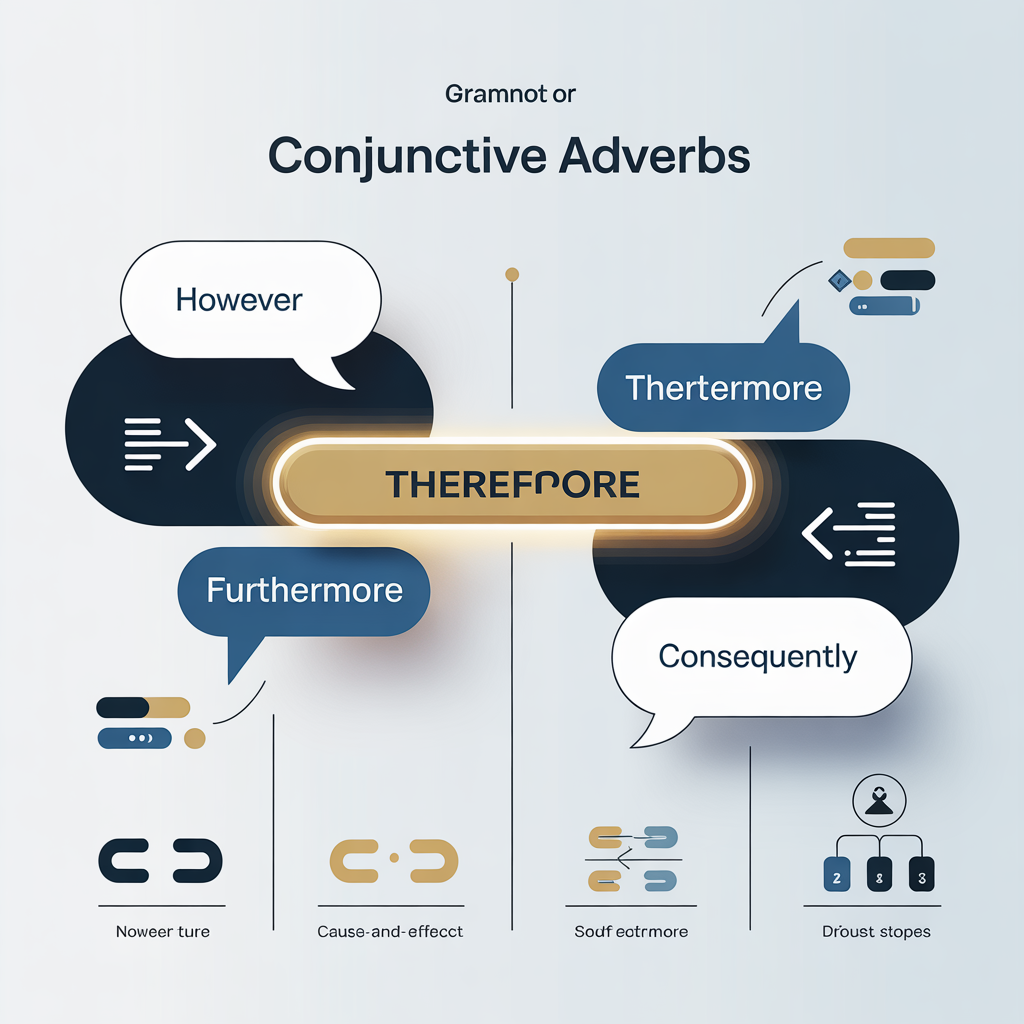
You’ve probably used words like however, therefore, and meanwhile countless times in your writing — but did you know these words belong to a very specific grammatical category? They’re called conjunctive adverbs, and understanding how they work can dramatically improve the clarity, flow, and sophistication of your writing. Whether you’re crafting a business email, an academic essay, or a creative piece, these little words carry a lot of weight.
What Are Conjunctive Adverbs? (A Clear Definition)
A conjunctive adverb is a type of adverb that connects two independent clauses or sentences, showing the logical relationship between them. Think of them as a bridge — they signal how one idea relates to another, whether that’s through contrast, cause and effect, sequence, addition, or emphasis.
The term itself breaks down neatly:
- Conjunctive = connecting or joining (from the Latin conjungere, meaning “to join together”)
- Adverb = a word that modifies a verb, adjective, or other adverb, or in this case, modifies an entire clause
So a conjunctive adverb does double duty: it functions as an adverb (modifying the clause that follows it) and as a conjunction (linking two ideas together). However — and this is crucial — conjunctive adverbs are not true coordinating conjunctions like and, but, or so. They work differently, and they require different punctuation.
Example:
“She studied hard. Therefore, she passed the exam.”
Here, therefore connects the two sentences and signals a cause-and-effect relationship.
How Do Conjunctive Adverbs Work Grammatically?
This is where many writers get tripped up, so let’s walk through this carefully.
A conjunctive adverb can appear in one of three main positions:
1. At the Beginning of a Sentence (After a Period or Semicolon)
This is the most common placement. When a conjunctive adverb starts a new sentence or follows a semicolon, it’s followed by a comma.
- “The project was delayed. However, the team remained optimistic.”
- “The project was delayed; however, the team remained optimistic.”
2. In the Middle of a Sentence (Interrupting a Clause)
When a conjunctive adverb appears mid-sentence, it’s set off with commas on both sides.
- “The team, however, remained optimistic about the outcome.”
3. At the End of a Sentence
Less common, but grammatically valid. A comma precedes the conjunctive adverb.
- “She wasn’t sure about the decision, however.”
The key grammatical rule: when a conjunctive adverb joins two independent clauses in a single sentence, use a semicolon before it and a comma after it.
Correct: “I wanted to go to the gym; nevertheless, I was too tired.”
Incorrect: “I wanted to go to the gym, nevertheless I was too tired.” ← This creates a comma splice!
Conjunctive Adverbs vs. Coordinating Conjunctions vs. Subordinating Conjunctions
It’s easy to confuse these three types of connectors. Here’s a quick breakdown:
| Type | Examples | Function | Punctuation Rule |
|---|---|---|---|
| Conjunctive Adverbs | however, therefore, moreover | Connects two independent clauses; can move within a sentence | Semicolon before; comma after |
| Coordinating Conjunctions | for, and, nor, but, or, yet, so (FANBOYS) | Joins two independent clauses | Comma before the conjunction |
| Subordinating Conjunctions | because, although, since, when | Introduces a dependent clause | Comma if clause comes first |
The biggest practical difference: conjunctive adverbs can be moved around in a sentence, while coordinating conjunctions cannot. You can say “The results were surprising; however, we moved forward” — and also “The results were surprising; we moved forward, however.” Try doing that with but — it doesn’t work the same way.
Complete List of Common Conjunctive Adverbs by Category
Conjunctive adverbs fall into several semantic categories based on the relationship they express between ideas. Here’s a comprehensive reference list:
Contrast / Opposition
These signal that the second idea is different from, or conflicts with, the first.
- however
- nevertheless
- nonetheless
- on the other hand
- conversely
- instead
- otherwise
- still
“The data was inconclusive; nevertheless, the researchers published their findings.”
Cause and Effect / Result
These show that the second idea is a logical outcome or consequence of the first.
- therefore
- thus
- consequently
- as a result
- hence
- accordingly
- so (when used as an adverb)
“The server crashed unexpectedly; consequently, all unsaved data was lost.”
Addition / Emphasis
These add more information or reinforce a point already made.
- furthermore
- moreover
- in addition
- besides
- also
- likewise
- similarly
- indeed
“The new policy reduced costs; furthermore, it improved employee morale.”
Time / Sequence
These indicate when something happens or the order in which events occur.
- then
- meanwhile
- subsequently
- finally
- afterward
- previously
- next
“The team completed the first phase; subsequently, they moved on to testing.”
Clarification / Illustration
These introduce an explanation, example, or restatement.
- for example
- for instance
- that is
- in other words
- namely
“She is remarkably disciplined; for instance, she wakes up at 5 a.m. every day.”
Concession
These acknowledge a point before introducing a counterpoint or qualification.
- admittedly
- granted
- at least
- of course
“The app has bugs; admittedly, the core functionality works well.”
Why Conjunctive Adverbs Matter in Writing
Conjunctive adverbs are far more than a grammatical technicality — they are essential tools for coherent, sophisticated writing. Here’s why they matter:
They Create Logical Flow
Without transitional words, writing can feel choppy and disconnected. Conjunctive adverbs guide the reader through your argument or narrative, making the logic explicit. The reader always knows whether you’re adding to an idea, contrasting it, or showing its consequences.
They Signal Your Intelligence as a Writer
Academic writing, professional communication, and high-quality journalism all rely heavily on conjunctive adverbs. Using them correctly signals that you understand the relationships between ideas — not just how to state them, but how they connect.
They Improve Sentence Variety
Rather than stringing clauses together with and and but, conjunctive adverbs give you a richer vocabulary for connection. Compare:
- Basic: “The weather was bad and the game was cancelled.”
- Refined: “The weather was bad; consequently, the game was cancelled.”
They Help Avoid Comma Splices
Knowing the rules around conjunctive adverbs also helps you avoid one of the most common writing errors: the comma splice (joining two independent clauses with just a comma). Using a semicolon before your conjunctive adverb is a clean, grammatically correct solution.
Common Mistakes Writers Make with Conjunctive Adverbs
Even experienced writers make errors with these words. Here are the most frequent pitfalls to watch out for:
Mistake 1: The Comma Splice
Using a comma alone before a conjunctive adverb when joining two independent clauses.
- ❌ “I was hungry, therefore I ordered pizza.”
- ✅ “I was hungry; therefore, I ordered pizza.”
- ✅ “I was hungry. Therefore, I ordered pizza.”
Mistake 2: Missing the Comma After the Conjunctive Adverb
When a conjunctive adverb begins a clause, it must be followed by a comma.
- ❌ “She failed the test; however she studied harder next time.”
- ✅ “She failed the test; however, she studied harder next time.”
Mistake 3: Confusing “However” with “But”
However and but both signal contrast, but they follow different punctuation rules. But is a coordinating conjunction and uses a comma before it (not a semicolon). However as a conjunctive adverb uses a semicolon before it and a comma after.
- ✅ “She tried hard, but she didn’t succeed.”
- ✅ “She tried hard; however, she didn’t succeed.”
Mistake 4: Overusing the Same Conjunctive Adverb
Repeating “however” or “therefore” in every paragraph makes writing monotonous. Vary your transitions. Use nevertheless, nonetheless, on the other hand, or yet for contrast; use thus, consequently, or as a result for cause and effect.
Mistake 5: Using a Conjunctive Adverb to Connect a Dependent Clause
Conjunctive adverbs connect independent clauses only — each clause must be able to stand alone as a complete sentence.
- ❌ “I went to the store; however was closed.” ← “was closed” is not a complete clause.
- ✅ “I went to the store; however, it was closed.”
Conjunctive Adverbs in Academic vs. Everyday Writing
The frequency and type of conjunctive adverbs used varies significantly across writing contexts.
In Academic Writing
Academic writing depends heavily on conjunctive adverbs to build arguments. Words like therefore, consequently, moreover, and thus signal logical reasoning, and their correct use is often assessed in essays and research papers. Formal transitions demonstrate that a writer can construct a coherent argument, not just list points.
In Professional / Business Writing
Business emails, reports, and proposals also benefit from conjunctive adverbs. Furthermore, accordingly, and as a result help convey precision and confidence. However, in shorter business communications, it’s fine to keep things simple — not every sentence needs a formal transition.
In Creative Writing
Creative writing uses conjunctive adverbs more sparingly, as heavy transitional language can feel stiff or overly formal in narrative prose. When used, simpler ones like then, meanwhile, and still tend to work best because they maintain momentum without interrupting the story’s voice.
In Everyday Conversation
In spoken English, we use conjunctive adverbs all the time — we just don’t think of them that way. “I was tired, but I went anyway” transitions naturally in speech. In casual writing (texts, social media), these formal connectors are largely replaced by simple words like “but,” “so,” and “also.”
Quick Practice: Identifying Conjunctive Adverbs
Test your understanding. Identify the conjunctive adverb in each sentence:
- “The budget was tight; nonetheless, the event was a success.”
- “He didn’t study; as a result, he failed the quiz.”
- “She is an excellent communicator; moreover, she has years of relevant experience.”
- “They finished the work early; subsequently, they were rewarded with a bonus.”
- “The instructions were unclear; in other words, no one knew what to do.”
In each case, notice how the conjunctive adverb is preceded by a semicolon and followed by a comma, and how it signals a specific logical relationship between the two clauses.
Conclusion
Conjunctive adverbs are small words that do big work. They connect independent ideas, signal logical relationships, and give your writing the kind of clarity and flow that makes readers actually want to keep reading. From however and therefore to consequently and furthermore, these linking words are found in every form of polished writing — academic, professional, journalistic, and beyond.
The key takeaways? Know the punctuation rules (semicolon before, comma after when joining two clauses). Understand the category of relationship you want to express — contrast, cause-effect, sequence, addition, or clarification — and then choose the right word from that group. And finally, vary your choices so your writing doesn’t become repetitive.
Master conjunctive adverbs, and you’ll have a powerful tool in your grammatical toolkit that immediately elevates the quality and coherence of everything you write.
Frequently Asked Questions (FAQs)
What is the difference between a conjunctive adverb and a conjunction?
A conjunction (like and, but, because) is a grammatical connector that cannot be moved within a sentence. A conjunctive adverb (like however, therefore) also connects ideas but functions as an adverb — meaning it can be repositioned within a clause. They also follow different punctuation rules: conjunctive adverbs require a semicolon before them when joining two independent clauses, while coordinating conjunctions require a comma.
Is “however” always a conjunctive adverb?
Not always. When however means “in whatever way,” it functions as a subordinating conjunction or adverb in a different sense — for example, “However you choose to do it, make sure it’s done right.” As a conjunctive adverb, it specifically means “on the other hand” or “despite that,” connecting two independent clauses.
Can a conjunctive adverb start a sentence?
Yes, absolutely. Starting a sentence with a conjunctive adverb like “Therefore,” “However,” or “Consequently,” followed by a comma, is grammatically correct and widely accepted in both formal and informal writing.
What is the most commonly used conjunctive adverb?
However is almost certainly the most frequently used conjunctive adverb in English, appearing regularly in academic papers, news articles, business writing, and everyday prose. It’s a versatile word for signaling contrast or qualification.
Is “also” a conjunctive adverb?
Yes, also can function as a conjunctive adverb when it connects two independent clauses to show addition — for example, “The app is fast; also, it’s free to download.” In this role, it’s synonymous with furthermore or in addition, though it’s considered less formal.
How many conjunctive adverbs are there in English?
There’s no exact number, but most grammarians identify between 40 and 60 core conjunctive adverbs in English. Many multi-word phrases (like on the other hand, as a result, in other words) also function as conjunctive adverbs and are often called conjunctive adverbial phrases.