
Have you ever written a sentence like “She seems tired” or “The soup smells delicious” and wondered what kind of verb that is? It’s not showing any action — so what exactly is it doing? The answer: it’s a linking verb. Linking verbs are one of the most fundamental building blocks of English grammar, yet they’re often misunderstood or overlooked. This guide breaks down everything you need to know — what linking verbs are, how they work, common examples, and how to confidently identify them in any sentence.
What Is a Linking Verb?
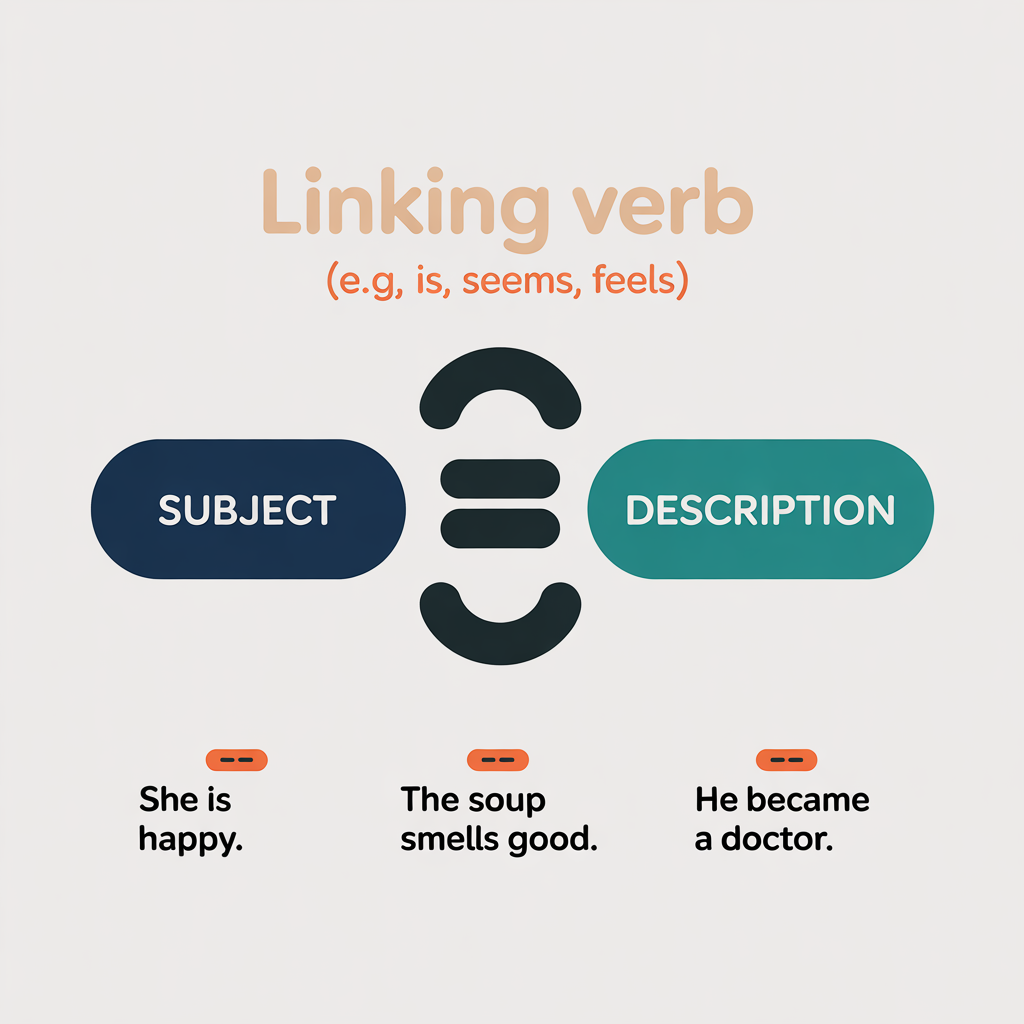
A linking verb is a type of verb that connects the subject of a sentence to a word or phrase that describes or identifies it — known as the subject complement. Unlike action verbs, linking verbs do not express physical or mental action. Instead, they describe a state of being or a condition.
Think of a linking verb as a grammatical equal sign (=). In the sentence “The sky is blue,” the verb is links the subject the sky to the descriptor blue. It’s essentially saying: The sky = blue.
The subject complement that follows a linking verb can be:
- A predicate adjective — an adjective that describes the subject (e.g., She looks happy.)
- A predicate nominative — a noun or pronoun that renames the subject (e.g., He became a doctor.)
The Most Common Linking Verb: “To Be”
The verb to be is by far the most common linking verb in English. It appears in many different forms depending on tense, person, and number:
- am — I am ready.
- is — She is kind.
- are — They are late.
- was — He was a teacher.
- were — We were excited.
- be — It can be difficult.
- being — She is being patient.
- been — They have been sick.
When used as a linking verb, to be simply connects the subject to a description or identification — it carries no action whatsoever.
Complete List of Common Linking Verbs
Beyond to be, English has many other verbs that can function as linking verbs. These are often grouped into two categories: always-linking verbs and sometimes-linking verbs.
Always-Linking Verbs
These verbs are always used as linking verbs — they never function as action verbs:
- be, am, is, are, was, were, been, being
- seem — The task seems simple.
- become — She became a leader.
- remain — He remained calm.
Sometimes-Linking Verbs (Sensory and State Verbs)
These verbs can act either as linking verbs or action verbs, depending on the sentence context. They are often related to the five senses or changes in state:
- look — She looks tired. (linking) / She looks at the painting. (action)
- feel — I feel great. (linking) / I feel the fabric. (action)
- smell — The roses smell sweet. (linking) / The dog smells the ground. (action)
- taste — The cake tastes wonderful. (linking) / She tasted the soup. (action)
- sound — That sounds interesting. (linking)
- appear — He appears confident. (linking)
- grow — The nights grew longer. (linking)
- turn — The leaves turn yellow. (linking)
- prove — The plan proved effective. (linking)
- stay — Please stay alert. (linking)
- keep — Keep calm. (linking)
- go — The milk went bad. (linking)
- get — She got angry. (linking)
- fall — He fell ill. (linking)
- run — The well ran dry. (linking)
- come — Her dream came true. (linking)
- make — She made a good teacher. (linking)
How to Identify a Linking Verb in a Sentence
The most useful trick to identify a linking verb is the substitution test: try replacing the verb in question with a form of to be (is, am, are, was, were). If the sentence still makes logical sense, the original verb is likely a linking verb.
Examples of the Substitution Test
- “The food tastes amazing.” → “The food is amazing.” ✅ Logical → tastes is a linking verb here.
- “She feels the cold water.” → “She is the cold water.” ❌ Doesn’t make sense → feels is an action verb here.
- “He grew nervous.” → “He was nervous.” ✅ Logical → grew is a linking verb here.
Another way to check: ask yourself, “Does the verb show action?” If there is no actor performing a physical or mental deed, it’s likely a linking verb. Ask also, “Is the word after the verb describing or renaming the subject?” If yes — you’ve found a linking verb.
Linking Verbs vs. Action Verbs
Understanding the difference between linking verbs and action verbs is essential for both grammar comprehension and writing clarity.
| Feature | Linking Verb | Action Verb |
|---|---|---|
| Expresses action? | No | Yes |
| Connects subject to description? | Yes | No |
| Followed by adjective or noun? | Often (predicate adjective/noun) | Followed by object (noun) |
| Can be replaced by “is/was”? | Usually yes | Usually no |
| Example | The soup smells good. | She smells the soup. |
Notice how in “She smells the soup,” there is a clear actor (she) performing a deliberate action on an object (the soup). But in “The soup smells good,” the soup isn’t doing anything — it’s simply being described. That’s the core distinction.
Linking Verbs vs. Helping Verbs
Students sometimes confuse linking verbs with helping verbs (also called auxiliary verbs). While they can look similar, they function differently.
- A helping verb works alongside a main verb to form a verb phrase. It helps express tense, mood, or voice.
Example: She is running. — Here, is is a helping verb supporting the action verb running. - A linking verb stands alone and links the subject to a complement — with no main action verb following it.
Example: She is tired. — Here, is is a linking verb connecting she to the adjective tired.
The key test: if the verb is followed by another verb form (-ing, past participle), it’s likely a helping verb. If it’s followed by an adjective or a noun, it’s likely a linking verb.
Linking Verbs and Subject Complements
One of the most important grammar concepts related to linking verbs is the subject complement — the word or phrase that appears after the linking verb and says something about the subject.
There are two types of subject complements:
1. Predicate Adjective
An adjective that follows a linking verb and modifies (describes) the subject.
- The weather is cold. (cold describes the weather)
- He seems exhausted. (exhausted describes him)
- The music sounds beautiful. (beautiful describes the music)
2. Predicate Nominative (Predicate Noun)
A noun or pronoun that follows a linking verb and renames or identifies the subject.
- She is a nurse. (a nurse renames she)
- He became the president. (the president renames he)
- That was a mistake. (a mistake renames that)
Why Linking Verbs Matter in Writing
Linking verbs are essential tools in both spoken and written English. Here’s why understanding them matters:
- Clarity in description: Linking verbs allow writers to attach qualities directly to subjects without unnecessary complexity. “She seems uncertain” is clean and direct.
- Sentence variety: Knowing when to use a linking verb versus an action verb helps writers vary their sentence structure and avoid monotony.
- Grammatical accuracy: Understanding that adjectives (not adverbs) follow linking verbs prevents common mistakes. For example, “I feel bad“ is correct, not “I feel badly“ — because bad is a predicate adjective modifying the subject I.
- Reading comprehension: Recognizing linking verbs helps readers understand the relationship between subjects and their descriptions quickly.
Common Mistakes with Linking Verbs
Even experienced writers make errors with linking verbs. Here are a few traps to avoid:
Mistake 1: Using an Adverb Instead of an Adjective
Since linking verbs connect the subject to a description, you should use an adjective — not an adverb — after them.
- ❌ The flowers smell sweetly.
- ✅ The flowers smell sweet.
- ❌ He looks angrily.
- ✅ He looks angry.
Mistake 2: Confusing “Feel Bad” and “Feel Badly”
This is one of the most debated grammar points in English. Because feel is a linking verb when expressing emotional state, the correct form is:
- ✅ I feel bad about what happened.
Saying “feel badly” would technically mean your sense of touch is impaired — not that you’re emotionally distressed.
Mistake 3: Not Recognizing Context
Remember, many verbs are only sometimes linking verbs. Always check the context.
- “The dog looks friendly.” → linking verb (looks = seems)
- “The dog looks at me.” → action verb (looks = directs gaze)
Quick Reference: Linking Verb Examples in Sentences
Here’s a quick-reference table of common linking verbs used in context:
| Linking Verb | Example Sentence | Subject Complement |
|---|---|---|
| is | The road is long. | long (adj) |
| seem | She seems nervous. | nervous (adj) |
| become | He became a chef. | a chef (noun) |
| appear | The results appear promising. | promising (adj) |
| remain | She remained hopeful. | hopeful (adj) |
| feel | I feel confident. | confident (adj) |
| taste | The tea tastes bitter. | bitter (adj) |
| grow | The crowd grew restless. | restless (adj) |
| turn | The sky turned gray. | gray (adj) |
| go | The milk went sour. | sour (adj) |
Conclusion
A linking verb is a verb that connects the subject of a sentence to a description or identification — without expressing action. Instead of showing what the subject does, it tells us what the subject is or how it appears. From the ever-present to be to sensory verbs like smell, taste, and feel, linking verbs are a vital part of English expression.
Mastering linking verbs helps you write with greater precision, avoid common grammar mistakes, and understand how sentences convey meaning at a deeper level. The next time you write “She seems worried” or “That sounds like a great idea,” you’ll know exactly what grammatical work those verbs are doing — and how to use them with confidence.
Frequently Asked Questions (FAQs)
What is a linking verb in simple terms?
A linking verb connects the subject of a sentence to a word that describes or identifies it, without showing any action. For example, in “She is happy,” the word is links she to happy.
What are the most common linking verbs?
The most common linking verb is the verb to be (am, is, are, was, were). Other common ones include seem, become, remain, appear, feel, look, smell, taste, sound, and grow.
How do I know if a verb is a linking verb or an action verb?
Use the substitution test: replace the verb with is or was. If the sentence still makes sense, it’s a linking verb. Also ask: is the word after the verb describing or renaming the subject? If so, you have a linking verb.
Can the same verb be both a linking verb and an action verb?
Yes. Many verbs — such as look, feel, smell, taste, turn, and grow — can function as either, depending on context. “She looks tired” (linking) vs. “She looks at the clock” (action).
Do linking verbs take objects?
No. Linking verbs are followed by subject complements (predicate adjectives or predicate nouns), not objects. This is a key difference from action verbs, which can take direct objects.
Is “feel” always a linking verb?
No. Feel is a linking verb when it describes an emotional or physical state (e.g., “I feel tired”). It becomes an action verb when it describes the physical act of touching something (e.g., “Feel the texture of this cloth”).