
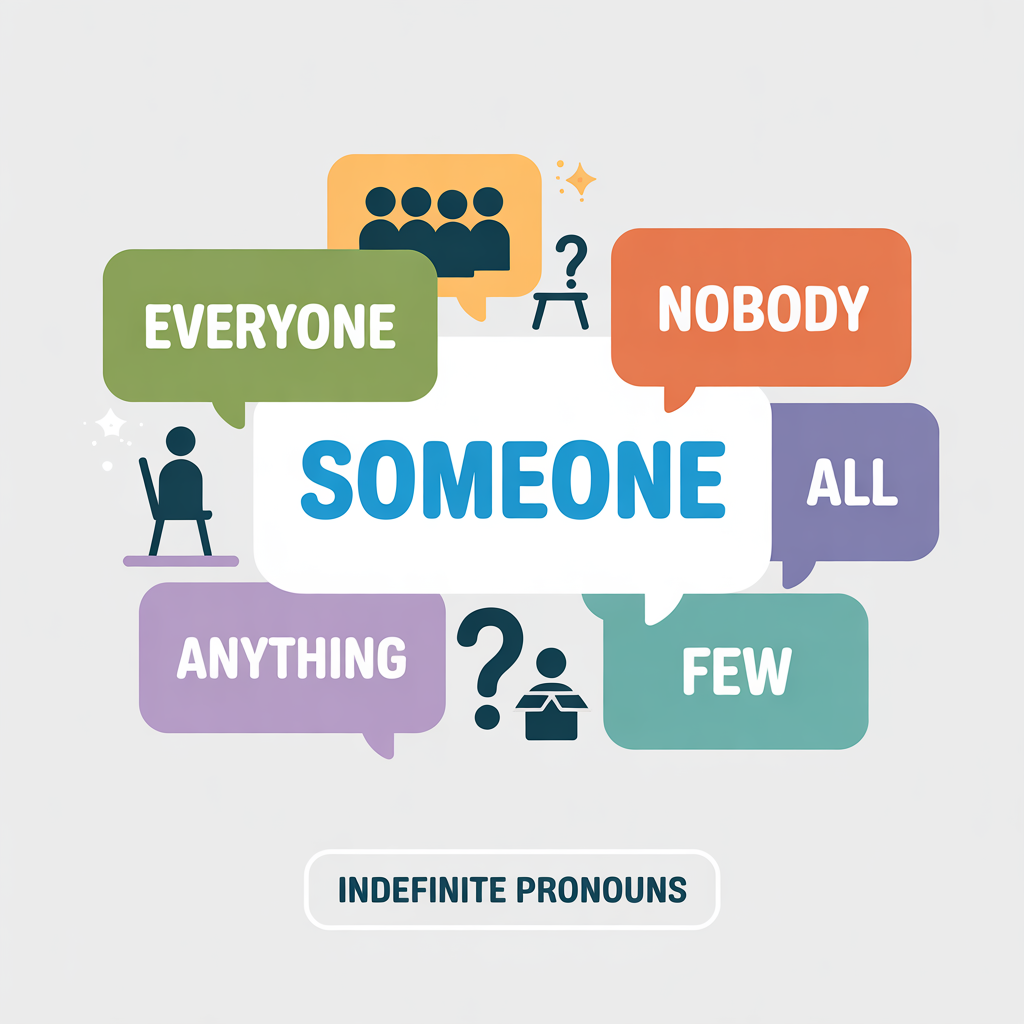
When you say “Everyone is welcome” or “Nobody told me about the meeting,” you are using one of the most common — yet often misunderstood — types of words in English grammar. These words are called indefinite pronouns, and they play a surprisingly important role in how we communicate every single day. Whether you are a student brushing up on grammar fundamentals, a professional writer polishing your prose, or simply someone curious about how language works, understanding indefinite pronouns will sharpen your English skills considerably.
What Is an Indefinite Pronoun?
An indefinite pronoun is a pronoun that refers to a non-specific person, place, thing, or amount — without identifying exactly who or what is being discussed. Unlike personal pronouns such as he, she, or they, which point to a specific individual or group, indefinite pronouns are deliberately vague. They stand in for nouns in a general, unspecified way.
Think of it this way: instead of saying “John ate all of the pizza,” you might say “Someone ate all of the pizza.” The word someone is the indefinite pronoun — it takes the place of a noun, but it does not tell us exactly who the person is.
The word “indefinite” comes from the Latin indefinitus, meaning “not defined” or “not limited.” That is precisely what these pronouns do: they leave the reference open, unspecified, or general.
Why Are Indefinite Pronouns Important?
Indefinite pronouns are a core building block of fluent, natural-sounding English. Here is why they matter:
- Efficiency: They allow speakers and writers to make general statements without listing out every specific person or thing.
- Flexibility: They help when the speaker does not know — or does not need to specify — the identity of a person or thing.
- Tone: They can make statements sound universal or all-encompassing (e.g., “Everything is possible”).
- Grammar accuracy: Knowing how indefinite pronouns work helps you avoid common agreement errors in writing and speech.
In academic writing, business communication, and everyday conversation, these pronouns appear constantly. Mastering them eliminates awkward phrasing and grammatical mistakes.
Common Examples of Indefinite Pronouns
English has a rich set of indefinite pronouns. They are often grouped by the kinds of meaning they express: people, things, quantities, and so on.
Indefinite Pronouns Referring to People
- Someone / Somebody — Someone left their umbrella in the lobby.
- Everyone / Everybody — Everybody deserves a second chance.
- No one / Nobody — Nobody wants to work on weekends.
- Anyone / Anybody — Is anyone home?
Indefinite Pronouns Referring to Things
- Something — Something smells delicious in the kitchen.
- Everything — Everything on the menu looks great.
- Nothing — Nothing could prepare us for that surprise.
- Anything — I will eat anything at this point — I am starving!
Indefinite Pronouns Referring to Quantity or Amount
- All — All of the water has been consumed.
- Both — Both are excellent choices.
- Each — Each of the students received a certificate.
- Either — Either option works for me.
- Neither — Neither of the answers was correct.
- Several — Several have already signed up.
- Many — Many were called, but few were chosen.
- Few — Few understand the complexity of the issue.
- More / Most — Most of the work is already done.
- Some — Some believe the project will fail.
- Any — Do you have any left?
- None — None of the information was accurate.
- One — One should always be honest.
- Other / Another — Another has been added to the list.
Types of Indefinite Pronouns
Indefinite pronouns can be classified in two useful ways: by their number (singular or plural) and by whether they are affirmative, negative, or universal in meaning.
1. Singular Indefinite Pronouns
These pronouns take a singular verb. This is one of the most common sources of grammatical errors, because some of these words feel plural in meaning but are grammatically singular.
Common singular indefinite pronouns include:
- anyone, anyone, everyone, no one, someone
- anybody, everybody, nobody, somebody
- anything, everything, nothing, something
- each, either, neither, one, another, other
Correct: Everyone is ready to leave. ✔
Incorrect: Everyone are ready to leave. ✘
Correct: Each of the players has a jersey. ✔
Incorrect: Each of the players have a jersey. ✘
2. Plural Indefinite Pronouns
These always take a plural verb. They are fewer in number but just as important.
- both, few, many, others, several
Example: Many have tried, but few have succeeded.
Example: Several were injured in the accident.
3. Singular or Plural Indefinite Pronouns (Context-Dependent)
Some indefinite pronouns can be either singular or plural depending on the noun they refer to. These include:
- all, any, more, most, none, some
The key is to look at what the pronoun refers to in context:
- Some of the cake is still left. (cake = uncountable, singular verb)
- Some of the guests have already arrived. (guests = countable plural, plural verb)
- All of the information is correct. (singular noun)
- All of the children are excited. (plural noun)
Affirmative, Negative, and Universal Indefinite Pronouns
Another way to understand indefinite pronouns is by the logical scope they express:
Universal Pronouns (Everyone / Everything / Everywhere)
These imply totality — they cover all members of a group.
- Everyone agreed with the proposal.
- Everything is under control.
Assertive / Affirmative Pronouns (Someone / Something / Somewhere)
These are used in affirmative sentences or polite requests. They indicate the existence of at least one unspecified member.
- Someone called while you were out.
- Would you like something to drink?
Non-Assertive Pronouns (Anyone / Anything / Anywhere)
These are used in questions, negatives, and conditional sentences to express an open or unrestricted possibility.
- Has anyone seen my keys?
- I did not say anything wrong.
- If anything goes wrong, call me immediately.
Negative Pronouns (No one / Nobody / Nothing / Nowhere)
These express a complete absence or negation. They carry a negative meaning by themselves, so you should not use them with another negative word (like not) in standard English, as this creates a double negative.
- Correct: Nobody said anything about the change. ✔
- Incorrect: Nobody didn’t say anything about the change. ✘
Indefinite Pronouns vs. Indefinite Adjectives
Here is an important distinction that often confuses learners. Many of the same words — such as some, any, each, few, and many — can function as both indefinite pronouns and indefinite adjectives (also called determiners).
The difference lies in how the word is used in a sentence:
- If the word stands alone (replacing a noun), it is an indefinite pronoun.
Many were surprised. — “many” replaces a noun, so it is a pronoun. - If the word modifies a noun (appears before it), it is an indefinite adjective (determiner).
Many people were surprised. — “many” describes “people,” so it is an adjective.
Being able to spot this difference will dramatically improve your grammatical precision.
Subject-Verb Agreement with Indefinite Pronouns
One of the trickiest aspects of indefinite pronouns is making sure verbs agree with them correctly. Here is a quick reference guide:
Always Singular — Use a Singular Verb
| Pronoun | Example |
|---|---|
| Everyone | Everyone is here. |
| Nobody | Nobody was hurt. |
| Each | Each has been informed. |
| Either | Either works for me. |
| Neither | Neither is available. |
| Something | Something smells off. |
| One | One must be careful. |
Always Plural — Use a Plural Verb
| Pronoun | Example |
|---|---|
| Both | Both are qualified. |
| Few | Few have responded. |
| Many | Many were confused. |
| Several | Several have left already. |
| Others | Others disagree. |
Singular or Plural — Depends on Context
| Pronoun | Singular Example | Plural Example |
|---|---|---|
| All | All of the bread is gone. | All of the players are ready. |
| Some | Some of the water was spilled. | Some of the students were late. |
| None | None of the milk is left. | None of the emails were answered. |
| Most | Most of the work is done. | Most of the people have voted. |
| Any | Is any of the food left? | Are any of the chairs available? |
Indefinite Pronouns and Gender-Neutral Language
A long-standing debate in English grammar involves using a singular indefinite pronoun with a following personal pronoun. Traditionally, the masculine pronoun he was used as a default in such cases:
Everyone should bring his own lunch.
This usage has widely fallen out of favor in modern writing, as it excludes people of other genders. Today, the singular “they” is overwhelmingly accepted as the gender-neutral alternative — even in formal writing:
- Everyone should bring their own lunch. ✔
- If anyone calls, tell them I am unavailable. ✔
- Someone left their bag on the bus. ✔
Major style guides — including the AP Stylebook, Chicago Manual of Style, and Merriam-Webster — now endorse singular “they” in these contexts. It is not just politically correct; it is grammatically sound and natural-sounding in modern English.
Common Mistakes to Avoid
Even advanced English users slip up with indefinite pronouns. Here are the most frequent errors and how to correct them:
Mistake 1: Using a Plural Verb with a Singular Indefinite Pronoun
- ❌ Everyone are waiting for you.
- ✔ Everyone is waiting for you.
Mistake 2: Double Negatives
- ❌ I don’t know nothing about it.
- ✔ I know nothing about it. OR I don’t know anything about it.
Mistake 3: Confusing “No one” vs. “None”
- No one refers only to people: No one came to the party.
- None can refer to people or things: None of the tickets are left.
Mistake 4: Treating “Each” and “Every” as Plural
- ❌ Each of the members have voted.
- ✔ Each of the members has voted.
Mistake 5: Using “Someone” in Questions and Negatives
- ❌ Did someone call? (grammatically fine but sounds odd in formal questions)
- ✔ Did anyone call? (preferred in questions)
Real-World Examples in Context
Let us look at how indefinite pronouns appear in natural, everyday English across different contexts:
In Professional Emails
“If anyone has questions about the new policy, please feel free to reach out. Everything has been outlined in the attached document, but someone from HR will be available on Thursday if you need further clarification.”
In Academic Writing
“Each of the participants was given a questionnaire. None of the responses were excluded from the analysis. Several reported difficulty completing the final section.”
In Casual Conversation
“Did anyone see where I put my phone? I have looked everywhere and I cannot find anything!”
In Literature
“No one had ever dared to speak the truth aloud. Everyone knew it, felt it — yet nothing was ever said.”
Quick Reference: Full List of Common Indefinite Pronouns
Here is a consolidated reference list to bookmark and revisit:
Singular Only
another, anybody, anyone, anything, each, either, everybody, everyone, everything, little, much, neither, nobody, no one, nothing, one, other, somebody, someone, something
Plural Only
both, few, fewer, many, others, several
Singular or Plural (Context-Dependent)
all, any, more, most, none, some, such
Conclusion
Indefinite pronouns are small words with a big job. They allow us to speak in broad strokes, make general claims, and communicate efficiently without specifying every last detail. From everyone and nobody to all and none, these pronouns are woven into the very fabric of English expression.
The key things to remember are:
- Indefinite pronouns refer to non-specific people, things, or amounts.
- Most indefinite pronouns are grammatically singular, even when they feel plural.
- Some pronouns — like all, some, and none — can be singular or plural depending on context.
- Avoid double negatives with negative indefinite pronouns.
- Use singular “they” for gender-neutral reference after singular indefinite pronouns.
Once you have a firm grasp of indefinite pronouns, your writing becomes more precise, your speech more natural, and your overall command of English grammar noticeably stronger. Practice spotting them in books, articles, and everyday conversations — you will be surprised how quickly you start seeing them everywhere.
Frequently Asked Questions (FAQs)
Is “they” an indefinite pronoun?
Not typically. They is a personal pronoun. However, the singular “they” is used after singular indefinite pronouns (e.g., Everyone brought their own food) as a gender-neutral reference. In that usage, “they” functions as an indefinite reference, though it is not classified as an indefinite pronoun itself.
What is the difference between “someone” and “anyone”?
Someone is used in affirmative sentences — it asserts the existence of at least one unspecified person: Someone is at the door. Anyone is used in questions, negatives, and conditionals, where the existence is open or uncertain: Is anyone at the door? / I don’t know anyone here.
Is “none” singular or plural?
None can be both. When it refers to an uncountable noun, use a singular verb: None of the water is left. When it refers to a countable plural noun, either singular or plural is acceptable in modern usage, with plural being increasingly common: None of the candidates were selected.
Can indefinite pronouns be possessive?
Yes. Indefinite pronouns can take a possessive form by adding an apostrophe + s: someone’s bag, nobody’s fault, everyone’s opinion. These are called possessive indefinite pronouns.
What is the difference between “few” and “a few”?
This is a subtle but meaningful distinction. Few (without an article) has a negative tone — it emphasizes scarcity: Few people attended (disappointingly small number). A few has a positive tone — it means some, at least a small amount: A few people attended (there were at least some).
Are indefinite pronouns only used in English?
No. Most languages have equivalents of indefinite pronouns. In Spanish, alguien (someone) and nadie (nobody) serve similar functions. In French, quelqu’un (someone) and personne (nobody) do the same. The concept is universal across languages; the specific words and grammar rules vary.