
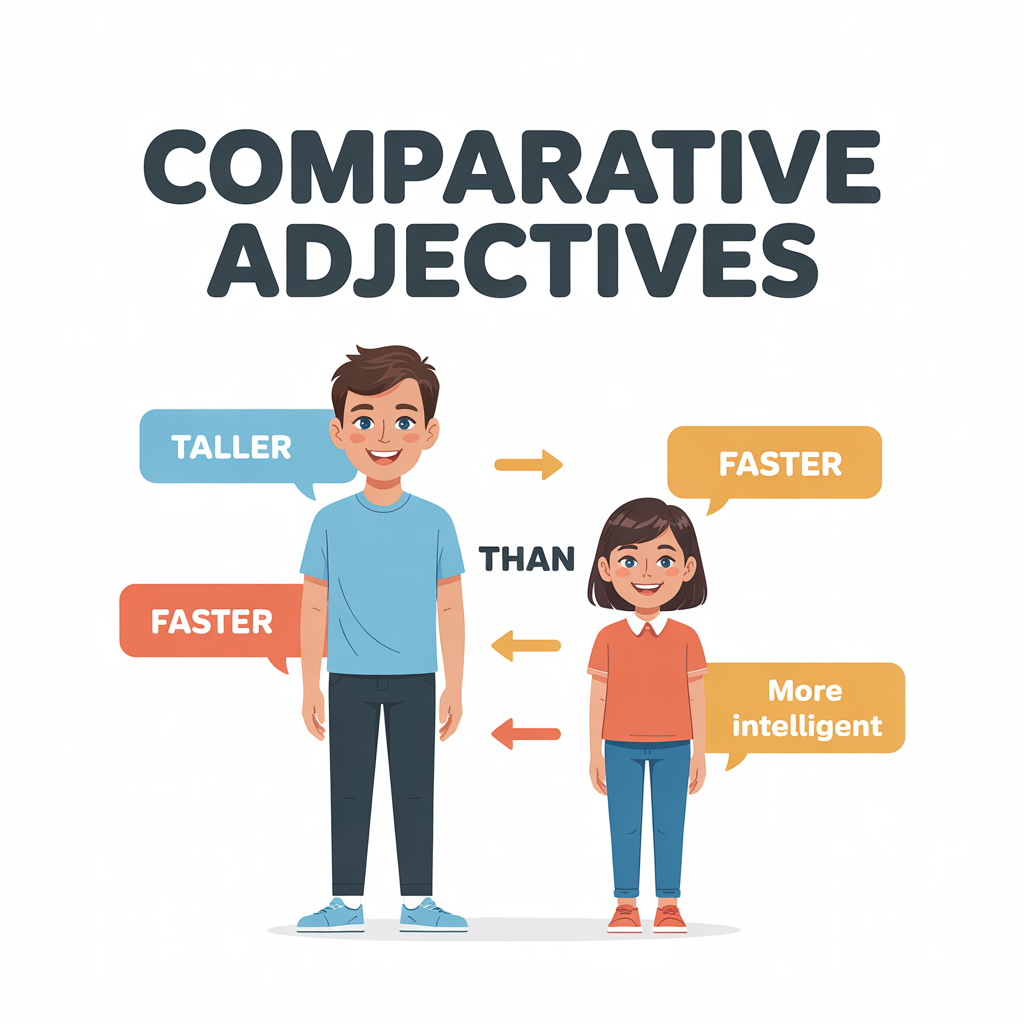
If you’ve ever said someone is taller, a pizza is better, or a road trip is more exciting than staying home, you’ve already used a comparative adjective — probably without even thinking about it. These small but powerful words are the engine behind comparisons in the English language. Understanding how they work doesn’t just polish your grammar; it sharpens the way you communicate every single day.
What Is a Comparative Adjective?
A comparative adjective is a form of an adjective used to compare two things, people, places, or ideas. It expresses that one noun has a quality to a greater or lesser degree than another.
In simple terms, when you want to show that something is more or less of something compared to one other thing, you reach for a comparative adjective.
Here are three quick examples to illustrate the concept:
- “This coffee is hotter than mine.” → comparing two cups of coffee
- “She is more confident than she used to be.” → comparing the same person at two points in time
- “The second route is less complicated than the first.” → comparing two routes
Notice that all three sentences involve exactly two subjects being compared. That’s the defining feature of comparative adjectives.
Comparative vs. Superlative Adjectives: What’s the Difference?
It’s easy to confuse comparative and superlative adjectives because they’re closely related. Here’s the key distinction:
- Comparative adjectives compare two things. (“She is smarter than her brother.”)
- Superlative adjectives compare three or more things and identify the one that has the most or least of a quality. (“She is the smartest student in the class.”)
Think of comparatives as drawing a line between two items and superlatives as picking the winner from a whole group.
How to Form Comparative Adjectives
English uses two main methods to form comparative adjectives, and the method you choose depends on the number of syllables in the base adjective.
1. Adding “-er” to Short Adjectives (One Syllable)
For most adjectives with one syllable, simply add -er to the end.
- tall → taller
- fast → faster
- cold → colder
- bright → brighter
- old → older
These are the simplest comparative forms. You pair them with the word “than” to complete the comparison: “January is colder than March.”
2. Using “More” or “Less” with Longer Adjectives (Two or More Syllables)
For adjectives with two or more syllables, place more (to indicate a higher degree) or less (to indicate a lower degree) before the adjective. Do not add “-er” to these words.
- beautiful → more beautiful / less beautiful
- expensive → more expensive / less expensive
- comfortable → more comfortable / less comfortable
- intelligent → more intelligent / less intelligent
- interesting → more interesting / less interesting
Example sentence: “This sofa is more comfortable than the old one.”
3. Two-Syllable Adjectives: A Gray Area
Two-syllable adjectives can be tricky. Some follow the -er rule, some use “more,” and some allow both. As a general guide:
- Adjectives ending in -y (happy, funny, heavy, easy) → change the y to i and add -er: happier, funnier, heavier, easier
- Adjectives ending in -le (simple, noble, gentle) → add -r: simpler, nobler, gentler
- Adjectives ending in -ow (narrow, shallow) → add -er: narrower, shallower
- Most other two-syllable adjectives → use “more”: more honest, more careful
Spelling Rules for Comparative Adjectives
When adding -er, a few spelling adjustments are necessary:
- Double the final consonant when the adjective ends in a consonant-vowel-consonant (CVC) pattern: big → bigger, hot → hotter, thin → thinner, fat → fatter
- Drop the final -e before adding -er: nice → nicer, large → larger, safe → safer
- Change -y to -i before adding -er: happy → happier, crazy → crazier, dry → drier
Missing these rules is one of the most common grammar mistakes learners make — so it’s worth taking a moment to memorize them.
Irregular Comparative Adjectives
Just like irregular verbs, some adjectives form their comparatives in completely unpredictable ways. These must simply be memorized because no rule applies to them.
| Base Adjective | Comparative Form |
|---|---|
| good | better |
| bad | worse |
| far | farther / further |
| little | less |
| much / many | more |
| old | older / elder |
| late | later / latter |
A note on “farther” vs. “further”: Both are comparative forms of “far,” but “farther” typically refers to physical distance (“The store is farther than I thought”), while “further” is used in a more abstract, figurative sense (“Let’s discuss this further”).
How to Use Comparative Adjectives in Sentences
Using comparative adjectives correctly requires attention to sentence structure. Here are the most common patterns:
Pattern 1: [Subject] + [be] + [comparative adjective] + than + [noun/pronoun]
This is the most standard comparative structure.
- “My apartment is smaller than yours.”
- “The new model is more efficient than the previous one.”
Pattern 2: [Subject] + [verb] + [comparative adjective] + than + [noun/pronoun]
Here, the comparative adjective follows an action verb to describe a noun.
- “She runs faster than anyone on the team.”
- “He speaks more quietly than his colleagues.”
Pattern 3: The [comparative adjective]…, the [comparative adjective]…
This “double comparative” structure shows a proportional relationship between two things.
- “The harder you work, the better the results.”
- “The more I learn, the more I realize I don’t know.”
Pattern 4: [Subject] + [be] + getting/becoming + [comparative adjective]
This pattern describes a change or progression over time.
- “The days are getting shorter.”
- “Traffic is becoming more unpredictable every year.”
Common Mistakes to Avoid
Even confident English speakers slip up with comparative adjectives. Watch out for these frequent errors:
- Double comparatives: Never use both “-er” and “more” at the same time. Saying “more taller” or “more bigger” is incorrect. Choose one method only.
- Leaving out “than”: The word “than” is almost always needed to complete the comparison. “She is smarter” is incomplete without telling the reader smarter than what.
- Using “more” with one-syllable adjectives: Saying “more fast” instead of “faster” sounds unnatural and is grammatically awkward.
- Forgetting spelling rules: Writing “biger” instead of “bigger” or “happyer” instead of “happier” are classic spelling errors.
- Confusing comparative and superlative: “She is the taller of them all” should be “She is the tallest of them all” when comparing more than two.
Real-World Examples of Comparative Adjectives
Comparative adjectives aren’t confined to grammar textbooks. They appear constantly in everyday conversation, advertising, journalism, and literature.
In Advertising
- “Cleaner formula. Whiter teeth.” (toothpaste ad)
- “Drive something smarter.” (car ad)
- “Faster delivery, better prices.” (e-commerce site)
In Everyday Conversation
- “Could we meet at a later time?”
- “This version of the app is more user-friendly than the last.”
- “I feel worse today than I did yesterday.”
In Literature and Journalism
- “The second half of the movie was more compelling than the first.”
- “Unemployment rates are lower this quarter than expected.”
Comparative Adjectives vs. Comparative Adverbs
It’s worth distinguishing between comparative adjectives and comparative adverbs, as they serve different purposes in a sentence.
- A comparative adjective modifies a noun: “She is a faster runner.” (modifies “runner”)
- A comparative adverb modifies a verb, adjective, or another adverb: “She runs more quickly.” (modifies the verb “runs”)
In essence, if you’re describing what a noun is like, use a comparative adjective. If you’re describing how something is done, use a comparative adverb.
Why Mastering Comparative Adjectives Matters
Comparative adjectives are not just a grammar checkbox. They are a fundamental communication tool that allows you to:
- Make persuasive arguments: “Our product is more durable and more affordable than the competition.”
- Tell better stories: Creating vivid contrasts between characters, places, and events is what makes narratives compelling.
- Think more analytically: The ability to articulate differences clearly — in writing, at work, in academic settings — is a sign of a precise and organized mind.
- Score better on language exams: Comparative adjectives appear in IELTS, TOEFL, SAT, and virtually every major English proficiency test.
Quick Reference Summary
- One-syllable adjectives: Add -er → fast → faster
- Adjectives ending in -y: Change y to i + add -er → easy → easier
- Two or more syllables: Use “more” or “less” → more beautiful, less expensive
- Irregular forms: Must be memorized → good → better, bad → worse
- Always pair with “than” to complete the comparison
- Never use double comparatives (e.g., “more bigger” is wrong)
Conclusion
A comparative adjective is one of the most versatile and frequently used tools in the English language. Whether you’re writing a persuasive essay, chatting with a friend, or crafting marketing copy, knowing how to form and use comparative adjectives correctly makes your language clearer, richer, and more precise.
The rules are straightforward once you break them down: short adjectives get -er, long adjectives get “more” or “less”, and a handful of tricky ones must simply be remembered. Master these patterns, keep an eye on spelling, and avoid the pitfall of double comparatives — and you’ll be communicating comparisons like a natural.
The better your understanding of grammar, the more confident your English will become. And that’s a comparison worth making.
Frequently Asked Questions
What is a comparative adjective in simple words?
A comparative adjective is a word used to show that one thing has more or less of a certain quality than another. For example, “bigger,” “faster,” and “more interesting” are all comparative adjectives.
What is the difference between a comparative and a superlative adjective?
A comparative adjective compares two things (“She is taller than her sister”), while a superlative adjective compares three or more things and identifies the one with the most of a quality (“She is the tallest in the class”).
Do you always need “than” with a comparative adjective?
In most sentences, yes. “Than” connects the two things being compared. However, sometimes the context makes the comparison implied, and “than” may be omitted — for example, in advertising slogans like “Drive something smarter.”
Can an adjective be both a comparative and use “more”?
Some two-syllable adjectives can be used with either -er or “more,” such as “simpler” and “more simple.” However, using both at the same time (e.g., “more simpler”) is always incorrect.
What are some examples of irregular comparative adjectives?
The most common irregular comparative adjectives are: good → better, bad → worse, far → farther/further, little → less, and many/much → more.
How do I know when to use -er vs. “more”?
A simple rule: if the adjective has one syllable, use -er (cold → colder). If it has three or more syllables, always use “more” (more beautiful). Two-syllable adjectives can go either way — if they end in -y, use -er after changing the y to i (happy → happier). Otherwise, use “more.”