
What Is a Verb? Definition, Types, and Examples Explained
Every sentence you have ever spoken, written, or read has one thing in common — a verb. Without a verb, a group of words is just a fragment, a collection of ideas floating without direction. Verbs are the engine of language. They tell us what is happening, what exists, and what someone or something experiences. Understanding what a verb is — and how it works — is one of the most foundational steps in mastering the English language.
The Core Definition: What Is a Verb?
A verb is a word that expresses an action, occurrence, or state of being. In grammar, it is one of the eight traditional parts of speech, and it is widely considered the most important one. Every complete sentence in English must contain at least one verb.
Here is the simplest way to think about it:
- Action: She runs every morning.
- Occurrence: The storm happened overnight.
- State of being: He is a doctor.
In each example, the italicized word is the verb. It tells you something essential about the subject — what the subject does, what happens to it, or what it is.
Linguists formally define a verb as a word that can be inflected (changed in form) to show tense, agreement with the subject, voice, mood, and aspect. This capacity to change — from “run” to “ran,” from “is” to “was” — is what makes verbs uniquely powerful among all parts of speech.
Why Verbs Matter So Much
Think of a sentence as a solar system. The verb is the sun — everything else orbits around it. The subject tells us who is doing something, but the verb tells us what is being done. Remove the verb, and the entire system collapses.
Consider: “The dog.” That is a noun phrase. It gives you an image but no information about what the dog is doing or being. Now add a verb: “The dog barked.” Suddenly, the sentence has life, energy, and meaning.
Verbs also carry the weight of time. They tell you whether something happened in the past, is happening now, or will happen in the future — a concept called tense, which no other part of speech can communicate on its own.
The Main Types of Verbs
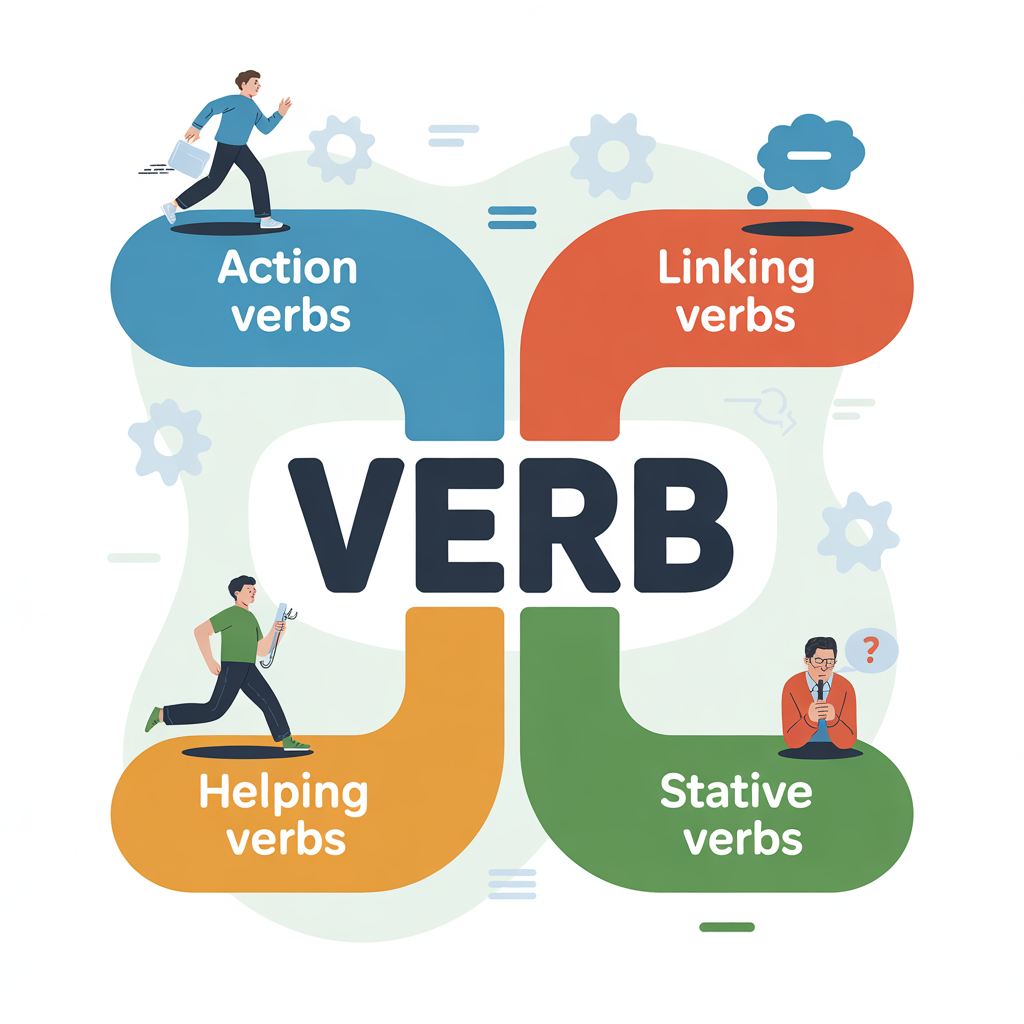
Not all verbs work the same way. English verbs fall into several distinct categories, each serving a specific grammatical function. Understanding these types will dramatically improve both your comprehension and your writing.
1. Action Verbs
Action verbs (also called dynamic verbs) describe physical or mental activities. They are the most common type of verb and the one most people think of first when they hear the word “verb.”
- Physical action: She kicked the ball. / He swam across the lake.
- Mental action: I think about it every day. / She decided to leave early.
Action verbs can be further divided into two subcategories:
- Transitive verbs: These require a direct object — something that receives the action. Example: “She ate the apple.” (The apple receives the action of eating.)
- Intransitive verbs: These do not need a direct object to make sense. Example: “He laughed.” (There is no object; the action is complete on its own.)
Some verbs can be both transitive and intransitive depending on context. “She runs the company” (transitive) vs. “She runs every day” (intransitive).
2. Linking Verbs
Linking verbs do not describe action. Instead, they connect the subject to a subject complement — a word or phrase that describes or identifies the subject. They essentially act as an equal sign in a sentence.
The most common linking verb in English is to be in all its forms: am, is, are, was, were, be, being, been.
Other common linking verbs include: seem, become, appear, feel, look, sound, smell, taste, remain, grow.
- “The soup tastes wonderful.” (Links “soup” to “wonderful”)
- “She became a surgeon.” (Links “she” to “surgeon”)
- “The music sounds relaxing.” (Links “music” to “relaxing”)
A useful trick: If you can replace the verb with a form of “to be” and the sentence still makes sense, it is likely a linking verb. “The soup is wonderful” still works — so “tastes” is functioning as a linking verb here.
3. Helping Verbs (Auxiliary Verbs)
Helping verbs, also known as auxiliary verbs, work alongside a main verb to form a verb phrase. They help express tense, mood, voice, or possibility.
English has three primary auxiliary verbs:
- To be: She is working late tonight.
- To have: They have finished the project.
- To do: I did not understand the question.
Then there are modal auxiliary verbs, which express ability, permission, possibility, necessity, or obligation:
- Can / Could — ability or possibility: “I can help you.”
- Will / Would — future or conditional: “She will arrive tomorrow.”
- May / Might — permission or possibility: “It might rain.”
- Shall / Should — obligation or recommendation: “You should see a doctor.”
- Must — strong necessity: “You must wear a seatbelt.”
- Ought to — moral obligation: “We ought to recycle more.”
4. Stative Verbs
Stative verbs describe states, conditions, or situations rather than actions. They refer to things that are ongoing but not actively “happening” in a dynamic way.
Common stative verbs include: know, believe, love, hate, need, own, want, understand, remember, prefer, contain, seem, belong.
- “I know the answer.”
- “She owns three cars.”
- “He believes in kindness.”
One important rule: stative verbs are generally not used in continuous tenses. You would not normally say “I am knowing the answer.” You say “I know the answer.” This is a common mistake for non-native English speakers.
Verb Forms: How Verbs Change
One of the most distinctive features of a verb is that it changes form depending on the grammatical context. These changes are called inflections. Understanding verb forms is essential for using verbs correctly.
The Five Main Verb Forms
Most English verbs have up to five different forms:
- Base form (infinitive): walk, eat, go
- Third-person singular present: walks, eats, goes
- Past tense: walked, ate, went
- Past participle: walked, eaten, gone
- Present participle / gerund: walking, eating, going
Regular vs. Irregular Verbs
This is one of the most talked-about distinctions in English grammar:
- Regular verbs follow a predictable pattern. You simply add -ed to form the past tense and past participle. Examples: walk → walked, jump → jumped, play → played.
- Irregular verbs do not follow this standard pattern. Their past tenses and past participles must be memorized individually. Examples: go → went → gone; eat → ate → eaten; run → ran → run; break → broke → broken.
English has hundreds of irregular verbs, and many of the most commonly used verbs in the language — be, have, do, go, say, make, know, take, come, see — are all irregular.
Verb Tense: Expressing Time
One of the most powerful functions of a verb is to communicate tense — when an action takes place. English has three primary tenses, each with four aspects, creating a system of 12 tenses in total.
The Three Primary Tenses
- Past tense: Describes actions or states that have already occurred. “She walked to the store.”
- Present tense: Describes actions or states happening now or habitually. “She walks to the store.”
- Future tense: Describes actions or states that have yet to occur. “She will walk to the store.”
The Four Aspects
Each tense can be expressed in four different aspects that indicate whether an action is ongoing, completed, or habitual:
- Simple: She writes. / She wrote. / She will write.
- Continuous (Progressive): She is writing. / She was writing. / She will be writing.
- Perfect: She has written. / She had written. / She will have written.
- Perfect Continuous: She has been writing. / She had been writing. / She will have been writing.
Verb Voice: Active vs. Passive
Verbs can also express voice, which shows the relationship between the subject and the action.
- Active voice: The subject performs the action. “The chef prepared the meal.” — clear, direct, and energetic.
- Passive voice: The subject receives the action. “The meal was prepared by the chef.” — the focus shifts to the object of the action.
Both voices are grammatically correct, but strong, clear writing generally favors the active voice because it is more direct and easier to read.
Verb Mood: The Speaker’s Attitude
Mood refers to the way a verb conveys the speaker’s attitude toward the action or state described. English has three main grammatical moods:
- Indicative mood: States facts or asks questions. “She works at the hospital.” — the most common mood in everyday speech.
- Imperative mood: Gives commands or makes requests. “Sit down.” / “Please close the door.”
- Subjunctive mood: Expresses wishes, hypothetical situations, demands, or conditions contrary to fact. “If I were you, I would apologize.” / “It is important that he be on time.”
Verbals: When Verbs Act Like Other Parts of Speech
Here is where grammar gets wonderfully interesting. Sometimes a verb form is used as a different part of speech entirely. These are called verbals.
Infinitives
An infinitive is the base form of a verb, usually preceded by “to.” It can act as a noun, adjective, or adverb.
- As a noun: “To travel is a great education.” (subject of the sentence)
- As an adjective: “I need a place to sleep.” (modifies “place”)
- As an adverb: “She studied hard to pass.” (modifies “studied”)
Gerunds
A gerund is the -ing form of a verb used as a noun.
- “Swimming is great exercise.” (subject)
- “She enjoys reading.” (object)
- “His hobby is painting.” (subject complement)
Participles
A participle is a verb form used as an adjective. It can be a present participle (-ing) or a past participle (-ed or irregular).
- “The running water sounded peaceful.” (present participle modifying “water”)
- “The broken window needed to be fixed.” (past participle modifying “window”)
How to Identify a Verb in a Sentence
If you are unsure whether a word is a verb, try these practical tests:
- The “yesterday / tomorrow” test: If you can sensibly put “yesterday” or “tomorrow” in front of the word or phrase and the sentence still makes sense, it is likely a verb. “Yesterday, she ran.” ✓
- The “he/she/it” test: Can you add an -s or -es to match a third-person singular subject? “She runs, he eats, it exists.” ✓
- Ask “What is the subject doing?”: Find the subject of the sentence, then ask what it is doing or being. The answer is the verb.
Common Verb Mistakes to Avoid
Even advanced English speakers make errors with verbs. Here are the most frequent ones to watch out for:
- Subject-verb agreement errors: The verb must agree in number with its subject. “The team is winning” (not “are” in American English for collective nouns).
- Confusing lay and lie: “Lay” requires a direct object (“Lay the book down”), while “lie” does not (“I need to lie down”).
- Using stative verbs in continuous tense: Saying “I am loving this” is informal. In formal writing, “I love this” is correct.
- Inconsistent tense shifts: Switching between past and present tense without reason is confusing for readers.
- Dangling participles: “Running down the street, the keys fell out of his pocket.” The keys were not running. The sentence should be restructured.
Verbs in Everyday Communication
Verbs do not exist only in textbooks. They shape every conversation you have, every email you send, and every story you tell. Choosing the right verb makes writing more vivid, precise, and powerful.
Compare these two sentences:
- “She walked into the room.” — neutral and basic.
- “She glided into the room.” — creates a specific visual impression.
Or:
- “He said that he was angry.” — flat and uninformative.
- “He snapped that he was angry.” — conveys tone and emotion.
Strong verbs reduce the need for adverbs. Instead of “she walked quickly,” consider “she rushed” or “she sprinted.” The precision of the right verb is one of the most powerful tools in a writer’s toolkit.
Conclusion
A verb is far more than just an “action word.” It is the grammatical backbone of every sentence — carrying time, mood, voice, and meaning all at once. From simple linking verbs like “is” and “seems” to complex verb phrases built with modals and auxiliaries, verbs give language its ability to describe the full range of human experience.
Understanding verbs — their types, forms, tenses, and functions — gives you a much firmer command of English, whether you are learning it for the first time or fine-tuning your writing. The next time you read a sentence, try spotting the verb first. Once you see how everything else orbits around it, the grammar of English will start to make a great deal more sense.
Frequently Asked Questions (FAQs)
What is a verb in simple terms?
A verb is a word that describes an action (“run,” “eat”), an occurrence (“happen,” “occur”), or a state of being (“is,” “seem”). Every complete English sentence needs at least one verb.
What are the four main types of verbs?
The four main types are action verbs (describe what someone does), linking verbs (connect the subject to a description), helping verbs (assist the main verb), and stative verbs (describe a state or condition rather than an action).
What is the difference between a regular and an irregular verb?
Regular verbs form their past tense by adding -ed (walk → walked). Irregular verbs do not follow this pattern and must be memorized individually (go → went, eat → ate).
Can a word be both a verb and a noun?
Yes. Many English words function as both. For example, “run” can be a verb (“She runs every morning”) or a noun (“She went for a run“). Context determines which part of speech the word is serving.
What is a verb phrase?
A verb phrase is a group of words that functions together as the verb of a sentence. It includes a main verb and one or more auxiliary (helping) verbs. Example: “She has been studying all night.” — “has been studying” is the verb phrase.
What is the difference between a gerund and a present participle?
Both use the -ing form, but they serve different roles. A gerund functions as a noun (“Swimming is fun”). A present participle functions as an adjective or part of a continuous verb tense (“The swimming fish was beautiful” / “She is swimming”).