
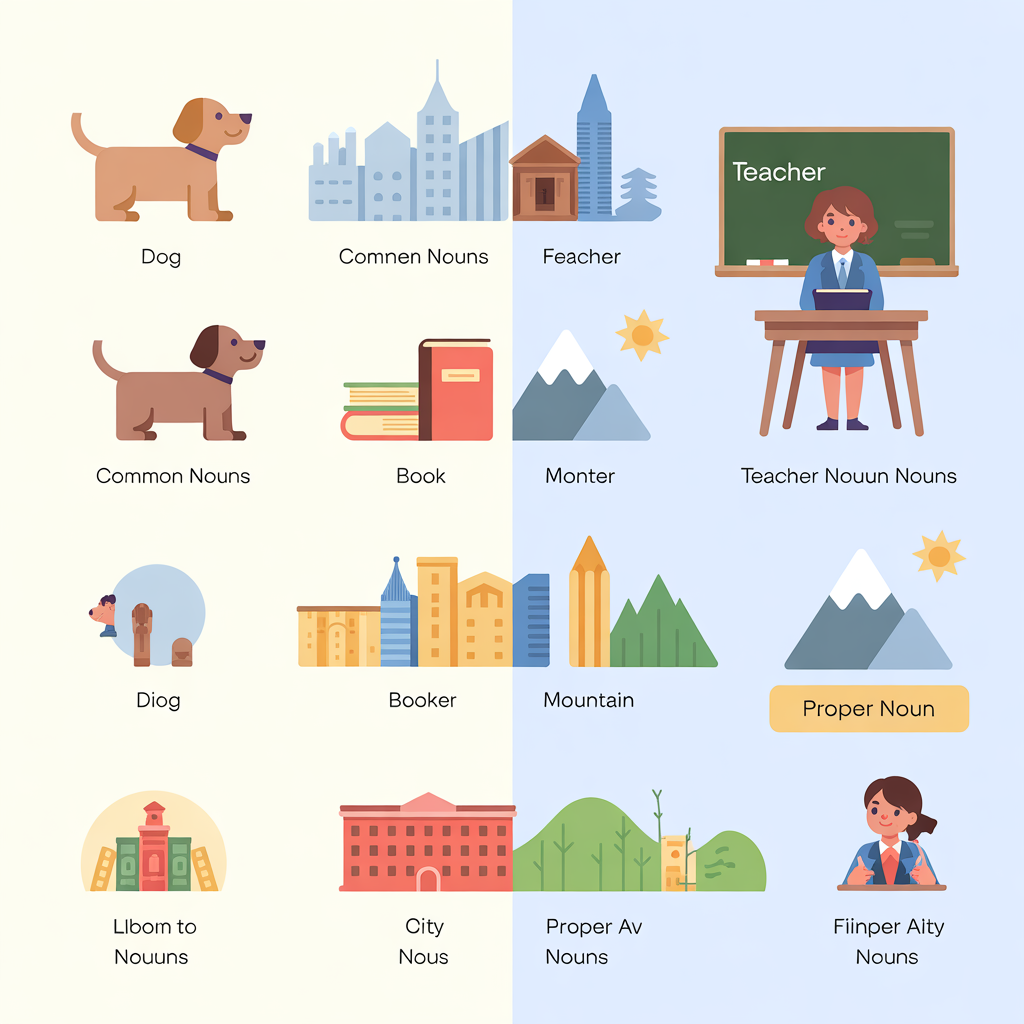
Every time you say “dog,” “city,” or “teacher,” you are using one of the most fundamental building blocks of the English language — a common noun. It might sound like a simple grammar term, but understanding common nouns deeply can sharpen your writing, clarify your thinking, and give you a much stronger command of English. Whether you are a student, a writer, or simply someone who wants to understand the language better, this guide will walk you through everything you need to know about common nouns — what they are, how they work, the different types, and how to use them correctly.
What Is a Common Noun?
A common noun is a word that names a general, non-specific person, place, thing, or idea — as opposed to a particular, named individual or entity. It refers to a class or category of things rather than one unique, identifiable item.
Think of it this way: when you say “river,” you are not talking about one specific river with a name. You are referring to any river — every river that exists. That generality is the defining characteristic of a common noun.
Common nouns are not capitalized (unless they appear at the start of a sentence), and they represent the vast majority of all nouns in English.
Simple Definition
- A common noun names a general person, place, thing, or idea.
- It is not capitalized in the middle of a sentence.
- It can be preceded by articles like “a,” “an,” or “the.”
- It refers to a class or category, not a unique, specific individual.
Common Noun vs. Proper Noun: The Key Difference
The easiest way to understand common nouns is to contrast them with proper nouns. A proper noun names a specific, one-of-a-kind person, place, or thing and is always capitalized.
| Common Noun | Proper Noun |
|---|---|
| city | Paris |
| river | Amazon River |
| boy | James |
| company | Apple |
| mountain | Mount Everest |
| language | Spanish |
| planet | Jupiter |
Notice the pattern: the common noun is the category; the proper noun is the specific member of that category. “City” is a common noun. “Paris” is a proper noun — it is a specific city.
Types of Common Nouns
Common nouns are not all the same. Grammarians classify them into several important subtypes, each with its own characteristics and rules. Understanding these types will help you use nouns with greater precision and confidence.
1. Concrete Nouns
A concrete noun names something that you can physically perceive — something you can see, touch, smell, hear, or taste. These are tangible objects that exist in the physical world.
Examples: table, rain, flower, bread, stone, music, coffee, book, hand
Concrete nouns are the easiest type for most learners to identify because they point to something real and observable in the world around us.
2. Abstract Nouns
An abstract noun names something that cannot be physically perceived — ideas, emotions, concepts, qualities, or states of being. These things exist in the mind or as concepts rather than as physical objects.
Examples: freedom, happiness, courage, justice, love, knowledge, faith, fear, democracy, childhood
Abstract nouns are often formed by adding suffixes to adjectives or verbs. For instance: kind → kindness; free → freedom; brave → bravery.
3. Countable Nouns
A countable noun (also called a count noun) names something that can be counted individually. Countable nouns have both singular and plural forms.
Singular examples: a chair, an apple, a dog, a mistake
Plural examples: chairs, apples, dogs, mistakes
You can say “one apple,” “two apples,” “five dogs,” and “dozens of mistakes.” This ability to be counted individually is what makes these nouns “countable.”
4. Uncountable Nouns
An uncountable noun (also called a mass noun or non-count noun) names something that cannot be easily divided into individual units and counted. These nouns typically do not have a plural form and cannot be used with the article “a” or “an” directly.
Examples: water, sand, air, music, information, furniture, advice, homework, rice, traffic
You would not say “a water” or “two informations.” Instead, you use quantity expressions: “a glass of water,” “two pieces of information,” “some advice.”
It is worth noting that some nouns can be both countable and uncountable depending on context. “Paper,” for example, is uncountable when referring to the material (“The book is made of paper”) but countable when referring to documents or articles (“She submitted three papers”).
5. Collective Nouns
A collective noun names a group of people, animals, or things as a single unit.
Examples: team, family, flock, audience, committee, crew, herd, class, army, jury
In American English, collective nouns are generally treated as singular: “The team is ready.” In British English, they are often treated as plural: “The team are ready.” Both forms are grammatically defensible depending on context and regional convention.
There are also many colorful, specific collective nouns for animals:
- A murder of crows
- A pride of lions
- A pod of whales
- A swarm of bees
- A pack of wolves
Everyday Examples of Common Nouns in Sentences
Seeing common nouns in context is one of the best ways to build a natural understanding of how they function. Here are some sentences with the common nouns highlighted:
- “The dog ran across the park.”
- “She handed the teacher her assignment.”
- “The city was full of noise and energy.”
- “He had a great deal of courage and determination.”
- “A small boat drifted across the calm lake.”
- “The committee made its final decision on the budget.”
- “She poured a glass of water and sat by the window.”
In every one of these sentences, the common nouns refer to general categories — not specific named individuals or places.
Rules for Using Common Nouns Correctly
Using common nouns accurately in writing requires paying attention to a few important grammar rules.
Rule 1: Do Not Capitalize Common Nouns Mid-Sentence
This is the most frequently broken rule, especially when people are used to capitalizing nouns in languages like German (where all nouns are capitalized). In English, common nouns are written in lowercase unless they begin a sentence.
Incorrect: I went to the Park near the River.
Correct: I went to the park near the river.
Exception: When a common noun becomes part of a proper name, it is capitalized. For example, “river” is a common noun, but “Colorado River” is a proper noun — the word “River” is now part of the official name.
Rule 2: Match Articles with Countability
Use “a” or “an” only with singular, countable nouns. Use “some” or no article with uncountable nouns.
- Correct: “a book,” “an idea,” “some water,” “some furniture”
- Incorrect: “a water,” “an advice,” “a furniture”
Rule 3: Plural Forms Follow Standard Rules — with Exceptions
Most countable common nouns form their plural by adding -s or -es. However, English has a significant number of irregular plurals that must be memorized.
| Singular | Plural |
|---|---|
| child | children |
| mouse | mice |
| tooth | teeth |
| foot | feet |
| person | people |
| goose | geese |
| ox | oxen |
| sheep | sheep (unchanged) |
Rule 4: Subject-Verb Agreement
A singular common noun takes a singular verb; a plural common noun takes a plural verb.
- “The bird sings every morning.” (singular)
- “The birds sing every morning.” (plural)
How Common Nouns Function in a Sentence
Common nouns can play several different grammatical roles within a sentence. Knowing these roles helps you understand how sentences are constructed and how meaning is conveyed.
As a Subject
The noun performs the action or is the main focus of the sentence.
“The teacher explained the lesson.”
As an Object
The noun receives the action of the verb (direct object) or indicates to/for whom the action is done (indirect object).
“She bought a book.” (direct object)
“He gave his sister a gift.” (indirect object)
As a Subject Complement
The noun follows a linking verb and renames or describes the subject.
“Maria is a talented musician.”
As an Object of a Preposition
The noun follows a preposition to form a prepositional phrase.
“The keys are on the table.”
As a Possessive
The noun shows ownership, typically formed with an apostrophe.
“The dog’s tail wagged furiously.”
Common Nouns and Noun Modifiers
In English, common nouns can be modified by a wide variety of words and phrases to make their meaning more precise:
- Adjectives: “a beautiful garden,” “a difficult problem”
- Articles and determiners: “the book,” “this table,” “every student”
- Other nouns (as noun adjuncts): “a coffee table,” “a book club,” “a city park“
- Prepositional phrases: “the house on the hill,” “the man in the blue suit“
- Relative clauses: “the teacher who inspired me“
Common Nouns in Academic and Professional Writing
In more formal contexts — academic essays, business reports, journalism — common nouns play a particularly critical role. Using precise common nouns rather than vague, overly general ones elevates the quality of writing.
Compare these two sentences:
- Vague: “The thing they did had a big effect on the stuff.”
- Precise: “The policy they implemented had a significant impact on the economy.”
The second sentence uses specific, well-chosen common nouns to communicate clearly and authoritatively. Good writers build their vocabulary of common nouns specifically to express ideas with precision.
Fun Facts About Common Nouns
- The word “thing” is one of the most versatile — and overused — common nouns in English. Replacing it with a more specific noun almost always improves your writing.
- Some words can be both common and proper nouns depending on context. “Earth” as a planet name is a proper noun; “earth” meaning soil or dirt is a common noun.
- Common nouns can become proper nouns over time. The word “google” started as a common misspelling of the mathematical term “googol,” became a proper noun as a brand name, and then re-entered the language as the common verb “to google.”
- In some languages, such as German, all nouns — common and proper — are capitalized. English only capitalizes proper nouns, which is why many German-speaking learners of English sometimes over-capitalize.
Quick Reference: 100 Common Examples of Common Nouns
Here is a broad list of common nouns organized by category to help you recognize them quickly:
People
child, woman, man, doctor, teacher, friend, artist, soldier, mother, neighbor
Places
city, country, school, hospital, beach, mountain, village, office, library, street
Animals
cat, dog, bird, fish, horse, lion, snake, elephant, rabbit, wolf
Objects
chair, phone, window, bottle, laptop, shirt, umbrella, knife, lamp, clock
Food and Drink
bread, rice, coffee, water, cake, salad, juice, pasta, soup, fruit
Nature
tree, rain, cloud, ocean, fire, soil, wind, river, stone, flower
Abstract Concepts
love, freedom, justice, time, power, truth, beauty, hope, peace, success
Common Mistakes People Make with Common Nouns
Even proficient English users make errors when it comes to common nouns. Here are the most frequent pitfalls to avoid:
- Unnecessary capitalization: Writing “I went to the Library” instead of “I went to the library.”
- Treating uncountable nouns as countable: Writing “informations” or “advices” instead of “information” or “advice.”
- Using wrong articles: Writing “a equipment” instead of “some equipment” or “a piece of equipment.”
- Confusing collective nouns: Using inconsistent verb agreement — “The team is training hard, and they are confident” (mixing singular and plural agreement).
- Over-relying on vague nouns: Depending too heavily on words like “thing,” “stuff,” or “issue” instead of choosing more precise common nouns.
Conclusion
Common nouns are the backbone of everyday language. They are how we categorize and communicate about the world around us — from tangible objects like “chair” and “mountain” to intangible ideas like “justice” and “freedom.” Understanding what a common noun is, how it differs from a proper noun, and how its subtypes function gives you a powerful grammatical foundation.
The key takeaways are simple: common nouns name general categories, are not capitalized in the middle of sentences, can be concrete or abstract, countable or uncountable, and can serve many different roles within a sentence. Mastering these principles will make you a clearer thinker and a stronger writer — in any context.
So the next time you look out the window and see a “tree,” smell the “rain,” or feel a sense of “wonder,” remember — you are surrounded by common nouns, and now you know exactly what they are.
Frequently Asked Questions (FAQs)
Is “water” a common noun?
Yes, “water” is a common noun — specifically, it is an uncountable (mass) noun because it refers to a substance that cannot easily be counted in individual units.
Can a common noun become a proper noun?
Yes. When a common noun is used as part of an official name, it becomes a proper noun and is capitalized. For example, “street” is a common noun, but “Baker Street” is a proper noun.
Is “love” a common noun?
Yes. “Love” is a common noun — more specifically, it is an abstract, uncountable noun because it refers to an emotion or concept rather than a physical object.
What is the difference between a common noun and a noun?
A noun is the broad grammatical category that includes all naming words. A common noun is a type of noun — specifically one that names a general, non-specific category. All common nouns are nouns, but not all nouns are common nouns (proper nouns are also nouns).
Are common nouns always singular?
No. Most countable common nouns have both singular and plural forms (e.g., “book/books,” “child/children”). Uncountable common nouns, however, do not typically have a plural form (e.g., “water,” “furniture”).
Is “school” a common noun or a proper noun?
“School” by itself is a common noun — it refers to any school in general. However, “Harvard School of Law” is a proper noun because it names a specific institution.