
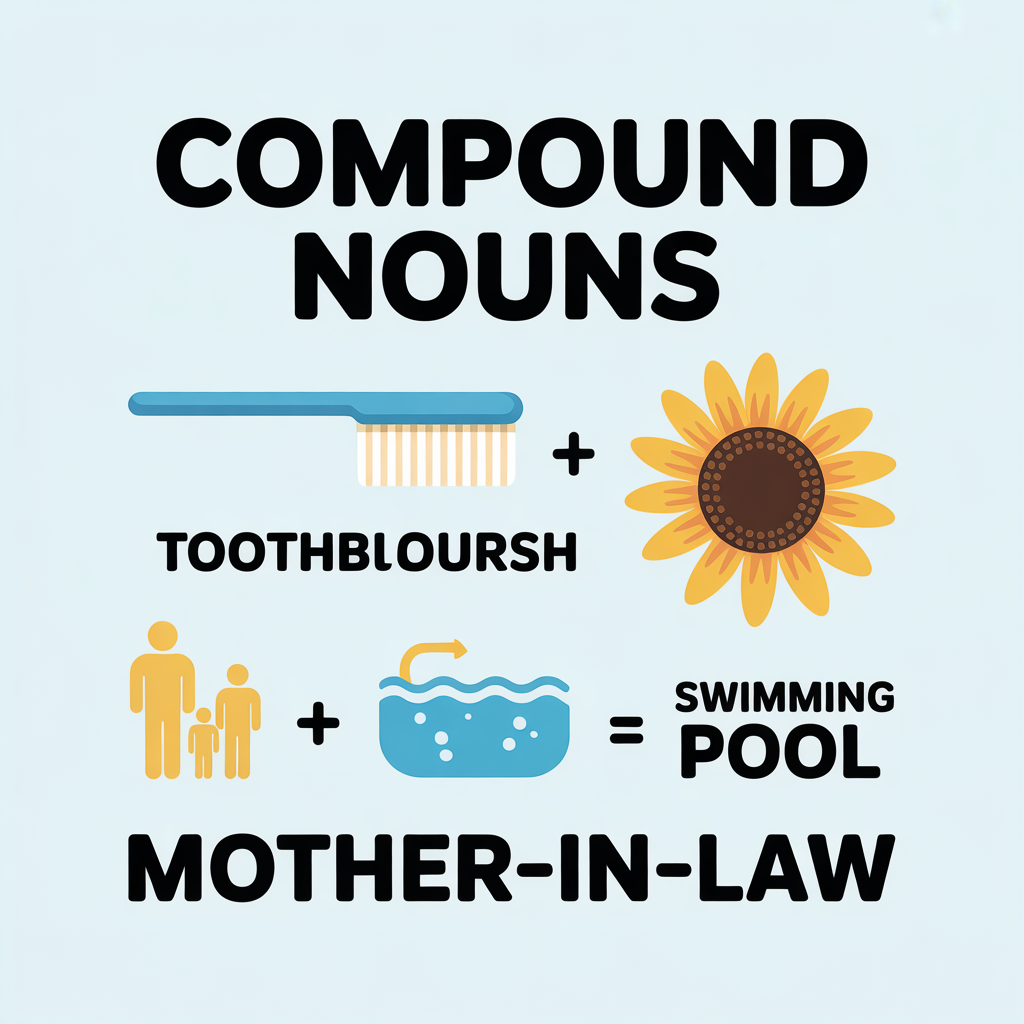
You use them every day without thinking twice. Toothbrush. Football. Swimming pool. Break-in. These are all compound nouns — and once you understand what they are and how they work, you’ll start spotting them everywhere. Whether you’re a student trying to sharpen your grammar, a writer aiming for precision, or just someone who loves understanding language more deeply, this guide will give you everything you need to know about compound nouns.
What Is a Compound Noun?
A compound noun is a type of noun formed by combining two or more words to create a single noun with a new, distinct meaning. The combined meaning is often different — or at least more specific — than the individual words taken separately.
For example:
- Sun + flower = Sunflower (a specific type of flower, not just any flower touched by the sun)
- Fire + place = Fireplace (a fixed structure in a room, not just a place where fire exists)
- Back + pack = Backpack (a specific type of bag worn on the back)
In each case, the two words merge — physically, conceptually, or both — to produce a brand-new noun that functions as a single unit in a sentence.
Compound nouns are one of the most productive features of the English language. English constantly creates new compound nouns to name new things, technologies, and ideas. Smartphone, laptop, password, cyberattack — all compound nouns born out of modern necessity.
Why Are Compound Nouns Important?
Understanding compound nouns matters for several practical reasons:
- Writing accuracy: Knowing whether to write e-mail, email, or e mail can make your writing look polished or sloppy.
- Reading comprehension: Recognizing compound nouns helps you parse sentences correctly and understand meaning faster.
- Vocabulary building: Once you understand how compound nouns are formed, learning new ones becomes much easier.
- Grammar and pluralization: Compound nouns have their own rules for pluralization, which differ from regular nouns.
The Three Written Forms of Compound Nouns
One of the trickiest things about compound nouns in English is that they don’t all look the same. There are three main written forms:
1. Closed (One Word)
The two words are written together as a single, unbroken word.
- Toothpaste
- Notebook
- Bedroom
- Keyboard
- Rainfall
This is the most common form for compound nouns that have been in use for a long time. Over the years, frequent use causes the words to “fuse” together.
2. Hyphenated (Two Words Joined by a Hyphen)
The words are connected by a hyphen (-), which signals that the two parts work together as one unit.
- Mother-in-law
- Six-pack
- Check-in
- Runner-up
- Editor-in-chief
Hyphenated compound nouns often occur with prepositional phrases or when the compound is newer and hasn’t yet merged into a single word.
3. Open (Two Separate Words)
The words remain separate but function together as one noun.
- Swimming pool
- Post office
- Ice cream
- Coffee table
- Bus stop
Open compound nouns can be confusing because they look like two ordinary words sitting next to each other. The key is that together, they name one specific thing.
How Do You Know Which Form to Use?
Honestly? Sometimes it’s complicated. English doesn’t always follow a strict rule for which form to use. The best approach is to:
- Check a reliable dictionary
- Follow the style guide relevant to your context (AP, Chicago, Oxford, etc.)
- Be aware that forms can change over time — e-mail has largely become email
Types of Compound Nouns by Word Class
Compound nouns can be formed in many different word-class combinations. Understanding these patterns can help you recognize and build compound nouns more intuitively.
Noun + Noun
This is by far the most common type.
- Football (foot + ball)
- Bedroom (bed + room)
- Sunlight (sun + light)
- Rainwater (rain + water)
Adjective + Noun
An adjective modifies a noun to form a new compound.
- Blackboard (black + board)
- Greenhouse (green + house)
- Smartphone (smart + phone)
- Deadline (dead + line)
Note that the meaning often shifts: a blackboard isn’t necessarily black, and a greenhouse isn’t necessarily green.
Verb + Noun
A verb root combines with a noun.
- Breakfast (break + fast)
- Swimsuit (swim + suit)
- Playground (play + ground)
- Drawbridge (draw + bridge)
Noun + Verb
- Sunrise (sun + rise)
- Haircut (hair + cut)
- Carpool (car + pool)
- Brainstorm (brain + storm)
Verb + Preposition / Preposition + Noun
- Breakdown (break + down)
- Outlook (out + look)
- Takeover (take + over)
- Underworld (under + world)
Gerund (–ing form) + Noun
The –ing form of a verb acts as a modifier.
- Swimming pool
- Sleeping bag
- Driving license
- Running track
How to Pluralize Compound Nouns
Pluralizing compound nouns trips up even experienced writers. The rules depend on the structure of the compound.
Rule 1: Pluralize the main noun (the “head noun”)
For most compound nouns, you make the most important word plural:
- Mothers-in-law (not mother-in-laws)
- Attorneys general (not attorney generals)
- Passersby (not passerbys)
- Brothers-in-law
In these cases, the first noun is the “head” — the main concept — and that’s what gets pluralized.
Rule 2: Pluralize the last word for closed compounds
When the compound is written as one word, simply add -s or -es to the end:
- Toothbrushes
- Bedrooms
- Notebooks
- Sunflowers
Rule 3: Watch for irregular compounds
- Spoonful → Spoonfuls (not spoonfuls for the “ful”)
- Editor-in-chief → Editors-in-chief
- Drive-in → Drive-ins
Compound Nouns vs. Noun Phrases: What’s the Difference?
This is a common point of confusion. Not every combination of a noun and another word is a compound noun.
The critical difference is meaning and stress:
- A compound noun has a fixed, unified meaning and is usually stressed on the first word.
- A noun phrase (or noun modifier) describes a noun more broadly and is usually stressed on the second word.
Consider these pairs:
| Compound Noun | Noun Phrase |
|---|---|
| GREENhouse (a building for growing plants) | green HOUSE (a house painted green) |
| BLACKbird (a specific type of bird) | black BIRD (any bird that happens to be black) |
| DARKroom (a room for developing photos) | dark ROOM (a room that is dark) |
When you say the compound noun, you emphasize the first word. When you describe something with a modifier + noun, you emphasize the noun itself. Listen to how native speakers say these words — it’s often the clearest clue.
Compound Nouns in Everyday English: Real-World Examples
Compound nouns are everywhere. Here are some categories to help you see just how common they are:
At Home
- Dishwasher
- Bathroom
- Living room
- Bookshelf
- Doorknob
Food and Drink
- Ice cream
- Cheeseburger
- Grapefruit
- Milkshake
- Coffee cup
Technology
- Laptop
- Password
- Smartphone
- Software
- Cyberspace
Work and Education
- Deadline
- Classroom
- Homework
- Internship
- Workforce
Nature and Environment
- Waterfall
- Earthquake
- Thunderstorm
- Moonlight
- Rainforest
How Compound Nouns Are Created: The Language Behind the Structure
English is remarkably flexible when it comes to creating new words — a process called compounding. Compounding is one of the most natural and productive word-formation processes in the language.
Here’s why compounding happens:
- Efficiency: It’s faster to say “laptop” than “a portable personal computing device.”
- Specificity: “Rucksack” is more precise than “a type of bag you carry on your back.”
- Cultural adoption: When new things are invented or borrowed from other cultures, compound nouns give them names quickly. Hotdog, skyscraper, website.
Language naturally tends toward economy and precision — compound nouns serve both goals at once.
Common Mistakes with Compound Nouns (and How to Avoid Them)
Mistake 1: Getting the Written Form Wrong
Writing “every day” when you mean “everyday,” or “into” when you mean “in to.” Always double-check whether the compound should be open, closed, or hyphenated.
Mistake 2: Incorrect Pluralization
Writing “mother-in-laws” instead of “mothers-in-law.” Remember — pluralize the head noun, not the last word.
Mistake 3: Confusing Compound Nouns with Compound Adjectives
A compound adjective modifies a noun and is typically hyphenated: a well-known author, a fast-moving car. A compound noun is the noun itself: well-being, fast food.
Mistake 4: Assuming Stress Rules Always Apply
While stress on the first word is a useful guideline, some compound nouns don’t follow it strictly. Context and regional variation can affect pronunciation.
Quick Reference: Compound Noun Summary Table
| Form | Example | Notes |
|---|---|---|
| Closed (one word) | Toothbrush, bedroom | Most established compounds |
| Hyphenated | Mother-in-law, check-in | Newer compounds or prepositional phrases |
| Open (two words) | Ice cream, post office | Can be confusing; context helps |
| Noun + Noun | Football, sunlight | Most common formation type |
| Adjective + Noun | Greenhouse, blackboard | Meaning often differs from parts |
| Gerund + Noun | Swimming pool, sleeping bag | Very common in everyday speech |
Conclusion
A compound noun is simply two or more words joined together to create a single noun with a unified, often distinct meaning. They come in three written forms — closed, hyphenated, and open — and can be built from many different combinations of word classes. Pluralizing them requires attention to which word is the “head,” and distinguishing them from ordinary noun phrases comes down to meaning and stress.
Far from being an obscure grammar topic, compound nouns are at the heart of how English names things — old and new. The more fluent you become with them, the more naturally your writing and speaking will flow. So next time you reach for your toothbrush, glance at the sunrise, or sit in a coffee shop, remember: you’re already fluent in the world of compound nouns.
Frequently Asked Questions (FAQs)
What is a compound noun in simple terms?
A compound noun is a noun made up of two or more words that together name one thing or concept. For example, toothbrush (tooth + brush) and swimming pool (swimming + pool) are both compound nouns.
What is the difference between a compound noun and a compound adjective?
A compound noun is used as a noun — the subject or object of a sentence (e.g., the greenhouse). A compound adjective is used to describe a noun and is usually hyphenated before it (e.g., a well-known author). The key difference is the grammatical function.
How do you know if a compound noun should be hyphenated or written as one word?
Unfortunately, there’s no universal rule. Usage often depends on how established the compound is, which style guide you follow, and regional conventions. The safest approach is to consult a reliable dictionary for each specific word.
Can a compound noun have more than two words?
Yes. Some compound nouns contain three or more words: mother-in-law, editor-in-chief, and forget-me-not are classic examples. These are often hyphenated to show they function as one unit.
Are compound nouns common in everyday English?
Extremely common. From bedroom to smartphone to ice cream, compound nouns make up a huge portion of everyday vocabulary. They are one of the most productive and frequently used features of the English language.
What is the plural of compound nouns with “in-law”?
Pluralize the main (head) noun: mothers-in-law, brothers-in-law, sisters-in-law, fathers-in-law. The word law is the preposition’s object and does not receive the plural.