
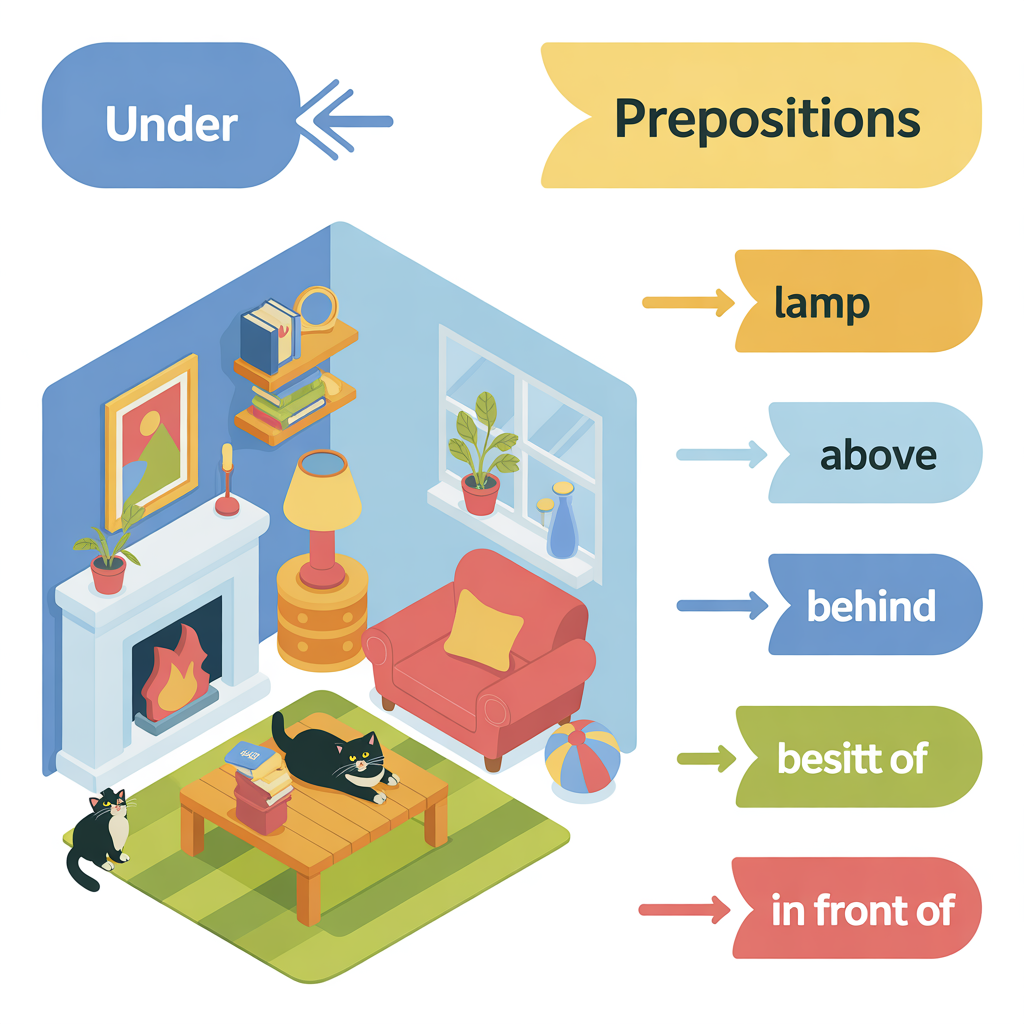
If you’ve ever tried to give someone directions, describe where your keys are, or explain where you live, you’ve already used prepositions of place. These small but mighty words are the invisible glue that connects objects, people, and locations in the English language. Understanding them is one of the most practical steps you can take toward speaking and writing English with confidence.
What Are Prepositions of Place?
A preposition of place is a word (or short phrase) that describes the position or location of a person, animal, object, or idea in relation to something else. They answer the question: “Where?”
For example:
- The cat is under the table.
- She lives in Paris.
- The book is on the shelf.
In each sentence, the bold word tells us exactly where something is located. Without these words, the sentence would lose its spatial meaning entirely.
Prepositions of place are a specific category within the broader family of prepositions, which also includes prepositions of time (e.g., “at noon,” “in January”) and prepositions of movement (e.g., “go into,” “walk across”). It’s important not to confuse these categories, as the same word can sometimes serve different functions depending on the sentence.
Why Are Prepositions of Place So Important?
Prepositions of place are among the most frequently used grammatical structures in everyday English. Whether you’re writing an email, having a conversation, reading a novel, or following instructions, these words appear constantly. Mastering them helps you:
- Communicate locations accurately — describe where things are without confusion.
- Give and follow directions — essential for travel, navigation, and everyday tasks.
- Write more descriptively — add depth and clarity to written and spoken descriptions.
- Understand native speakers — recognize natural English expressions involving location.
Despite their importance, prepositions of place are notoriously tricky for English learners because many languages handle spatial relationships very differently. There often isn’t a direct one-to-one translation, which is why studying them in context is so valuable.
The Most Common Prepositions of Place (With Examples)
Let’s break down the most widely used prepositions of place one by one. Each comes with a clear explanation and practical examples to help you see exactly how they work.
1. In
“In” is used when something is inside or enclosed within a space — whether physical, geographical, or conceptual.
- She is in the kitchen. (inside a room)
- He works in London. (within a city)
- The documents are in the folder. (contained within an object)
- There’s a bug in the soup. (submerged or enclosed)
Use “in” for: rooms, buildings, cities, countries, continents, and enclosed spaces.
2. On
“On” describes something resting on a surface or attached to a surface.
- The glass is on the table. (resting on a flat surface)
- There’s a painting on the wall. (attached to a surface)
- She lives on Baker Street. (on a street)
- The island is on the coast of Spain. (along a larger geographical feature)
Use “on” for: surfaces (floors, tables, walls), floors of a building, streets, and bodies of water (on the river).
3. At
“At” refers to a specific, precise point or location. It’s more exact than “in” or “on.”
- Meet me at the corner. (a specific point)
- She is at the door. (a specific location)
- He’s studying at university. (a specific institution)
- We arrived at the airport. (a specific destination)
Use “at” for: specific addresses, points in space, events, institutions, and named locations.
In vs. On vs. At: A Quick Comparison
These three are the most commonly confused prepositions of place. Here’s a simple way to remember them:
- In = enclosed or inside a larger area (a country, a box, a room)
- On = touching a surface or line (a table, a floor, a street)
- At = a precise, specific point (an address, a doorway, a meeting spot)
Compare: “I’m in New York” (the city as a whole) vs. “I’m at Times Square” (a specific spot in New York).
4. Above
“Above” means at a higher level than something else, but not necessarily directly over it.
- The plane flew above the clouds.
- The temperature was above 30 degrees.
- Her apartment is above the shop.
5. Below
“Below” is the opposite of “above” — it means at a lower level, without requiring direct contact.
- The valley lies below the mountain.
- The submarine was below the surface.
- His score was below average.
6. Over
“Over” means directly above something, often suggesting movement or coverage. It can also imply physical contact in some uses.
- A bird flew over the house.
- She put a blanket over the child.
- There’s a bridge over the river.
Note: “Over” and “above” are often interchangeable, but “over” more commonly implies movement or covering something completely.
7. Under
“Under” means directly below something, often with something directly on top.
- The cat hid under the bed.
- The tunnel runs under the river.
- She swept the dust under the rug.
8. Behind
“Behind” means at the back of something, or hidden from the front view.
- He parked the car behind the building.
- The garden is behind the house.
- She stood behind him in the queue.
9. In Front Of
“In front of” is the opposite of “behind.” It describes something positioned facing the front of an object or person.
- She was sitting in front of the screen.
- There’s a garden in front of the house.
- He stood in front of the crowd and spoke.
10. Next To / Beside
Both “next to” and “beside” mean very close to something, at the side of it. They are largely interchangeable.
- She sat next to me on the bus.
- The pharmacy is beside the supermarket.
- He placed his bag next to the door.
11. Between
“Between” refers to a position in the middle of two specific things or people.
- The park is between the library and the school.
- She sat between her two friends.
- There is a fence between the two gardens.
Important: “Between” is typically used with two clearly defined things. When referring to more than two things in a general sense, use “among.”
12. Among
“Among” is used when something is surrounded by or part of a group of more than two things.
- She found her phone among the pile of books.
- He was standing among the crowd.
- The secret was shared among the team members.
13. Near / Close To
Both “near” and “close to” describe a short distance from something — not right beside it, but not far either.
- Is there a bank near here?
- The school is close to the park.
- Don’t stand too near the edge.
14. Far From
“Far from” is the opposite of “near” — it describes a significant distance between two things.
- The nearest hospital is far from the village.
- Her office is far from home.
15. Opposite
“Opposite” means directly facing something or someone — on the other side.
- The post office is opposite the train station.
- She sat opposite him at the table.
16. Inside / Outside
“Inside” means within the boundaries or walls of something. “Outside” means beyond or exterior to those boundaries.
- Please stay inside the building.
- The children are playing outside the house.
- Leave your shoes outside the door.
17. Around
“Around” can describe something that surrounds an area or something located in the general vicinity of a place.
- There’s a fence around the garden.
- The shops around the corner are great.
- She looked around the room nervously.
18. Along
“Along” refers to a position following the length or course of something — typically a road, river, or path.
- There are trees along the road.
- We walked along the river bank.
- Several cafes are along the high street.
Prepositional Phrases of Place
A prepositional phrase of place is a group of words that begins with a preposition and ends with a noun or pronoun (called the object of the preposition). Together, they function as a single unit that describes location.
Structure: Preposition + Noun/Pronoun
- In the garden — the flowers are blooming.
- At the top of the stairs — there’s a window.
- Behind the sofa — you’ll find the remote control.
- Between the two buildings — there’s a small alley.
These phrases can appear at the beginning, middle, or end of a sentence, making them highly flexible grammatical tools.
Prepositions of Place vs. Prepositions of Movement
A very common point of confusion is the difference between prepositions that describe a static location (place) and those that describe movement toward or through a location (movement/direction).
Compare these pairs:
| Preposition of Place (Static) | Preposition of Movement (Dynamic) |
|---|---|
| She is in the room. | She walked into the room. |
| The cat is on the roof. | The cat climbed onto the roof. |
| He stood at the top. | He climbed to the top. |
| She was under the bridge. | She swam under the bridge. (movement) |
The key question to ask is: Is the subject moving or staying still? If they’re moving, you likely need a preposition of movement. If they’re stationary, use a preposition of place.
Common Mistakes with Prepositions of Place (And How to Avoid Them)
Even advanced English learners make errors with prepositions of place. Here are the most frequent mistakes and how to fix them:
Mistake 1: Using “in” instead of “at” for specific addresses
- ❌ She lives in 45 Park Avenue.
- ✅ She lives at 45 Park Avenue.
Use “at” for specific street addresses.
Mistake 2: Using “on” instead of “in” for enclosed vehicles
- ❌ She is on a taxi.
- ✅ She is in a taxi.
Use “in” for enclosed vehicles (taxi, car, helicopter) and “on” for larger or open ones (bus, train, plane, ship, bike).
Mistake 3: Confusing “between” and “among”
- ❌ He is between his classmates. (many people, not just two)
- ✅ He is among his classmates.
Mistake 4: Using “in” instead of “on” for streets
- ❌ The restaurant is in Main Street.
- ✅ The restaurant is on Main Street.
Mistake 5: Using “on” instead of “at” for corners
- ❌ I’ll meet you on the corner.
- ✅ I’ll meet you at the corner.
A Reference Table: Prepositions of Place at a Glance
| Preposition | Meaning | Example |
|---|---|---|
| In | Inside / within an area | The keys are in the drawer. |
| On | On a surface or line | The cup is on the table. |
| At | At a specific point | She’s at the office. |
| Above | Higher than, not touching | The sign is above the door. |
| Below | Lower than, not touching | The fish swam below the surface. |
| Over | Directly above / covering | A cloud passed over the sun. |
| Under | Directly below | The dog is under the chair. |
| Behind | At the back of | The garden is behind the house. |
| In front of | Facing / at the front | He stood in front of the class. |
| Next to / Beside | At the side of | Sit beside me. |
| Between | In the middle of two things | The park is between the two buildings. |
| Among | Surrounded by more than two | She was among friends. |
| Near / Close to | A short distance from | There’s a café near the school. |
| Opposite | Facing, on the other side | The bank is opposite the hotel. |
| Inside | Within the interior | Come inside the house. |
| Outside | Exterior to a space | The shoes are outside the door. |
| Around | Surrounding / in the vicinity | Fences around the yard. |
| Along | Following the length of | Trees along the road. |
How to Practice Prepositions of Place Effectively
Knowing the rules is one thing — building instinctive fluency is another. Here are some highly effective strategies to practice prepositions of place:
- Describe your environment: Right now, look around the room and describe everything you see using prepositions. “My laptop is on the desk. A lamp is beside the window. My shoes are under the bed.”
- Use picture descriptions: Find a detailed image or illustration and write or speak sentences about it using as many prepositions of place as possible.
- Play “Where is it?”: Hide an object (or imagine one) and have a partner ask questions using prepositions to guess the location.
- Read and highlight: When reading in English — news articles, short stories, or even social media posts — highlight every preposition of place you encounter. Then study how it’s being used in context.
- Flashcard drills: Create flashcards with an image on one side and the correct prepositional phrase on the other. Apps like Anki make this especially effective.
- Write directions: Write out directions from your home to a nearby landmark, paying careful attention to which prepositions you use for static positions vs. movement.
Prepositions of Place in Real-Life Contexts
To see just how naturally prepositions of place appear in everyday English, here are a few real-world context examples:
Giving Directions
“Go straight, and the café will be on your left, just opposite the post office and next to the bookshop. You can’t miss it — there’s a big sign above the door.”
Describing a Room
“The living room is cosy. There’s a sofa in front of the television, a bookshelf beside the window, and a small coffee table between the two armchairs. A rug lies under the table.”
Telling Someone Where Something Is
“Your keys are on the kitchen counter, next to the fruit bowl, behind the kettle.”
Notice how naturally these words flow together. That fluency comes with practice and exposure.
Conclusion
Prepositions of place are small words with enormous power. They allow us to describe the world around us with precision — telling people where things are, where to go, and how one thing relates to another in space. From the fundamental trio of in, on, and at to more specific terms like between, among, opposite, and along, each preposition carries a distinct spatial meaning that enriches your communication.
The best way to master them is not through memorizing rules alone, but by encountering them in context, practising regularly, and paying close attention to how native speakers use them. Over time, the right preposition will feel natural — and that’s the real goal of language learning.
Start small: look around your immediate environment right now and describe what you see. You’ll be surprised how quickly these words become second nature.
Frequently Asked Questions (FAQs)
What is the difference between “above” and “over”?
Both mean “higher than,” but “over” usually implies being directly above or covering something (e.g., “a bridge over the river”), while “above” is more general and often used for higher positions without direct covering (e.g., “the apartment above mine”). They are often interchangeable, but “over” more commonly appears with movement.
Can a preposition of place also be a preposition of movement?
Yes! Many prepositions can function as both, depending on context. For example, “under” can be a place preposition (“the cat is under the table”) or a movement preposition (“she crawled under the fence”). The verb in the sentence usually signals which function is being used.
How many prepositions of place are there in English?
There’s no fixed number, but learners typically focus on around 15–25 core prepositions of place. Beyond single-word prepositions, there are also prepositional phrases like “in front of,” “on top of,” “in the middle of,” and “at the bottom of” that expand the range significantly.
What is a prepositional phrase of place?
A prepositional phrase of place is a group of words that starts with a preposition and ends with a noun or pronoun, collectively describing a location. Example: “behind the old oak tree” or “at the end of the corridor.”
Is “in” or “at” used for schools and universities?
Both can be correct depending on meaning. Use “at” when referring to the institution as a concept or activity (e.g., “She studied at Oxford”). Use “in” when physically describing being inside the building (e.g., “I left my bag in the school”).