
Every sentence you write rests on a single grammatical foundation: a finite verb. Without one, a group of words is just a fragment — a collection of ideas with nowhere to go. Understanding finite verbs is one of the most powerful things you can do to sharpen your grammar, improve your writing, and build sentences that actually work. In this guide, we’ll break down exactly what a finite verb is, how to spot one, how it differs from a non-finite verb, and why the distinction matters more than you might think.
What Is a Finite Verb?
A finite verb is a verb form that is directly linked to the subject of a sentence and is limited — or “defined” — by that subject in terms of person, number, and tense. The word “finite” comes from the Latin finitus, meaning “limited” or “defined.” A finite verb tells you who is doing the action, how many are doing it, and when it is happening.
In the simplest terms: a finite verb is the main verb in a clause that carries tense and agrees with its subject.
For example:
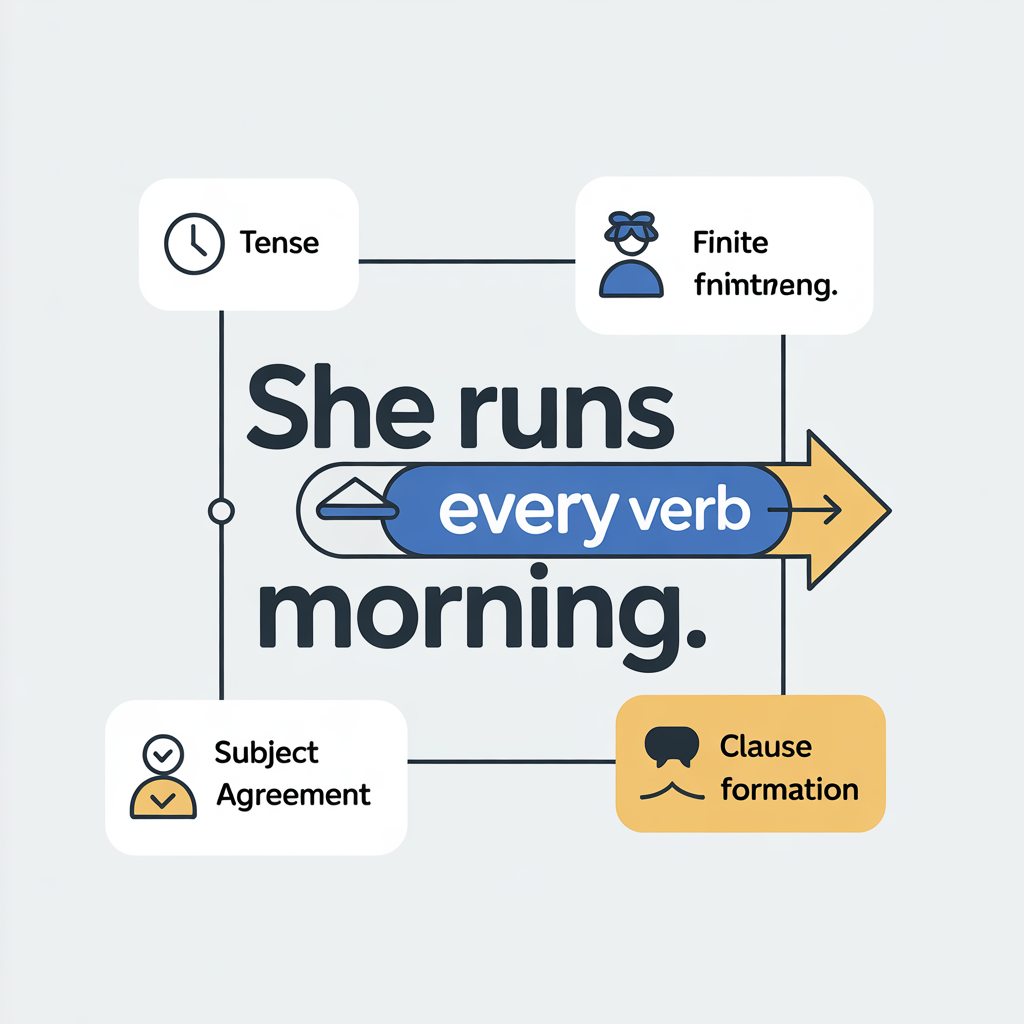
- She runs every morning. — “runs” is finite (third person singular, present tense)
- They laughed at the joke. — “laughed” is finite (third person plural, past tense)
- I am ready. — “am” is finite (first person singular, present tense)
Each finite verb here is anchored to its subject and tells us exactly when the action takes place.
The Three Key Features of a Finite Verb
To identify a finite verb with confidence, look for these three defining characteristics:
1. Tense
Finite verbs express a specific time frame — present, past, or future. They are “tensed” verbs.
- He writes every day. (present tense)
- He wrote a letter. (past tense)
- He will write tomorrow. (future tense — the auxiliary “will” is the finite element)
2. Subject Agreement
Finite verbs change their form to match the subject in person and number. This is called subject-verb agreement.
- I am tired. / She is tired. / They are tired.
- He goes to school. / They go to school.
Notice how the verb shifts depending on whether the subject is first, second, or third person, and whether it is singular or plural.
3. It Can Stand Alone as the Predicate
A finite verb can serve as the complete predicate — the part of the sentence that says something about the subject — all by itself (or with the help of auxiliary verbs).
- The dog barked. — “barked” is the full predicate
- The dog was barking. — “was” is the finite verb; “barking” is the non-finite element
Examples of Finite Verbs in Sentences
Let’s look at a broader range of examples to make the concept crystal clear:
| Sentence | Finite Verb | Tense | Person/Number |
|---|---|---|---|
| The child sleeps peacefully. | sleeps | Present | 3rd person singular |
| We finished the project. | finished | Past | 1st person plural |
| She has a new job. | has | Present | 3rd person singular |
| They were exhausted. | were | Past | 3rd person plural |
| The team will compete next week. | will | Future | 3rd person singular |
| I do not understand the question. | do | Present | 1st person singular |
Notice that in verb phrases with auxiliaries (helping verbs), it is the auxiliary that carries the tense and agreement — making it the finite element, not the main verb that follows.
Finite Verbs vs. Non-Finite Verbs
The clearest way to truly understand finite verbs is to contrast them with their grammatical opposite: non-finite verbs.
A non-finite verb does not change according to the subject. It has no tense on its own, and it cannot stand alone as the main predicate of a sentence. There are three main types of non-finite verbs:
1. Infinitives
The base form of a verb, usually preceded by “to.”
- She wants to learn French. — “to learn” is non-finite
- I need to sleep. — “to sleep” is non-finite
2. Gerunds
The -ing form of a verb used as a noun.
- Swimming is great exercise. — “swimming” is non-finite
- He enjoys reading. — “reading” is non-finite
3. Participles
Verb forms used as adjectives or as part of verb phrases.
- The broken window was replaced. — “broken” is non-finite (past participle used as adjective)
- Running down the street, he tripped. — “running” is non-finite (present participle)
Side-by-Side Comparison
| Feature | Finite Verb | Non-Finite Verb |
|---|---|---|
| Has tense | ✅ Yes | ❌ No |
| Agrees with subject | ✅ Yes | ❌ No |
| Can form a complete sentence | ✅ Yes | ❌ No (by itself) |
| Examples | runs, was, will go, decided | to run, running, broken, decided* |
*Note: Some verb forms like “decided” can be both finite (past tense) or a past participle (non-finite) depending on context.
The Role of Auxiliary Verbs in Finite Verb Phrases
Many English sentences use auxiliary verbs (also called helping verbs) alongside a main verb. In these cases, it is the auxiliary verb that acts as the finite element — it carries the tense and agrees with the subject.
Consider this verb phrase: “She has been studying for hours.”
- has — finite verb (3rd person singular, present tense)
- been — non-finite (past participle)
- studying — non-finite (present participle)
The common auxiliary verbs that serve as finite elements include:
- Be forms: am, is, are, was, were
- Have forms: have, has, had
- Do forms: do, does, did
- Modal auxiliaries: will, would, shall, should, can, could, may, might, must
Modal auxiliary verbs are a special case — they are always finite, but they do not change form based on person (you say “he can” not “he cans”). They are finite because they carry tense and mood.
Finite Verbs in Different Clause Types
Every clause — whether it is a main clause or a subordinate clause — must contain a finite verb. This is what makes a clause a clause.
Main Clauses
A main (independent) clause has one finite verb and can stand alone:
- The sun sets in the west.
Subordinate Clauses
A subordinate (dependent) clause also contains its own finite verb, but it cannot stand alone as a complete sentence:
- I stayed inside because it was raining. — “was” is the finite verb of the subordinate clause
- She smiled when she heard the news. — “heard” is the finite verb of the subordinate clause
Phrases (Not Clauses)
By contrast, a phrase does not contain a finite verb — it contains a non-finite form:
- Running through the park — a participial phrase, no finite verb
- To win the championship — an infinitive phrase, no finite verb
How to Identify a Finite Verb: A Step-by-Step Method
Not sure whether a verb in a sentence is finite or not? Follow this simple process:
- Find the verb (or verb phrase). Ask yourself: what is the action or state being described?
- Check for tense. Can you change the sentence from present to past (or vice versa) by changing this verb? If yes, it’s finite.
- Check for subject agreement. Does the verb change if you swap the subject (e.g., “he” to “they”)? If yes, it’s likely finite.
- Ask: can this verb anchor the sentence on its own? If removing all other elements still leaves a grammatical core (Subject + this verb), it’s finite.
Quick test example:
The students completed their assignments before midnight.
- Change tense: “The students complete…” ✅ tense changes = finite
- Change subject: “He completed…” — works, confirms agreement ✅
- Core sentence: “Students completed.” ✅ makes sense
Conclusion: “completed” is a finite verb. ✅
Common Mistakes with Finite Verbs
Even experienced writers make errors related to finite verbs. Here are the most frequent ones to watch out for:
1. Sentence Fragments
A sentence without a finite verb is a fragment, not a complete sentence.
- ❌ The boy running down the street. — “running” is non-finite; there is no finite verb
- ✅ The boy was running down the street.
2. Subject-Verb Agreement Errors
The finite verb must match its subject.
- ❌ The team are ready to play. (in American English)
- ✅ The team is ready to play.
3. Tense Inconsistency
Mixing tenses carelessly creates confusion.
- ❌ She walked into the room and says nothing.
- ✅ She walked into the room and said nothing.
4. Confusing Participles with Finite Verbs
- ❌ The report written by the manager. — “written” is a past participle (non-finite); no finite verb present
- ✅ The report was written by the manager.
Why Finite Verbs Matter for Grammar and Writing
Understanding finite verbs is not just an academic exercise. It has real, practical consequences for the quality of your writing:
- It prevents sentence fragments. Every sentence needs a finite verb. Knowing this helps you avoid one of the most common writing errors.
- It ensures subject-verb agreement. Recognizing the finite verb helps you match it correctly to the subject.
- It helps with tense control. Understanding which verb carries the tense lets you maintain consistency throughout a paragraph or passage.
- It aids in sentence analysis. Whether you are diagramming sentences, studying a foreign language, or editing a document, identifying the finite verb is the first step in understanding any clause’s structure.
- It improves language learning. Many languages mark finiteness differently. Understanding the concept in English makes learning the grammar of other languages significantly easier.
Finite Verbs in Complex and Compound Sentences
Complex and compound sentences simply have more than one finite verb — one for each clause.
Compound sentence:
The rain fell heavily, and the rivers flooded.
- “fell” — finite verb of the first independent clause
- “flooded” — finite verb of the second independent clause
Complex sentence:
Although she was tired, she kept working.
- “was” — finite verb of the subordinate clause
- “kept” — finite verb of the main clause
Counting finite verbs is actually a useful way to count the number of clauses in a sentence — each finite verb signals one clause.
Conclusion
A finite verb is the grammatical engine of every sentence. It carries tense, agrees with the subject, and makes a clause complete. Without it, you don’t have a sentence — you have a fragment. Whether you are a student studying grammar for the first time, a writer trying to tighten your prose, or a language learner building a strong foundation, understanding finite verbs will fundamentally improve how you read, write, and think about language.
The next time you sit down to write, try this: underline the finite verb in every sentence. If you can’t find one, you’ve found a fragment that needs fixing. It’s a small habit that builds enormous grammatical awareness over time.
Frequently Asked Questions (FAQs)
Can a sentence have more than one finite verb?
Yes. In compound and complex sentences, each clause has its own finite verb. For example: “She laughed and he smiled” has two finite verbs — “laughed” and “smiled.”
Is “to go” a finite verb?
No. “To go” is an infinitive, which is a non-finite verb form. It has no tense and does not agree with a subject. The finite forms would be “go,” “goes,” or “went.”
What is the difference between a finite verb and a main verb?
These terms overlap but are not identical. A main verb is the verb that carries the core meaning of the predicate. A finite verb is defined by its grammatical properties (tense + agreement). In simple sentences, the main verb is also finite. In verb phrases with auxiliaries, the auxiliary is finite while the main verb may be non-finite.
Are modal verbs finite?
Yes. Modal verbs (can, could, will, would, shall, should, may, might, must) are finite because they carry tense and mood. However, they do not change form based on person or number (we say “he can” not “he cans”).
Can a finite verb appear at the beginning of a sentence?
Yes, especially in questions and certain literary or formal constructions. For example: “Is she coming?” or “Were I to know the answer, I would tell you.”
What is a non-finite clause?
A non-finite clause is a subordinate clause built around a non-finite verb form (infinitive, gerund, or participle). It does not have its own tense and often has no explicit subject. Example: “He asked me to stay“ — “to stay” heads a non-finite clause.