
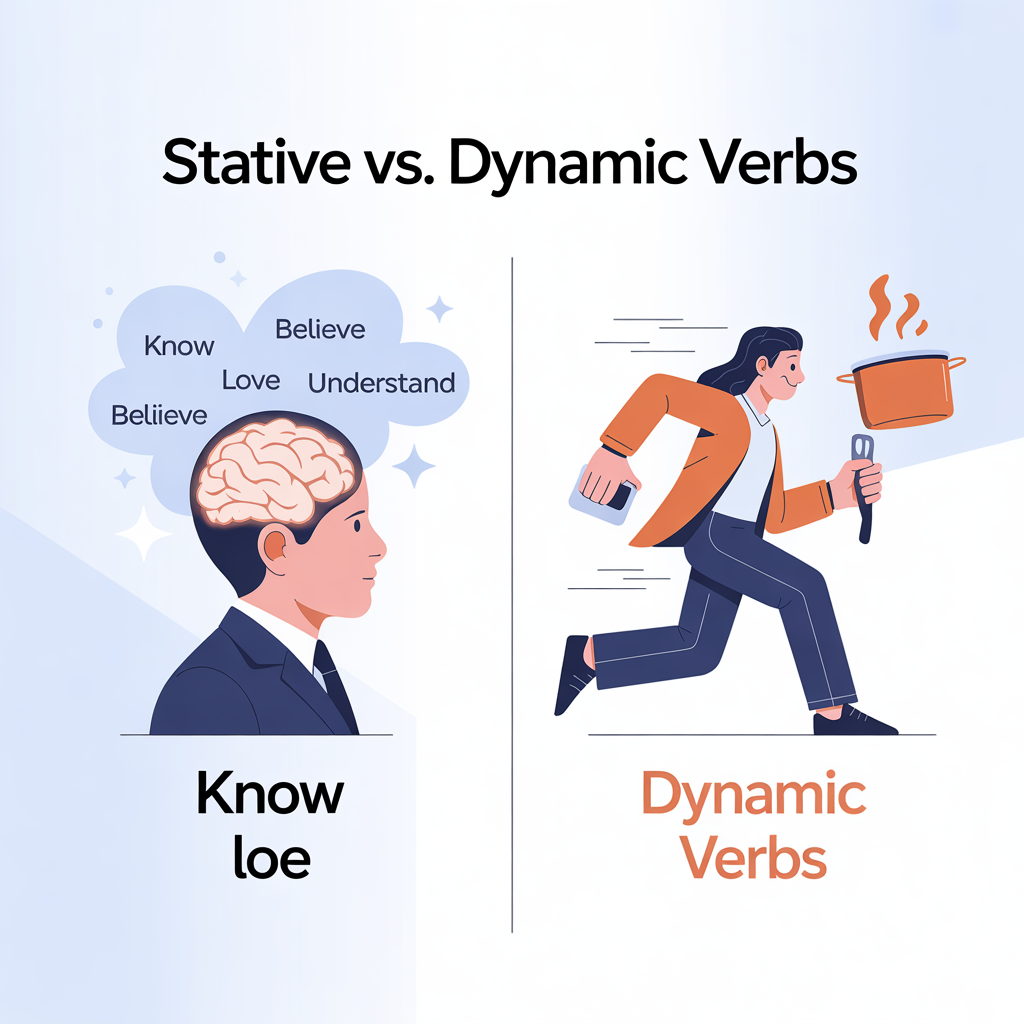
You probably use stative verbs dozens of times every day without even realizing it. Every time you say “I know the answer,” “She believes in you,” or “This coffee smells amazing,” you are using a stative verb. Yet despite how common they are, stative verbs trip up even intermediate and advanced English learners — mostly because of one tricky rule: you generally cannot use them in the continuous tense. Understanding what a stative verb is, why it behaves the way it does, and when the rules get complicated will sharpen your grammar and make your English sound far more natural.
What Is a Stative Verb? (The Core Definition)
A stative verb (also called a state verb) is a verb that describes a state of being, feeling, thinking, or perceiving rather than a physical action or event. In other words, it expresses a condition that simply exists — something that is ongoing and relatively stable over time — rather than something that is actively happening or changing.
Compare these two sentences:
- “She is running in the park.” (action — it has a clear start and finish)
- “She knows the answer.” (state — there is no observable activity; she simply possesses that knowledge)
Running describes a physical, dynamic action. Knowing describes a mental state. That difference is the heart of what separates stative verbs from all other verbs in English.
The term comes from the word “state” — a condition that persists rather than progresses. Think of it as a photograph versus a video: a stative verb is the photograph (a fixed moment or ongoing condition), while a dynamic verb is the video (something in motion, with a process unfolding).
Stative Verbs vs. Dynamic Verbs: What Is the Difference?
To fully understand stative verbs, you need to see them clearly in contrast with their opposites — dynamic verbs (also called action verbs).
| Feature | Stative Verb | Dynamic Verb |
|---|---|---|
| What it describes | A state, condition, or quality | An action, event, or process |
| Typical tense | Simple tenses (present simple, past simple) | All tenses, including continuous |
| Progressive form? | Usually NOT used in continuous tenses | Freely used in continuous tenses |
| Example | “I love this song.” | “I am singing this song.” |
Notice the key rule in the table above: stative verbs are almost never used in the present continuous or past continuous tenses. This is the single most important grammar rule attached to stative verbs — and the one that causes the most confusion.
- ✅ “I understand the problem.” (correct — simple present)
- ❌ “I am understanding the problem.” (incorrect — continuous form)
The Four Main Categories of Stative Verbs
Stative verbs are easier to identify when you group them by the type of state they describe. There are four primary categories.
1. Verbs of Mental and Cognitive State
These verbs describe what the mind holds — knowledge, belief, recognition, or thought.
- know — “She knows three languages.”
- believe — “He believes the story is true.”
- understand — “I understand the instructions.”
- remember — “They remember the old house.”
- forget — “I always forget his birthday.”
- recognize — “She recognized him immediately.”
- realize — “He realizes his mistake.”
- think (when it means “have an opinion”) — “I think it’s a great idea.”
- doubt — “They doubt the results.”
2. Verbs of Emotion and Feeling
These verbs express an internal emotional or psychological state.
- love — “I love jazz music.”
- hate — “She hates being late.”
- like — “He likes quiet evenings.”
- dislike — “I dislike crowded places.”
- want — “They want a refund.”
- need — “She needs more time.”
- prefer — “He prefers tea over coffee.”
- fear — “I fear the worst.”
- care — “She cares about the environment.”
3. Verbs of Perception and Sensation
These verbs describe how we experience the world through our senses — but in a passive way (as in, it just happens to you).
- see — “I see a bird outside.” (passive perception)
- hear — “Do you hear that noise?”
- smell — “The soup smells delicious.” (when describing a quality)
- taste — “This tastes strange.”
- feel (when describing a physical or emotional quality) — “The fabric feels soft.”
- appear — “She appears nervous.”
- seem — “That seems wrong.”
- look (when it means “appear”) — “He looks tired.”
- sound — “That sounds like a good plan.”
4. Verbs of Possession, Relationship, and Being
These verbs describe ownership, relationships, or states of existence.
- have — “She has two cats.” (ownership)
- own — “They own a restaurant.”
- belong — “This key belongs to me.”
- contain — “The box contains glassware.”
- consist — “The team consists of twelve members.”
- include — “The package includes free delivery.”
- lack — “He lacks confidence.”
- be — “She is a doctor.”
- exist — “No proof exists.”
- resemble — “She resembles her mother.”
- depend — “Success depends on effort.”
Why Can’t Stative Verbs Be Used in the Continuous Form?
This is the most common question people ask once they grasp the concept. The answer comes down to what progressive (continuous) tenses communicate.
In English, continuous tenses signal that an action is:
- Currently in progress
- Temporary in nature
- Unfinished at a particular moment
But stative verbs describe permanent or semi-permanent conditions — states that just are. They do not have a beginning, middle, and end in the way that actions do. Because of this, it is logically inconsistent to describe a state as something that is “in progress.” You cannot be “in the middle of knowing something.”
That is why:
- ❌ “I am owning a car.” sounds wrong — you simply own it; there is no ongoing process of owning.
- ❌ “He is believing you.” sounds wrong — belief is a state you hold, not an activity you perform.
The Tricky Part: Verbs That Can Be Both Stative AND Dynamic
Here is where grammar gets genuinely interesting. Some verbs in English can be either stative or dynamic, depending entirely on their meaning in context. This is one of the most important nuances to master.
When a verb shifts to a dynamic (action) meaning, it can suddenly be used in the continuous form — and the meaning changes significantly.
The verb “think”
- Stative (= to have an opinion): “I think she is right.” (simple present — an opinion)
- Dynamic (= to actively consider or reason): “I am thinking about your offer.” (continuous — a deliberate mental activity)
The verb “have”
- Stative (= to own or possess): “She has a new car.” (simple present)
- Dynamic (= in certain expressions or phrasal verb contexts): “She is having breakfast.” / “We are having a meeting.” (continuous — these are experiences or activities)
The verb “see”
- Stative (= passive visual perception): “I see a mountain in the distance.”
- Dynamic (= meeting someone or dating): “She is seeing a new doctor.” / “They are seeing each other.” (continuous — active engagement)
The verb “smell” and “taste”
- Stative (= to emit a smell/flavor): “The soup smells wonderful.” / “The cake tastes sweet.”
- Dynamic (= to actively sniff or sample): “The chef is tasting the sauce.” / “She is smelling the flowers.” (continuous — deliberate action)
The verb “appear”
- Stative (= to seem): “She appears confident.”
- Dynamic (= to come on stage or arrive): “The band is appearing live tomorrow.”
The verb “feel”
- Stative (= an emotional or physical state): “I feel tired today.”
- Dynamic (= to physically touch or explore): “She is feeling the texture of the fabric.” (continuous — a physical activity)
The key takeaway: always look at the meaning, not just the verb itself, to decide whether to use simple or continuous tense.
Common Mistakes Learners Make with Stative Verbs
Even advanced learners make errors with stative verbs. Here are the most frequent ones — and how to correct them.
Mistake 1: Using the Present Continuous with a Stative Verb
- ❌ “I am knowing the answer.”
- ✅ “I know the answer.”
- ❌ “She is loving chocolate ice cream.”
- ✅ “She loves chocolate ice cream.”
Note: You may have seen “I’m loving it” in McDonald’s advertising. This is a deliberate, informal stylistic choice to add emphasis and dynamism. It works as a slogan precisely because it breaks the expected rule. In standard writing and formal English, this form is considered grammatically incorrect.
Mistake 2: Confusing Active Perception with Passive Perception
- ❌ “I am seeing a strange light in the sky.” (if you mean passive, involuntary sight)
- ✅ “I see a strange light in the sky.”
But if you mean you are actively meeting someone, “I’m seeing a new therapist” is perfectly correct.
Mistake 3: Using a Stative Verb in a Progressive Infinitive
- ❌ “He seems to be knowing the answer.”
- ✅ “He seems to know the answer.”
Mistake 4: Forgetting Context Changes the Category
A learner who memorizes “have = stative verb” might say:
- ❌ “We have a great time last night.” (instead of the past continuous)
- ✅ “We were having a great time last night.”
Because “having a great time” is a dynamic expression (an experience), the continuous form is correct here.
Stative Verbs in Perfect Tenses
It is worth clarifying that the “no continuous” rule specifically applies to progressive/continuous tenses. Stative verbs are used comfortably in perfect tenses:
- “She has known him for ten years.” ✅ (present perfect simple)
- “They had owned the house since 1998.” ✅ (past perfect simple)
- “I have always believed in hard work.” ✅ (present perfect simple)
However, present perfect continuous with stative verbs is generally avoided:
- ❌ “She has been knowing him for ten years.”
- ✅ “She has known him for ten years.”
Quick-Reference List: The Most Common Stative Verbs in English
Here is a consolidated reference list organized for easy recall:
Mental States
know, believe, understand, remember, forget, realize, recognize, suppose, doubt, imagine, think (opinion), mean, notice, consider
Emotions and Desires
love, hate, like, dislike, want, need, prefer, fear, envy, care, mind, wish, adore, loathe, satisfy, impress, please, surprise
Senses and Perception
see, hear, smell, taste, feel, sound, appear, seem, look (appear), notice
Possession and Relationships
have (own), own, belong, possess, contain, consist, include, lack, involve, require, depend, deserve, matter, owe, fit, suit
States of Being
be, exist, weigh (a permanent weight), measure (a permanent measurement), resemble, equal, cost
A Practical Test: How to Tell If a Verb Is Stative
If you are ever unsure whether a verb is stative in a given context, try this simple two-step test:
- Ask yourself: “Is there a physical or deliberate activity happening here?” If no — if it is simply a state that exists — it is likely stative.
- Try the continuous form and ask: “Does this describe something ‘in progress’?” If the continuous form feels awkward or illogical, the verb is being used statively.
For example: “I am resembling my father more each year.” Does “resembling” describe an ongoing activity you are performing? No — it is just a state. So it should be: “I resemble my father more each year.”
Why Mastering Stative Verbs Matters for Your English
Understanding stative verbs is not just a grammar exercise. Getting it right produces several real benefits:
- More natural-sounding English: Native speakers use the simple tenses for stative verbs instinctively. Using continuous tenses where they don’t belong is one of the clearest signals of a non-native speaker.
- Better writing: Academic writing, business communication, and formal essays all rely on precise grammatical construction. Misusing stative verbs in these contexts can undermine your credibility.
- Clearer communication: The distinction between “I think about the problem” (continuous, active deliberation) and “I think it’s a problem” (simple, an opinion) carries real meaning. Getting it wrong changes what you actually say.
- Higher exam scores: Tests like IELTS, TOEFL, and Cambridge exams frequently test knowledge of stative and dynamic verbs in error-correction and writing tasks.
Conclusion
A stative verb is a verb that expresses a state — a mental condition, an emotion, a perception, a relationship, or a state of being — rather than a physical action. Because states simply exist rather than progress, stative verbs are typically used in simple tenses, not continuous ones. The four major categories are mental states (know, believe, understand), emotions and desires (love, want, prefer), perception and sensation (see, hear, smell), and possession and being (have, belong, consist).
The most important nuance to remember is that many verbs can be both stative and dynamic depending on their meaning — and that shift in meaning changes which tense is correct. Always let the intended meaning, not a rigid memorized rule, guide your choice.
Once you internalize the logic behind stative verbs — that they capture a snapshot, not a video — you will find that using them correctly becomes completely natural. And that understanding, ironically, is itself a perfect example of a stative verb in action.
Frequently Asked Questions (FAQs)
Can stative verbs ever be used in the continuous tense?
In most cases, no. However, some stative verbs can shift to a dynamic meaning in certain contexts — and when used dynamically, the continuous tense is acceptable. For example, “I’m thinking about your offer” (active deliberation) vs. “I think it’s a good idea” (opinion). Context and meaning always determine the correct form.
Is “love” a stative verb?
Yes, in standard grammar, “love” is a stative verb because it describes an emotional state rather than an action. The correct form is “I love this movie,” not “I am loving this movie.” The continuous form is sometimes used in informal or marketing language for stylistic emphasis, but it is not standard grammar.
What is the difference between “I see” and “I am seeing”?
“I see” uses the stative meaning of “see,” referring to passive visual perception — your eyes are registering something without deliberate effort. “I am seeing” uses the dynamic meaning, typically indicating you are meeting with someone (“I am seeing a specialist next week”) or romantically involved with someone (“They are seeing each other”).
Are stative verbs always non-action verbs?
Generally, yes. Stative verbs by definition describe conditions or states rather than actions. However, because some verbs have both a stative and a dynamic sense, the same verb can technically function as either, depending on usage. So it is more accurate to say: when a verb is being used statively, it is functioning as a non-action verb in that specific instance.
Do stative verbs work in past tense?
Absolutely. Stative verbs work normally in the past simple tense. For example: “She knew the answer,” “He believed in the project,” “They owned a bakery for twenty years.” The restriction is specifically against the continuous/progressive forms — not against past tense use in general.