
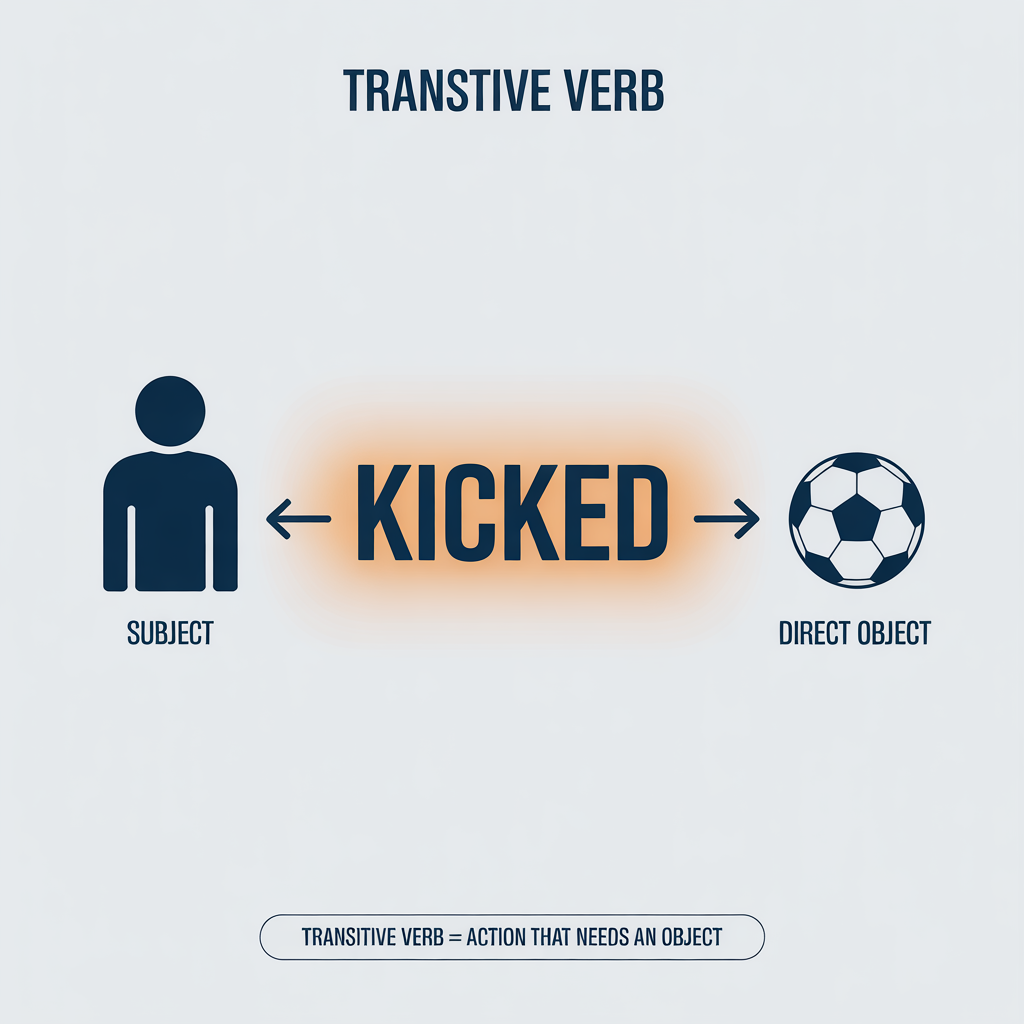
Every sentence tells a story — someone does something to something else. But for that chain of action to work grammatically, you often need a very specific kind of verb. A transitive verb is the engine that connects an action to its target, making your sentences precise, complete, and meaningful. Whether you’re a student brushing up on grammar basics or a writer trying to sharpen your craft, understanding transitive verbs is one of the most practical skills you can build. This guide covers everything you need to know: the definition, how they work, real-world examples, and how to avoid common mistakes.
What Is a Transitive Verb? The Core Definition
A transitive verb is an action verb that requires a direct object to complete its meaning. In other words, the action described by the verb is transferred — or “transited” — from the subject to something or someone else.
The word transitive itself comes from the Latin transitivus, meaning “going across.” Think of it like a bridge: the verb carries the action from the subject across to the object.
Here’s a basic formula:
Subject + Transitive Verb + Direct Object
For example:
- She kicked the ball. (Subject: She | Verb: kicked | Direct Object: the ball)
- He read the book. (Subject: He | Verb: read | Direct Object: the book)
- The chef prepared dinner. (Subject: The chef | Verb: prepared | Direct Object: dinner)
In each case, if you remove the object, the sentence feels incomplete. “She kicked.” — Kicked what? The verb demands an answer. That demand for an object is the defining feature of a transitive verb.
What Is a Direct Object?
To fully understand transitive verbs, you need to understand what a direct object is. A direct object is the noun, pronoun, or noun phrase that receives the action of the verb.
The easiest way to find a direct object is to ask:
- “[Subject] [verb] what?”
- “[Subject] [verb] whom?”
Examples:
- Maria loves chocolate. → Maria loves what? → Chocolate (direct object)
- The teacher called the student. → The teacher called whom? → The student (direct object)
- They built a new house. → They built what? → A new house (direct object)
If a clear, logical answer exists, the verb is transitive and the answer is the direct object.
Transitive Verbs vs. Intransitive Verbs: What’s the Difference?
Understanding transitive verbs becomes much easier when you compare them to their counterpart: intransitive verbs.
An intransitive verb does not require a direct object. The action either stays with the subject or simply does not transfer to anything else.
| Feature | Transitive Verb | Intransitive Verb |
|---|---|---|
| Requires a direct object? | Yes | No |
| Can stand alone? | No (meaning is incomplete) | Yes |
| Example | She bought a car. | She slept. |
Compare these pairs:
- The dog ate the bone. (Transitive — “the bone” is the direct object)
- The dog ate quickly. (Intransitive — no object, “quickly” is an adverb)
- She runs the company. (Transitive — “the company” is the direct object)
- She runs every morning. (Intransitive — no direct object)
This brings up an important point: many English verbs can be both transitive and intransitive depending on how they are used in a sentence. Context is everything.
Verbs That Can Be Both Transitive and Intransitive
One of the most interesting aspects of English grammar is its flexibility. Many common verbs switch roles depending on the sentence. These are sometimes called ambitransitive verbs.
Here are some examples:
The Verb “Write”
- She writes poetry. (Transitive — poetry is the direct object)
- She writes beautifully. (Intransitive — no object)
The Verb “Read”
- He read the article. (Transitive)
- He read for an hour. (Intransitive)
The Verb “Drive”
- She drives a truck. (Transitive)
- She drives carefully. (Intransitive)
The Verb “Sing”
- He sang a song. (Transitive)
- He sang all night. (Intransitive)
The takeaway: don’t judge a verb by its dictionary entry alone. Always look at how it functions in a specific sentence.
Transitive Verbs with Indirect Objects
Some transitive verbs can take two objects: a direct object and an indirect object. The indirect object is the person or thing that receives the direct object — it answers the question “to whom?” or “for whom?”
Structure: Subject + Verb + Indirect Object + Direct Object
Examples:
- She gave him a gift. (Direct object: a gift | Indirect object: him)
- The teacher sent the class an email. (Direct object: an email | Indirect object: the class)
- My mother made me a sandwich. (Direct object: a sandwich | Indirect object: me)
Common transitive verbs that often pair with indirect objects include: give, send, show, tell, teach, buy, make, offer, bring, lend.
Monotransitive vs. Ditransitive Verbs
Linguists sometimes divide transitive verbs into two subcategories:
- Monotransitive verbs take only one object (a direct object).
- Ditransitive verbs take two objects (a direct object and an indirect object).
| Type | Example | Objects |
|---|---|---|
| Monotransitive | She kicked the ball. | Direct object only |
| Ditransitive | He gave her a rose. | Indirect + Direct object |
Most everyday conversations involve both types without you even realizing it.
How to Identify a Transitive Verb: A Step-by-Step Method
Not sure if a verb is transitive? Follow this simple three-step test:
- Find the verb. Identify the action word in the sentence.
- Ask “what?” or “whom?” after the verb. Direct that question at the verb.
- Check the answer. If a noun or noun phrase answers your question logically, that’s a direct object — and the verb is transitive. If there’s no sensible answer, the verb is likely intransitive.
Example:
The scientist discovered a new species.
- Verb: discovered
- Ask: “Discovered what?” → A new species
- Result: Transitive ✓
Another example:
The baby laughed.
- Verb: laughed
- Ask: “Laughed what?” → No logical answer.
- Result: Intransitive ✓
Common Transitive Verbs in English
Here is a list of frequently used transitive verbs grouped by category:
Verbs of Communication
- tell, ask, inform, answer, describe, explain
- She told the truth.
Verbs of Perception
- see, hear, feel, smell, notice, watch
- I noticed the change.
Verbs of Possession or Transfer
- buy, sell, give, send, lend, take, bring
- He sold his car.
Verbs of Creation or Action
- build, make, write, paint, create, design
- They built a bridge.
Verbs of Consumption
- eat, drink, use, spend, consume
- We spent the budget wisely.
Why Transitive Verbs Matter in Writing and Grammar
Understanding transitive verbs isn’t just a classroom exercise. It has real, practical value:
1. Clarity and Precision
Transitive verbs force you to be specific. When you say “She finished,” the reader wonders: finished what? Adding a direct object — “She finished the report” — eliminates ambiguity and makes your writing sharper.
2. Active vs. Passive Voice
Only transitive verbs can form the passive voice. When you flip a transitive sentence from active to passive, the direct object becomes the subject.
- Active: The manager approved the plan.
- Passive: The plan was approved by the manager.
Intransitive verbs cannot be made passive because there is no direct object to promote to subject position. This distinction is crucial for academic, professional, and creative writing.
3. Sentence Variety
Recognizing transitive verbs helps you build richer, more varied sentences. You can expand a simple transitive structure with indirect objects, prepositional phrases, and modifiers without losing grammatical correctness.
4. Language Learning
For non-native English speakers, correctly using transitive verbs — especially knowing when an object is required — is a key milestone in achieving fluency. It prevents incomplete or confusing sentences.
Transitive Verbs and the Passive Voice: A Deeper Look
Because transitive verbs are the only type that can be passivized, it’s worth exploring this connection further.
In an active sentence, the subject performs the action:
The company launched a new product.
In a passive sentence, the subject receives the action:
A new product was launched by the company.
The passive voice is formed with be + past participle. This construction is only possible because “launched” is transitive — it has a direct object (“a new product”) that can become the new subject.
Writers use the passive voice when:
- The doer of the action is unknown or unimportant (“The window was broken.”)
- They want to emphasize the result over the actor (“The vaccine was approved.”)
- They want to maintain a formal or objective tone
Common Mistakes to Avoid with Transitive Verbs
Even experienced writers make errors related to transitive verbs. Here are the most common pitfalls:
Mistake 1: Leaving out the required direct object
Incorrect: She explained.
Correct: She explained the situation.
The verb “explain” is almost always transitive in English. It demands an object.
Mistake 2: Confusing “lie” and “lay”
This is one of English’s most notorious grammar traps.
- Lie (to recline) is intransitive: She lies on the couch.
- Lay (to place something) is transitive: She lays the book on the table.
The confusion deepens because “lay” is also the past tense of “lie.” When in doubt, ask: is there an object? If yes, use “lay.”
Mistake 3: Treating “discuss” as requiring a preposition
Incorrect: We discussed about the project.
Correct: We discussed the project.
“Discuss” is transitive and takes a direct object — no preposition needed.
Mistake 4: Using “mention” or “suggest” with “about”
Incorrect: She mentioned about her trip.
Correct: She mentioned her trip.
Similar to “discuss,” these verbs are transitive and don’t need “about” to bridge them to their object.
Transitive Verbs Across Languages
The concept of transitivity is not unique to English. Most languages — including Spanish, French, German, Japanese, and Chinese — distinguish between transitive and intransitive verbs. However, the rules about which specific verbs are transitive can vary significantly.
For example:
- In Japanese, some verbs that are intransitive in English have distinct transitive forms.
- In Spanish, many verbs can switch between transitive and reflexive uses with a simple pronoun shift.
For language learners, it’s important not to assume that a verb’s transitivity in your native language maps directly onto English.
Quick Reference: Transitive vs. Intransitive at a Glance
| Sentence | Verb | Direct Object | Transitive? |
|---|---|---|---|
| He opened the door. | opened | the door | ✅ Yes |
| She arrived early. | arrived | — | ❌ No |
| They watched the game. | watched | the game | ✅ Yes |
| The child cried. | cried | — | ❌ No |
| We enjoy good music. | enjoy | good music | ✅ Yes |
| Birds fly south. | fly | — | ❌ No |
Conclusion
A transitive verb is an action verb that transfers its action to a direct object — and without that object, the sentence feels unfinished. From the simple act of “kicking a ball” to the complexity of giving, sending, and explaining, transitive verbs are at the heart of how we communicate actions and their consequences in English.
Once you understand the concept, you’ll start noticing transitive verbs everywhere: in news headlines, in literature, in everyday conversation. More importantly, you’ll use them more deliberately in your own writing — creating clearer, more precise, and more compelling sentences.
The next time you write a sentence, ask yourself: does this verb carry the action somewhere? If the answer is yes, you’re working with a transitive verb — and now you know exactly what to do with it.
Frequently Asked Questions (FAQs)
What is a transitive verb in simple terms?
A transitive verb is an action verb that needs a direct object to complete its meaning. The verb “carries” the action from the subject to a person or thing. For example, in “She reads the book,” reads is transitive because it requires the book to make sense.
What is the difference between a transitive and intransitive verb?
A transitive verb requires a direct object (e.g., “He threw the ball”), while an intransitive verb does not (e.g., “She laughed“). Many English verbs can function as both, depending on the context.
Can a verb be both transitive and intransitive?
Yes. Many English verbs — such as eat, write, read, run, and sing — can function as both transitive and intransitive verbs depending on whether a direct object follows them in the sentence.
How do I find the direct object of a transitive verb?
Ask the question “verb + what?” or “verb + whom?” after the verb. If you get a logical noun or pronoun as an answer, that’s the direct object and the verb is transitive.
Why can only transitive verbs be used in the passive voice?
The passive voice works by moving the direct object into the subject position. Since intransitive verbs have no direct object, there’s nothing to reposition, making passive constructions impossible with them.
Is “explain” always a transitive verb?
In standard English, “explain” is almost always transitive. It requires a direct object: “She explained the process.” The construction “she explained about the process” is grammatically incorrect — no preposition is needed.
What are some examples of transitive verbs?
Common examples include: buy, read, write, see, love, hate, kick, make, give, call, send, show, tell, use, and build. Each of these needs an object to complete its meaning in most contexts.