
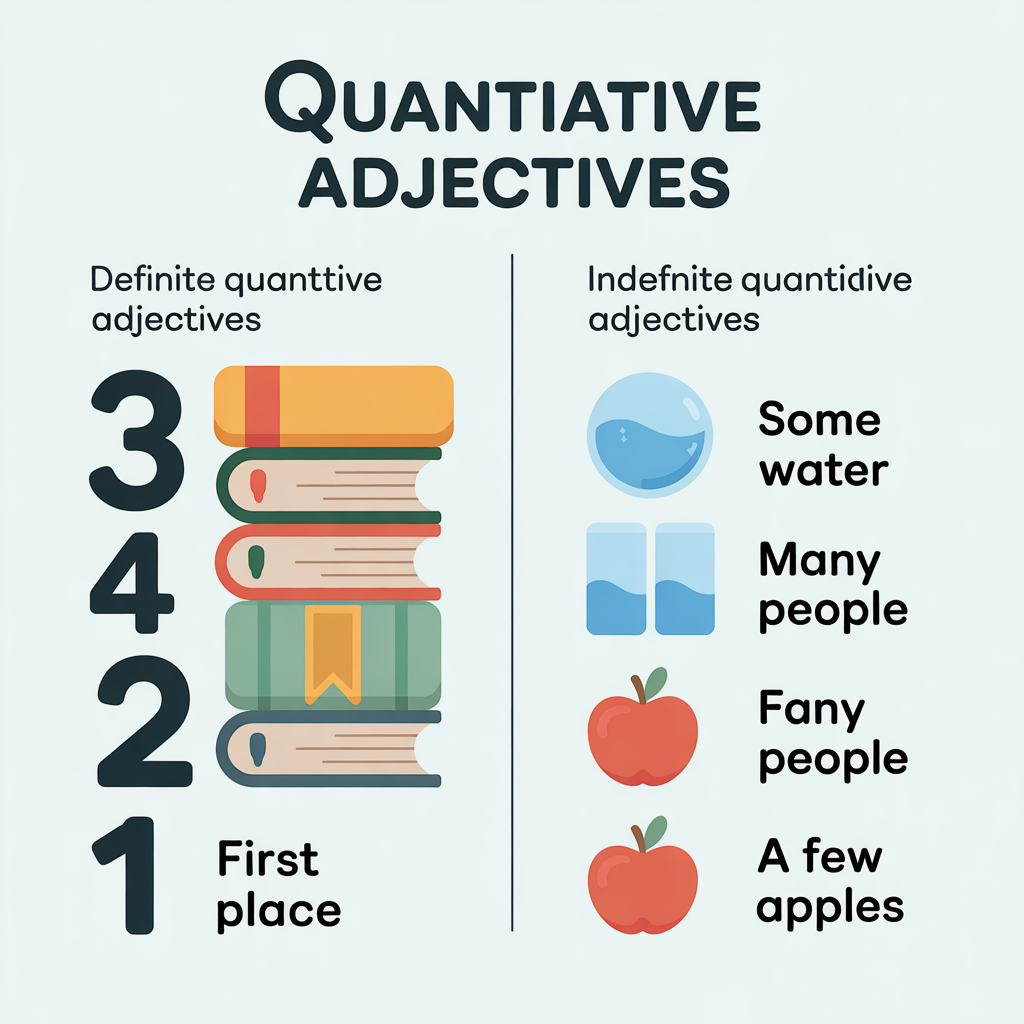
When you say “I need three eggs” or “She drank some water,” you are already using quantitative adjectives — perhaps without even realizing it. These small but powerful words tell us how many or how much of something exists, making your language more precise, informative, and natural. Whether you are a student learning English grammar, a teacher preparing a lesson plan, or simply someone who wants to communicate more clearly, understanding quantitative adjectives is an essential step. This guide will walk you through everything you need to know — from the basic definition to real-world examples, types, common mistakes, and practical usage tips.
What Are Quantitative Adjectives? (Definition)
A quantitative adjective is a type of adjective that describes the quantity of a noun — in other words, it tells us how much or how many of something there is. Rather than describing quality, color, or size, quantitative adjectives focus on amount or number.
They answer the questions:
- How many? (e.g., three books, several students)
- How much? (e.g., some water, little patience)
Quantitative adjectives always modify a noun or pronoun and appear either before the noun (attributive position) or after a linking verb (predicative position).
Examples:
- “She has two cats.” → modifies “cats” (how many)
- “There is enough sugar in the bowl.” → modifies “sugar” (how much)
- “He made several mistakes.” → modifies “mistakes” (how many)
Quantitative Adjectives vs. Other Types of Adjectives
Adjectives in English cover a wide range of descriptive functions. It helps to understand where quantitative adjectives fit in the broader picture.
| Type of Adjective | What It Describes | Example |
|---|---|---|
| Qualitative | Quality or characteristic | a beautiful painting |
| Quantitative | Amount or number | three paintings |
| Demonstrative | Which specific one | this painting |
| Possessive | Ownership | my painting |
| Interrogative | Question about a noun | which painting? |
The key distinction is clear: quantitative adjectives are exclusively concerned with measurement of quantity, not description of nature or identity.
Types of Quantitative Adjectives
Quantitative adjectives fall into two main categories, each serving a distinct purpose in grammar.
1. Definite Quantitative Adjectives (Numeral Adjectives)
Definite quantitative adjectives give an exact number or quantity. They leave no ambiguity — you know precisely how many or how much is involved. These are also widely called numeral adjectives.
They are further divided into three subtypes:
a) Cardinal Numbers
These express a specific count of something.
- “She bought five apples.”
- “There are twenty students in the class.”
- “He worked for forty hours straight.”
b) Ordinal Numbers
These describe the position or order of a noun in a sequence.
- “This is the third time I’ve asked.”
- “She finished in first place.”
- “He lives on the seventh floor.”
c) Multiplicative Numbers
These describe how many times something occurs or multiplied quantity.
- “She earns a double salary.”
- “This is a triple espresso.”
- “He received fourfold the original amount.”
2. Indefinite Quantitative Adjectives
Indefinite quantitative adjectives express a vague or approximate quantity without specifying an exact number. These are among the most commonly used words in everyday English.
Here is a comprehensive list with examples:
- Some — “Would you like some coffee?”
- Any — “Do you have any questions?”
- Many — “She has many friends.”
- Much — “There isn’t much time left.”
- Few — “Only a few seats remain.”
- Little — “There is very little milk.”
- Several — “He made several attempts.”
- Enough — “Do we have enough supplies?”
- All — “All the students passed.”
- Most — “Most people agree.”
- No — “There is no excuse for that.”
- Whole — “She ate the whole pizza.”
- Half — “Half the class was absent.”
- Sufficient — “There is sufficient evidence.”
- Plenty of — “We have plenty of time.”
How to Use Quantitative Adjectives Correctly
Using quantitative adjectives accurately depends on understanding the noun they modify. Nouns in English are either countable (things you can count individually) or uncountable (things measured as a mass or substance). The wrong choice leads to grammatical errors.
With Countable Nouns
Use adjectives that work with plural, countable nouns:
- Many, few, several, a number of, both, each, every
- “Many cars were parked outside.” ✔
- “Several children played in the park.” ✔
- “Few employees volunteered.” ✔
With Uncountable Nouns
Use adjectives that work with singular, uncountable nouns:
- Much, little, a great deal of, a bit of
- “There is much confusion about this rule.” ✔
- “She showed little patience.” ✔
- “He has a great deal of experience.” ✔
With Both Countable and Uncountable Nouns
Some quantitative adjectives are flexible and work with both:
- Some, any, all, most, enough, no, more, less/fewer
- “Some water” (uncountable) / “Some books” (countable) ✔
- “Enough time” / “Enough chairs” ✔
- “No money” / “No tickets” ✔
Quantitative Adjectives in Sentences: Detailed Examples
Seeing quantitative adjectives in context is the best way to solidify understanding. Below are examples across different sentence structures.
In Affirmative Sentences
- “The baker made twelve loaves of bread this morning.”
- “There is some hope that the situation will improve.”
- “All the evidence points to the same conclusion.”
- “She needs more time to complete the project.”
In Negative Sentences
- “There isn’t any salt in this soup.”
- “He has no intention of apologizing.”
- “We don’t have enough budget for the campaign.”
- “Few scientists have challenged this theory.” (implies a small, disappointing number)
In Questions
- “How many people attended the event?”
- “Is there any chance of rain today?”
- “Do you have enough time to review this?”
- “Are there several options available?”
In Complex Sentences
- “Although many solutions were proposed, only a few were practical.”
- “She had little money left, so she borrowed some from a friend.”
- “Most of the team agreed, but several members had reservations.”
Common Mistakes to Avoid
Even experienced English speakers make errors with quantitative adjectives. Here are the most frequent pitfalls and how to correct them.
Mistake 1: Using “Much” with Countable Nouns
- ❌ “There are much people in the queue.”
- ✔ “There are many people in the queue.”
Mistake 2: Using “Many” with Uncountable Nouns
- ❌ “She drank many water.”
- ✔ “She drank a lot of water.” / “She drank much water.”
Mistake 3: Confusing “Few” and “A Few”
These two have different implications. “Few” (without article) carries a negative nuance — it means “not many, and that’s a problem.” “A few” carries a positive nuance — it means “not a lot, but enough.”
- “Few students passed the exam.” (Most failed — concerning.)
- “A few students passed the exam.” (Some did — encouraging.)
Mistake 4: Confusing “Little” and “A Little”
The same logic applies to “little” and “a little” with uncountable nouns.
- “There is little water left.” (Almost none — worrying.)
- “There is a little water left.” (Not much, but some — reassuring.)
Mistake 5: Using “Less” Instead of “Fewer” with Countable Nouns
Although increasingly common in informal speech, traditionally:
- ❌ “We need less volunteers.”
- ✔ “We need fewer volunteers.” (countable noun)
- ✔ “We need less help.” (uncountable noun)
The Role of Quantitative Adjectives in Academic and Professional Writing
Quantitative adjectives are not just classroom grammar tools — they are critical in professional and academic communication. Precision in quantity can change the meaning of a sentence entirely.
Consider these two sentences:
- “Some patients showed improvement after treatment.”
- “Most patients showed improvement after treatment.”
The shift from “some” to “most” dramatically changes the interpretation of a clinical finding. In business reports, scientific papers, legal documents, and news writing, choosing the right quantitative adjective is not just a grammar decision — it is a matter of accuracy, credibility, and meaning.
In academic writing, indefinite quantitative adjectives like many, several, and few are commonly used when exact figures are not available. However, when data is available, definite quantitative adjectives (cardinal numbers) are always preferred for precision.
Quantitative Adjectives vs. Quantitative Pronouns
It is worth noting the distinction between quantitative adjectives and quantitative pronouns, since many of the same words serve both roles.
- As an adjective: “I bought some apples.” → “some” modifies “apples”
- As a pronoun: “I bought apples. Would you like some?” → “some” replaces “apples”
The rule is simple: if the word stands before a noun and modifies it, it is an adjective. If it stands alone and replaces a noun, it is a pronoun. The grammatical role depends entirely on how the word functions in the sentence.
Quick Reference: Common Quantitative Adjectives at a Glance
| Adjective | Use With | Example |
|---|---|---|
| Many | Countable (plural) | many days |
| Much | Uncountable | much effort |
| Few / A few | Countable (plural) | few cars / a few cars |
| Little / A little | Uncountable | little time / a little time |
| Several | Countable (plural) | several attempts |
| Some | Both | some water / some ideas |
| Any | Both | any milk / any tickets |
| All | Both | all the rice / all the students |
| Enough | Both | enough food / enough chairs |
| No | Both | no rain / no answers |
| Cardinal numbers (one, two…) | Countable (plural) | three books |
| Ordinal numbers (first, second…) | Countable (singular) | the fifth chapter |
Conclusion
Quantitative adjectives are a foundational element of English grammar that we rely on every single day. They bring clarity, precision, and meaning to our sentences by telling listeners and readers exactly how much or how many of something is being discussed. From definite quantitative adjectives like cardinal and ordinal numbers to indefinite ones like some, many, few, and enough, mastering this category of adjectives will make your writing sharper and your speech more confident.
The most important takeaway is to always match your quantitative adjective to the type of noun it modifies — countable or uncountable — and to be mindful of subtle distinctions like “few” versus “a few.” These small choices have a big impact on meaning.
Practice using quantitative adjectives in your daily writing and conversation, and you will quickly find that communicating quantity becomes second nature.
Frequently Asked Questions (FAQs)
Are numbers considered quantitative adjectives?
Yes. Cardinal numbers (one, two, three…) and ordinal numbers (first, second, third…) are both classified as definite quantitative adjectives because they specify an exact quantity or position. They are sometimes called numeral adjectives.
What is the difference between quantitative and qualitative adjectives?
Quantitative adjectives describe the amount or number of a noun (e.g., “five apples,” “some water”). Qualitative adjectives describe the nature or quality of a noun (e.g., “a red apple,” “cold water”). The key question to ask is: does the adjective answer “how many/much?” or “what kind?”
Can “all,” “most,” and “half” be quantitative adjectives?
Yes. Words like all, most, half, whole, and both are all indefinite quantitative adjectives because they describe the quantity of a noun in a general or approximate way. Example: “All the students passed” or “Half the audience left early.”
Is “enough” a quantitative adjective?
Yes. “Enough” is an indefinite quantitative adjective that describes a sufficient amount or number. It can modify both countable nouns (“enough chairs”) and uncountable nouns (“enough water”). It can appear before or after the noun it modifies, though placing it before the noun is more common in formal usage.
What is the difference between “few” and “little” as quantitative adjectives?
“Few” is used with plural, countable nouns (e.g., “few options”), while “little” is used with uncountable nouns (e.g., “little sugar”). Both carry a slightly negative tone, implying an insufficient amount — unlike “a few” and “a little,” which suggest a small but adequate quantity.