
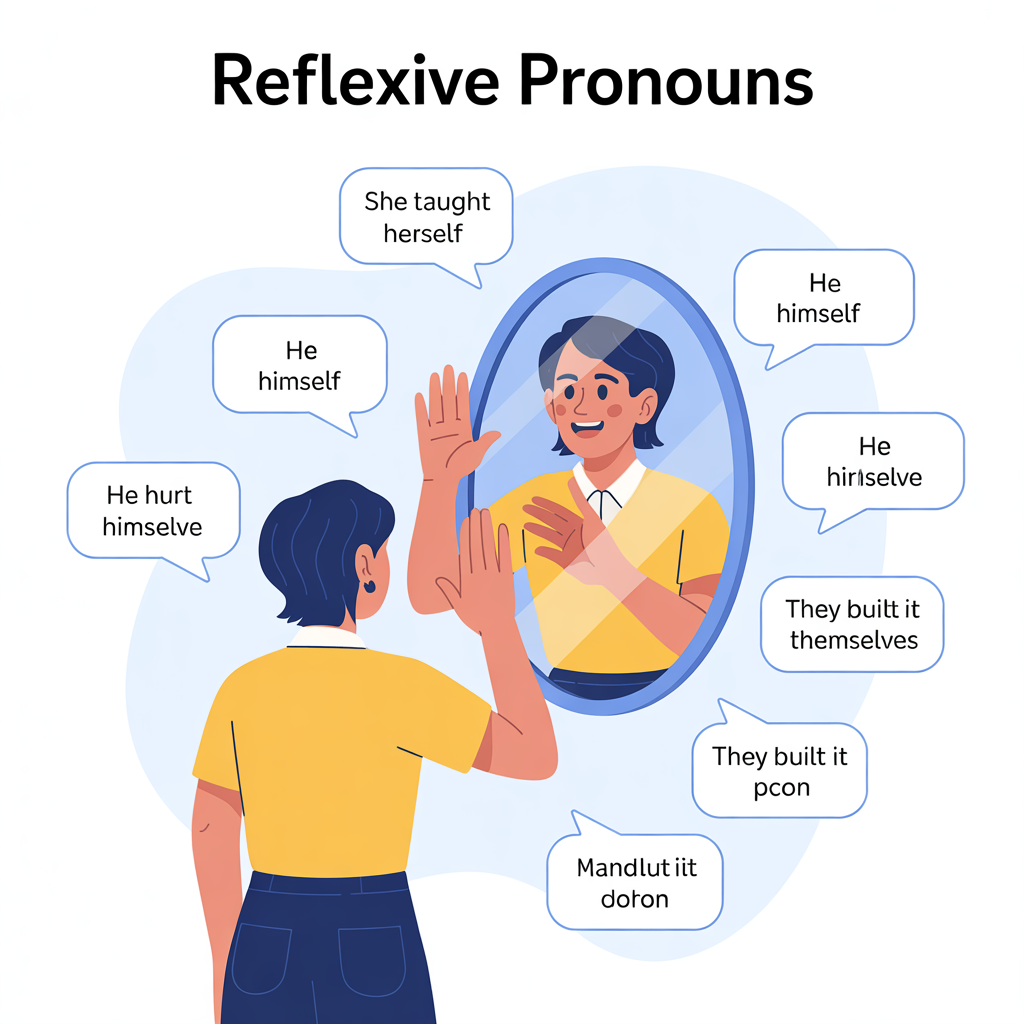
You brush yourself off after a fall. A cat cleans itself. A team congratulates itself after a win. These little words — yourself, itself, themselves — show up constantly in English, yet many learners stumble over when and how to use them. They are called reflexive pronouns, and once you understand what they do, you will use them confidently and correctly every single time.
This guide covers everything you need to know: the definition of reflexive pronouns, a complete list, grammar rules, real-world examples, common mistakes, and the difference between reflexive and intensive pronouns. Whether you are an English learner, a student brushing up on grammar, or a writer who wants to be precise, this article has you covered.
What Is a Reflexive Pronoun? (Definition)
A reflexive pronoun is a type of pronoun used when the subject and the object of a sentence refer to the same person or thing. In other words, the action “reflects” back onto the person performing it — hence the name reflexive.
Think of it like a mirror. The subject does something, and the action bounces right back to that same subject.
Example:
- She hurt herself.
Here, “she” is both the one doing the action (hurting) and the one receiving it (being hurt). The reflexive pronoun herself signals that connection.
Without a reflexive pronoun, this sentence would be unclear or grammatically broken:
- ❌ She hurt her. — This implies she hurt someone else, not herself.
- ✅ She hurt herself. — Clear: the action falls back on the subject.
The Complete List of Reflexive Pronouns in English
English has nine reflexive pronouns, each corresponding to a specific subject pronoun. Here is the full list:
| Subject Pronoun | Reflexive Pronoun |
|---|---|
| I | myself |
| you (singular) | yourself |
| he | himself |
| she | herself |
| it | itself |
| we | ourselves |
| you (plural) | yourselves |
| they | themselves |
| one | oneself |
Notice the pattern: most reflexive pronouns are formed by adding -self (singular) or -selves (plural) to the base pronoun.
Quick tip: “Hisself” and “theirselves” are not standard English, even though you may hear them in informal speech. Always use himself and themselves.
The Two Main Uses of Reflexive Pronouns
Reflexive pronouns serve two distinct grammatical purposes. Understanding both will clear up a great deal of confusion.
1. Reflexive Use (The Core Function)
The primary job of a reflexive pronoun is to indicate that the subject of the sentence is also the object — the same person or thing is both doing and receiving the action.
This happens most often in three grammatical positions:
- As the direct object: He taught himself to play guitar.
- As the indirect object: I bought myself a coffee.
- As the object of a preposition: She was proud of herself.
In each case, the pronoun sends the action back to the subject.
2. Intensive (Emphatic) Use
Reflexive pronouns can also be used for emphasis, to stress that someone did something personally or without help. In this role, the pronoun is called an intensive pronoun — though the form is identical.
Examples:
- The president himself signed the document.
- I baked this cake myself.
- She fixed the engine herself.
The key difference: an intensive pronoun can be removed from the sentence without changing its basic meaning. A reflexive pronoun cannot.
- I baked this cake myself. → Remove “myself” → I baked this cake. ✅ The sentence still works. (Intensive)
- She hurt herself. → Remove “herself” → She hurt. ❌ The sentence breaks. (Reflexive)
Reflexive Pronouns with Common Verbs
Some verbs are almost always paired with reflexive pronouns because the action naturally involves the subject acting on themselves. Getting familiar with these verb-pronoun pairings will boost both your grammar and your fluency.
Verbs Commonly Used Reflexively
- Introduce: Please introduce yourself to the group.
- Enjoy: Did you enjoy yourselves at the party?
- Behave: The children behaved themselves all evening.
- Prepare: She prepared herself for the interview.
- Express: He had trouble expressing himself.
- Push: You need to push yourself harder.
- Remind: I have to remind myself to stay calm.
- Blame: Don’t blame yourself for what happened.
Reflexive Pronouns After Prepositions
Reflexive pronouns frequently follow prepositions when the subject and the object of the preposition are the same person.
- She kept the secret to herself.
- He did all the work by himself.
- They finished the project among themselves.
- I was talking to myself.
Note: The phrase “by + reflexive pronoun” is a very common pattern meaning “alone” or “without help.” She lives by herself. They solved it by themselves.
Examples of Reflexive Pronouns in Sentences
Seeing reflexive pronouns in a wide variety of real contexts is one of the fastest ways to internalize their usage. Here are examples for every pronoun in the list:
- Myself: I pushed myself to finish the marathon.
- Yourself: You should be proud of yourself.
- Himself: Jack cut himself while cooking.
- Herself: Maria taught herself three languages.
- Itself: The door closed itself.
- Ourselves: We built the cabin ourselves.
- Yourselves: Help yourselves to the snacks.
- Themselves: The students graded themselves.
- Oneself: It is important to know oneself. (formal/literary)
Common Mistakes with Reflexive Pronouns
Even native speakers make errors with reflexive pronouns. Knowing what to watch out for will save you from these pitfalls.
Mistake 1: Using a Reflexive Pronoun Instead of a Personal Pronoun
This is one of the most frequent errors — using a reflexive pronoun as a subject or when a simple personal pronoun is all that is needed.
- ❌ Please send your questions to John or myself.
- ✅ Please send your questions to John or me.
- ❌ Myself and Sarah went to the conference.
- ✅ I and Sarah went to the conference. / Sarah and I went to the conference.
Reflexive pronouns cannot replace subject pronouns (I, he, she, we, they) or regular object pronouns (me, him, her, us, them) — they are used only when the subject and object are the same person.
Mistake 2: Using Incorrect Forms
- ❌ He did it hisself.
- ✅ He did it himself.
- ❌ They organized it theirselves.
- ✅ They organized it themselves.
Mistake 3: Forgetting the Reflexive Pronoun When It Is Needed
Some sentences are grammatically incomplete or change meaning without a reflexive pronoun.
- ❌ She looked at in the mirror.
- ✅ She looked at herself in the mirror.
Mistake 4: Using Reflexive Pronouns with Verbs That Don’t Need Them
In English, certain verbs that are reflexive in other languages (like Spanish or French) do not require a reflexive pronoun in English.
- ❌ I woke myself up at 6 a.m. (technically possible but usually unnecessary)
- ✅ I woke up at 6 a.m.
- ❌ She sat herself down.
- ✅ She sat down.
Verbs like wash, shave, dress, feel often don’t need a reflexive pronoun in English unless you are making a specific point about the person doing it for themselves.
Reflexive Pronouns vs. Reciprocal Pronouns
Students sometimes confuse reflexive pronouns with reciprocal pronouns. Here is a clear distinction:
- Reflexive pronoun: One subject acts on itself. They hurt themselves. (Each person hurt themselves.)
- Reciprocal pronoun: Multiple subjects act on each other. They hurt each other. (Person A hurt Person B, and Person B hurt Person A.)
The two reciprocal pronouns in English are each other (for two people or things) and one another (traditionally for three or more, though this distinction is increasingly relaxed in modern usage).
- The twins looked at each other.
- The team supported one another through the challenge.
Reflexive Pronouns in Fixed Expressions and Idioms
English has a number of set phrases and idiomatic expressions that use reflexive pronouns. Learning these as fixed chunks will make your English sound more natural.
- Help yourself — Take what you want freely. “Help yourself to more food.”
- Make yourself at home — Feel comfortable. “Sit down, make yourself at home.”
- Suit yourself — Do what you want (sometimes with a hint of indifference). “Suit yourself, I’ll go alone.”
- Pull yourself together — Regain composure. “Take a breath and pull yourself together.”
- Watch yourself — Be careful. “Watch yourself on that icy path.”
- Behave yourself — Act appropriately. “The teacher told them to behave themselves.”
- Knock yourself out — Go ahead and do it as much as you like. “Want more cake? Knock yourself out.”
- Be yourself — Act naturally. “Just be yourself during the interview.”
A Note on “Myself” in Formal and Professional Writing
One particularly tricky usage issue involves the word myself. In formal and business writing, it is increasingly common to see sentences like:
- “Please contact Sarah or myself for more information.”
This usage has become widespread, but traditional grammar guides — and most style editors — still consider it incorrect. The reflexive pronoun myself should only be used when I is also the subject of the same clause, or for emphasis. In the example above, me is the grammatically correct choice.
Why do people use myself here? Often it sounds more polite or formal to them, or they are simply uncertain about whether to say “contact Sarah or I” or “contact Sarah or me.” (The correct answer is me, by the way.) When in doubt, test the sentence by removing the other person: “Please contact me” — that sounds right. “Please contact myself” — that sounds wrong. Follow your instinct.
Why Reflexive Pronouns Matter
Reflexive pronouns do more than fill a grammatical role. They carry real communicative weight:
- Precision: They eliminate ambiguity about who is doing and receiving an action.
- Emphasis: They give sentences extra rhetorical force when used intensively.
- Naturalness: They appear in countless idioms and set phrases that make English sound fluent and authentic.
- Nuance: They can convey ideas of independence, self-reliance, and personal responsibility.
Mastering reflexive pronouns is one of those small grammar wins that makes a noticeable difference in the overall quality and clarity of your English.
Quick Summary: Reflexive Pronoun Rules at a Glance
- Use a reflexive pronoun when the subject and the object are the same person or thing.
- The nine reflexive pronouns are: myself, yourself, himself, herself, itself, ourselves, yourselves, themselves, oneself.
- They can function as the direct object, indirect object, or object of a preposition.
- They can be used intensively for emphasis but can then be removed without breaking the sentence.
- Do not use reflexive pronouns as standalone subject pronouns or in place of me, him, her, us, them when the subject and object differ.
- Avoid the non-standard forms hisself and theirselves.
Conclusion
A reflexive pronoun is simply a pronoun that bends the action of a sentence back onto the person performing it. When you say I taught myself, she prepared herself, or they built it themselves, you are using these pronouns exactly as intended — to show that the same person is both actor and recipient.
Understanding the nine forms, knowing the difference between reflexive and intensive use, and avoiding the common traps covered in this guide will give you real command over this corner of English grammar. From everyday conversation to professional writing, reflexive pronouns are everywhere — and now you know exactly how to handle them.
Frequently Asked Questions (FAQs)
What is a reflexive pronoun in simple terms?
A reflexive pronoun is a word that refers back to the subject of the sentence. It shows that the subject and the object are the same person or thing. Examples include myself, yourself, himself, herself, itself, ourselves, yourselves, and themselves.
How many reflexive pronouns are there in English?
There are nine reflexive pronouns in English: myself, yourself, himself, herself, itself, ourselves, yourselves, themselves, and oneself.
What is the difference between a reflexive pronoun and an intensive pronoun?
They look identical, but they serve different functions. A reflexive pronoun is grammatically necessary — remove it and the sentence breaks or changes meaning. An intensive pronoun is used for emphasis and can be removed without affecting the core meaning. For example: “I baked this cake myself” (intensive — you can drop “myself”) vs. “I burned myself” (reflexive — you cannot drop “myself”).
Is “theirselves” a correct reflexive pronoun?
No. Theirselves is not standard English. The correct reflexive pronoun for they/them is themselves. Similarly, hisself is not standard — the correct form is himself.
Can I use “myself” instead of “me” to sound more polite?
This is a very common habit, especially in business writing, but it is grammatically incorrect. Myself should only be used when I is the subject of the sentence. Instead of saying “contact Sarah or myself,” you should say “contact Sarah or me.”
What is the difference between reflexive pronouns and reciprocal pronouns?
Reflexive pronouns (themselves, herself, etc.) refer back to the subject performing an action on themselves. Reciprocal pronouns (each other, one another) describe a mutual action between two or more people — where each acts on the other.