
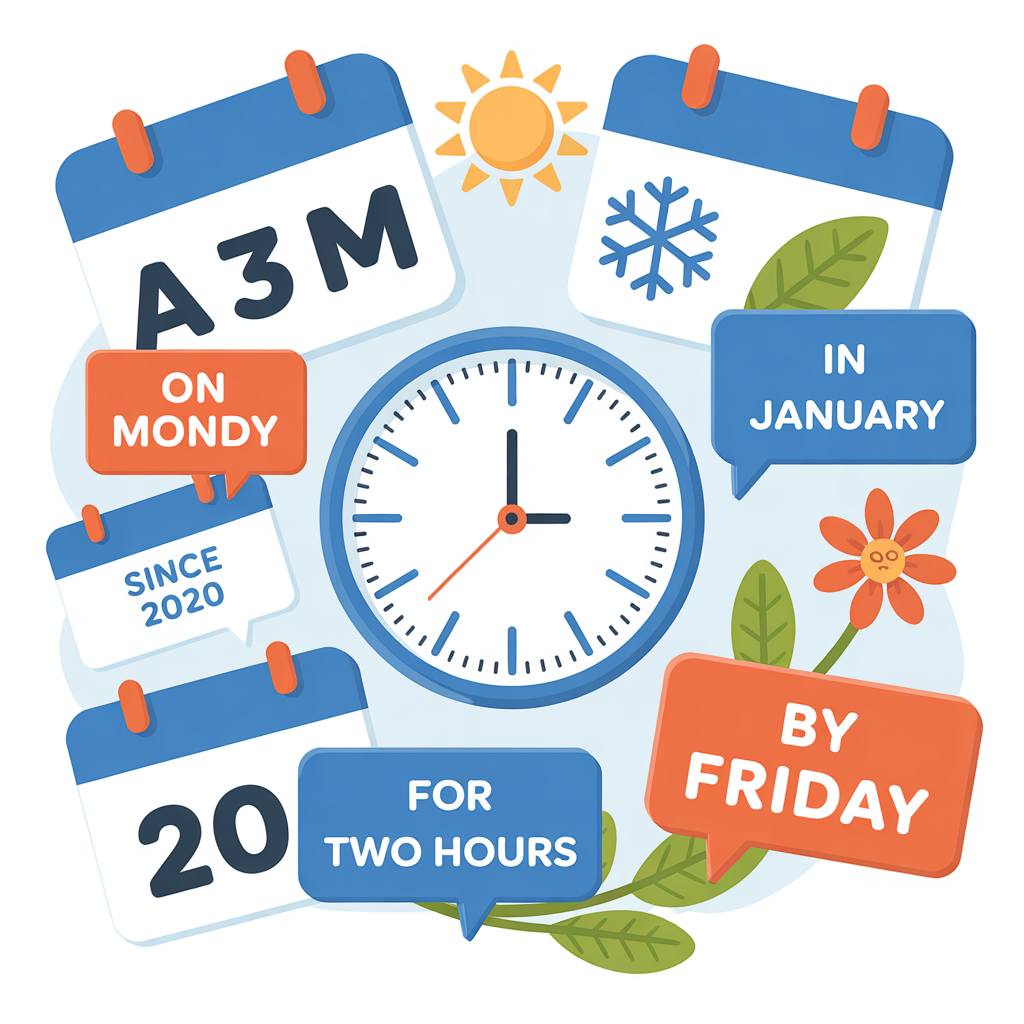
If you’ve ever second-guessed whether to say “on Monday” or “in Monday,” you’re not alone. Prepositions of time are some of the trickiest little words in the English language — small, but mighty. They tell us exactly when something happens, and using the wrong one can completely change the meaning of a sentence. This guide breaks down everything you need to know about prepositions of time: what they are, how they work, when to use each one, and the most common mistakes learners make. Whether you’re a student, a teacher, or simply someone polishing their English, this is your go-to resource.
What Are Prepositions of Time?
A preposition of time is a word (or phrase) placed before a noun or noun phrase to show its relationship to time. In plain terms, these are the words that answer the question “When?”
Consider this sentence:
“The meeting starts at 9 o’clock on Monday.”
Here, both at and on are prepositions of time. They connect the action (starting) to specific time references (9 o’clock and Monday).
Prepositions of time belong to a broader category of prepositions that also includes prepositions of place (in, on, at for location) and prepositions of movement (to, through, across). Time-focused prepositions are unique because they anchor events within a timeline — whether that’s a precise moment, a period, or a duration.
The most commonly used prepositions of time in English are:
- At
- On
- In
- By
- Since
- For
- Until / Till
- From…to / From…until
- During
- Before / After
- Within
- Between
Each one has its own rules, nuances, and common pitfalls. Let’s explore them one by one.
The “Big Three”: At, On, and In
The prepositions at, on, and in are the foundation of time expressions in English. A helpful way to remember them is to think of them in terms of specificity — from the most precise to the most general.
At — For Precise Points in Time
At is used for specific, exact moments in time. Think of it as pointing to a dot on a timeline.
Common uses of “at”:
- Clock times: at 7:30 AM, at noon, at midnight, at 3 o’clock
- Mealtimes: at breakfast, at lunch, at dinner
- Specific moments: at the moment, at the same time, at that instant
- Holidays (when referring to the period): at Christmas, at Easter, at New Year
- Age (in some fixed expressions): at the age of 18, at 30
Examples:
- The train departs at 6:45 PM.
- I always feel nostalgic at Christmas.
- She graduated at the age of 22.
- Let’s meet at noon.
On — For Specific Days and Dates
On is used for named days — think of it as placing an event “on” a particular square of a calendar.
Common uses of “on”:
- Days of the week: on Monday, on Friday, on weekdays, on weekends
- Specific dates: on July 4th, on the 15th of March
- Special days: on Christmas Day, on New Year’s Eve, on my birthday
- Parts of specific days: on Monday morning, on Friday evening
Examples:
- The report is due on Thursday.
- She was born on April 23rd.
- We always have a family dinner on Sunday evenings.
- The festival takes place on New Year’s Eve.
In — For Longer Periods of Time
In is used for broader, more general time periods — months, seasons, years, centuries, and parts of the day.
Common uses of “in”:
- Months: in January, in March, in December
- Seasons: in spring, in summer, in autumn/fall, in winter
- Years: in 2020, in 1995, in the 1980s
- Centuries and decades: in the 21st century, in the 1960s
- Parts of the day: in the morning, in the afternoon, in the evening (Note: NOT “in the night” — we say “at night”)
- Time periods: in a few minutes, in a week, in two months (meaning after that amount of time)
Examples:
- It gets very cold in February.
- She started her business in 2018.
- I prefer reading in the morning.
- The project will be finished in three weeks.
Quick Reference: At, On, In
| Preposition | Used for | Examples |
|---|---|---|
| At | Exact times, precise moments | at 8 PM, at noon, at Christmas |
| On | Days, dates, special occasions | on Monday, on June 5th, on my birthday |
| In | Months, years, seasons, parts of the day | in July, in 2010, in the afternoon |
Other Essential Prepositions of Time
Beyond the “big three,” English has a rich set of time prepositions that express duration, deadlines, and relative time. Here’s a thorough look at each one.
By — Meaning “No Later Than”
By sets a deadline. It means “at or before a certain time.” It does not mean “exactly at.”
- Please submit the form by Friday. (before or on Friday, but not later)
- I’ll be home by 8 PM.
- The package should arrive by the end of the week.
Key distinction: “By 5 PM” means the action must be completed no later than 5 PM. “At 5 PM” means exactly at that time.
Since — From a Point in the Past Until Now
Since refers to a starting point in the past and implies the situation continues up to the present moment. It is almost always used with the perfect tenses.
- She has lived here since 2015.
- I haven’t eaten since breakfast.
- We’ve been friends since childhood.
Important: “Since” is used with a specific point in time (2015, breakfast, childhood), not a duration.
For — Expressing Duration
For indicates how long something lasts. It is used with a period or length of time — not a specific starting point.
- She has lived here for seven years.
- I waited for two hours.
- He studied medicine for six years.
Since vs. For — the classic confusion:
- I’ve known her since 2018. (specific starting point)
- I’ve known her for five years. (length of time)
Until / Till — Up to a Point in Time
Until (and its informal equivalent till) means “up to a certain point in time.” It describes how long a situation continues before something changes.
- I’ll wait until 6 PM.
- She studied until midnight.
- The store is open till 9 PM.
Until vs. By:
- “I’ll wait until 6 PM” — I’m actively waiting during the whole period up to 6 PM.
- “I’ll arrive by 6 PM” — I’ll arrive at some point no later than 6 PM.
From…To / From…Until — Expressing a Time Range
These structures show the start and end point of a period. They are often interchangeable, but “until” can emphasize the endpoint more strongly.
- The exhibition runs from Monday to Friday.
- She worked from 9 AM until 5 PM.
- The sale is valid from January 1st to January 31st.
During — Within a Period of Time
During is used to say that something happens within a particular period or event. Unlike “for,” which answers “how long?”, “during” answers “when?” within a time frame.
- He fell asleep during the movie.
- We saw dolphins during our vacation.
- There were many changes during the 20th century.
For vs. During:
- “I slept for two hours” — duration (how long)
- “I slept during the lecture” — within an event (when)
Before and After — Relative Time
Before means “earlier than” a specific time or event. After means “later than.”
- Please arrive before 10 AM.
- We’ll have dessert after dinner.
- He called me after the meeting ended.
- Finish this before the deadline.
Within — Inside a Time Frame
Within means “inside a certain period,” often implying it won’t exceed that time. It’s frequently used in formal and professional contexts.
- Your order will be shipped within 3 business days.
- Please respond within 24 hours.
- The project was completed within the deadline.
Between — A Time Span with Two Defined Points
Between is used when there are two clear, named reference points in time.
- I’m free between 2 PM and 4 PM.
- The accident happened between midnight and 1 AM.
- She wrote three novels between 2010 and 2020.
Ago — Looking Backward from Now
Ago is placed after a time expression and refers to a period before the present moment. It is used with the simple past tense.
- She left two hours ago.
- I started this job three years ago.
- That happened a long time ago.
About / Around — Approximate Time
About and around signal that a time is approximate, not exact. They can be used before or, in some cases, after the time expression.
- He arrived at about 7 PM.
- I’ll be there around noon.
- She was born around 1990.
Prepositions of Time in Context: Real Sentence Examples
Seeing these prepositions work together in natural sentences reinforces how they interact and contrast with each other.
- “The conference begins at 9 AM on Tuesday and runs until Friday evening.”
- “I’ve been learning Spanish since January, and I’ve already studied for over 200 hours.”
- “Please send in your application by the end of the month — ideally before the 25th.”
- “During the summer, we usually wake up in the morning and go swimming.”
- “She moved to New York five years ago and has lived there since then.”
Common Mistakes with Prepositions of Time (and How to Avoid Them)
Even advanced English learners trip up on time prepositions. Here are the most frequent errors and the corrections you need.
Mistake 1: Using “in” instead of “on” for days
- ❌ I’ll see you in Monday.
- ✅ I’ll see you on Monday.
Mistake 2: Saying “in the night” instead of “at night”
- ❌ The baby cried in the night.
- ✅ The baby cried at night.
- ✅ The baby cried in the middle of the night. (This is also acceptable.)
Mistake 3: Confusing “since” and “for”
- ❌ I’ve worked here since five years.
- ✅ I’ve worked here for five years.
- ✅ I’ve worked here since 2019.
Mistake 4: Using “during” when “for” is needed
- ❌ She studied during three hours.
- ✅ She studied for three hours.
Mistake 5: Forgetting that “ago” comes after the time expression
- ❌ I saw him ago two days.
- ✅ I saw him two days ago.
Mistake 6: Using a preposition before “last,” “next,” “this,” and “every”
- ❌ I’ll call you on next Monday.
- ✅ I’ll call you next Monday.
- ❌ She came in last year.
- ✅ She came last year.
This is one of the most overlooked rules: no preposition is used before expressions like last, next, this, every, each when they precede a time word.
Prepositions of Time with Perfect Tenses
Some prepositions of time are closely tied to specific verb tenses, and understanding this connection helps learners use both the grammar and the prepositions correctly.
- Since → always used with present perfect or past perfect tenses
- She has worked here since 2020.
- For → used with perfect tenses (and also simple past for completed durations)
- I have lived here for a decade.
- She waited for two hours.
- By → often used with future perfect to emphasize completion before a deadline
- By next month, I will have finished the course.
- Ago → only used with simple past tense
- He graduated three years ago.
Phrasal Prepositions of Time
English also has phrasal prepositions of time — multi-word units that function like a single preposition. These are worth knowing, especially for formal or academic writing.
- Prior to — meaning “before”: “Prior to the meeting, please review the agenda.”
- Subsequent to — meaning “after”: “Subsequent to the report, action was taken.”
- As of — meaning “starting from” or “at the time of”: “As of January 1st, the new policy applies.”
- Up until — an emphatic form of “until”: “Up until recently, I had never traveled abroad.”
- At the time of — referring to a specific moment: “At the time of the accident, he was driving.”
Tips for Mastering Prepositions of Time
Learning prepositions is less about memorizing rigid rules and more about building instincts through repeated exposure. Here are some practical strategies:
- Use the funnel method for at/on/in: Think of it from specific to general — at (a moment) → on (a day) → in (a period). The broader the time, the bigger the word.
- Read and listen actively: Pay attention to prepositions in books, podcasts, and articles. Note how native speakers use them in context.
- Create your own examples: Write sentences about your own life using each preposition. Personalized examples are easier to remember.
- Practice with collocations: Learn time prepositions together with common noun partners, such as “at night,” “on time,” “in the morning,” “by Friday,” and “since childhood.”
- Don’t translate directly: Prepositions often don’t translate one-to-one between languages. Trust English patterns rather than your native language’s logic.
Conclusion
Prepositions of time are small words with enormous jobs. From pinpointing an exact second (at midnight) to spanning decades (during the Cold War), they give English sentences their temporal structure. The key prepositions — at, on, in, by, since, for, until, during, before, after, within, between, and ago — each carry a distinct meaning and follow consistent patterns once you understand the logic behind them.
The most important thing? Don’t be intimidated by the complexity. Every native English speaker learned these through years of reading, listening, and making mistakes. With deliberate practice and the rules in this guide as your reference, using prepositions of time correctly will start to feel completely natural.
Frequently Asked Questions
What is the difference between “in time” and “on time”?
“On time” means punctual — arriving or happening exactly when planned. “In time” means early enough — before a deadline or limit. Example: “The train left on time” (punctually) vs. “We arrived in time to catch the train” (early enough to make it).
Can “for” be used with all tenses?
Yes. While “for” is very common with perfect tenses (“I have studied for two years”), it can also be used with the simple past (“She waited for an hour”) and future tenses (“I will stay for a week”). The key is that it always expresses duration — the length of time something lasts.
Is it correct to say “since last year”?
Yes, this is perfectly correct. “I haven’t seen him since last year” is natural English. “Since” pairs with a starting point, and “last year” functions as that reference point. No preposition is needed before “last.”
What’s the difference between “at the end” and “in the end”?
These are idiomatic expressions. “At the end” refers to the final point of something specific — a time period, event, or object. “At the end of the movie, she cried.” “In the end” means “finally” or “ultimately” after a process. “In the end, we decided to stay home.”
Do prepositions of time ever change meaning depending on the context?
Yes, context matters significantly. For instance, “at Christmas” (holiday period) vs. “on Christmas Day” (the specific day) both use different prepositions to express different degrees of specificity. Always consider whether you’re referring to an exact moment, a named day, or a broader period to choose the right preposition.
When should I use “within” vs. “in”?
Both can indicate future time, but with a subtle difference. “In two days” simply means after two days have passed. “Within two days” means no more than two days — it sets an upper limit. Example: “I’ll call you in two days” (after exactly/roughly two days) vs. “I’ll call you within two days” (any time in the next 48 hours).