
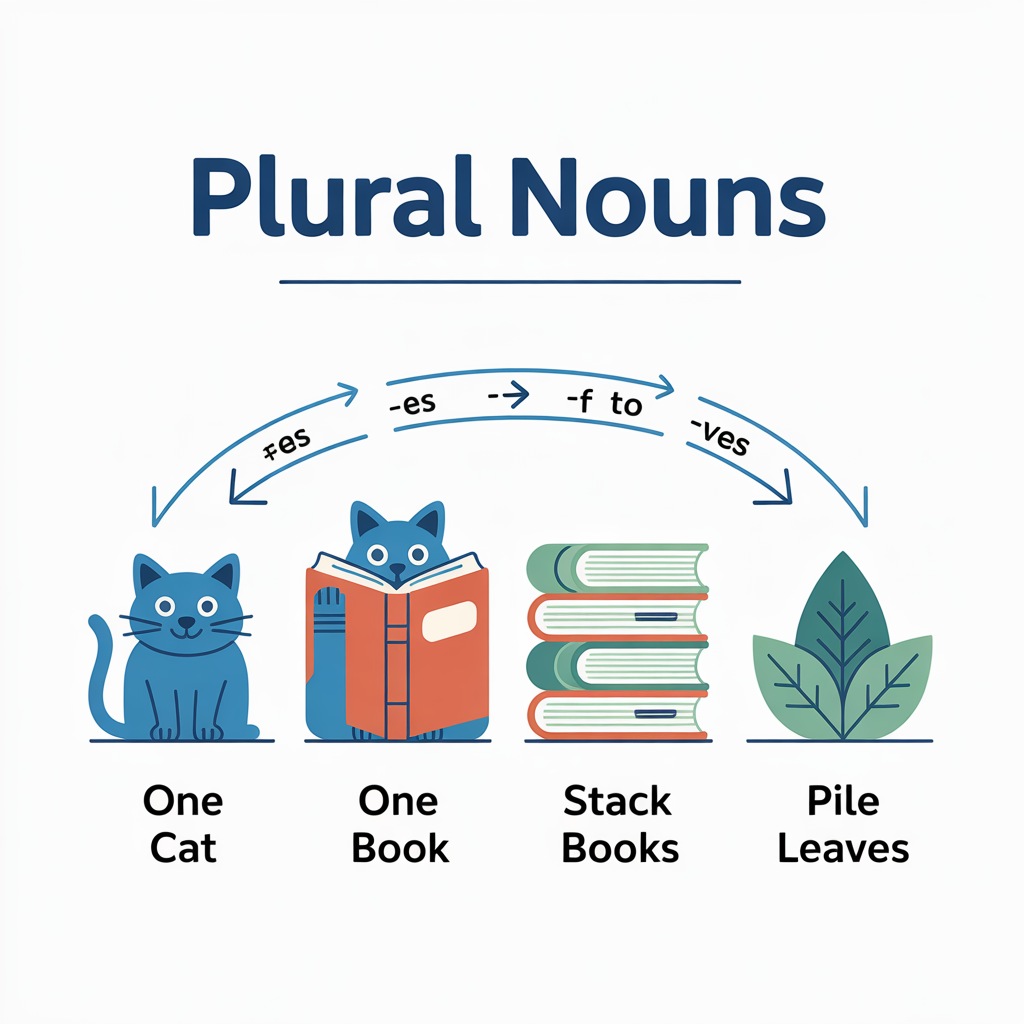
Every time you talk about more than one thing — whether it’s two cats, a dozen countries, or several children — you’re using plural nouns. They’re one of the most fundamental building blocks of the English language, and yet the rules for forming them can be surprisingly tricky. From simple add-an-S cases to unpredictable irregular forms, plural nouns come with their own set of patterns, exceptions, and quirks that every English learner and writer needs to master. This guide breaks it all down in a clear, organized way so you’ll never second-guess a plural again.
What Are Plural Nouns?
A plural noun is the form of a noun that refers to more than one person, place, thing, or idea. In English, nouns have two number forms:
- Singular — refers to one: dog, city, box, child
- Plural — refers to two or more: dogs, cities, boxes, children
The concept of number in grammar is how a language signals quantity. English marks this difference primarily through changes in the noun itself — usually by adding a suffix, changing the spelling, or sometimes using a completely different word.
For example:
- One book → Three books
- A woman → Several women
- One analysis → Two analyses
Understanding plural nouns isn’t just about grammar rules on paper — it directly affects how clearly and correctly you communicate, both in writing and speaking.
Why Are Plural Nouns Important?
Plural nouns matter for several practical reasons:
- Subject-verb agreement: Verbs must match the number of the subject. Saying “The dogs runs” is incorrect because the plural noun dogs requires the plural verb run.
- Clarity of meaning: Using singular when you mean plural (or vice versa) changes the meaning of your sentence entirely.
- Professionalism in writing: Incorrect plurals undermine credibility in academic, professional, and creative writing.
- English fluency: For ESL learners, mastering plurals is a key milestone in developing natural, confident English.
Types of Plural Nouns
English plural nouns fall into several broad categories based on how they are formed.
1. Regular Plural Nouns
Most English nouns form their plurals by following predictable, rule-based patterns. These are called regular plurals. There are several sub-rules depending on the ending of the noun.
2. Irregular Plural Nouns
Some nouns don’t follow any standard rule. These are called irregular plurals, and they simply must be memorized.
3. Uncountable Nouns (No Plural Form)
Certain nouns — called uncountable or mass nouns — don’t have a plural form at all. They refer to things that can’t be counted individually: water, information, furniture, advice.
4. Nouns That Are Always Plural
Some nouns exist only in plural form. These are known as pluralia tantum. Examples include scissors, trousers, glasses, tweezers. You wouldn’t say “a scissor” — the word only exists as a plural.
Rules for Forming Regular Plural Nouns
The vast majority of English nouns form their plurals using one of the following rules. Learning these will cover well over 90% of the plural nouns you’ll encounter.
Rule 1: Add -s (The Default Rule)
For most nouns, simply add -s to the end.
- cat → cats
- table → tables
- river → rivers
- idea → ideas
- book → books
This is the default rule and applies to any noun that doesn’t fall into a special category.
Rule 2: Add -es After Certain Endings
Nouns ending in -s, -ss, -sh, -ch, -x, or -z require -es to make them easier to pronounce. Adding just -s would create an awkward consonant cluster.
- bus → buses
- class → classes
- brush → brushes
- church → churches
- box → boxes
- quiz → quizzes
Rule 3: Nouns Ending in -y
The treatment of -y endings depends on what comes before the -y:
- If there is a consonant before -y: change -y to -ies
- city → cities
- baby → babies
- story → stories
- country → countries
- If there is a vowel before -y: simply add -s
- day → days
- key → keys
- boy → boys
- toy → toys
Rule 4: Nouns Ending in -f or -fe
Many nouns ending in -f or -fe change to -ves in the plural:
- leaf → leaves
- knife → knives
- wolf → wolves
- half → halves
- shelf → shelves
- wife → wives
However, there are exceptions where you simply add -s:
- roof → roofs
- belief → beliefs
- chef → chefs
- cliff → cliffs
Rule 5: Nouns Ending in -o
Nouns ending in -o are inconsistent — some take -s, others take -es:
- Add -es: tomato → tomatoes, hero → heroes, potato → potatoes, echo → echoes
- Add -s: photo → photos, piano → pianos, radio → radios, video → videos
- Both are accepted: zero → zeros/zeroes, volcano → volcanos/volcanoes
A useful tip: nouns that came into English from other languages (especially music-related ones like piano, soprano, solo) usually just take -s.
Irregular Plural Nouns
Irregular plurals don’t follow the standard patterns. They are remnants of Old English or borrowings from Latin, Greek, and other languages. The only way to master these is through memorization and repeated exposure.
Vowel Changes (Mutated Plurals)
These nouns change an internal vowel to form the plural — a pattern called umlaut, inherited from Old English:
| Singular | Plural |
|---|---|
| man | men |
| woman | women |
| tooth | teeth |
| foot | feet |
| goose | geese |
| mouse | mice |
| louse | lice |
Entirely Different Words
Some nouns use a completely different word in the plural — these are called suppletive plurals:
- child → children
- ox → oxen
- person → people (though “persons” is also used in formal/legal contexts)
Same Form for Singular and Plural (Zero Plurals)
Some nouns have an identical form in both singular and plural — no change at all. These are called zero plurals or invariant nouns:
- sheep → sheep
- deer → deer
- fish → fish (though “fishes” is used when referring to multiple species)
- aircraft → aircraft
- species → species
- series → series
Latin and Greek Plural Nouns in English
English has borrowed heavily from Latin and Greek, and many of those borrowed nouns kept their original plural forms. These are especially common in academic, scientific, and medical writing.
Latin-Origin Plurals
| Singular | Plural | Pattern |
|---|---|---|
| alumnus | alumni | -us → -i |
| cactus | cacti / cactuses | -us → -i or -uses |
| stimulus | stimuli | -us → -i |
| datum | data | -um → -a |
| medium | media / mediums | -um → -a or -ums |
| bacterium | bacteria | -um → -a |
| appendix | appendices / appendixes | -ix → -ices or -ixes |
Greek-Origin Plurals
| Singular | Plural | Pattern |
|---|---|---|
| analysis | analyses | -is → -es |
| crisis | crises | -is → -es |
| thesis | theses | -is → -es |
| criterion | criteria | -on → -a |
| phenomenon | phenomena | -on → -a |
Note: In everyday informal English, anglicized plurals (e.g., cactuses, forums, syllabuses) are increasingly accepted and sometimes preferred. The Latin/Greek forms are more common in formal or academic writing.
Plural Nouns vs. Possessive Nouns
One of the most common errors in English writing is confusing plural nouns with possessive nouns. Understanding the difference is essential.
- Plural noun: Shows quantity — no apostrophe needed.
“The students submitted their essays.” - Possessive noun: Shows ownership — requires an apostrophe.
“The student’s essay was outstanding.” (one student)
“The students’ essays were outstanding.” (multiple students)
A simple rule: Never use an apostrophe to make a noun plural. Writing “apple’s for sale” is a very common mistake (sometimes called the “greengrocer’s apostrophe”) and should always be avoided in formal writing.
Plural Nouns with Compound Words
When a noun is made up of two or more words (a compound noun), knowing which part to pluralize can be confusing.
Closed Compound Nouns
When two words are written as one, pluralize the last element:
- toothbrush → toothbrushes
- notebook → notebooks
- sunflower → sunflowers
Hyphenated or Open Compound Nouns
When a compound noun includes a modifier and a main noun (the head noun), pluralize the most important word — usually the noun being modified:
- mother-in-law → mothers-in-law
- commander-in-chief → commanders-in-chief
- passer-by → passers-by
- runner-up → runners-up
If no clear noun exists, pluralize the last word:
- grown-up → grown-ups
- stand-by → stand-bys
Nouns That Are Always Plural (Pluralia Tantum)
Some English nouns refer to a single item that consists of two parts, or exist only conceptually in pairs or multiples. These are used exclusively in plural form, even when referring to just one item:
- Clothing: trousers, jeans, shorts, tights, pyjamas
- Tools & instruments: scissors, tweezers, pliers, glasses, binoculars
- Other concepts: thanks, riches, regards, earnings, outskirts, premises
To talk about one of these items, use the phrase “a pair of“: “a pair of scissors,” “a pair of glasses.”
Uncountable Nouns: When There Is No Plural
Uncountable nouns (also called mass nouns or non-count nouns) represent things that are thought of as a whole or a mass, not as individual, countable units. They do not have a plural form and cannot be used with numbers or indefinite articles like “a/an.”
Common categories include:
- Liquids & substances: water, milk, oil, sand, air
- Abstract concepts: love, happiness, knowledge, freedom, advice
- Fields of study: mathematics, physics, economics, music
- Activities: swimming, shopping, research
- Natural phenomena: weather, traffic, darkness
You can quantify uncountable nouns using a countable unit: “two glasses of water,” “a piece of advice,” “three items of furniture.”
Tricky cases: Some nouns can be both countable and uncountable depending on meaning:
- “Can I have a coffee?” (countable — a cup of coffee)
- “Coffee is grown in Brazil.” (uncountable — the substance)
Common Mistakes with Plural Nouns
Even fluent English speakers make errors with plural nouns. Here are the most frequent ones to watch out for:
- Using apostrophes to form plurals: “Two dog’s” → should be “two dogs”
- Wrong irregular plural: “childs” → should be “children”
- Pluralizing uncountable nouns: “advices” or “informations” → incorrect; use “advice” and “information”
- Treating always-plural nouns as singular: “The scissor is sharp” → should be “The scissors are sharp”
- Over-applying Latin plurals: “octopi” for octopus is disputed — “octopuses” is more widely accepted in modern English since octopus comes from Greek, not Latin
- Wrong compound noun plural: “mother-in-laws” → should be “mothers-in-law”
Quick Summary Table: Plural Noun Rules
| Noun Ending | Rule | Example |
|---|---|---|
| Most nouns | Add -s | cat → cats |
| -s, -ss, -sh, -ch, -x, -z | Add -es | church → churches |
| Consonant + -y | Change -y to -ies | city → cities |
| Vowel + -y | Add -s | boy → boys |
| -f / -fe (most) | Change to -ves | leaf → leaves |
| -f / -fe (exceptions) | Add -s | roof → roofs |
| -o (some) | Add -es | tomato → tomatoes |
| -o (others) | Add -s | photo → photos |
| Internal vowel change | Change vowel | man → men |
| Same form | No change | sheep → sheep |
| Latin -um | Change to -a | datum → data |
| Greek -is | Change to -es | crisis → crises |
Conclusion
Plural nouns are far more than just “add an S and move on.” They represent one of the richest and most revealing aspects of the English language — showing its Germanic roots, Latin and Greek influences, and centuries of evolution. From straightforward regular plurals to tricky irregular forms, from always-plural words to nouns that never pluralize at all, each type has its own logic.
The good news? The rules covered in this guide account for the overwhelming majority of plural nouns you’ll ever use. Master the core patterns, keep a mental note of the most common irregulars (like children, women, teeth, feet), and watch out for the pitfalls that trip up even experienced writers. With practice, forming correct plurals will become second nature — and your writing will be clearer, more accurate, and more professional for it.
Frequently Asked Questions About Plural Nouns
What is the difference between a plural noun and a singular noun?
A singular noun refers to one person, place, thing, or idea (e.g., dog, city, idea). A plural noun refers to more than one (e.g., dogs, cities, ideas). In English, this difference is usually marked by adding -s or -es to the end of the noun, though irregular plurals may change the word form entirely.
What are some examples of irregular plural nouns?
Common irregular plurals include: child → children, man → men, woman → women, tooth → teeth, foot → feet, mouse → mice, goose → geese, ox → oxen, sheep → sheep (no change), deer → deer (no change). These must be memorized as they don’t follow standard spelling rules.
Do all nouns have a plural form?
No. Uncountable nouns (mass nouns) such as water, air, information, furniture, and advice don’t have plural forms. On the other hand, some nouns — called pluralia tantum — exist only in the plural, like scissors, trousers, and glasses.
Should I write “data is” or “data are”?
Technically, data is the plural of the Latin word datum, so the grammatically strict form is “data are.” However, in everyday English, “data is” has become widely accepted and used, especially in non-scientific writing. In academic and scientific contexts, “data are” is still generally preferred.
What is a “zero plural” noun?
A zero plural (also called an invariant plural) is a noun that has the same form in both singular and plural. Examples include sheep, deer, fish, aircraft, species, and series. Context tells you whether the speaker means one or many: “One sheep was in the field” vs. “Twenty sheep were in the field.”
How do I pluralize a compound noun?
For closed compounds (written as one word), pluralize the final word: toothbrush → toothbrushes. For hyphenated compounds, pluralize the main (head) noun: mother-in-law → mothers-in-law, runner-up → runners-up.