
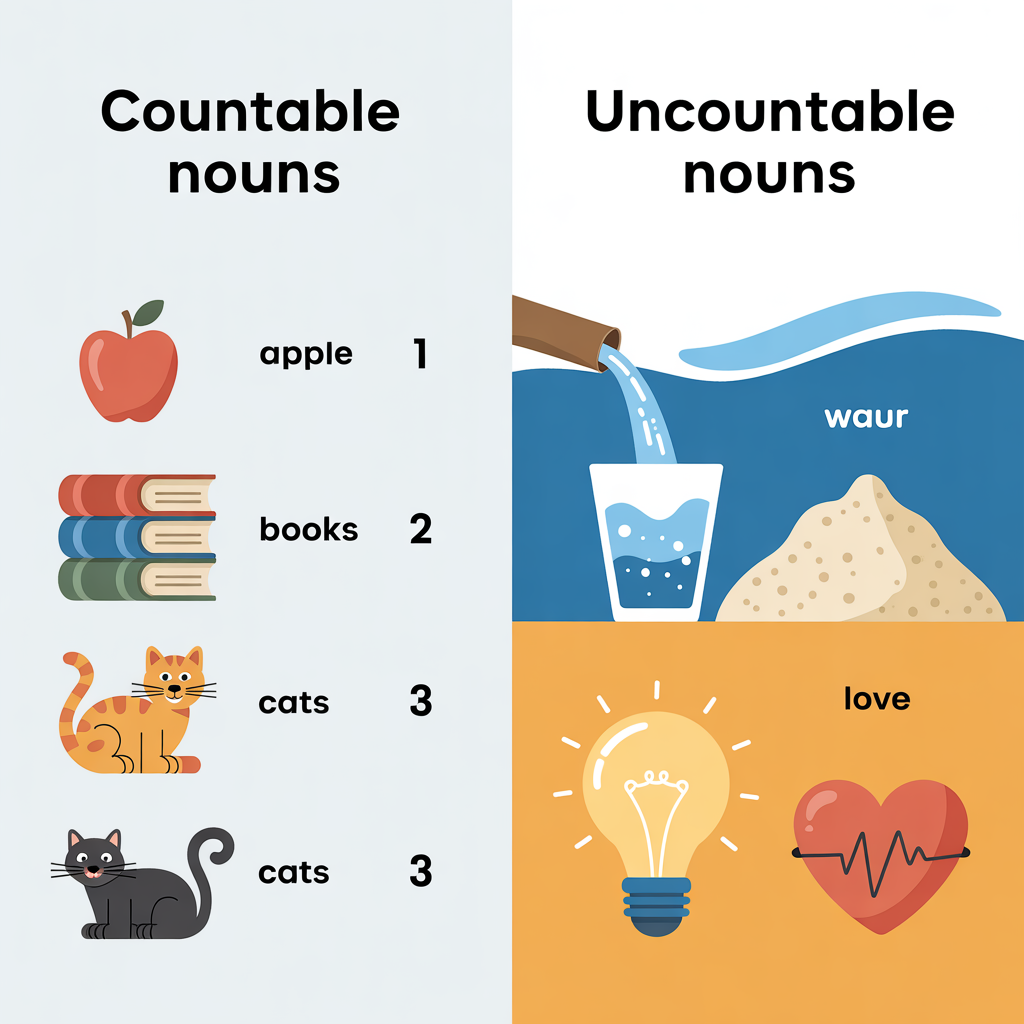
If you’ve ever wondered whether to say “a water” or just “water,” you’ve already bumped into one of the most fundamental concepts in English grammar: the difference between countable and uncountable nouns. Understanding this distinction isn’t just an academic exercise — it shapes the way you build sentences, choose articles, and select the right quantifiers every single day. This guide breaks it all down clearly, with plenty of examples, so you can use both noun types with confidence.
What Are Nouns? A Quick Refresher
Before diving into the countable vs. uncountable debate, it helps to have a solid foundation. A noun is a word that names a person, place, thing, or idea. Words like teacher, city, book, and happiness are all nouns.
In English, every noun falls into at least one of two broad categories:
- Countable nouns — things you can count individually
- Uncountable nouns — things you cannot count as separate units
This classification determines which articles (a, an, the), quantifiers (many, much, few, little), and verb forms you use alongside a noun. Getting this right is essential for natural, grammatically correct English.
What Are Countable Nouns?
A countable noun (also called a count noun) refers to things that exist as individual, separate units. You can put a number in front of them and they make perfect sense.
Think of it this way: if you can say one ___, two ___, three ___ and it sounds natural, you’re dealing with a countable noun.
Key Features of Countable Nouns
- They have both a singular and a plural form.
- They can be used with the indefinite article a or an in the singular.
- They can be preceded by numbers: one dog, two dogs, three dogs.
- They work with quantifiers like many, few, several, and a number of.
Examples of Countable Nouns
| Singular | Plural |
|---|---|
| a cat | three cats |
| an apple | five apples |
| a chair | many chairs |
| a country | several countries |
| an idea | a few ideas |
Countable Nouns in Sentences
- I have a dog and two cats.
- She bought an umbrella yesterday.
- There are many students in the classroom.
- He read three books last month.
Notice how countable nouns change form (singular to plural) and pair naturally with numbers and certain quantifiers.
What Are Uncountable Nouns?
An uncountable noun (also called a mass noun or non-count noun) refers to things that cannot be easily divided into separate, individual units. They are treated as a whole, not as a collection of countable items.
The simple test: if saying one ___, two ___ sounds strange or impossible, it’s likely an uncountable noun. You wouldn’t say “two waters” or “three luggages” in standard English.
Key Features of Uncountable Nouns
- They do not normally have a plural form.
- They cannot be used with a or an directly.
- They cannot be preceded by numbers on their own.
- They pair with quantifiers like much, little, a lot of, some, and any.
- They typically take a singular verb.
Common Categories of Uncountable Nouns
Uncountable nouns tend to fall into recognizable groups:
- Liquids and substances: water, milk, oil, blood, wine, coffee
- Food in bulk or powder form: rice, flour, sugar, salt, bread, cheese
- Materials and raw matter: wood, metal, glass, paper, plastic, cotton
- Abstract concepts and emotions: happiness, love, anger, freedom, knowledge, advice
- Academic subjects and areas of study: mathematics, music, history, physics
- Natural phenomena: weather, thunder, lightning, rain, snow, sunshine
- Languages: English, French, Spanish, Mandarin
- Activities expressed as a whole: homework, traffic, luggage, furniture, equipment
Uncountable Nouns in Sentences
- Can I have some water, please?
- We don’t have much time left.
- She gave me very useful advice.
- The furniture in this room is old. (not “furnitures”)
- There is a lot of traffic on the highway.
How to Tell Countable and Uncountable Nouns Apart
The line between countable and uncountable isn’t always obvious, especially for learners coming from languages that categorize nouns differently. Here are some practical strategies.
The Number Test
Try placing the number two or three in front of the noun. Does it make sense?
- two books ✅ → countable
- two informations ❌ → uncountable (the correct form is “two pieces of information”)
The Article Test
Can you use a or an naturally before it?
- a suggestion ✅ → countable
- an advice ❌ → uncountable (advice cannot take an article on its own)
Context and Meaning
Some nouns change their countability based on meaning. This is one of the trickiest aspects of English grammar, but it’s also one of the most fascinating.
Nouns That Can Be Both Countable and Uncountable
Here’s where things get interesting. Many English nouns behave as both countable and uncountable depending on the context and the specific meaning intended.
Examples of Dual-Category Nouns
| Noun | Uncountable Use | Countable Use |
|---|---|---|
| glass | The window is made of glass. (material) | She drank a glass of juice. (a container) |
| paper | I need some paper to write on. (material) | She published three papers this year. (academic articles) |
| light | There isn’t much light in this room. (illumination) | Turn off the light before you leave. (a lamp or source) |
| chicken | I’d like some chicken for dinner. (the meat) | There are three chickens in the yard. (the animal) |
| experience | She has a lot of experience in marketing. (general skill) | Traveling was a wonderful experience. (a specific event) |
| hair | She has beautiful hair. (all her hair as a whole) | There’s a hair in my soup! (a single strand) |
The key takeaway: always consider the meaning and context, not just the word itself.
Articles With Countable and Uncountable Nouns
One of the most common areas where learners make mistakes is article usage. The rules are closely tied to whether a noun is countable or uncountable.
Using “A” and “An”
- Use a or an with singular countable nouns only.
- ✅ I saw a bird in the garden.
- ❌ I saw a furniture in the room. (furniture is uncountable)
Using “The”
- The can be used with both countable and uncountable nouns when referring to something specific.
- ✅ The water in this bottle is cold. (specific water)
- ✅ The car outside is mine. (specific car)
No Article (Zero Article)
- Uncountable nouns and plural countable nouns often appear with no article when referring to things in general.
- ✅ Water is essential for life. (uncountable, general)
- ✅ Dogs are loyal animals. (plural countable, general)
Quantifiers: Which Ones Go With Which Nouns?
A quantifier is a word or phrase that indicates quantity. Using the wrong quantifier is one of the most common grammar errors in English. Here’s a clear breakdown:
Quantifiers for Countable Nouns Only
- many → many books, many friends
- few / a few → a few apples, few opportunities
- several → several questions
- a number of → a number of problems
- both → both options
- each / every → each student, every country
Quantifiers for Uncountable Nouns Only
- much → much money, much effort
- little / a little → a little milk, little hope
- a great deal of → a great deal of patience
- a bit of → a bit of advice
Quantifiers for Both Countable and Uncountable Nouns
- some / any → some chairs / some water; any ideas / any help
- a lot of / lots of / plenty of → a lot of cars / a lot of traffic
- enough → enough chairs / enough time
- no → no excuses / no evidence
- more / most → more students / more information
Making Uncountable Nouns Countable: Partitives
What do you do when you genuinely need to talk about a specific amount of an uncountable noun? You use a partitive expression — a phrase that creates a countable “portion” of an uncountable thing.
The structure is: a/number + unit word + of + uncountable noun
Common Partitive Expressions
- a glass of water
- a cup of tea
- a piece of advice / cake / paper / music
- a slice of bread / cheese / pizza
- a bag of rice / flour / sugar
- a bottle of wine / oil / water
- a bit of information / luck / fun
- a clap of thunder
- two loaves of bread
- three pieces of furniture
Partitives are incredibly useful and widely used in both spoken and written English. Mastering them allows you to be precise about quantities while still respecting the uncountable nature of certain nouns.
Commonly Confused Uncountable Nouns (Words Learners Often Get Wrong)
A number of English nouns are uncountable but are frequently treated as countable by learners — often because their equivalents in other languages are countable. Here are the most important ones to know:
- Advice — not “an advice” or “advices.” Use: a piece of advice
- Information — not “an information” or “informations.” Use: a piece of information
- News — always singular, even though it ends in -s. The news is good. (not “are”)
- Luggage / Baggage — not “a luggage” or “luggages.” Use: a piece of luggage / a bag
- Furniture — not “a furniture” or “furnitures.” Use: a piece of furniture
- Equipment — not “an equipment.” Use: a piece of equipment
- Progress — not “progresses.” Use: make progress
- Knowledge — not “knowledges.” Use: a great deal of knowledge
- Research — not “a research” or “researches.” Use: a piece of research / a study
- Travel — not “travels” when referring to the general activity. Use: a lot of travel (though “travels” can appear poetically or colloquially)
- Homework — not “a homework.” Use: a homework assignment or simply homework
- Money — not “moneys.” Use: a sum of money
Verb Agreement With Countable and Uncountable Nouns
The countable/uncountable distinction also affects subject-verb agreement — that is, whether you use a singular or plural verb.
- Uncountable nouns always take a singular verb:
- ✅ The information is correct.
- ❌ The information are correct.
- Singular countable nouns take a singular verb:
- ✅ The cat is sleeping.
- Plural countable nouns take a plural verb:
- ✅ The cats are sleeping.
Countable and Uncountable Nouns in Everyday Communication
Understanding this grammar point has very real, practical implications for daily English use. Here are some scenarios where it makes a difference:
Ordering Food and Drinks
In restaurants and cafés, you’ll constantly deal with this distinction:
- “I’d like a coffee, please.” — Here, “a coffee” treats it as countable, meaning one serving (common in informal speech).
- “Can I have some coffee?” — Treats it as uncountable (also correct).
- “Two beers, please.” — Treating a drink as countable to mean “two servings.”
Giving Advice
Saying “Let me give you an advice” immediately signals a grammar error to native speakers. The correct phrase is: “Let me give you some advice” or “Let me give you a piece of advice.”
Academic and Professional Writing
In professional settings, errors like “we need more equipments” or “the researches show” undermine credibility. These are uncountable nouns and should always remain in their base form.
Quick Summary: Countable vs. Uncountable Nouns at a Glance
| Feature | Countable Nouns | Uncountable Nouns |
|---|---|---|
| Has a plural form? | Yes (book → books) | No (furniture → furniture) |
| Can use “a/an”? | Yes (a book) | No (not “a furniture”) |
| Can use numbers? | Yes (two books) | No (not “two furnitures”) |
| Quantifier: “many” or “much”? | many (many books) | much (much furniture) |
| Quantifier: “few” or “little”? | few (few books) | little (little information) |
| Verb agreement | Singular or plural (book is / books are) | Always singular (furniture is) |
Tips for Mastering Countable and Uncountable Nouns
Learning this concept takes time and consistent practice. Here are some strategies that actually work:
- Learn nouns with their category. When you learn a new noun, note whether it’s countable (C) or uncountable (U) immediately. Many dictionaries and vocabulary apps label nouns this way.
- Use the number test and article test as quick checks whenever you’re unsure.
- Memorize the most common uncountable nouns, especially the ones that surprise learners (advice, furniture, news, information, luggage, equipment, progress).
- Practice with partitive expressions. Get comfortable saying “a piece of advice,” “a glass of water,” and similar phrases — they come up constantly.
- Read widely in English. Encountering nouns in context is the fastest way to internalize their correct usage without having to consciously apply rules every time.
- Pay attention to quantifiers in native speech. Listen to how native speakers choose between “much/little” and “many/few” — it becomes second nature over time.
Conclusion
Countable and uncountable nouns are a cornerstone of English grammar. Put simply, countable nouns name individual items that can be separated and numbered, while uncountable nouns refer to substances, concepts, and masses that are treated as a whole. This single distinction drives your choice of articles, quantifiers, and verb forms in countless everyday sentences.
The good news is that once you understand the core logic — and memorize the most common exceptions — these rules start to feel intuitive rather than mechanical. Keep practicing, pay attention to how native speakers use these nouns in context, and don’t be afraid to make mistakes along the way. Every error is a step closer to getting it right.
Frequently Asked Questions
Can all uncountable nouns become countable?
Not all, but many can shift to countable usage when the meaning changes. For example, “wine” is typically uncountable (wine is delicious), but a sommelier might say “a wine” to refer to a specific variety or serving. These context-dependent shifts are common in everyday English, especially in food, drink, and trade contexts.
Is “money” countable or uncountable?
“Money” is uncountable. You would say “a lot of money” or “some money,” not “a money” or “two moneys.” However, individual currency units like “dollar,” “euro,” or “coin” are countable — so you can say “three dollars” or “a coin.”
Why is “news” treated as singular even though it ends in -s?
The word “news” looks plural because of its -s ending, but it is grammatically uncountable and always takes a singular verb: “The news is surprising.” This is a historical quirk of English — the word originally came from the plural of “new” (as in “new things”), but it evolved into a singular, uncountable noun over time.
How do I know if an abstract noun is countable or uncountable?
Most abstract nouns (happiness, freedom, love, patience, courage) are uncountable. However, some can be both depending on usage. “An experience” (a specific event) is countable, but “experience” (general skill or knowledge) is uncountable. When in doubt, use the number test or consult a dictionary.
Do other languages have countable and uncountable nouns?
Yes, many languages have a similar distinction, though the specific nouns classified as countable or uncountable can differ significantly. For instance, “hair” (as a mass) is uncountable in English but the equivalent word may be countable in Spanish or French. This is why learners whose first language classifies nouns differently often find this area particularly tricky.