
Language is full of elegant shortcuts, and collective nouns are one of the most fascinating. Instead of saying “a group of wolves,” you can say “a pack of wolves.” Instead of “a group of judges,” you say “a bench of judges.” These single words carry the weight of a whole crowd — and they make English richer, more precise, and often surprisingly poetic. But what exactly is a collective noun, how does it work, and why does it sometimes cause so much confusion? This guide covers everything you need to know.
What Is a Collective Noun?
A collective noun is a word that refers to a collection or group of people, animals, or things as a single unit. It describes many individuals bundled together under one label.
Think of it this way:
- One bee is just a bee.
- Many bees together form a swarm.
“Swarm” is the collective noun. It names the entire group without listing every individual member.
More formally, a collective noun is defined as: a noun that denotes a group of persons, animals, or objects treated as a single entity.
Common examples include:
- Team (a team of players)
- Flock (a flock of birds)
- Fleet (a fleet of ships)
- Jury (a jury of peers)
- Bunch (a bunch of grapes)
Collective nouns belong to the broader category of count nouns — words that refer to identifiable things — but they carry the special characteristic of representing multiplicity within a single grammatical unit.
Why Do Collective Nouns Exist?
Collective nouns exist because language naturally evolves to become more efficient and expressive. Rather than constantly repeating “a group of…” or “many…,” speakers developed specific words to describe particular gatherings.
Many of these terms originated in medieval hunting culture, particularly in 15th-century England. Hunters developed elaborate vocabulary to describe different animal groups — partly for precision and partly as a mark of social education. A gentleman was expected to know the difference between a “pride” of lions and a “pack” of wolves.
These terms were compiled in texts like The Book of Saint Albans (1486), which catalogued dozens of collective nouns for animals. Many of those same words are still in use today.
Over time, the concept expanded beyond animals to cover people, objects, and abstract ideas — giving us richly descriptive terms like “a parliament of owls,” “a galaxy of stars,” and “a panel of experts.”
Categories of Collective Nouns
Collective nouns fall into several broad categories based on what type of group they describe.
1. Collective Nouns for People
These words describe groups of human beings, often organized by profession, role, or activity.
| Collective Noun | Group It Describes |
|---|---|
| Audience | A group of spectators or listeners |
| Crew | A group of workers or sailors |
| Panel | A group of judges or experts |
| Choir | A group of singers |
| Board | A group of directors or managers |
| Staff | A group of employees |
| Troupe | A group of performers |
| Squad | A group of soldiers or athletes |
| Faculty | A group of teachers or professors |
| Congregation | A group of worshippers |
2. Collective Nouns for Animals
This is where collective nouns get especially creative. English has developed hundreds of specific terms for animal groups, many of which are vivid and evocative.
| Collective Noun | Animal |
|---|---|
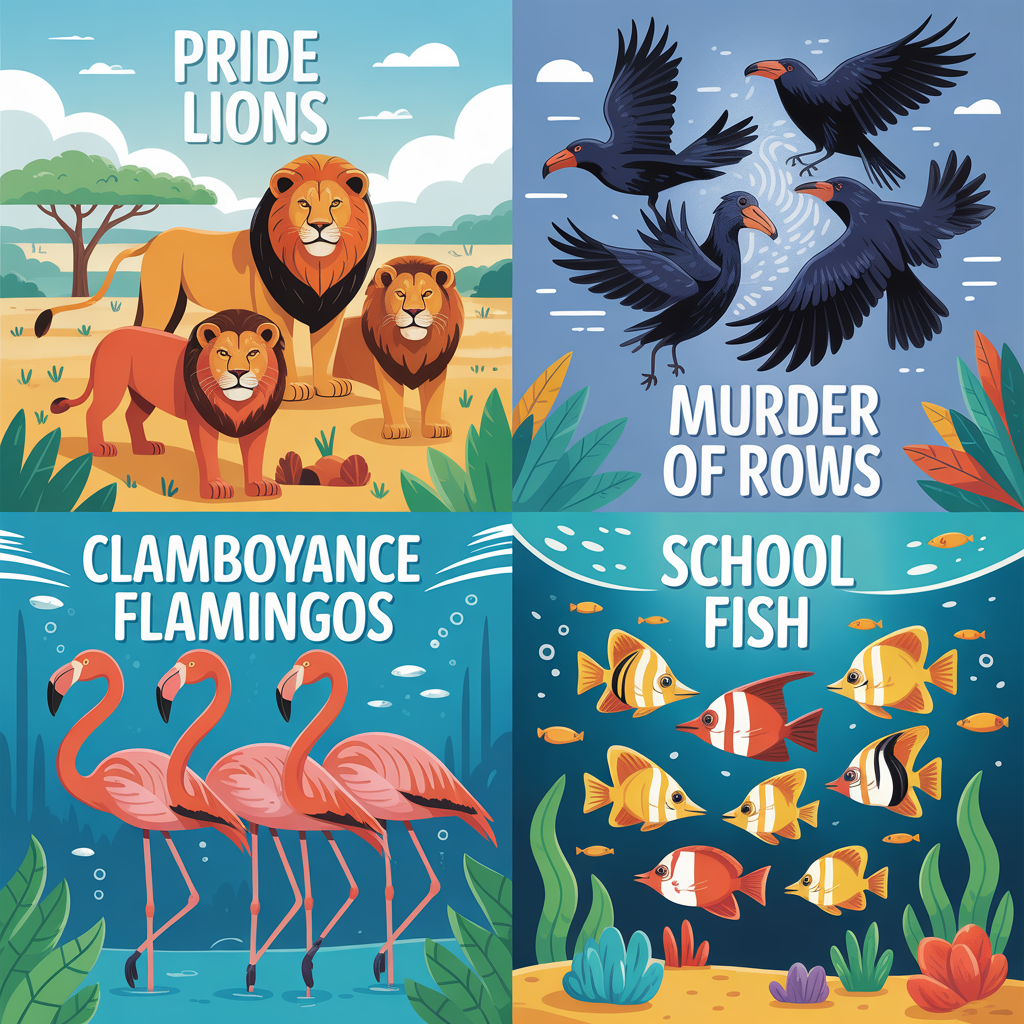
| Pride | Lions |
| Pack | Wolves |
| Flock | Birds / Sheep |
| Pod | Whales / Dolphins |
| Swarm | Bees / Insects |
| Murder | Crows |
| Parliament | Owls |
| Herd | Cattle / Elephants |
| School | Fish |
| Colony | Ants / Bats / Penguins |
| Gaggle | Geese (on ground) |
| Skein | Geese (in flight) |
| Crash | Rhinos |
| Tower | Giraffes |
| Bloat | Hippopotamuses |
Notice how some of these terms feel almost metaphorical — a “murder” of crows, a “parliament” of owls. This poetic quality is one reason collective nouns capture so much attention.
3. Collective Nouns for Things
Objects and concepts also have their own collective nouns.
| Collective Noun | What It Describes |
|---|---|
| Fleet | Ships / Vehicles |
| Bunch | Grapes / Keys / Flowers |
| Bouquet | Flowers |
| Bundle | Sticks / Clothes / Papers |
| Stack | Papers / Books |
| Cluster | Stars / Grapes / Islands |
| Suite | Furniture / Software programs |
| Galaxy | Stars |
| Deck | Cards |
| Batch | Cookies / Files / Emails |
How Collective Nouns Work in a Sentence
This is where many writers get confused: do collective nouns take singular or plural verbs?
The answer depends on which variety of English you use and what you mean to emphasize.
American English: Usually Singular
In American English, collective nouns are almost always treated as singular — because the group is seen as one unified entity.
- The team is ready to play. ✅
- The jury has reached a verdict. ✅
- The committee meets every Monday. ✅
British English: Singular or Plural
In British English, collective nouns can take either singular or plural verbs, depending on whether you’re thinking of the group as a whole unit or as individual members acting separately.
- The team is playing well. (acting as one unit) ✅
- The team are arguing among themselves. (acting as individuals) ✅
Both forms are grammatically acceptable in British English. Context determines which feels more natural.
The Golden Rule
The key principle is consistency. Whichever form you choose (singular or plural), stick with it throughout your sentence and paragraph. Mixing them creates confusion:
- ❌ The staff is unhappy about the change; they are planning to protest. (switching mid-sentence)
- ✅ The staff are unhappy about the change; they are planning to protest. (consistent plural treatment)
Collective Nouns vs. Other Types of Nouns
It helps to understand how collective nouns differ from related noun types.
Collective Nouns vs. Plural Nouns
A plural noun simply adds -s or -es to indicate more than one thing:
- Dog → Dogs
- City → Cities
A collective noun, by contrast, is already singular in form but represents many:
- Pack (of dogs)
- Network (of cities)
The difference: “dogs” tells you there are multiple individuals. “Pack” tells you those individuals form a recognized group.
Collective Nouns vs. Compound Nouns
A compound noun is made of two or more words combined to create a new meaning (e.g., “toothbrush,” “ice cream,” “swimming pool”). Collective nouns can sometimes overlap with compound nouns but are defined by their function of grouping — not by their structure.
Collective Nouns vs. Mass Nouns (Uncountable Nouns)
A mass noun (also called an uncountable noun) describes something you can’t count individually, like “water,” “sand,” or “information.” These are not the same as collective nouns. Collective nouns describe countable groups; mass nouns describe substances or concepts that don’t have individual units.
Common Collective Nouns You Should Know
Here is a curated list of the most commonly used and most important collective nouns across different contexts:
For Professional and Social Groups
- Cabinet — a cabinet of ministers
- Bench — a bench of judges
- Band — a band of musicians
- Class — a class of students
- Gang — a gang of workers / thieves
- Panel — a panel of experts
- Senate — a senate of senators
- Platoon — a platoon of soldiers
For Animals
- Litter — a litter of kittens / puppies
- Kindle — a kindle of kittens
- Skulk — a skulk of foxes
- Prickle — a prickle of porcupines
- Flamboyance — a flamboyance of flamingos
- Conspiracy — a conspiracy of lemurs
- Ambush — an ambush of tigers
- Raft — a raft of otters
For Everyday Objects
- Set — a set of tools / dishes
- Series — a series of events
- Range — a range of products
- Collection — a collection of stamps / art
- Pack — a pack of cards / lies
Unusual and Surprising Collective Nouns
Some collective nouns are so unexpected that they feel like riddles. These are often the terms that originated in medieval England and have been preserved as curious linguistic treasures.
- A murder of crows — evokes the dark reputation of these birds
- A parliament of owls — reflecting their perceived wisdom
- A shrewdness of apes — acknowledging their intelligence
- A pandemonium of parrots — perfectly capturing the chaos of a parrot group
- A bloat of hippos — a vivid description of their enormous bodies
- A flamboyance of flamingos — clearly inspired by their spectacular appearance
- A business of ferrets — ferrets are notoriously busy, curious creatures
- A conspiracy of lemurs — the stuff of linguistic legend
- A crash of rhinos — capturing the sheer force of these animals
- A tower of giraffes — describing what you actually see when they stand together
These terms remind us that collective nouns are not just grammatical tools — they are small pieces of cultural and natural history.
How to Use Collective Nouns Correctly: Practical Tips
Knowing the right collective noun is only half the job. Using it correctly requires attention to a few key rules.
Tip 1: Match Your Verb to Your Intent
Ask yourself: is the group acting as one unit or as separate individuals?
- “The committee has decided to approve the budget.” (one decision, unified)
- “The committee are divided in their opinions.” (members acting separately)
Tip 2: Watch Your Pronoun
The pronoun you use should match your verb choice:
- “The team is doing its best.” (singular)
- “The team are doing their best.” (plural, British style)
Tip 3: Use “Members of” When in Doubt
If you’re unsure whether to use singular or plural, restructure the sentence:
- Instead of: “The jury is/are debating.”
- Try: “The members of the jury are debating.” ✅
Tip 4: Don’t Use a Plural Verb with a Clearly Unified Group
- ❌ The crowd were cheering as one. (contradicts the idea of unity)
- ✅ The crowd was cheering as one.
Tip 5: Be Consistent Throughout Your Writing
Pick singular or plural treatment for your collective noun and maintain it for the entire passage. Switching mid-paragraph creates confusion for readers.
Collective Nouns in Literature and Creative Writing
Writers and poets have long used collective nouns for their evocative power. When you describe “a murder of crows circling the old barn,” you’re doing far more than labeling a group of birds — you’re creating atmosphere, mood, and imagery in a single phrase.
In creative writing, unusual or lesser-known collective nouns can:
- Add specificity — showing you know your subject deeply
- Create tone — “a conspiracy of lemurs” feels darker than “a group of lemurs”
- Engage readers — unexpected word choices stop readers and make them think
- Build world — in fantasy or historical fiction, precise collective nouns ground the reader in a believable reality
Many contemporary writers deliberately use archaic or unusual collective nouns to evoke a sense of history or to add a layer of wit to their prose.
Teaching Collective Nouns to Children
Collective nouns are a beloved topic in elementary language education — and for good reason. Children often find them delightful, especially the unusual animal terms.
Effective approaches for teaching collective nouns include:
- Matching games — pairing animals with their collective nouns
- Fill-in-the-blank sentences — “A ___ of fish swam past.”
- Illustrated charts — visual learners respond well to images paired with labels
- Story writing — encouraging students to use collective nouns in short creative pieces
- Quiz competitions — “What do you call a group of flamingos?” sparks enthusiasm
Once children learn that a group of kittens is a “kindle” and a group of flamingos is a “flamboyance,” they tend to become enthusiastic collectors of these terms themselves.
Quick Reference: Most Important Collective Nouns at a Glance
| Group | Collective Noun |
|---|---|
| Lions | Pride |
| Wolves | Pack |
| Fish | School / Shoal |
| Bees | Swarm |
| Crows | Murder |
| Owls | Parliament |
| Flamingos | Flamboyance |
| Geese | Gaggle / Skein |
| Ants | Colony |
| Dolphins | Pod |
| Judges | Bench |
| Directors | Board |
| Singers | Choir |
| Students | Class |
| Ships | Fleet |
| Cards | Deck |
| Stars | Galaxy / Cluster |
| Flowers | Bouquet / Bunch |
Conclusion
A collective noun is a single word that names a group of people, animals, or things as one unified entity. From the familiar (“a class of students,” “a flock of birds”) to the extraordinary (“a murder of crows,” “a flamboyance of flamingos”), collective nouns are one of the most expressive features of the English language.
They originated largely in medieval hunting culture, expanded across centuries, and today cover virtually every domain of life — from the boardroom to the ocean floor. Understanding how to use them correctly — especially regarding verb agreement — is an important step toward confident, polished writing.
Whether you’re a student building your vocabulary, a writer hunting for the perfect phrase, or simply a language lover who finds words endlessly fascinating, collective nouns offer a window into how English captures the complexity of the world in remarkably efficient — and often beautiful — ways.
Frequently Asked Questions
What is a collective noun in simple terms?
A collective noun is a word that describes a group of people, animals, or things as a single unit. For example, “team,” “flock,” “crowd,” and “fleet” are all collective nouns.
Is “family” a collective noun?
Yes. “Family” is one of the most common collective nouns in English. It refers to a group of people related by blood, marriage, or adoption, treated as a single unit.
Do collective nouns use singular or plural verbs?
In American English, collective nouns almost always take singular verbs (“The team is ready”). In British English, both singular and plural verbs are acceptable depending on whether the group is acting as one unit or as separate individuals.
What is the collective noun for a group of cats?
A group of cats is called a clowder. A group of kittens is called a kindle or litter.
Can a word be both a collective noun and a regular noun?
Yes. Many words function as both. “School” can refer to an educational institution (regular noun) or a group of fish (collective noun). Context always determines the meaning.
What is the most unusual collective noun?
Many people find “a murder of crows,” “a parliament of owls,” and “a flamboyance of flamingos” among the most surprising and memorable collective nouns. All three are historically documented and still in active use today.
Are collective nouns the same in all varieties of English?
The words themselves are generally consistent across English dialects, but the grammar rules differ. American English strongly prefers singular verb agreement with collective nouns, while British English allows both singular and plural depending on context.