
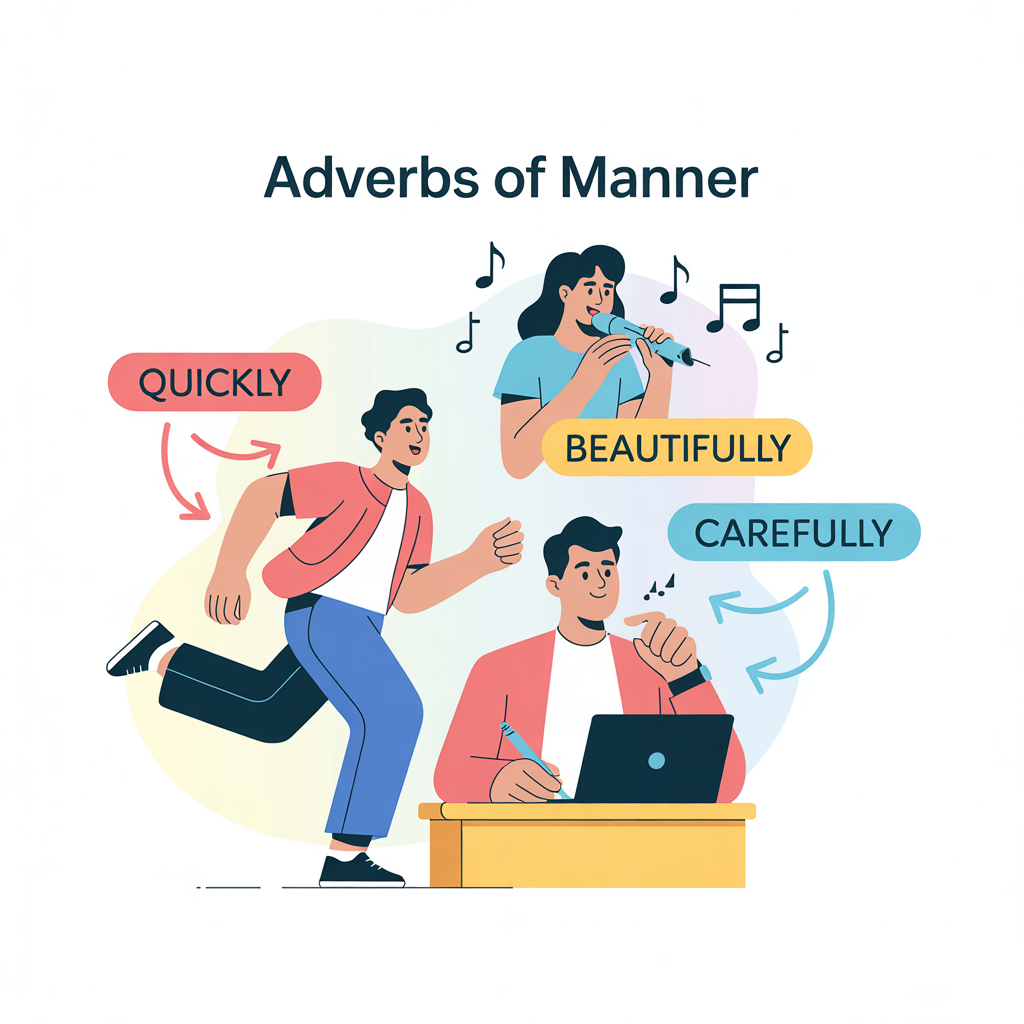
If you’ve ever wondered why “She sang beautifully” feels more vivid than simply “She sang,” you already have an intuitive sense of what adverbs of manner do. These small but mighty words add color, precision, and life to your sentences by telling us how something happens. Whether you’re learning English for the first time, brushing up on grammar rules, or trying to write more expressively, understanding adverbs of manner is a foundational step that pays off in every conversation and piece of writing you produce.
What Are Adverbs of Manner?
An adverb of manner is a type of adverb that describes how an action is performed. It modifies a verb, an adjective, or another adverb by providing more detail about the way something is done, happens, or exists.
Put simply: if the verb is the action, the adverb of manner is the style in which that action takes place.
Consider these quick examples:
- He drives carefully. → How does he drive? Carefully.
- The children laughed loudly. → How did they laugh? Loudly.
- She answered the question confidently. → How did she answer? Confidently.
In each case, the adverb of manner answers the question “How?” — which is the simplest test you can apply to identify one.
How Are Adverbs of Manner Formed?
The most common and recognizable pattern for forming adverbs of manner is adding the suffix -ly to an adjective. However, there are important variations and exceptions to know.
The Standard -ly Rule
Most adjectives simply take -ly at the end:
- quick → quickly
- slow → slowly
- soft → softly
- brave → bravely
- careful → carefully
- beautiful → beautifully
Spelling Adjustments
Some adjectives require a small spelling change before adding -ly:
- Adjectives ending in -y: change y to i, then add -ly
- happy → happily
- easy → easily
- angry → angrily
- Adjectives ending in -le: drop the e, then add -y
- gentle → gently
- simple → simply
- noble → nobly
- Adjectives ending in -ic: add -ally
- dramatic → dramatically
- basic → basically
- enthusiastic → enthusiastically
Irregular Adverbs of Manner
Not all adverbs of manner follow the -ly pattern. Some are completely irregular, and a few look identical to their adjective forms:
- well (from the adjective good) — “She plays the piano well.”
- fast (same as the adjective) — “He runs fast.”
- hard (same as the adjective) — “They worked hard.”
- late (same as the adjective) — “She arrived late.”
- straight — “Go straight ahead.”
⚠️ Watch out: Hardly and lately exist, but their meanings are completely different. Hardly means “barely,” and lately means “recently.” They are not adverbs of manner.
Where Do Adverbs of Manner Go in a Sentence?
Placement is one of the trickiest aspects of adverbs of manner, and getting it right makes a real difference in clarity and naturalness. Here are the key rules:
1. After the Main Verb (Most Common Position)
When there is no object, the adverb of manner typically comes directly after the verb.
- “She smiled warmly.”
- “The baby slept peacefully.”
2. After the Object
When a verb has a direct object, the adverb of manner goes after the object, not between the verb and its object.
- ✅ “He read the book carefully.”
- ❌ “He read carefully the book.” ← Unnatural in most contexts
3. Before the Main Verb (for Emphasis or Style)
Adverbs of manner can sometimes appear before the main verb for emphasis, especially in formal writing or poetry.
- “She quietly closed the door.”
- “He gently placed the vase on the shelf.”
4. At the Beginning of a Sentence
Placing the adverb at the very start of a sentence adds dramatic emphasis, but this is used sparingly.
- “Slowly, the fog began to lift.”
- “Carefully, she unwrapped the fragile gift.”
Quick Placement Summary
| Position | Example | Effect |
|---|---|---|
| After the verb (no object) | She danced gracefully. | Most natural, neutral |
| After the object | He finished the task quickly. | Standard, clear |
| Before the verb | She carefully examined it. | Slightly emphatic |
| At the start | Nervously, he walked in. | Dramatic, stylistic |
Common Adverbs of Manner with Example Sentences
Below is a curated list of frequently used adverbs of manner, grouped by the type of action they typically describe:
Speed & Movement
- Quickly — “She quickly packed her bags.”
- Slowly — “The old man walked slowly down the street.”
- Fast — “The car was moving fast.”
- Swiftly — “The eagle swooped swiftly through the valley.”
Care & Attention
- Carefully — “She carefully carried the glass.”
- Cautiously — “He cautiously opened the unfamiliar door.”
- Neatly — “The report was neatly organized.”
- Precisely — “She cut the fabric precisely.”
Emotion & Tone
- Happily — “The children played happily in the park.”
- Sadly — “He nodded sadly when he heard the news.”
- Angrily — “She slammed the door angrily.”
- Nervously — “The student answered nervously.”
- Proudly — “He stood proudly to accept the award.”
Sound & Voice
- Loudly — “He spoke loudly to be heard over the noise.”
- Softly — “She whispered softly in the child’s ear.”
- Clearly — “The teacher explained the concept clearly.”
Effort & Skill
- Hard — “They worked hard to finish the project.”
- Well — “She plays chess well.”
- Expertly — “The chef expertly sliced the vegetables.”
- Skillfully — “He navigated the crisis skillfully.”
Adverbs of Manner vs. Other Types of Adverbs
Adverbs come in several varieties, and it’s easy to confuse them. Here’s how adverbs of manner compare with the other main types:
| Type | Question Answered | Example |
|---|---|---|
| Manner | How? | She spoke quietly. |
| Time | When? | She spoke yesterday. |
| Place | Where? | She spoke here. |
| Frequency | How often? | She always speaks. |
| Degree | How much / To what extent? | She spoke very quietly. |
The key differentiator for adverbs of manner is always that they answer the question “How?” in relation to a specific action.
Comparative and Superlative Forms
Just like adjectives, adverbs of manner can be compared. This allows you to express degrees of how an action is performed.
One-syllable adverbs
Use -er and -est:
- fast → faster → fastest
- hard → harder → hardest
- late → later → latest
Multi-syllable adverbs
Use more and most:
- carefully → more carefully → most carefully
- quietly → more quietly → most quietly
- efficiently → more efficiently → most efficiently
Irregular comparisons
- well → better → best
- badly → worse → worst
In context:
- “She sings more beautifully than anyone I’ve heard.”
- “Of all the athletes, he runs fastest.”
- “After practice, she plays better than before.”
Adverbs of Manner Modifying Adjectives and Other Adverbs
While adverbs of manner most commonly modify verbs, they can also intensify or qualify adjectives and even other adverbs. In these cases, words like remarkably, surprisingly, incredibly, and wonderfully often serve a dual purpose.
- Modifying an adjective: “She is incredibly talented.” → How talented? Incredibly so.
- Modifying another adverb: “He moved surprisingly quickly.” → How quickly? Surprisingly so.
In these uses, the adverb is often considered a degree adverb rather than a pure manner adverb — but many grammar resources acknowledge the overlap, especially with -ly adverbs derived from participial adjectives (e.g., remarkably, astonishingly).
Common Mistakes to Avoid
Even advanced English learners make errors with adverbs of manner. Here are the most frequent pitfalls:
1. Using an adjective instead of an adverb
- ❌ “She sings beautiful.”
- ✅ “She sings beautifully.”
Remember: adjectives modify nouns; adverbs modify verbs. After an action verb, you need the adverb form.
2. Confusing “good” and “well”
- ❌ “He did good on the test.” (informal/non-standard)
- ✅ “He did well on the test.”
Good is an adjective; well is its adverb form when describing how an action is performed.
3. Misplacing the adverb between the verb and its object
- ❌ “She read carefully the instructions.”
- ✅ “She read the instructions carefully.”
4. Confusing “hard” and “hardly”
- “She worked hard.” → She put in great effort.
- “She hardly worked.” → She did very little work.
These two sentences have nearly opposite meanings. The same distinction applies to late/lately and near/nearly.
Why Adverbs of Manner Matter in Real-World Communication
Understanding adverbs of manner isn’t just an academic exercise — it has real, practical value:
- Writing clarity: They help readers visualize exactly how events unfold. “He walked into the room” is functional. “He walked into the room hesitantly” tells a story.
- Speaking precision: In conversation, adverbs of manner convey tone, attitude, and intent. Saying someone “responded coldly” versus “responded warmly” paints very different pictures.
- Storytelling and creative writing: Fiction, journalism, and poetry all rely heavily on manner adverbs to build atmosphere and character voice.
- Professional communication: In business and academic writing, adverbs of manner like efficiently, thoroughly, and systematically convey competence and precision.
Quick Practice: Test Your Understanding
Try identifying the adverb of manner in each sentence and ask yourself: How is the action being done?
- “The surgeon operated skillfully on the patient.”
- “Quietly, she tiptoed out of the sleeping child’s room.”
- “He answered every question correctly.”
- “The stars shone brightly in the clear night sky.”
- “She gracefully accepted both the praise and the criticism.”
In every example, the bolded word tells us how the action occurred — that’s the hallmark of an adverb of manner.
Conclusion
Adverbs of manner are among the most expressive tools in the English language. They transform flat, functional statements into rich, vivid communication by answering the fundamental question: How? From the standard -ly formation rules to irregular forms like well, fast, and hard, mastering these adverbs gives you greater control over meaning, tone, and style in everything you say and write.
The next time you write or speak, pause for a moment and consider: Can I add a manner adverb here to make this clearer, more vivid, or more precise? More often than not, the answer will be yes — and your communication will be all the better for it.
Frequently Asked Questions (FAQs)
What is the simplest definition of an adverb of manner?
An adverb of manner is a word that describes how an action is performed. It modifies a verb and typically answers the question “How?” For example, in “She ran quickly,” the word quickly is the adverb of manner.
Do all adverbs of manner end in -ly?
No. While most adverbs of manner are formed by adding -ly to an adjective (e.g., slow → slowly), several common ones do not follow this pattern. Words like fast, hard, late, straight, and well are adverbs of manner that do not end in -ly.
Where should I place an adverb of manner in a sentence?
The most natural positions are after the main verb (when there’s no object) or after the object (when there is one). For example: “She spoke softly” and “He read the letter carefully.” You can also place it before the verb or at the start of a sentence for emphasis.
What is the difference between an adverb of manner and an adverb of degree?
An adverb of manner describes how an action is done (e.g., “She sang beautifully“). An adverb of degree describes the intensity or extent of a quality or action (e.g., “She is very talented” or “He almost fell”). The key test: manner adverbs answer “How?” while degree adverbs answer “How much?” or “To what extent?”
Can adverbs of manner modify adjectives?
Yes, particularly -ly adverbs derived from participial adjectives (like remarkably, surprisingly, incredibly). For example: “She is incredibly dedicated.” In these cases, the adverb functions more as a degree modifier, but many such words blur the line between manner and degree.
What is the comparative form of adverbs of manner?
One-syllable adverbs use -er/-est (e.g., fast → faster → fastest). Multi-syllable adverbs use more/most (e.g., carefully → more carefully → most carefully). Irregular forms include well → better → best and badly → worse → worst.