
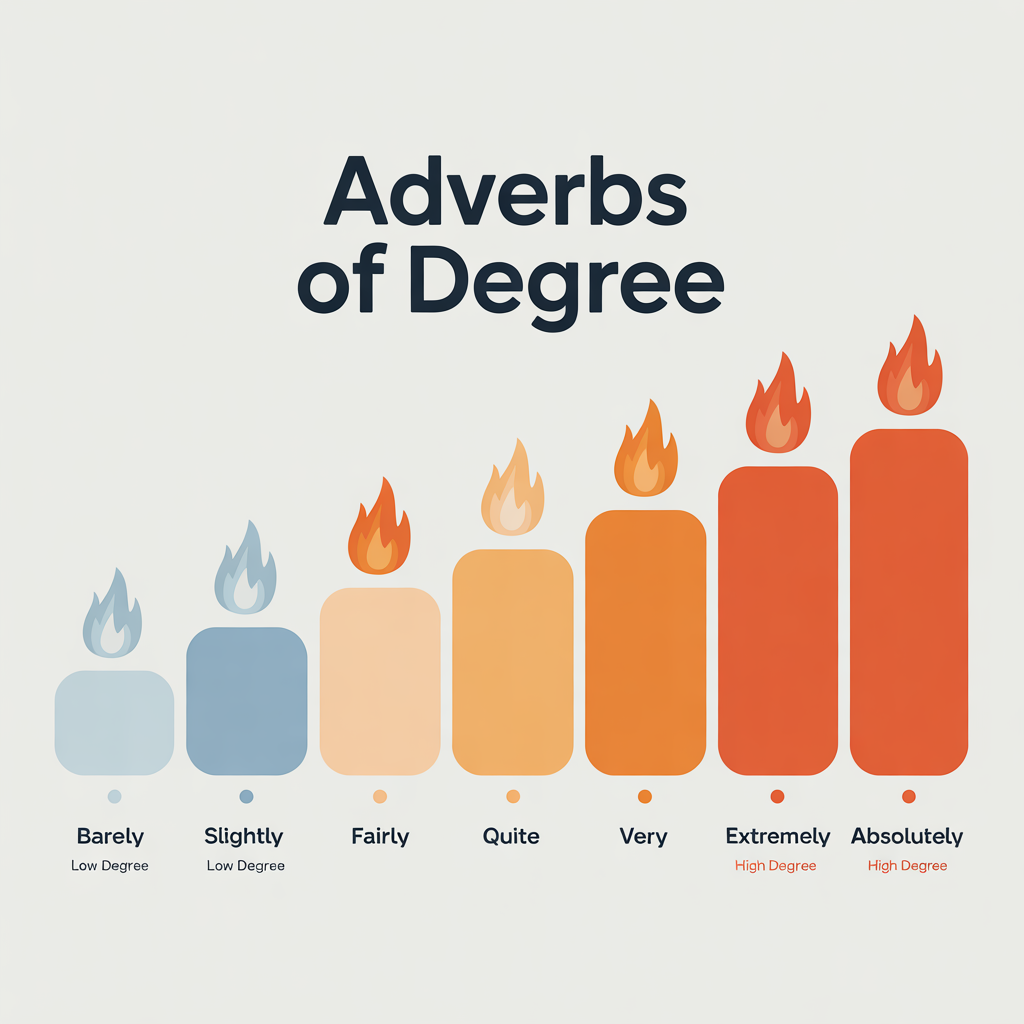
When you say something is very interesting or barely noticeable, you’re already using adverbs of degree — and you probably didn’t even think twice about it. These small but powerful words shape how strongly or weakly we express ideas in everyday English. Whether you’re a language learner, a writer, or simply someone who wants to communicate more precisely, understanding adverbs of degree will transform the way you use the language. This guide covers everything you need to know: what they are, how they work, the different types, common mistakes, and plenty of real-world examples.
What Are Adverbs of Degree?
An adverb of degree is a word that modifies an adjective, another adverb, or occasionally a verb to indicate the intensity, extent, or level of something. In plain terms, adverbs of degree tell us how much or to what degree something happens or exists.
They answer questions like:
- How much?
- To what extent?
- How intensely?
Consider these examples:
- “She is extremely talented.” → How talented? Extremely.
- “He barely finished the race.” → To what extent did he finish? Barely.
- “The soup is too hot to eat.” → How hot? Too hot.
Without adverbs of degree, language would feel flat and vague. They add color, nuance, and precision to everything we say and write.
Where Do Adverbs of Degree Come From?
Most adverbs of degree don’t follow the typical adverb pattern of adding -ly to an adjective (like quickly from quick). Instead, many are standalone, irregular forms — words like quite, rather, almost, and enough that have evolved through centuries of English usage.
Some do follow the -ly pattern, however. Words like incredibly, remarkably, and surprisingly all function as adverbs of degree when placed before adjectives.
What Do Adverbs of Degree Modify?
This is one of the most important things to understand: adverbs of degree primarily modify adjectives and other adverbs, not verbs. This sets them apart from other types of adverbs (like adverbs of manner or frequency).
Modifying an Adjective
This is the most common use. The adverb of degree comes directly before the adjective it modifies.
- The test was incredibly difficult.
- She looked slightly tired.
- It was a fairly easy question.
Modifying Another Adverb
Adverbs of degree can also boost or reduce the strength of another adverb.
- He ran surprisingly fast.
- She spoke quite softly.
- They finished remarkably quickly.
Modifying a Verb (less common)
Some adverbs of degree, particularly almost, nearly, barely, and just, can modify verbs directly.
- I almost forgot your birthday.
- She barely spoke a word.
- He nearly collapsed from exhaustion.
Types of Adverbs of Degree
Not all adverbs of degree work the same way. They can be grouped into several categories based on the effect they create.
1. Intensifiers (Amplifiers)
Intensifiers — also called amplifiers — increase the degree or intensity of what they modify. They make the meaning stronger.
| Intensifier | Example Sentence |
|---|---|
| very | The movie was very entertaining. |
| extremely | It was extremely cold last night. |
| incredibly | She is incredibly talented. |
| terribly | He was terribly rude. |
| awfully | That was awfully kind of you. |
| remarkably | The child was remarkably calm. |
| absolutely | The performance was absolutely stunning. |
Note: Words like absolutely, completely, and utterly are a subgroup called maximizers. They push meaning to the maximum — they imply total or complete degree. You can say something is “absolutely perfect” but not “very perfect,” because “perfect” already implies completion.
2. Downtoners (Diminishers)
Downtoners reduce the degree or intensity of the word they modify. They soften or weaken the meaning.
| Downtoner | Example Sentence |
|---|---|
| slightly | She looked slightly annoyed. |
| barely | He barely passed the exam. |
| hardly | I could hardly hear the music. |
| scarcely | There was scarcely enough food for everyone. |
| a little | The room was a little messy. |
| somewhat | The instructions were somewhat confusing. |
3. Approximators
Approximators indicate that something is close to — but not quite at — a certain point. They signal nearness or approximation.
- I have almost finished the project.
- She nearly won the competition.
- We’re just about ready to leave.
4. Sufficiency Markers
These adverbs indicate whether something meets, exceeds, or falls short of a required level.
- Enough: “She is tall enough to reach the shelf.” (meets the standard)
- Too: “The coffee is too hot to drink.” (exceeds an acceptable level, negative)
- Sufficiently: “The report is sufficiently detailed.” (formal way to express enough)
Important: Notice that enough comes after the adjective or adverb it modifies, while too comes before. This is a common source of errors for learners.
5. Moderators
Moderators (sometimes called “medium intensifiers”) occupy the middle ground — they neither strongly amplify nor significantly diminish meaning. They add a sense of moderation or qualification.
| Moderator | Example Sentence |
|---|---|
| quite | The film was quite good. |
| fairly | The weather is fairly mild today. |
| rather | She was rather upset about the news. |
| pretty | That’s pretty impressive work. |
| reasonably | The price seems reasonably fair. |
A Spectrum of Degree: From Least to Most
One of the best ways to truly grasp adverbs of degree is to visualize them on a spectrum. Think of intensity as a scale from 0 to 100:
- 0–10 (Very low degree): barely, scarcely, hardly, a little
- 10–40 (Low-to-moderate degree): slightly, somewhat, a bit
- 40–60 (Moderate degree): fairly, quite, pretty, rather
- 60–80 (High degree): very, highly, terribly, awfully
- 80–100 (Maximum degree): extremely, incredibly, absolutely, completely, utterly
Understanding this spectrum helps you choose the right adverb for the right context — whether you’re writing a formal report, a casual text message, or a compelling story.
Position of Adverbs of Degree in a Sentence
Word order matters a great deal in English grammar. Adverbs of degree generally follow these placement rules:
Before the Word They Modify (Most Common)
The vast majority of adverbs of degree are placed immediately before the adjective or adverb they modify.
- “She is very smart.” ✅
- “She is smart very.” ✗
After the Word They Modify (Special Cases)
The word enough always comes after the adjective or adverb.
- “He is old enough to vote.” ✅
- “He is enough old to vote.” ✗
Before the Main Verb (When Modifying Verbs)
When adverbs of degree modify a verb directly, they typically appear before the main verb.
- “I almost fell off the ladder.”
- “She barely remembers his name.”
Adverbs of Degree vs. Other Types of Adverbs
It’s easy to confuse adverbs of degree with other types of adverbs. Here’s a quick comparison to keep them straight:
| Type | What It Modifies / Tells Us | Example |
|---|---|---|
| Adverb of Degree | How much / to what extent | She is very tired. |
| Adverb of Manner | How something is done | She ran quickly. |
| Adverb of Frequency | How often something happens | She always runs. |
| Adverb of Time | When something happens | She ran yesterday. |
| Adverb of Place | Where something happens | She ran outside. |
The Tricky Case of “Quite” in British vs. American English
One of the most fascinating — and confusing — aspects of adverbs of degree is how the same word can mean different things depending on dialect.
The word “quite” is a perfect example:
- In British English, “quite” usually functions as a downtoner or moderator. “The film was quite good” typically means it was fairly good — good, but not exceptional.
- In American English, “quite” often acts more like an intensifier. “The film was quite good” can mean it was very good — more than average.
This is a genuine source of miscommunication between speakers from different regions, so context and awareness of your audience always matter.
Common Mistakes with Adverbs of Degree
Even experienced English speakers make errors with these words. Here are the most common pitfalls to avoid:
Mistake 1: Using “too” instead of “very”
“Too” implies a problem or negative consequence. “Very” simply intensifies.
- ❌ “The concert was too amazing.” (This implies the amazingness was somehow a problem.)
- ✅ “The concert was very amazing.”
Mistake 2: Placing “enough” before the adjective
- ❌ “She is enough tall to reach the shelf.”
- ✅ “She is tall enough to reach the shelf.”
Mistake 3: Confusing “hardly” with “hard”
Hardly is an adverb of degree meaning “scarcely” or “almost not.” It has nothing to do with working hard.
- “I can hardly believe it.” (= I can barely believe it.)
- “I worked hard today.” (= I exerted great effort.)
Mistake 4: Double intensifying
Stacking intensifiers is grammatically awkward and stylistically weak.
- ❌ “She was very extremely tired.”
- ✅ “She was extremely tired.” or “She was very tired.”
Mistake 5: Modifying absolute adjectives
Some adjectives are absolute — they represent a state that cannot be graded. Words like unique, perfect, dead, pregnant, and impossible cannot logically be intensified with gradable intensifiers.
- ❌ “This design is very unique.” (Unique means one of a kind — you can’t be “more unique.”)
- ✅ “This design is truly unique.” (Use maximizers like truly, absolutely instead.)
Adverbs of Degree in Academic and Formal Writing
In formal or academic writing, word choice becomes critical. Casual intensifiers like very, pretty, and awfully are generally avoided in favor of more precise, elevated alternatives.
| Informal / Casual | Formal / Academic Alternative |
|---|---|
| very important | highly significant / critically important |
| pretty difficult | considerably challenging |
| a bit surprising | somewhat unexpected |
| really fast | remarkably rapid |
| awfully complex | highly complex / exceedingly complex |
A good rule of thumb: the more formal the context, the more precise and measured your language should be. Replace vague intensifiers with specific, accurate ones.
Adverbs of Degree in Literature and Creative Writing
Great writers use adverbs of degree deliberately and sparingly. Overusing intensifiers like very and extremely can actually weaken your writing by making it feel exaggerated or lazy. Mark Twain famously advised:
“Substitute ‘damn’ every time you’re inclined to write ‘very’; your editor will delete it and the writing will be just as it should be.”
While that’s a bit tongue-in-cheek, the lesson is real: precise word choice often eliminates the need for intensifiers entirely. Instead of “very tired,” consider “exhausted.” Instead of “very happy,” try “elated” or “overjoyed.”
That said, adverbs of degree are effective when used to create contrast, suggest irony, or establish a character’s voice. The key is intentionality.
Quick Reference: Most Common Adverbs of Degree
Here is a comprehensive list organized by function:
Amplifiers / Intensifiers
- very, extremely, incredibly, terribly, awfully, remarkably, exceptionally, particularly, especially, deeply, profoundly, highly, intensely
Maximizers
- absolutely, completely, totally, entirely, utterly, perfectly, fully, thoroughly, quite (in some contexts)
Approximators
- almost, nearly, just about, practically, virtually
Moderators
- quite, fairly, rather, pretty, reasonably, moderately, relatively, somewhat
Downtoners / Minimizers
- slightly, a little, a bit, mildly, barely, hardly, scarcely, narrowly, faintly
Sufficiency Markers
- enough, sufficiently, adequately, too, excessively, overly
Practice: Identify the Adverbs of Degree
Test your understanding with these sentences. Find the adverb of degree and identify what it modifies:
- “The patient was surprisingly calm during the procedure.”
- “He almost broke the world record.”
- “The room is barely large enough for two people.”
- “She speaks French remarkably well.”
- “The application process is somewhat complicated.”
Answers:
- Surprisingly → modifies the adjective “calm”
- Almost → modifies the verb “broke”
- Barely → modifies the adjective “large”
- Remarkably → modifies the adverb “well”
- Somewhat → modifies the adjective “complicated”
Conclusion
Adverbs of degree are among the most versatile and frequently used tools in the English language. They do far more than add emphasis — they fine-tune meaning, convey tone, signal formality, and give language its emotional texture. From the barely-there softness of slightly to the full force of absolutely, these words form an entire spectrum of expression.
The key takeaways to remember:
- Adverbs of degree tell us how much or to what extent.
- They primarily modify adjectives and other adverbs.
- They come in several types: intensifiers, downtoners, approximators, moderators, and sufficiency markers.
- Most come before the word they modify, except enough, which comes after.
- Context, dialect, and formality all influence which adverb of degree is the right choice.
Once you start noticing adverbs of degree in speech and writing, you’ll find them everywhere. And once you use them with intention and precision, your own communication will become sharper, clearer, and far more compelling.
Frequently Asked Questions
What is the difference between an adverb of degree and an adverb of manner?
An adverb of manner describes how an action is performed (e.g., “She sang beautifully“). An adverb of degree describes how much or to what extent (e.g., “She is extremely talented”). Adverbs of degree primarily modify adjectives and adverbs, while adverbs of manner mainly modify verbs.
Is “very” always an adverb of degree?
In standard modern English, yes — very functions as an adverb of degree that intensifies adjectives and other adverbs. However, it can occasionally appear as an adjective itself in formal or literary contexts (e.g., “the very idea”), where it means “actual” or “precise.” In everyday usage, treat very as an adverb of degree.
Can adverbs of degree modify nouns?
Generally, no. Adverbs of degree modify adjectives, other adverbs, and sometimes verbs — not nouns directly. Nouns are modified by adjectives. However, some phrases like “quite a challenge” or “rather a surprise” involve adverbs of degree appearing before noun phrases, which is an idiomatic exception, particularly in British English.
What is the difference between “too” and “very”?
Very is a neutral intensifier — it simply increases the degree. Too implies excess that causes a problem or prevents something. “It’s very hot” is just a description. “It’s too hot to work” means the heat is preventing work. Using too always carries a negative or problematic implication.
Are adverbs of degree important for IELTS or TOEFL?
Absolutely. Both exams assess lexical resource (vocabulary range and accuracy). Using a varied range of adverbs of degree — rather than repeating very — demonstrates vocabulary breadth. In writing tasks, appropriately hedging claims with words like somewhat, considerably, and relatively also reflects academic sophistication.