
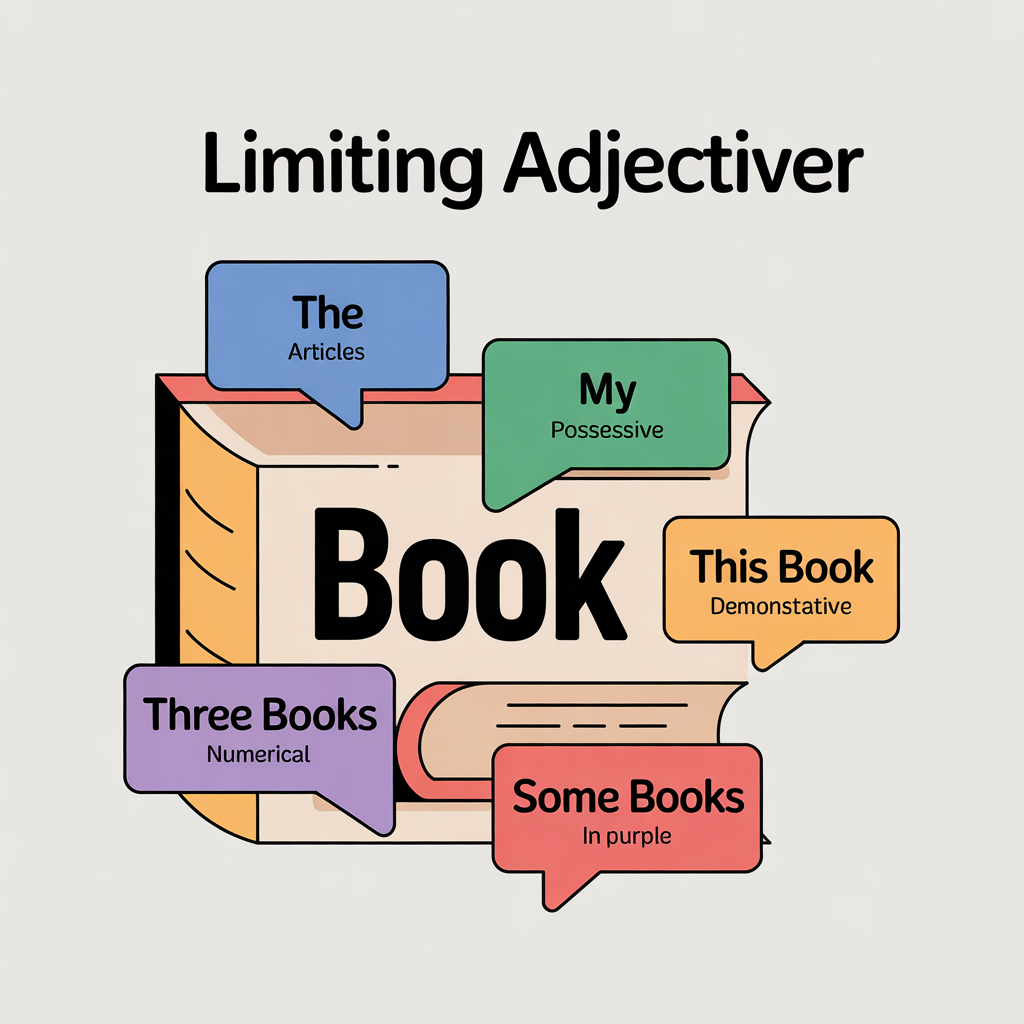
When you write or speak in English, adjectives do a lot of heavy lifting. But not all adjectives work the same way. Some describe qualities — like beautiful, tall, or cold. Others do something fundamentally different: they limit or define a noun rather than describe it. These are called limiting adjectives, and understanding them is a key step toward mastering English grammar.
Whether you’re a student, a writer, or someone brushing up on grammar fundamentals, this guide will walk you through everything you need to know about limiting adjectives — what they are, how they work, the different types, and how to use them naturally and correctly.
What Are Limiting Adjectives?
A limiting adjective is a type of adjective that restricts, quantifies, or specifies a noun without actually describing its qualities. Instead of telling you what something is like, a limiting adjective tells you which one, how many, or whose it is.
Think of it this way: the sentence “She has a beautiful car” uses a descriptive adjective. But the sentence “She has three cars” uses a limiting adjective — it places a numerical boundary on the noun cars without saying anything about their appearance, condition, or quality.
Limiting adjectives are also called determiners in modern grammar, although some traditional grammar systems use both terms. Regardless of the label, their function is the same: to limit the scope or reference of a noun.
Simple definition: A limiting adjective modifies a noun by defining its quantity, possession, location, order, or identity — not its qualities.
Limiting Adjectives vs. Descriptive Adjectives
Before diving deeper, it helps to clearly distinguish limiting adjectives from their counterparts.
| Feature | Limiting Adjectives | Descriptive Adjectives |
|---|---|---|
| Function | Restrict or define a noun | Describe a quality of a noun |
| Answer the question | Which? How many? Whose? | What kind? What does it look like? |
| Examples | this, five, my, each, the | blue, fast, enormous, fragrant |
| Comparison possible? | Generally no | Yes (bigger, most beautiful) |
You can say “a very beautiful house” (intensifying a descriptive adjective), but you cannot say “a very this house” or “a very my car” — limiting adjectives don’t accept degree modifiers. That’s one of the clearest grammatical signs that they operate differently.
Types of Limiting Adjectives
Limiting adjectives come in several distinct categories, each serving a specific function. Let’s explore each type in detail.
1. Articles
Articles are perhaps the most commonly used limiting adjectives in English. There are only three: a, an, and the.
- The (definite article) — refers to a specific, known noun: the dog, the idea
- A / An (indefinite articles) — refer to any one of a category: a book, an umbrella
Articles limit a noun by telling the reader whether you’re referring to something specific or something general. They are technically the most basic form of limiting adjectives.
2. Demonstrative Adjectives
Demonstrative adjectives point to specific nouns and indicate their proximity to the speaker — either near or far in space or time.
- This — singular, near: this book
- That — singular, far: that building
- These — plural, near: these flowers
- Those — plural, far: those mountains
Example sentences:
- I prefer this design over that one.
- Can you hand me those files?
Note: When used alone (without a noun), these words become demonstrative pronouns. The adjective role only applies when they modify a noun directly.
3. Possessive Adjectives
Possessive adjectives show ownership or belonging. They answer the question: Whose is it?
- My, your, his, her, its, our, their
Example sentences:
- Have you seen my glasses?
- Their performance was outstanding.
- The cat licked its paws.
A common point of confusion: its (possessive adjective, no apostrophe) vs. it’s (contraction of “it is”). Only its is a possessive adjective.
4. Interrogative Adjectives
Interrogative adjectives are used in questions to ask about a specific noun. They are: which, what, and whose.
Example sentences:
- Which route do you prefer?
- What color is your car?
- Whose jacket is this?
Again, the distinction is important: when which or what is used alone without a noun, it functions as an interrogative pronoun, not an adjective.
5. Indefinite Adjectives
Indefinite adjectives refer to nouns in a non-specific or general way. They don’t point to a particular person or thing.
Common indefinite adjectives include:
- some, any, all, few, many, much, several, both, each, every, either, neither, other, another, enough, no
Example sentences:
- Some students arrived early.
- She didn’t have any experience.
- Each team member has a responsibility.
- Several options are available.
Indefinite adjectives are incredibly common in everyday English and are often overlooked as adjectives precisely because they feel so natural.
6. Numerical Adjectives
Numerical adjectives express exact or approximate numbers. They fall into two subcategories:
- Cardinal numbers — indicate quantity: one, two, ten, fifty, a hundred
- I ordered two coffees.
- Ordinal numbers — indicate order or position: first, second, last, next
- She won first place.
- Take the next left turn.
7. Distributive Adjectives
Distributive adjectives refer to members of a group individually or collectively. They include: each, every, either, neither.
Example sentences:
- Every child deserves access to education.
- Neither answer is correct.
- Either option works for me.
These words distribute reference across all individuals in a set, which is what gives them the name “distributive.”
Where Do Limiting Adjectives Appear in a Sentence?
Limiting adjectives almost always appear before the noun they modify. In English grammar, the standard order of adjectives in a noun phrase places limiting adjectives at the very beginning — before any descriptive adjectives.
Standard order:
[Limiting adjective] + [Descriptive adjective(s)] + Noun
Examples:
- My old blue jacket
- Three tall oak trees
- Those beautiful red roses
- Every serious grammar student
This positional rule makes it easy to identify limiting adjectives in a sentence — they almost always come first in the noun phrase.
Why Are Limiting Adjectives Important?
You might wonder: if limiting adjectives are so common, why do they even need a label? Because understanding them has real practical value.
1. Clarity and Precision in Writing
Limiting adjectives help you specify exactly what you mean. Saying “Give me a pen” is vague. Saying “Give me this pen” or “Give me any pen” is far more precise. The right limiting adjective can eliminate ambiguity instantly.
2. Correct Grammar Usage
Knowing that limiting adjectives don’t take degree modifiers helps you avoid errors. You would never write “the most every student” or “very some water.” Understanding the category helps you recognize and correct such mistakes.
3. Better Reading Comprehension
Recognizing limiting adjectives helps you understand the scope of a statement. There’s a significant difference between “students need help”, “some students need help”, “all students need help”, and “no students need help.” The limiting adjective changes the meaning entirely.
4. Language Learning and Teaching
For ESL learners and English teachers alike, identifying limiting adjectives is fundamental to teaching determiners, quantifiers, and possessives — all core components of English grammar instruction.
Common Mistakes with Limiting Adjectives
Even experienced writers make errors with limiting adjectives. Here are the most frequent ones to watch out for:
Confusing Possessive Adjectives with Possessive Pronouns
- Wrong: The book is my.
- Right: The book is mine. (possessive pronoun) OR It is my book. (possessive adjective)
Possessive adjectives (my, your, his, her) must always be followed by a noun. Possessive pronouns (mine, yours, his, hers) stand alone.
Using “Each” and “Every” with Plural Nouns
- Wrong: Each students must submit their work.
- Right: Each student must submit their work.
Each and every are singular — they always take a singular noun, even though they refer to multiple individuals.
Misusing “Some” and “Any”
- Some is typically used in positive statements and offers: “Would you like some tea?”
- Any is typically used in negative statements and questions: “I don’t have any money.”
Mixing Up “Few” and “A Few”
- Few people attended — implies a disappointingly small number (negative connotation)
- A few people attended — implies some people came (neutral or slightly positive)
The presence or absence of the article a changes the tone and meaning significantly.
Limiting Adjectives in Context: Real-World Examples
Seeing limiting adjectives in natural sentences helps solidify understanding. Here are several examples across different categories:
- “The company released its annual report last week.” — article + possessive
- “Both candidates delivered compelling speeches.” — indefinite
- “Which department handles these requests?” — interrogative + demonstrative
- “Every second counts when you’re on deadline.” — distributive + ordinal
- “Several of her colleagues disagreed with that decision.” — indefinite + possessive + demonstrative
Notice how each limiting adjective shapes the meaning of the sentence without adding any descriptive quality to the nouns they modify.
Quick Reference: Types of Limiting Adjectives at a Glance
- Articles: a, an, the
- Demonstrative: this, that, these, those
- Possessive: my, your, his, her, its, our, their
- Interrogative: which, what, whose
- Indefinite: some, any, all, few, many, much, several, each, every, either, neither, no, another, other, enough, both
- Numerical (Cardinal): one, two, three, ten, etc.
- Numerical (Ordinal): first, second, third, last, next, etc.
- Distributive: each, every, either, neither
Conclusion
Limiting adjectives are one of the most fundamental — and frequently used — elements of English grammar. They quietly do the work of defining, specifying, and quantifying nouns in nearly every sentence you read or write. From the simple article the to words like every, several, or those, limiting adjectives give language its precision and clarity.
Once you start recognizing them, you’ll notice them everywhere. And the better you understand how they work, the more confidently and accurately you’ll be able to use them — whether you’re writing an essay, crafting a professional email, or simply trying to express yourself clearly.
Grammar isn’t just a set of dry rules. It’s the architecture behind every clear thought you express. And limiting adjectives are a foundational beam in that structure.
Frequently Asked Questions (FAQs)
Are articles considered limiting adjectives?
Yes. Articles (a, an, the) are traditionally classified as a type of limiting adjective because they restrict the reference of a noun — either to something specific (the) or to any member of a category (a/an). In modern linguistics, they are often categorized under “determiners.”
What is the difference between a limiting adjective and a determiner?
The terms are largely overlapping. “Limiting adjective” is the traditional grammar term, while “determiner” is the modern linguistic term. Both refer to words that restrict or define a noun rather than describe its qualities. For most practical purposes, they mean the same thing.
Can a word be both a limiting adjective and another part of speech?
Yes, absolutely. Many words shift roles depending on how they’re used in a sentence. For example, this is a limiting adjective in “This car is new” but a demonstrative pronoun in “This is new.” Similarly, which is a limiting adjective in “Which book?” but a relative pronoun in “The book which I read…”
Is “no” a limiting adjective?
Yes. When no modifies a noun (as in “There is no time left” or “No students were absent”), it functions as a limiting adjective. It restricts the noun by indicating a complete absence.
How do I teach limiting adjectives to beginners?
Start with the most concrete types: articles and demonstratives. Use physical objects to demonstrate this/that/these/those. Then introduce possessives with personal context (my book, your desk). Numbers are also intuitive. Build up to indefinite adjectives like some, any, many once the basics are solid.