
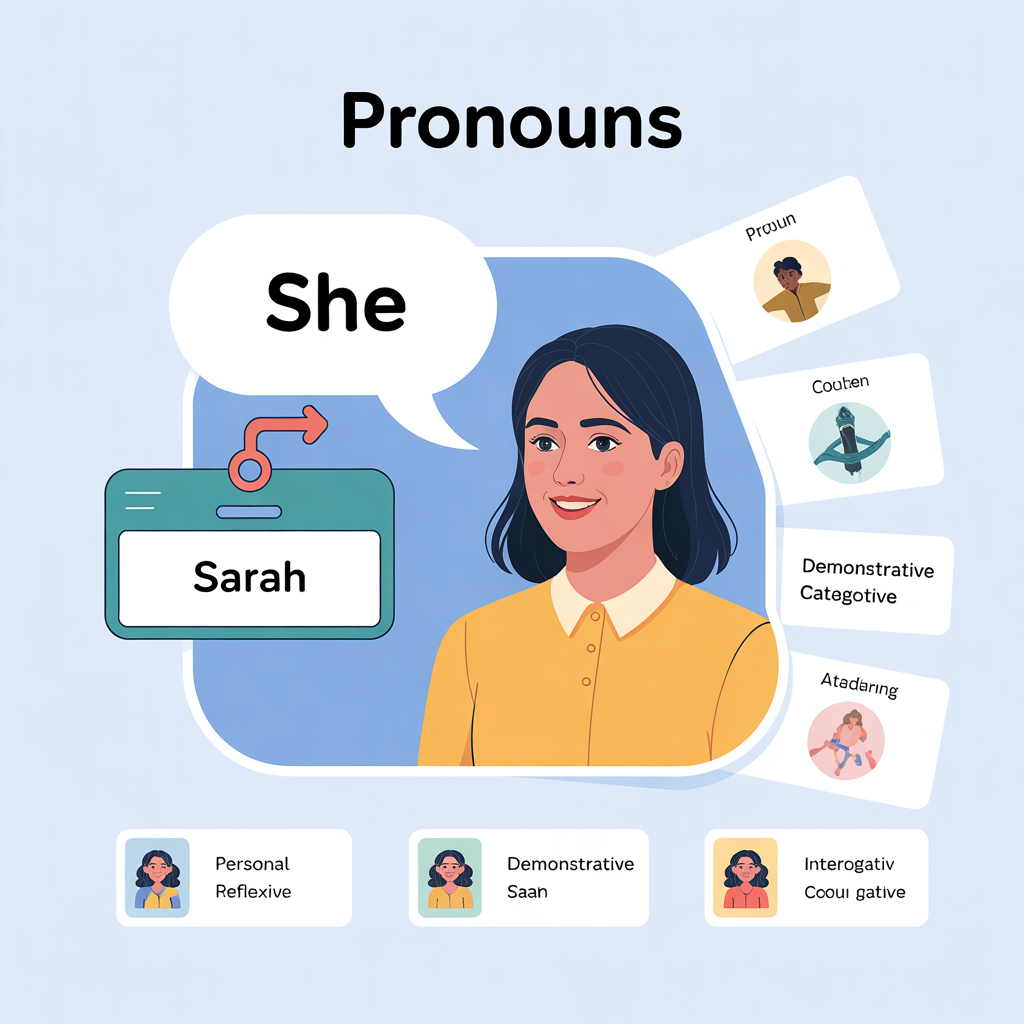
Every time you say “she called me” instead of “Sarah called John,” you are using one of the most powerful tools in the English language — the pronoun. Pronouns are so deeply embedded in how we communicate that most people use dozens of them every single day without thinking twice. But what exactly is a pronoun, and why does it matter so much to grammar, writing, and even social identity? This guide breaks it all down in a clear, accessible way — from the basic definition to every major type, with real examples you can apply right away.
What Is a Pronoun? (The Core Definition)
A pronoun is a word that takes the place of a noun — or a noun phrase — in a sentence. Instead of repeating a person’s name, an object’s name, or a concept over and over, a pronoun steps in as a stand-in, keeping language fluid and natural.
Consider this example:
- Without pronouns: “Maria told Maria’s friend that Maria would be late because Maria’s car broke down.”
- With pronouns: “Maria told her friend that she would be late because her car broke down.”
The second sentence is obviously far easier to read. That is the core job of a pronoun: to prevent unnecessary repetition while keeping meaning clear.
The word or noun that a pronoun replaces is called its antecedent. In the example above, “Maria” is the antecedent for both “her” and “she.” For communication to be clear, a pronoun’s antecedent must usually be obvious to the reader or listener.
Why Are Pronouns Important?
Pronouns do a lot more than just save words. Here is why they matter:
- Clarity and readability: They eliminate clunky repetition and make sentences flow naturally.
- Efficiency: A single pronoun can replace an entire noun phrase, saving time and mental effort.
- Identity and respect: In modern usage, personal pronouns carry significant social meaning. Using someone’s correct pronouns (he/him, she/her, they/them, etc.) is a form of basic respect.
- Grammatical structure: Choosing the right pronoun form (I vs. me, who vs. whom) is a key marker of grammatical accuracy.
The 8 Major Types of Pronouns
English pronouns are not a single category — they are a diverse family of words, each serving a specific grammatical function. Here is a comprehensive look at every major type.
1. Personal Pronouns
These are the most common pronouns. They refer to specific people or things and change form based on three factors: person (1st, 2nd, or 3rd), number (singular or plural), and grammatical case (subject, object, or possessive).
Subject pronouns perform the action in a sentence:
- I, you, he, she, it, we, they
- Example: “She finished the report before the deadline.”
Object pronouns receive the action:
- me, you, him, her, it, us, them
- Example: “The teacher called him to the front of the class.”
Possessive pronouns show ownership and stand alone (unlike possessive adjectives like my or his that modify nouns):
- mine, yours, his, hers, its, ours, theirs
- Example: “That laptop is mine.”
2. Reflexive Pronouns
Reflexive pronouns refer back to the subject of the sentence. They are formed by adding -self (singular) or -selves (plural) to a base pronoun.
- myself, yourself, himself, herself, itself, ourselves, yourselves, themselves
- Example: “She taught herself how to code.”
They are also used for emphasis (also called intensive pronouns in that role):
- Example: “The CEO himself signed the contract.”
3. Demonstrative Pronouns
These pronouns point to specific things and indicate whether they are near or far — in physical space or in time.
- this, that, these, those
- This/These = near (in space or time)
- That/Those = far (in space or time)
- Example: “These are the documents you requested.”
- Example: “That was the best concert I have ever attended.”
Note: When these words come before a noun (e.g., “this book”), they are acting as demonstrative adjectives, not pronouns.
4. Interrogative Pronouns
These pronouns are used to ask questions. They introduce questions where the answer is the missing noun.
- who, whom, whose, which, what
- Example: “Who left the lights on?”
- Example: “What did you order for dinner?”
- Example: “Whom did you contact at the company?” (formal, used as object)
A quick tip: use who as a subject (“who did this?”) and whom as an object (“to whom did you speak?”). If you can replace it with “him,” use “whom.”
5. Relative Pronouns
Relative pronouns connect a dependent (relative) clause to a main clause. They relate additional information about a noun already mentioned.
- who, whom, whose, which, that
- Example: “The scientist who discovered penicillin changed medicine forever.”
- Example: “This is the book that everyone is talking about.”
- Example: “She returned the wallet, which still had all the cash inside.”
A key distinction: use who/whom for people, and which for things or animals. That can be used for both, though formal writing sometimes avoids “that” for people.
6. Indefinite Pronouns
Unlike personal pronouns, indefinite pronouns do not refer to any specific person, place, or thing. They are among the most frequently used pronouns in English.
Common indefinite pronouns:
- everyone, everybody, everything, someone, somebody, something, anyone, anybody, anything, no one, nobody, nothing
- all, both, each, either, neither, few, many, more, most, much, other, several, some, such
Examples:
- “Everyone is welcome to attend the meeting.”
- “Nobody expected the announcement.”
- “Several of the students passed the exam with distinction.”
Important grammar note: Many indefinite pronouns (everyone, nobody, each, either) are grammatically singular, even when they feel plural in meaning. This means they take singular verbs: “Everyone is here,” not “Everyone are here.”
7. Reciprocal Pronouns
These pronouns express a mutual relationship — an action or feeling that goes both ways between two or more people.
- each other, one another
- Example: “The two business partners trust each other completely.”
- Example: “The team members encouraged one another throughout the project.”
Traditionally, each other is used for two people and one another for three or more, though this distinction is less strictly followed in modern usage.
8. Intensive Pronouns (Emphatic Pronouns)
Intensive pronouns look identical to reflexive pronouns but serve a different purpose: they add emphasis to a noun or pronoun already in the sentence. Unlike reflexive pronouns, they can be removed without changing the core meaning.
- myself, yourself, himself, herself, itself, ourselves, yourselves, themselves
- Example: “I baked this cake myself.” (emphasizes that no one else helped)
- Example: “The president himself addressed the crowd.”
Pronoun Case: Getting the Form Right
One of the most common grammar mistakes in English involves using the wrong pronoun case. Pronoun case simply refers to the form a pronoun takes depending on its role in a sentence.
- Subjective case (subject of a verb): I, you, he, she, it, we, they
- Objective case (object of a verb or preposition): me, you, him, her, it, us, them
- Possessive case (showing ownership): my/mine, your/yours, his, her/hers, its, our/ours, their/theirs
Common mistakes to avoid:
- ❌ “Between you and I” → ✅ “Between you and me” (after prepositions, use objective case)
- ❌ “Him and I went to the store” → ✅ “He and I went to the store” (subject of the sentence)
- ❌ “The award goes to I” → ✅ “The award goes to me“
Pronoun Agreement: Matching in Number and Gender
Pronoun-antecedent agreement is another critical concept. A pronoun must agree with its antecedent in both number (singular/plural) and gender.
- ✅ “Every student must submit their assignment by Friday.” (singular “their” used for gender neutrality — increasingly accepted)
- ✅ “The company updated its privacy policy.” (singular neutral)
- ❌ “Each player must know their positions” → ✅ “Each player must know his or her position” (or use “their” in informal contexts)
The singular use of “they/them” to refer to a non-specific or gender-neutral individual has a long history in English (dating back to the 14th century) and is now widely accepted in both formal and informal writing.
Gender-Neutral and Neopronouns
Language evolves with society, and pronouns are no exception. Beyond the traditional he/she/they, a growing number of people use neopronouns — newly coined pronouns that reflect gender identity outside the binary.
Some examples include:
- ze/zir (used instead of he or she)
- xe/xem
- ey/em
The use of they/them as singular pronouns for non-binary individuals is now officially recognized by major style guides, including the AP Stylebook and the Chicago Manual of Style. Many dictionaries, including Merriam-Webster, named “they” their 2019 Word of the Year precisely because of this expanding usage.
In professional and social settings, asking for someone’s pronouns and using them correctly is considered a matter of basic courtesy and inclusion.
Common Pronoun Mistakes and How to Fix Them
Even experienced writers trip up on pronouns. Here are the most frequent errors:
-
Vague pronoun reference: When it is unclear what the pronoun refers to.
❌ “After John talked to Mike, he felt better.” (Who felt better?)
✅ “After John talked to Mike, John felt better.” -
Shifting pronoun person: Inconsistently switching between first, second, and third person.
❌ “When one exercises regularly, you feel more energetic.”
✅ “When you exercise regularly, you feel more energetic.” -
Who vs. Whom confusion:
❌ “Who did you call?” (if “whom” is needed as object)
✅ “Whom did you call?” (whom = him/her/them → object) -
Its vs. It’s: “It’s” = “it is”; “its” = belonging to it.
❌ “The dog wagged it’s tail.”
✅ “The dog wagged its tail.”
Pronouns in Different Contexts
In Formal Writing
Formal academic or business writing tends to favor precision. Avoid vague pronoun references, ensure clear antecedents, and follow traditional case rules carefully (who vs. whom, I vs. me).
In Creative Writing
Pronouns can be used stylistically in creative writing. Authors sometimes use “you” (second person) to draw readers in, or intentionally withhold pronoun gender to create mystery around a character.
In Everyday Speech
Informal conversation is far more flexible. Singular “they” is common, strict who/whom distinctions are often relaxed, and context usually fills in any ambiguity.
Quick Reference: Types of Pronouns at a Glance
| Type | Examples | Function |
|---|---|---|
| Personal | I, you, he, she, it, we, they, me, him, her | Refers to specific people or things |
| Reflexive | myself, yourself, themselves | Refers back to the subject |
| Demonstrative | this, that, these, those | Points to specific things |
| Interrogative | who, whom, what, which, whose | Asks a question |
| Relative | who, whom, which, that, whose | Links clauses to a noun |
| Indefinite | everyone, nobody, some, many, few | Refers to non-specific things or people |
| Reciprocal | each other, one another | Expresses mutual action |
| Intensive | herself, himself, themselves | Adds emphasis to a noun |
Conclusion
Pronouns are far more than just shorthand for nouns — they are the glue that holds language together, making communication natural, efficient, and human. From the basic personal pronouns we learn as children to the nuanced use of gender-neutral language in modern writing, understanding pronouns means understanding how meaning works in English.
Whether you are a student trying to master grammar, a writer working to polish your prose, or simply someone who wants to communicate more clearly and respectfully, a solid grasp of pronouns gives you real, practical power over language. The next time you reach for “they” instead of repeating someone’s name three times — you will know exactly why that choice is both smart and correct.
Frequently Asked Questions (FAQs)
What is the simplest definition of a pronoun?
A pronoun is a word that takes the place of a noun or noun phrase in a sentence. Common examples include I, you, he, she, it, we, they, me, him, and her.
How many types of pronouns are there in English?
There are typically eight main types: personal, reflexive, demonstrative, interrogative, relative, indefinite, reciprocal, and intensive. Some grammarians also list possessive and intensive as separate sub-categories.
Can “they” be used as a singular pronoun?
Yes. The singular use of “they” for a non-binary individual or a person of unspecified gender is grammatically valid and has centuries of precedent in English. It is now accepted by major style guides, including the AP Stylebook and Chicago Manual of Style.
What is the difference between a pronoun and a noun?
A noun names a specific person, place, thing, or idea (e.g., “doctor,” “Paris,” “freedom”). A pronoun replaces a noun to avoid repetition (e.g., “she” instead of “the doctor”). Nouns are the originals; pronouns are the stand-ins.
What is pronoun-antecedent agreement?
It is the grammatical rule that a pronoun must match its antecedent (the noun it replaces) in number (singular/plural) and gender. For example, “The student forgot her notebook” — “her” agrees with the singular, feminine “student.”
What is the difference between “its” and “it’s”?
“Its” is a possessive pronoun meaning “belonging to it” (e.g., “The cat licked its paw”). “It’s” is a contraction of “it is” or “it has” (e.g., “It’s raining outside”). When in doubt, expand it — if “it is” fits, use “it’s.”