
You use prepositional phrases every single day — in conversation, in writing, and in everything you read. Phrases like “on the table,” “after the storm,” and “because of the traffic” are all prepositional phrases. Yet many people have never been formally introduced to this essential building block of the English language. Understanding what a prepositional phrase is, how it functions, and how to use it well can sharpen your grammar, improve your writing clarity, and help you communicate with real precision. This guide covers everything you need to know — from the basics all the way to advanced usage.
What Is a Prepositional Phrase?
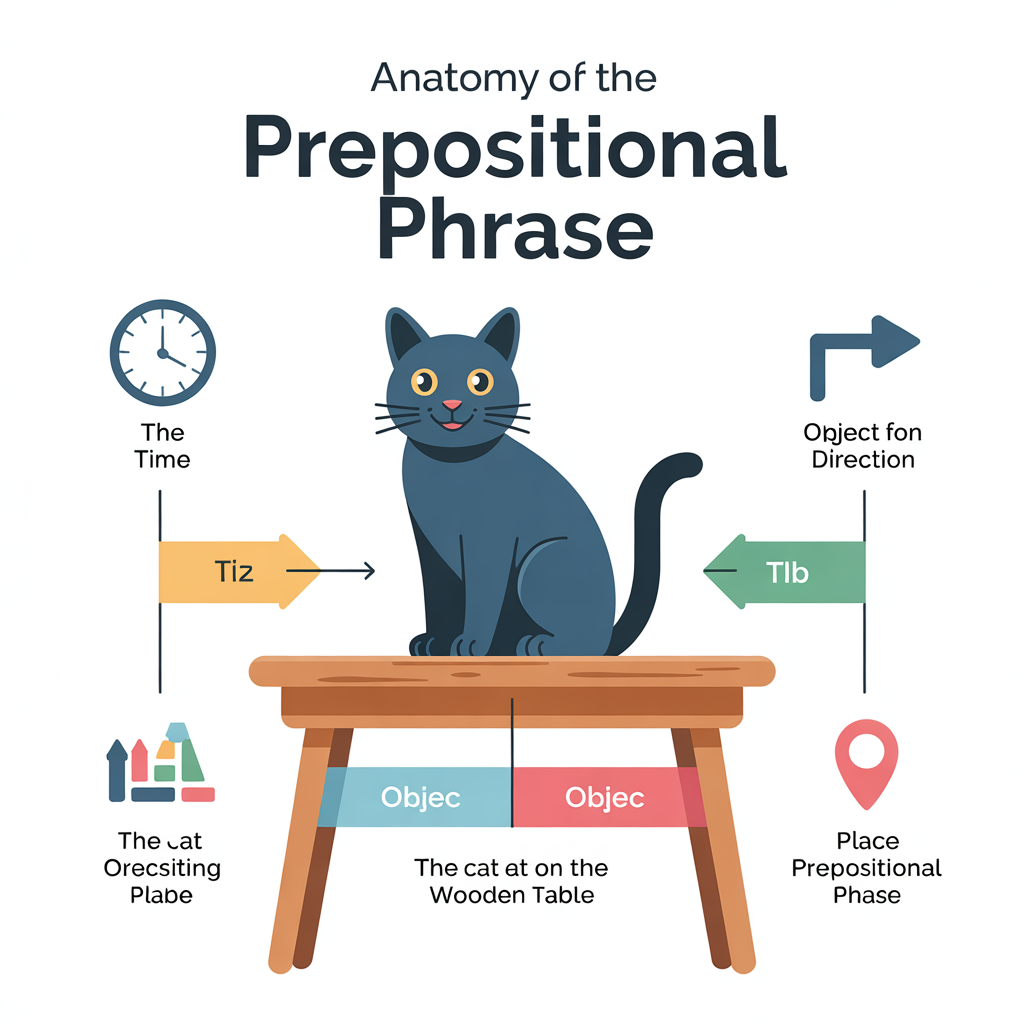
A prepositional phrase is a group of words that begins with a preposition and ends with a noun, pronoun, or noun phrase (known as the object of the preposition). Together, these words function as a single unit — usually acting as either an adjective or an adverb within a sentence.
Here is the basic formula:
Preposition + (optional modifiers) + Object
For example:
- On the roof → on is the preposition; the roof is the object
- After a long day → after is the preposition; a long day is the object
- Between you and me → between is the preposition; you and me is the object
Notice that the object of a preposition is always in the object form (also called the objective case). This is why we say “between you and me” — not “between you and I.”
The Building Blocks: What Makes Up a Prepositional Phrase?
To fully understand prepositional phrases, you need to be comfortable with their two essential components: the preposition and the object.
1. The Preposition
A preposition is a word that shows the relationship between its object and another element in the sentence. That relationship can involve:
- Location or position: in, on, at, under, over, behind, beside, between, near, above, below
- Direction or movement: to, into, onto, toward, through, across, along, past
- Time: before, after, during, since, until, within, throughout
- Cause or reason: because of, due to, for
- Manner or means: by, with, without, like
- Possession or association: of, with, about
English has single-word prepositions (simple prepositions) like in, on, at, by, of, and multi-word prepositions (complex prepositions) like in front of, on top of, due to, according to, in spite of.
2. The Object of the Preposition
The object of the preposition is the noun, pronoun, gerund, or noun phrase that comes after the preposition. It is the “target” of the preposition’s meaning.
- She sat beside him. → pronoun as object
- We talked about the project. → noun phrase as object
- He is interested in painting. → gerund as object
3. Optional Modifiers
Between the preposition and its object, you can have adjectives, articles, or other modifiers that describe the object further.
- In the old wooden box → “the old wooden” modifies “box”
- On a bright sunny morning → “a bright sunny” modifies “morning”
How Do Prepositional Phrases Function in a Sentence?
This is where prepositional phrases become truly interesting. They rarely just “sit there” — they do important grammatical work. Prepositional phrases function in two primary ways:
1. As an Adjective (Adjectival Prepositional Phrase)
When a prepositional phrase modifies a noun or pronoun, it acts as an adjective. It answers questions like Which one? or What kind? and typically comes right after the noun it describes.
- The book on the shelf is mine. → Which book? The one on the shelf.
- The woman with the red umbrella waved at us. → Which woman? The one with the red umbrella.
- That house at the corner has been empty for years.
2. As an Adverb (Adverbial Prepositional Phrase)
When a prepositional phrase modifies a verb, adjective, or another adverb, it acts as an adverb. It answers questions like When? Where? How? Why? or To what extent?
- She left in a hurry. → How did she leave?
- He arrived before sunrise. → When did he arrive?
- The cat slept under the blanket. → Where did the cat sleep?
- They worked hard for the reward. → Why did they work hard?
An adverbial prepositional phrase can appear at the beginning, middle, or end of a sentence, giving writers flexibility in how they construct meaning and emphasis.
Examples of Prepositional Phrases in Real Sentences
Let’s look at prepositional phrases in action across a range of sentence types. The prepositional phrases are shown in bold.
Showing Place or Position
- The keys are on the kitchen counter.
- They built a cabin in the middle of the forest.
- The cat is hiding behind the couch.
Showing Time
- I will see you after work.
- During the meeting, no phones were allowed.
- She has been waiting since morning.
Showing Direction or Movement
- He ran through the park.
- Turn left at the traffic light.
- The birds flew across the sky.
Showing Cause or Reason
- The game was cancelled because of the rain.
- She cried out of joy.
- He apologized for his mistake.
Showing Manner or Means
- He solved the problem with great skill.
- She spoke in a calm voice.
- The message was sent by email.
Prepositional Phrases vs. Other Phrases: What’s the Difference?
It can be easy to confuse prepositional phrases with other types of phrases. Here is a quick comparison:
| Phrase Type | Starts With | Example |
|---|---|---|
| Prepositional phrase | A preposition | in the garden |
| Noun phrase | A noun or article | the big garden |
| Verb phrase | A main verb or auxiliary | has been running |
| Adjective phrase | An adjective | very happy about it |
| Participial phrase | A participle (-ing or -ed) | walking through the park |
A key distinction: a participial phrase may begin with a word ending in -ing, just like a gerund (noun) used as the object of a preposition. The difference lies in function:
- She left without saying goodbye. → Prepositional phrase (without = preposition; saying = gerund, object)
- Walking through the park, she felt at peace. → Participial phrase modifying “she” (not a prepositional phrase)
Common Mistakes with Prepositional Phrases
Even experienced writers make errors involving prepositional phrases. Here are the most common pitfalls to avoid.
1. Using Subject Pronouns as Objects
Remember: the object of a preposition must be in the objective case.
- ❌ between you and I
- ✅ between you and me
- ❌ for he and his family
- ✅ for him and his family
2. Dangling or Misplaced Prepositional Phrases
A misplaced prepositional phrase modifies the wrong word and can create confusion or unintended humor.
- ❌ She served cake to the guests on paper plates. → Were the guests on paper plates?
- ✅ She served cake on paper plates to the guests.
3. Stacking Too Many Prepositional Phrases
Chaining too many prepositional phrases together creates clunky, hard-to-follow sentences.
- ❌ The report on the performance of the team in the department of sales for the quarter of October is ready.
- ✅ The October quarterly sales performance report is ready.
4. Ending Sentences with Prepositions
The old rule that you should never end a sentence with a preposition is largely considered outdated and overly rigid. Natural-sounding sentences often end with a preposition, and forcing an alternative can sound awkward.
- ✅ What are you talking about? — perfectly acceptable
- Forced alternative: About what are you talking? — technically “correct” but unnatural
In formal academic or professional writing, it is still wise to restructure sentences to avoid ending with a preposition when possible — but in everyday communication, it is completely fine.
Prepositional Phrases in Complex Sentences
Prepositional phrases can appear in virtually any type of clause or sentence structure. Understanding how they interact with the rest of a sentence helps you write with more control and sophistication.
Introductory Prepositional Phrases and Comma Rules
When a prepositional phrase introduces a sentence (appears at the beginning), it is typically followed by a comma — especially if it is long or if omitting the comma would cause confusion.
- After the ceremony, everyone gathered outside. → comma used
- In June the project will begin. → short phrase; comma optional
- Before eating, wash your hands. → comma used to prevent misreading
Nested Prepositional Phrases
One prepositional phrase can contain another within it. The inner prepositional phrase often acts as a modifier within the larger phrase.
- She found the letter in a box under the bed.
- They met at the café on the corner of Fifth Avenue.
While this nesting is grammatically valid, be careful not to overload your reader with too many layers.
Why Prepositional Phrases Matter for Good Writing
Prepositional phrases are not just a grammatical technicality — they are powerful writing tools. Here is why they matter:
- They add detail and context. Without prepositional phrases, sentences would be bare and vague. Compare “She walked” with “She walked through the quiet park after midnight.”
- They control emphasis. Placing a prepositional phrase at the beginning of a sentence highlights it. “In the middle of the chaos, she stayed calm.”
- They create rhythm and flow. Varying the position of prepositional phrases prevents choppy, repetitive writing.
- They show precise relationships. The difference between “on Tuesday” and “by Tuesday” or “before Tuesday” can completely change meaning.
Quick Reference: Most Common Prepositions in English
Here is a handy reference list of frequently used prepositions grouped by meaning:
Place / Position
at, in, on, above, below, under, over, behind, beside, between, among, near, inside, outside, opposite
Time
at, in, on, before, after, during, since, until, by, within, throughout, between
Direction / Movement
to, toward, into, onto, through, across, along, past, up, down, around, away from
Cause / Purpose
because of, due to, for, out of, thanks to, on account of
Manner
by, with, without, like, as, via
Complex (Multi-Word) Prepositions
in front of, on top of, in spite of, in addition to, according to, as well as, instead of, with regard to
How to Identify a Prepositional Phrase: A Step-by-Step Method
If you are unsure whether a group of words is a prepositional phrase, use this simple approach:
- Find the preposition. Look for a word that shows relationship — place, time, direction, manner, or cause.
- Ask: What is the object? Find the noun, pronoun, or noun phrase that follows the preposition.
- Check for modifiers. Are there any adjectives, articles, or other words between the preposition and its object?
- Group them together. That entire unit — from the preposition to the last word of the object — is your prepositional phrase.
- Determine its function. Does it modify a noun (adjective function) or a verb/adjective/adverb (adverbial function)?
Practice sentence: The dog with the spotted collar ran quickly across the yard.
- “with the spotted collar” → preposition: with; object: collar; modifies: dog (adjective function)
- “across the yard” → preposition: across; object: yard; modifies: ran (adverbial function)
Conclusion
A prepositional phrase is one of the most versatile and frequently used structures in the English language. It consists of a preposition, an optional modifier, and an object — and it functions either as an adjective (modifying a noun) or an adverb (modifying a verb, adjective, or adverb). From telling us where something is to when it happened and why, prepositional phrases add the layers of meaning that turn bare sentences into rich, communicative language.
Whether you are a student learning grammar for the first time, a writer looking to tighten your prose, or a non-native speaker aiming to master English nuance, understanding prepositional phrases gives you a real edge. Practice identifying them in your daily reading, experiment with their placement in your own writing, and you will quickly notice how naturally and powerfully they enhance your communication.
Frequently Asked Questions (FAQs)
Can a sentence have more than one prepositional phrase?
Yes, absolutely. Most sentences contain multiple prepositional phrases. For example: “After dinner, we sat on the porch and talked about the future.” This sentence has three: after dinner, on the porch, and about the future.
Is a prepositional phrase a clause?
No. A clause contains both a subject and a verb. A prepositional phrase contains a preposition and its object but no subject-verb pair. That is why it is a phrase, not a clause.
What is the difference between a preposition and a prepositional phrase?
A preposition is just the single word (e.g., on, in, after). A prepositional phrase is the whole group — the preposition plus its object and any modifiers (e.g., on the kitchen table).
Can a prepositional phrase be the subject of a sentence?
Generally, no. Prepositional phrases function as modifiers (adjectives or adverbs), not as subjects. However, a gerund phrase that begins with a preposition-like word can sometimes be confused for a prepositional phrase. True prepositional phrases do not act as sentence subjects.
Why is it wrong to say “between you and I”?
Because the object of a preposition must be in the objective case. “I” is a subject pronoun; “me” is the correct object pronoun. The correct form is “between you and me.”
What is the object of a preposition?
The object of a preposition is the noun, pronoun, or noun phrase that follows the preposition and completes its meaning. In “She walked toward the door,” the object of the preposition toward is the door.