
When you say “I will definitely finish this project” or “She is probably on her way,” you are doing something very specific with language — you are telling the listener how confident you are about what you are saying. That little word doing all that work? It is an adverb of certainty. These small but mighty words shape the tone and meaning of almost every conversation and piece of writing, yet many learners overlook them. This guide breaks down everything you need to know about adverbs of certainty — what they are, how they work, where they go in a sentence, and how to use them naturally and accurately.
What Are Adverbs of Certainty?
Adverbs of certainty are a specific category of adverbs that express the speaker’s level of confidence, sureness, or belief about an action, event, or state. In other words, they tell your listener or reader how certain you are that something is true or will happen.
They belong to the broader family of adverbs of manner and degree, but they serve a unique communicative function: signaling epistemic modality — a grammar term for how probable or certain the speaker considers the information being shared.
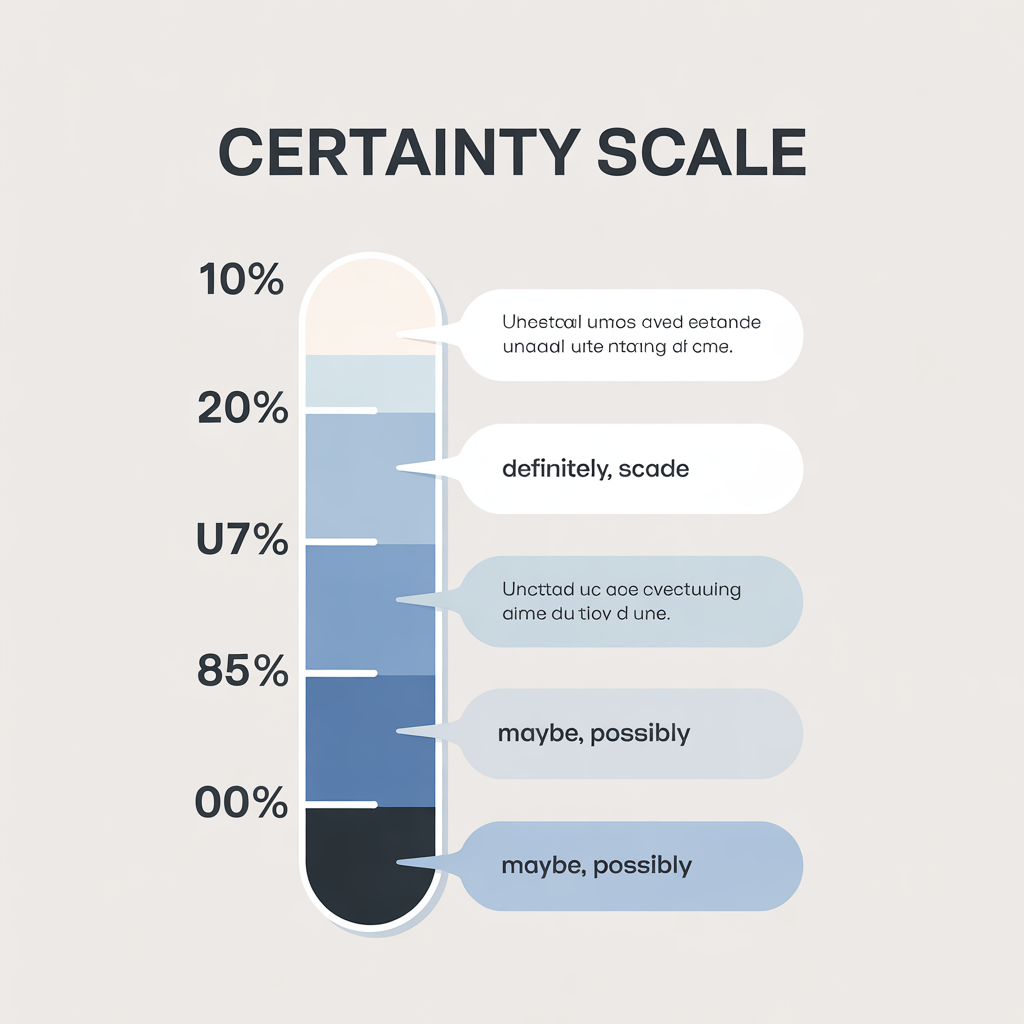
Think of adverbs of certainty as a sliding scale. At one end, you have words that express complete confidence (certainly, definitely, undoubtedly). In the middle, there are words that suggest probability (probably, presumably). At the lower end, there are words that indicate doubt or possibility (perhaps, possibly, maybe).
The Certainty Scale: From Certain to Uncertain
Understanding adverbs of certainty is much easier when you visualize them on a spectrum of confidence. Here is how the most common ones line up:
| Level of Certainty | Adverbs | Approximate Confidence (%) |
|---|---|---|
| Absolute certainty | certainly, definitely, undoubtedly, clearly, obviously | 95–100% |
| High probability | probably, presumably, doubtlessly | 70–90% |
| Moderate possibility | perhaps, possibly, conceivably | 30–60% |
| Low possibility / doubt | maybe (informal), supposedly | 10–40% |
This scale is not a rigid scientific classification, but it gives you an intuitive sense of the weight each word carries. Choosing the wrong adverb can make you sound far more or less confident than you intend.
A Full List of Common Adverbs of Certainty
Let us look at each major adverb of certainty in detail, including its meaning and a natural example sentence.
Certainly
Expresses that something is without doubt true or will happen. It is a strong, formal word.
- “She will certainly pass the exam — she studied for weeks.”
- “This is certainly the best coffee I have ever tasted.”
Definitely
Very similar to certainly but slightly more emphatic and common in everyday speech. It leaves absolutely no room for doubt.
- “I will definitely call you tomorrow.”
- “That was definitely an earthquake.”
Undoubtedly
Means something is accepted as true without any doubt. Often used in formal writing or to make a strong argument.
- “He is undoubtedly the most talented player on the team.”
- “This discovery will undoubtedly change medical science.”
Clearly / Obviously
These suggest that something is evident and apparent to everyone — the speaker expects the listener to agree.
- “She is clearly exhausted; she has been working since dawn.”
- “He has obviously never cooked a meal before.”
Note: Be careful with obviously. It can sound condescending if overused, as it implies the listener should already know something.
Probably
Indicates that something is likely but not guaranteed. It is one of the most commonly used adverbs of certainty in everyday English.
- “It will probably rain this afternoon.”
- “She is probably stuck in traffic.”
Presumably
Used when you assume something is true based on reasonable evidence or expectation, though you do not know for certain.
- “He didn’t answer the phone, so he’s presumably asleep.”
- “Presumably, they will announce the results on Monday.”
Perhaps
A formal and somewhat literary word for possibility. It suggests the speaker is genuinely unsure.
- “Perhaps we should try a different approach.”
- “That is, perhaps, the most difficult question in philosophy.”
Possibly
Slightly more tentative than perhaps. It opens up the idea that something could happen or be true without strong conviction.
- “Could you possibly help me carry these boxes?” (also used for polite requests)
- “The delay is possibly due to a technical issue.”
Maybe
The most informal and conversational of all adverbs of certainty. Its meaning is close to perhaps and possibly, but it is commonly heard in everyday dialogue.
- “Maybe we should leave early to avoid the rush.”
- “I don’t know — maybe he forgot.”
Supposedly
Implies skepticism. The speaker is repeating what others claim but does not necessarily believe it themselves.
- “This product is supposedly guaranteed to whiten your teeth in a week.”
- “He is supposedly an expert, though his advice seemed questionable.”
Doubtlessly / No doubt
Express strong certainty, similar to undoubtedly. They are more common in formal or literary contexts.
- “She will no doubt be promoted after such outstanding work.”
- “This will doubtlessly spark debate.”
Where Do Adverbs of Certainty Go in a Sentence?
Position matters a great deal with adverbs of certainty. Placing them incorrectly can make a sentence sound unnatural or even change the meaning. Here are the main rules:
1. Before the Main Verb (Most Common Position)
In most sentences, adverbs of certainty sit directly before the main verb.
- “She definitely knows the answer.”
- “He probably left his keys at home.”
2. After the Verb “To Be”
When the main verb is a form of to be (is, are, was, were), the adverb comes after it.
- “She is certainly the most qualified candidate.”
- “They are probably already there.”
3. After the First Auxiliary Verb
In sentences with auxiliary or modal verbs (will, can, have, should, etc.), the adverb goes after the first auxiliary.
- “It will probably snow tonight.”
- “She has definitely improved her writing.”
4. At the Beginning or End of a Sentence (Certain Adverbs)
Some adverbs of certainty — especially perhaps, maybe, possibly, and presumably — can appear at the start of a sentence to frame the whole idea. They can also appear at the end for emphasis.
- “Perhaps we are looking at this the wrong way.”
- “Maybe that is the answer.”
- “He is wrong, probably.” (end position — informal)
Summary of Position Rules
- Before main verb: She definitely knows.
- After “to be”: He is certainly tired.
- After first auxiliary: They will probably win.
- Sentence-initial (some adverbs only): Perhaps it is time to leave.
Adverbs of Certainty vs. Modal Verbs: What Is the Difference?
A common question in English grammar is: What is the difference between using an adverb of certainty and a modal verb?
Both tools can express certainty or probability, but they work differently:
- Modal verbs (must, might, could, should, may, will) are part of the verb phrase and change the grammatical structure of the sentence.
- Adverbs of certainty are additional modifiers that do not change the verb structure — they simply comment on how likely something is.
Compare these examples:
- “She might be at home.” (modal verb → possibility)
- “She is possibly at home.” (adverb of certainty → same idea, slightly different emphasis)
- “He must be the new teacher.” (modal → logical deduction, high certainty)
- “He is certainly the new teacher.” (adverb → direct statement of certainty)
Often, both can be used interchangeably, but modal verbs tend to feel more speculative, while adverbs of certainty feel more like the speaker is directly expressing their own viewpoint.
How Adverbs of Certainty Change the Meaning of a Sentence
One of the best ways to appreciate these adverbs is to see the same sentence transformed by swapping them out. The facts stay the same, but the speaker’s confidence — and the impression the sentence makes — changes dramatically.
Base sentence: “The meeting will be canceled.”
- “The meeting will definitely be canceled.” — I am 100% sure. No question.
- “The meeting will probably be canceled.” — I expect it will happen, but I am not 100% sure.
- “The meeting will possibly be canceled.” — It could happen. I am genuinely unsure.
- “The meeting will maybe be canceled.” — I have a vague feeling, no strong evidence.
- “The meeting will supposedly be canceled.” — Someone told me, but I am skeptical.
Each version tells a completely different story about what the speaker knows and believes. This is the power of adverbs of certainty.
Formal vs. Informal Usage
The choice of adverb also signals your register — whether you are speaking or writing formally or casually.
- Formal/written English: certainly, undoubtedly, presumably, conceivably, ostensibly
- Neutral/everyday English: probably, clearly, obviously, perhaps, possibly
- Informal/spoken English: maybe, definitely (common in speech), no doubt
When writing academic essays, business reports, or formal letters, lean toward certainly, undoubtedly, and presumably. In casual conversation, maybe, probably, and definitely will feel natural and appropriate.
Common Mistakes with Adverbs of Certainty
Even confident English speakers make errors with these words. Here are the most common pitfalls to avoid:
Mistake 1: Wrong Position in the Sentence
Incorrect: “She knows definitely the answer.”
Correct: “She definitely knows the answer.”
Mistake 2: Confusing “Maybe” and “May be”
Maybe (one word) is an adverb: “Maybe she will come.”
May be (two words) is a verb phrase: “She may be coming.”
Mistake 3: Overusing “Obviously” or “Clearly”
These words imply the listener should already know something. Overusing them can sound condescending or dismissive. Use them sparingly.
Mistake 4: Using “Surely” as 100% Certainty
Many learners think surely means the same as certainly. However, in modern English, surely often seeks agreement or expresses surprise, not pure certainty.
- “Surely you don’t believe that?” → The speaker is surprised, not simply certain.
Mistake 5: Mixing Up “Probably” and “Possibly”
Probably = more likely than not (above 50%).
Possibly = may or may not happen (could be below 50%).
Using them interchangeably can send the wrong signal about how confident you are.
Adverbs of Certainty in Negative Sentences
Adding an adverb of certainty to a negative sentence creates interesting nuance:
- “She will definitely not accept that offer.” — Complete certainty about a negative outcome.
- “He will probably not remember.” — Likely, but not certain, that he will forget.
- “They are certainly not ready yet.” — Strong assertion of unreadiness.
In informal speech, probably not is often contracted to “probably won’t”, and it is perfectly natural to do so: “She probably won’t be there.”
Adverbs of Certainty in Questions
These adverbs can also appear in questions to soften tone or seek agreement:
- “Are you definitely coming to the party?” — Checking for certainty.
- “Is that possibly what happened?” — Floating a tentative suggestion.
- “Will she probably need help?” — Asking for a probability estimate.
Quick Reference: Adverbs of Certainty at a Glance
- Certainly — 100% confident, formal
- Definitely — 100% confident, common in speech
- Undoubtedly — 100% confident, formal/academic
- Clearly / Obviously — evident to all, be cautious with tone
- Probably — likely (roughly 70–90%)
- Presumably — assumed to be true based on evidence
- Perhaps — possible, formal register
- Possibly — could be true, genuinely uncertain
- Maybe — could be true, informal register
- Supposedly — claimed by others, speaker is skeptical
Why Do Adverbs of Certainty Matter for English Fluency?
Mastering adverbs of certainty is a hallmark of genuine English fluency. Here is why they matter so much:
- They make your communication precise. Without them, every statement sounds like absolute fact. Real language is full of shades of meaning.
- They protect you from overcommitting. Saying “I will definitely finish it by Friday” is a promise. Saying “I will probably finish it by Friday” is a realistic estimate. In professional settings, this distinction matters enormously.
- They build rapport. Hedging with perhaps or possibly in conversation makes you sound thoughtful rather than arrogant. Showing certainty with definitely or certainly signals confidence and reliability.
- They are everywhere in academic writing. Researchers and scholars use hedging language constantly — possibly, presumably, arguably, probably — to qualify claims and maintain intellectual honesty.
Conclusion
Adverbs of certainty are a small but transformative category of English grammar. They let speakers and writers communicate not just what they believe, but how strongly they believe it. From the absolute confidence of definitely and certainly to the cautious possibility of perhaps and maybe, these words add depth, precision, and authenticity to your language.
The key takeaways are simple: know the certainty scale, learn where to place these adverbs in a sentence, and choose the one that honestly reflects your level of confidence. With a little practice, using adverbs of certainty will feel completely natural — and your English will sound all the more fluent and credible for it.
Frequently Asked Questions
What is the difference between “certainly” and “definitely”?
Both express 100% certainty, but certainly is more formal and often used in writing or professional speech. Definitely is more emphatic and very common in everyday conversation. You can usually swap them without changing meaning, though the tone may shift slightly.
Is “maybe” an adverb of certainty?
Yes. Maybe is an adverb of certainty — specifically, it expresses low-to-moderate possibility. It is more informal than perhaps or possibly and is very common in spoken English.
Can adverbs of certainty appear at the start of a sentence?
Yes, but only some of them. Perhaps, maybe, possibly, presumably, and certainly can all open a sentence naturally. For example: “Perhaps we should wait.” However, adverbs like probably and definitely sound unnatural at the very start and work best before the main verb or after an auxiliary.
What is the difference between “possibly” and “probably”?
Probably suggests something is more likely than not — above a 50% chance. Possibly is more neutral and open-ended — it could go either way. If someone asks “Will you come to the party?”, answering “probably” means yes with some reservation, while “possibly” means you are genuinely unsure.
Are adverbs of certainty the same as modal verbs?
No, though they can express similar ideas. Modal verbs (will, might, could, must, may) are part of the verb phrase and change the grammar of the sentence. Adverbs of certainty are separate modifiers added to the sentence. You can even combine both: “She will probably come” uses the modal will and the adverb probably together.
Where should I place adverbs of certainty in a sentence?
The general rules are: before the main verb, after the verb “to be”, and after the first auxiliary verb. Some adverbs (perhaps, maybe, possibly) can also go at the beginning of a sentence to frame the whole statement.