
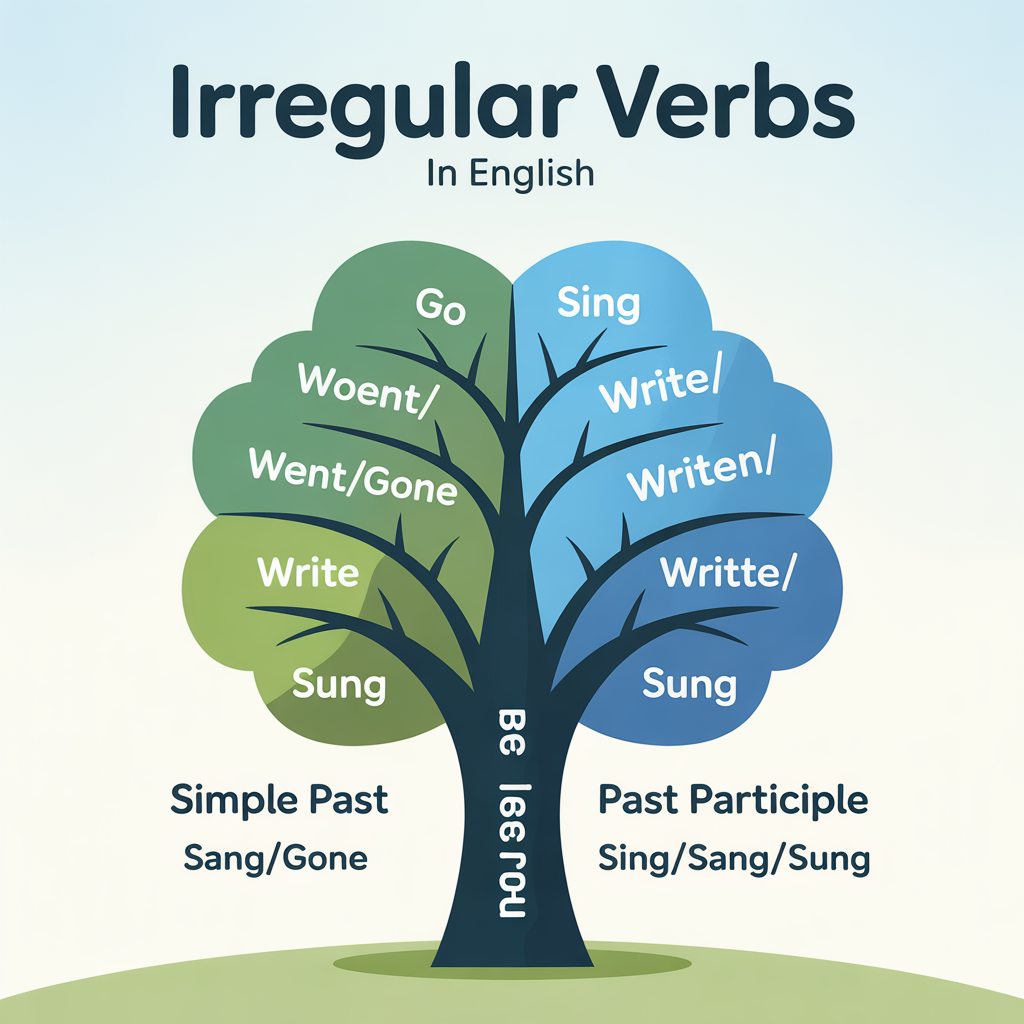
If you have ever typed “goed” instead of “went” or written “thinked” when you meant “thought,” you have already met one of English grammar’s most fascinating — and occasionally frustrating — features: the irregular verb. Irregular verbs do not follow the standard rules that most learners expect, and that unpredictability is exactly what makes them worth understanding deeply. Whether you are a student, a teacher, or simply someone who wants to write and speak English with confidence, this guide will walk you through everything you need to know about irregular verbs — what they are, why they exist, how they work, and how to master them.
What Is an Irregular Verb?
An irregular verb is a verb that does not form its simple past tense or past participle by simply adding -ed or -d to the base form. Instead, these verbs change in unpredictable ways — sometimes altering their vowel sounds, sometimes changing entirely, and sometimes not changing at all.
In English, there are two main categories of verbs: regular verbs and irregular verbs. Understanding the difference between them is the foundation of correct verb conjugation.
Regular Verbs vs. Irregular Verbs
To understand irregular verbs clearly, it helps to first see how regular verbs behave:
- Regular verbs follow a predictable pattern. You simply add -ed (or -d) to form both the simple past and the past participle. For example: walk → walked → walked, love → loved → loved, jump → jumped → jumped.
- Irregular verbs do not follow this rule. Their past forms are formed differently and must often be memorized individually. For example: go → went → gone, break → broke → broken, think → thought → thought.
This distinction matters enormously in everyday communication. Using the wrong verb form — such as saying “she singed the contract” instead of “she signed the contract” (though that one is regular), or “he runned away” instead of “he ran away” — immediately signals a gap in language fluency.
The Three Principal Parts of a Verb
Every English verb has three key forms that you need to know. These are called the three principal parts:
- Base form (infinitive): The basic, unconjugated form of the verb. Example: write, eat, sing.
- Simple past: The form used to describe a completed action in the past. Example: wrote, ate, sang.
- Past participle: The form used with auxiliary (helping) verbs like have, has, had, or in passive constructions. Example: written, eaten, sung.
For regular verbs, all three forms are easy to predict. For irregular verbs, each form may look completely different — which is why deliberate practice and exposure are so important.
Why Do Irregular Verbs Exist?
This is one of the most common questions learners ask, and it has a genuinely interesting historical answer.
Most irregular verbs in modern English are irregular because they are among the oldest words in the language. They come primarily from Old English (spoken roughly 1,000 to 1,500 years ago) and from Proto-Germanic roots. In Old English, verbs were conjugated through a process called ablaut — a systematic shifting of vowel sounds to indicate tense and mood. This is why you see patterns like:
- sing → sang → sung
- ring → rang → rung
- drink → drank → drunk
- swim → swam → swum
Over centuries, as English absorbed massive amounts of vocabulary from Latin, French, and other languages, newer verbs simply adopted the simpler -ed ending. But the ancient words — the everyday verbs people used constantly — retained their old vowel-shifting patterns because they were so deeply embedded in the language.
In short, irregular verbs are irregular because they are old, not because they are broken. They are living fossils of an earlier grammatical system.
Types of Irregular Verbs
Irregular verbs are not entirely random. When you study them carefully, you can identify several recognizable patterns. Grouping them by pattern makes memorization much more manageable.
1. Verbs That Are the Same in All Three Forms
These verbs do not change at all across the base form, simple past, and past participle. They are sometimes called zero-change irregular verbs.
- cut → cut → cut
- put → put → put
- let → let → let
- hit → hit → hit
- hurt → hurt → hurt
- set → set → set
- cost → cost → cost
- read → read → read (pronunciation changes: “reed” → “red” → “red”)
2. Verbs Where the Simple Past and Past Participle Are the Same
This is the largest group of irregular verbs. The base form is different, but the past and past participle are identical.
- buy → bought → bought
- bring → brought → brought
- think → thought → thought
- teach → taught → taught
- catch → caught → caught
- build → built → built
- spend → spent → spent
- keep → kept → kept
- feel → felt → felt
- leave → left → left
- lose → lost → lost
- make → made → made
- have → had → had
3. Verbs Where All Three Forms Are Different
These are the verbs that learners often find most challenging, because each of the three principal parts takes a distinct form.
- go → went → gone
- be → was/were → been
- give → gave → given
- write → wrote → written
- take → took → taken
- speak → spoke → spoken
- see → saw → seen
- eat → ate → eaten
- grow → grew → grown
- know → knew → known
- break → broke → broken
- choose → chose → chosen
- drive → drove → driven
- rise → rose → risen
- sing → sang → sung
- swim → swam → swum
- begin → began → begun
- drink → drank → drunk
- ring → rang → rung
- run → ran → run
The Most Common Irregular Verbs in English
There are around 200 to 250 irregular verbs in modern English, but the good news is that you do not need to learn all of them at once. Research into English language frequency shows that a relatively small set of irregular verbs accounts for the vast majority of everyday usage. Here are the most essential ones, organized for quick reference:
| Base Form | Simple Past | Past Participle |
|---|---|---|
| be | was / were | been |
| have | had | had |
| do | did | done |
| say | said | said |
| go | went | gone |
| get | got | gotten / got |
| make | made | made |
| know | knew | known |
| think | thought | thought |
| take | took | taken |
| see | saw | seen |
| come | came | come |
| want | wanted | wanted |
| give | gave | given |
| find | found | found |
| tell | told | told |
| put | put | put |
| buy | bought | bought |
| write | wrote | written |
| speak | spoke | spoken |
How Irregular Verbs Are Used in Sentences
Knowing the forms is only half the battle. You also need to know when and how to use each form correctly in context.
Simple Past Tense
Use the simple past form to describe a completed action at a specific time in the past.
- She wrote a letter yesterday.
- They went to the market this morning.
- He broke his phone last week.
Present Perfect Tense
Use the past participle with have or has to form the present perfect. This tense connects a past action to the present moment.
- She has written three novels.
- They have gone to Paris.
- He has never broken a promise.
Past Perfect Tense
Use the past participle with had to show that one past action happened before another.
- She had already written the report before the meeting.
- By the time I arrived, they had gone.
Passive Voice
The past participle is essential for forming passive sentences.
- The window was broken by the storm.
- The letter was written by the CEO.
Common Mistakes With Irregular Verbs
Even advanced English speakers make occasional errors with irregular verbs. Here are the most frequent mistakes to watch out for:
Using the Base Form Instead of the Past Form
- ❌ I go to the store yesterday.
- ✅ I went to the store yesterday.
Adding -ed to an Irregular Verb
- ❌ She goed home early.
- ✅ She went home early.
- ❌ He thinked about it for hours.
- ✅ He thought about it for hours.
Confusing the Simple Past With the Past Participle
This is one of the most common errors, particularly with verbs like go, see, and write.
- ❌ I have went to the gym three times this week.
- ✅ I have gone to the gym three times this week.
- ❌ She has wrote a new article.
- ✅ She has written a new article.
Using the Past Participle Without an Auxiliary Verb
- ❌ He spoken to the manager about the issue.
- ✅ He spoke to the manager about the issue. (simple past)
- ✅ He has spoken to the manager about the issue. (present perfect)
How to Learn and Remember Irregular Verbs
Memorizing irregular verbs does not have to be a painful, rote-learning experience. With the right strategies, it can actually be quite effective and even enjoyable.
1. Learn Verbs in Groups by Pattern
As shown earlier, many irregular verbs share similar vowel patterns. Learning them in groups reinforces the pattern rather than forcing you to memorize each verb in isolation.
- i → a → u pattern: sing/sang/sung, drink/drank/drunk, swim/swam/swum, begin/began/begun, ring/rang/rung
- ow → ew → own pattern: know/knew/known, grow/grew/grown, throw/threw/thrown, blow/blew/blown, fly/flew/flown
- eak → oke → oken pattern: speak/spoke/spoken, break/broke/broken, wake/woke/woken
2. Use Them in Context, Not in Isolation
Writing sentences or short paragraphs using irregular verbs helps your brain retain them far better than staring at a list. Create sentences about your own life to add personal meaning.
3. Practice With Flashcards
Classic for a reason. Write the base form on one side and the past and past participle on the other. Review them regularly, especially the ones that give you trouble.
4. Listen and Read Extensively
Exposure to authentic English — through books, podcasts, films, and conversations — naturally reinforces correct verb forms in context. You will start to “feel” when something sounds wrong without having to consciously recall the rule.
5. Focus on High-Frequency Verbs First
Do not try to master all 200+ irregular verbs at once. Start with the 30 to 50 most common ones (the ones listed in the table above) and build from there. These verbs appear constantly in everyday speech and writing.
6. Use Mnemonics and Stories
For particularly tricky verbs, invent a silly sentence or story that connects the three forms. The more memorable and unusual the story, the better it tends to stick.
Irregular Verbs in American English vs. British English
It is worth noting that some irregular verbs have two acceptable past forms — one more common in American English and one more common in British English. This does not mean one is wrong; it is simply a matter of regional variation.
- get: American English → got / gotten; British English → got / got
- dive: American English → dove or dived; British English → typically dived
- dream: American English → dreamed or dreamt; British English → dreamt is more common
- learn: American English → learned; British English → learnt or learned
- burn: American English → burned; British English → burnt or burned
When writing for a specific audience, be consistent with one variety of English. Both forms are grammatically acceptable.
Why Mastering Irregular Verbs Matters
You might wonder: why invest so much effort in irregular verbs specifically? The answer is simple — they are everywhere. The most frequently used verbs in the English language are, almost without exception, irregular: be, have, do, say, go, make, know, think, see, come.
Every time you speak in the past tense, write a formal email, craft an academic essay, or hold a business conversation, you will draw on irregular verbs. Getting them right signals fluency, care, and command of the language. Getting them wrong — consistently — creates unnecessary friction in communication and can undermine your credibility as a writer or speaker.
The effort you put into learning irregular verbs pays dividends across every skill: speaking, listening, reading, and writing.
Conclusion
An irregular verb is simply a verb that forms its past tense and past participle in a non-standard way — not by adding -ed, but through vowel changes, entirely different word forms, or no change at all. These verbs are irregular because of their ancient origins in Old English and Proto-Germanic, and they happen to be the most commonly used verbs in the entire language.
Understanding irregular verbs is not about memorizing a list of exceptions — it is about understanding the living history of the English language. The patterns are there once you know where to look, and with consistent practice, these forms become second nature.
Start with the high-frequency verbs, group them by pattern, use them actively in your writing and speaking, and expose yourself to as much authentic English as possible. Before long, you will not need to think twice before reaching for the right form — it will simply feel natural.
Frequently Asked Questions About Irregular Verbs
How many irregular verbs are there in English?
Modern English has approximately 200 to 250 irregular verbs, depending on how you count compound forms and variants. However, only around 50 to 80 of these appear with high frequency in everyday communication, so focusing on those will cover the vast majority of real-world usage.
Is “read” an irregular verb?
Yes. Read is a fascinating irregular verb because all three forms are spelled identically: read → read → read. However, the pronunciation changes — the base form is pronounced “reed,” while the simple past and past participle are both pronounced “red.” This makes it a zero-change irregular verb in spelling but a pronunciation-change verb in speech.
What is the most irregular verb in English?
By most accounts, be is the most irregular verb in English. It has eight distinct forms: be, am, is, are, was, were, being, been — far more variation than any other verb in the language. This reflects its extraordinary frequency and its ancient, deeply embedded roots.
Are irregular verbs difficult to learn?
They require deliberate effort, but they are far from impossible to learn. The key is learning them in groups by pattern, using them actively in context, and exposing yourself to lots of authentic English. Most learners find that the most common irregular verbs become automatic with regular practice.
Do all languages have irregular verbs?
Most languages that use verb conjugation have some form of irregular or strong verbs. German, Spanish, French, Italian, and many other languages all have verbs that deviate from standard conjugation patterns. In many cases, the same principle applies: the most commonly used verbs tend to be the most irregular ones, having survived centuries of linguistic change in their original form.
What is the difference between a strong verb and an irregular verb?
In linguistics, strong verbs specifically refers to verbs that form their past tense through vowel change (ablaut), such as sing/sang/sung. Irregular verbs is a broader, more commonly used term in English language teaching that includes all verbs not following the standard -ed pattern — including strong verbs, verbs that change entirely (like go/went), and verbs that do not change at all (like cut/cut). In everyday grammar instruction, the term “irregular verb” is preferred.