
If you’ve ever written a sentence like “I stayed home because it was raining” or “She left before the movie ended,” you’ve already used a subordinating conjunction — you just might not have known what to call it. These small but powerful words are the glue that holds complex sentences together. They show relationships between ideas, add depth to writing, and make communication far more precise. In this guide, you’ll learn exactly what a subordinating conjunction is, how it functions in a sentence, which ones you should know, and how to avoid the most common mistakes people make when using them.
What Is a Subordinating Conjunction?
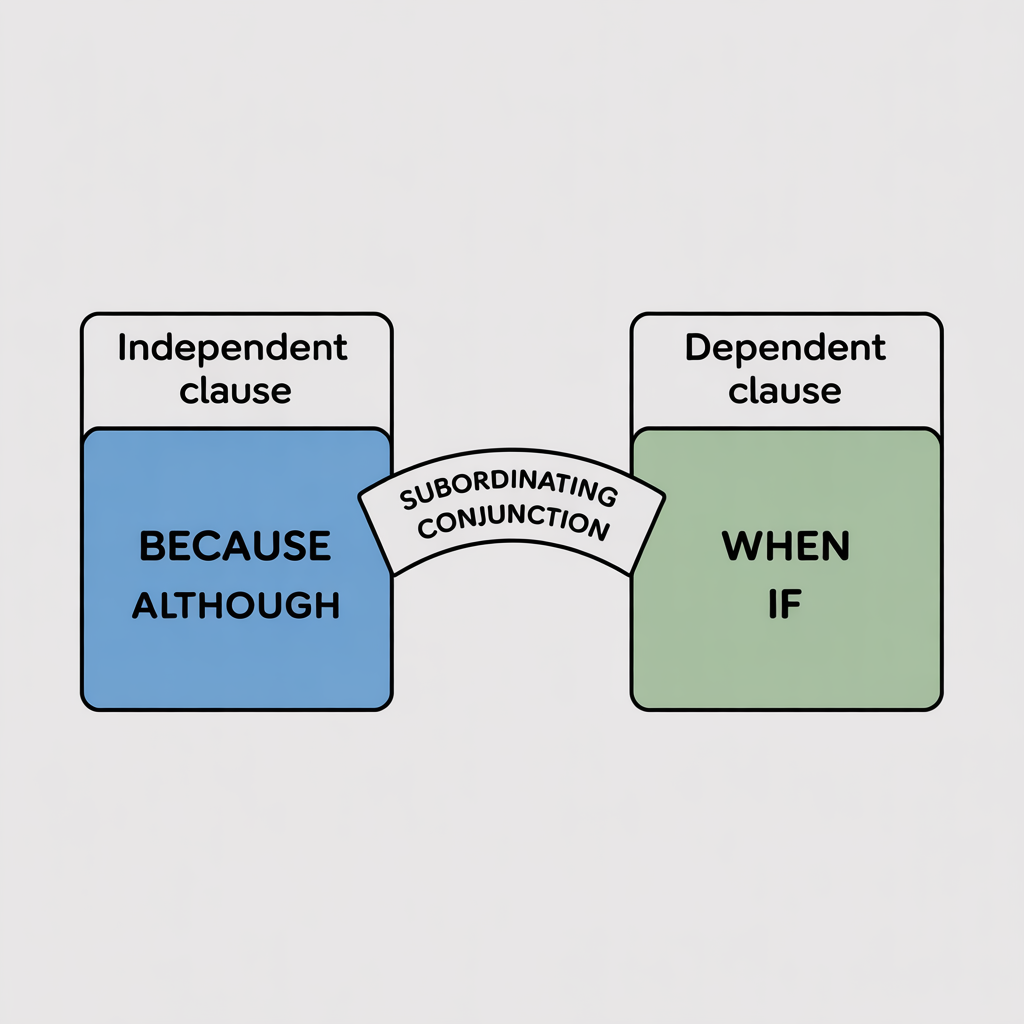
A subordinating conjunction is a word (or sometimes a short phrase) that connects a dependent clause to an independent clause. It signals that one part of the sentence cannot stand alone — it depends on the other part to make complete sense.
Let’s break that down simply:
- An independent clause is a complete thought that can stand on its own as a sentence. Example: “She smiled.”
- A dependent clause (also called a subordinate clause) is an incomplete thought that needs more context. Example: “Because she won the award.”
When you join them using a subordinating conjunction, you get a full, meaningful sentence:
“She smiled because she won the award.”
The word “because” is the subordinating conjunction here. It introduces the dependent clause and shows the reason behind the main action.
Subordinating Conjunctions vs. Other Types of Conjunctions
English has three main types of conjunctions. Understanding the differences helps you use each one correctly.
1. Coordinating Conjunctions
These join two equal clauses (two independent clauses). The most common ones are remembered using the acronym FANBOYS: For, And, Nor, But, Or, Yet, So.
Example: “I was tired, but I finished the work.”
2. Correlative Conjunctions
These come in pairs and also connect equal elements. Examples include either…or, neither…nor, and both…and.
Example: “Either you come now, or you miss the train.”
3. Subordinating Conjunctions
These connect an unequal pair — a dependent clause to an independent clause — creating what is called a complex sentence.
Example: “Although it was cold, we went for a walk.”
The key distinction: subordinating conjunctions create a hierarchy between clauses. One clause becomes the “main” idea, and the other becomes secondary — providing context, reason, condition, or contrast.
How Do Subordinating Conjunctions Work?
A subordinating conjunction does two important jobs at once:
- It introduces the dependent clause. It marks the beginning of the clause that cannot stand alone.
- It establishes a relationship between the two clauses. That relationship could be cause and effect, contrast, time, condition, and more.
Here’s a simple visual structure:
[Independent Clause] + [Subordinating Conjunction + Dependent Clause]
OR
[Subordinating Conjunction + Dependent Clause], + [Independent Clause]
Notice that the subordinating conjunction always travels with the dependent clause. It doesn’t float in the middle on its own.
Also important: when the dependent clause comes first, you typically use a comma to separate the two clauses. When the independent clause comes first, no comma is usually needed.
- ✅ “When the alarm rang, I jumped out of bed.” (comma used)
- ✅ “I jumped out of bed when the alarm rang.” (no comma needed)
Complete List of Common Subordinating Conjunctions
There are dozens of subordinating conjunctions in English. The good news is that they can be grouped by the type of relationship they express, which makes them much easier to learn and remember.
Time Relationships
These show when something happens relative to something else.
- after — “We left after the show ended.”
- before — “Finish your homework before you play.”
- when — “Call me when you arrive.”
- while — “She read while he cooked.”
- as soon as — “I’ll call you as soon as I land.”
- until / till — “Wait here until I return.”
- once — “Once you start, don’t stop.”
- since — “Things have changed since you left.”
- whenever — “Whenever I see her, I smile.”
Cause and Effect Relationships
These explain why something happens.
- because — “He studied hard because he wanted to pass.”
- since — “Since it was late, we decided to go home.”
- as — “As the temperature dropped, the pipes froze.”
- so that — “She spoke slowly so that everyone could understand.”
- in order that — “He saved money in order that he could travel.”
Contrast and Concession
These show an unexpected or opposing idea.
- although — “Although she was tired, she kept going.”
- though — “He agreed, though he had doubts.”
- even though — “Even though it rained, the event continued.”
- while — “While I like jazz, I prefer classical.”
- whereas — “She loves the city, whereas he prefers the countryside.”
Condition
These introduce a condition that must be met for something else to happen.
- if — “If it rains, we’ll cancel the trip.”
- unless — “Don’t go unless you’re invited.”
- provided that — “You can borrow it provided that you return it.”
- as long as — “I’ll help you as long as you try.”
- in case — “Bring an umbrella in case it rains.”
- whether — “I’ll be there whether you like it or not.”
Purpose
These explain the intention or goal behind an action.
- so that — “I wrote it down so that I wouldn’t forget.”
- in order that — “She trained every day in order that she could compete.”
Place
These indicate location or direction.
- where — “I’ll go where you go.”
- wherever — “Wherever she travels, she keeps a journal.”
Comparison and Manner
These describe how something is done relative to something else.
- as — “Do it as I showed you.”
- as if — “He spoke as if he knew everything.”
- as though — “She looked as though she’d seen a ghost.”
Why Are Subordinating Conjunctions Important?
Subordinating conjunctions are far more than a grammar rule. They are essential tools for clear and sophisticated communication. Here’s why they matter:
They Add Nuance and Context
Without subordinating conjunctions, writing becomes choppy and overly simplistic. Compare these two versions:
- ❌ “The bridge was old. We crossed it carefully.” (Two separate, blunt statements)
- ✅ “Because the bridge was old, we crossed it carefully.” (Clear cause-and-effect relationship)
They Show Logical Relationships
Readers understand not just what happened, but why, when, how, and under what conditions it happened. This makes your writing far more informative and persuasive.
They Build Complex Sentences
The ability to construct complex sentences is a hallmark of advanced writing. Academic writing, professional communication, and storytelling all rely heavily on subordinating conjunctions to express layered, sophisticated ideas.
They Indicate Emphasis
By placing one clause as the “main” clause and subordinating the other, a writer can control which idea receives the most emphasis. The independent clause carries the primary message.
Subordinating Conjunctions in Action: Real Sentence Examples
Let’s look at how subordinating conjunctions work in different contexts to give you a clearer picture.
In Academic Writing
- “Although the study had limitations, its findings were statistically significant.”
- “The experiment was halted because the control group showed unexpected results.”
In Everyday Conversation
- “I’ll pick you up unless you’d rather take the bus.”
- “Whenever she’s stressed, she goes for a run.”
In Storytelling
- “As the sun dipped below the horizon, the crowd fell silent.”
- “He waited until he was sure no one was watching.”
Common Mistakes to Avoid
Even experienced writers occasionally slip up when using subordinating conjunctions. Here are the most frequent errors — and how to fix them.
Mistake 1: Creating a Sentence Fragment
A dependent clause starting with a subordinating conjunction cannot stand alone as a sentence. This is one of the most common writing errors.
- ❌ “Because I was tired.” (Fragment — incomplete thought)
- ✅ “I went to bed early because I was tired.”
Mistake 2: Comma Confusion
Remember the comma rule: use a comma when the dependent clause comes first. Don’t add one when the independent clause leads.
- ❌ “I left early, because I was tired.” (Unnecessary comma when independent clause is first)
- ✅ “I left early because I was tired.”
- ✅ “Because I was tired, I left early.” (Comma needed here)
Mistake 3: Confusing “Since” as a Subordinating Conjunction vs. a Preposition
The word since can function as both a subordinating conjunction and a preposition. When it introduces a clause (with a subject and verb), it’s a conjunction. When it precedes a noun phrase, it’s a preposition.
- Conjunction: “Since she moved away, the house feels empty.”
- Preposition: “I haven’t seen her since last summer.”
Mistake 4: Using “Although” and “But” Together
These two words express similar ideas (contrast), but they belong to different types of conjunctions. Using them together is redundant and grammatically incorrect.
- ❌ “Although she tried, but she didn’t succeed.”
- ✅ “Although she tried, she didn’t succeed.”
- ✅ “She tried, but she didn’t succeed.”
Mistake 5: Misusing “While” for Cause and Effect
While primarily means “at the same time” or “in contrast.” Using it to show causation (where because or since would be better) can confuse readers.
- ❌ “While I was hungry, I ate a lot.” (Unclear — simultaneous or causal?)
- ✅ “Because I was hungry, I ate a lot.”
Tips for Using Subordinating Conjunctions Effectively
Knowing the rule is one thing. Using subordinating conjunctions with skill and intentionality is another. Keep these practical tips in mind:
- Choose the right conjunction for the right relationship. Don’t use although when you mean because. The specific conjunction you choose shapes the meaning of the entire sentence.
- Vary your sentence structure. Alternate between starting with the dependent clause and starting with the independent clause to keep your writing dynamic.
- Don’t overload one sentence. Using multiple subordinating conjunctions in one sentence can quickly become confusing. Keep it clear.
- Read your sentence aloud. If it sounds incomplete or awkward, check whether you’ve accidentally created a fragment or misplaced the conjunction.
- Use them to signal transitions. In longer writing, subordinating conjunctions help guide the reader through logical progressions of ideas.
Quick Reference: Subordinating Conjunctions by Category
| Category | Common Subordinating Conjunctions |
|---|---|
| Time | after, before, when, while, since, until, once, as soon as, whenever |
| Cause/Reason | because, since, as, so that, in order that |
| Contrast/Concession | although, though, even though, while, whereas |
| Condition | if, unless, provided that, as long as, in case, whether |
| Purpose | so that, in order that |
| Place | where, wherever |
| Manner/Comparison | as, as if, as though |
Conclusion
A subordinating conjunction is a connecting word that links a dependent clause to an independent clause, creating a complex sentence that expresses nuanced relationships — whether that’s time, cause, contrast, condition, or purpose. Words like because, although, while, if, and when are just a few examples of the many subordinating conjunctions that give English its flexibility and depth.
Mastering subordinating conjunctions isn’t just about passing a grammar test. It’s about becoming a more precise, expressive, and persuasive communicator. Once you understand how these small words work, you’ll start noticing them everywhere — and using them with far greater confidence in your own writing.
Frequently Asked Questions (FAQs)
What is the difference between a subordinating conjunction and a coordinating conjunction?
A coordinating conjunction (like and, but, or) joins two equal, independent clauses. A subordinating conjunction (like because, although, when) connects a dependent clause to an independent clause, making one clause secondary to the other.
Can a subordinating conjunction start a sentence?
Yes. It’s perfectly grammatical to begin a sentence with a subordinating conjunction, as long as the dependent clause is followed by a complete independent clause. Example: “Although it was late, she kept working.” Just remember to use a comma after the dependent clause in this case.
Is “that” a subordinating conjunction?
The word that can act as a subordinating conjunction in certain sentences, particularly when introducing a noun clause. Example: “I believe that honesty is important.” However, it is sometimes categorized differently depending on the grammatical framework being used.
How many subordinating conjunctions are there in English?
There is no fixed, universally agreed-upon number, but most grammar resources identify between 40 and 70 subordinating conjunctions in English, including multi-word phrases like as long as, in order that, and even though.
What happens if I use a subordinating conjunction without an independent clause?
You create a sentence fragment — an incomplete sentence that doesn’t express a full thought. For example, “Because I was late.” is a fragment. Always pair the dependent clause with an independent clause to form a complete sentence.
Can a sentence have two subordinating conjunctions?
Technically, yes, but it should be done carefully to avoid confusing the reader. Example: “If you study hard because you want to succeed, you’ll see results.” Such sentences work best when each conjunction clearly introduces its own clause.