
You use them every single day — probably without even thinking about it. Phrases like “my coffee,” “her car,” or “their house” all contain a possessive adjective. These small but mighty words are the backbone of how we express ownership and belonging in English. Yet many learners — and even native speakers — can’t always explain exactly what they are or how they differ from similar-sounding words. This guide breaks it all down clearly: what a possessive adjective is, how it works, when to use it, and how to avoid the most common mistakes.
What Is a Possessive Adjective?
A possessive adjective is a type of adjective that modifies a noun by showing ownership or a close relationship between the noun and a person, animal, or thing. In other words, it tells you whose something is.
Like all adjectives, possessive adjectives come before the noun they describe. They do not stand alone — they always need a noun to modify.
Here’s a simple example:
- “This is my book.” → my modifies book and tells us who the book belongs to.
- “She forgot her umbrella.” → her modifies umbrella.
Possessive adjectives are sometimes called possessive determiners in modern linguistics, because they function as determiners within a noun phrase. However, in most English grammar textbooks — especially those written for learners — the term “possessive adjective” is standard and widely understood.
The Complete List of Possessive Adjectives in English
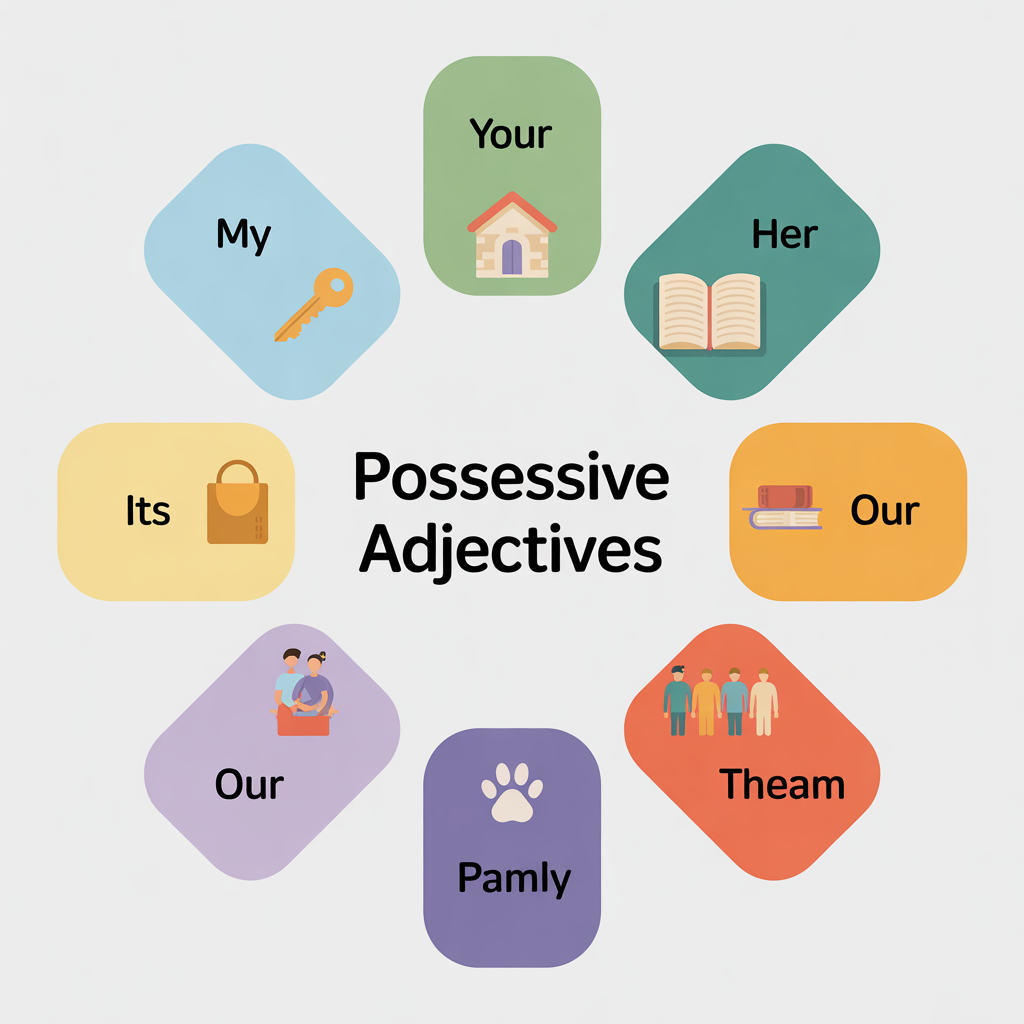
English has seven possessive adjectives, each corresponding to a specific personal pronoun. Here they are in a clear overview:
| Personal Pronoun | Possessive Adjective | Example |
|---|---|---|
| I | my | That is my jacket. |
| You (singular) | your | Is this your seat? |
| He | his | I like his style. |
| She | her | She painted her room blue. |
| It | its | The dog wagged its tail. |
| We | our | We love our neighborhood. |
| You (plural) | your | Please bring your forms. |
| They | their | They sold their old car. |
Notice that your is the same whether you’re speaking to one person or many. Context usually makes it clear which is meant.
How Do Possessive Adjectives Work?
Understanding how possessive adjectives function in a sentence requires looking at two key rules: they agree with the owner, and they always precede a noun.
Rule 1: Agreement Is with the Owner, Not the Object Owned
This is the most important rule — and also the one that trips up learners most often, especially those whose native language works differently.
In English, a possessive adjective reflects the gender and number of the owner, not the thing being owned. The noun that follows it doesn’t change the adjective at all.
- “John left his keys.” → his because John (the owner) is male.
- “Maria left her keys.” → her because Maria (the owner) is female.
- “The team celebrated its victory.” → its because the team is a single, non-personal entity.
Whether the thing owned is singular or plural doesn’t affect the possessive adjective:
- “She lost her phone.” (singular thing owned)
- “She lost her keys.” (plural thing owned)
Both sentences use her — because it’s about the owner (she), not the object.
Rule 2: A Possessive Adjective Always Comes Before a Noun
A possessive adjective cannot stand alone. It is always followed — directly or with other modifiers — by a noun.
- ✅ “This is my bag.” (correct — my modifies bag)
- ❌ “This bag is my.” (incorrect — nothing follows my)
When you want the possessive word to stand alone at the end of a sentence, you need a possessive pronoun instead (more on that distinction below).
Possessive Adjectives vs. Possessive Pronouns: What’s the Difference?
This is one of the most common points of confusion in English grammar. Both express ownership, but they play different roles in a sentence.
A possessive adjective modifies a noun. A possessive pronoun replaces a noun entirely — it stands on its own.
| Possessive Adjective | Possessive Pronoun |
|---|---|
| my | mine |
| your | yours |
| his | his |
| her | hers |
| its | its (rare in use) |
| our | ours |
| their | theirs |
Compare these two sentences:
- “That is my car.” → my is a possessive adjective modifying car.
- “That car is mine.” → mine is a possessive pronoun replacing my car.
Both sentences mean the same thing, but the structure is different. When a noun follows, use a possessive adjective. When no noun follows, use a possessive pronoun.
Possessive Adjectives vs. Personal Pronouns
Another common confusion is between possessive adjectives and personal pronouns, particularly with her and his.
- “I called her.” → her is a personal pronoun (object pronoun), not a possessive adjective.
- “I borrowed her pen.” → her is a possessive adjective modifying pen.
The key test: Is there a noun directly after it? If yes, it’s likely a possessive adjective. If the word stands alone or acts as the object of a verb, it’s a personal pronoun.
Common Mistakes with Possessive Adjectives
Even advanced English learners make errors with possessive adjectives. Here are the most frequent ones — and how to fix them.
Mistake 1: Confusing “its” and “it’s”
This is possibly the most common written error in the English language.
- its = possessive adjective → “The cat licked its paw.”
- it’s = contraction of “it is” or “it has” → “It’s raining outside.”
Quick tip: If you can replace the word with “it is” and the sentence still makes sense, use it’s. If not, use its.
Mistake 2: Confusing “their,” “there,” and “they’re”
- their = possessive adjective → “They packed their bags.”
- there = a place or an existential word → “Put it over there.”
- they’re = contraction of “they are” → “They’re coming tomorrow.”
Mistake 3: Confusing “your” and “you’re”
- your = possessive adjective → “Is this your phone?”
- you’re = contraction of “you are” → “You’re doing great!”
Mistake 4: Adding an apostrophe to a possessive adjective
Possessive adjectives never need an apostrophe. They are complete words on their own. Writing “her’s” or “our’s” is incorrect. The correct possessive pronoun forms are hers and ours — no apostrophe needed.
Mistake 5: Using a possessive adjective alone without a noun
- ❌ “That notebook is my.”
- ✅ “That is my notebook.” or “That notebook is mine.”
Possessive Adjectives with Body Parts and Clothing
In English, possessive adjectives are commonly used with body parts and clothing when the owner is clear from context. This is especially notable because other languages (like French or Spanish) may use a definite article in these cases.
- “She broke her arm.” (not “the arm”)
- “He put on his coat.”
- “The child rubbed its eyes.”
In English, the possessive adjective makes it explicit whose body part or item of clothing is being referred to, which avoids ambiguity.
Possessive Adjectives in Formal and Informal Contexts
Possessive adjectives are used equally in formal and informal English. However, there are some nuances worth noting in professional writing:
- In academic and business writing, clarity about ownership is crucial. Possessive adjectives help establish precise attribution — for example, “The company reported its quarterly earnings.”
- In gender-neutral writing, the singular their has become widely accepted when the gender of the owner is unknown or irrelevant: “Every student must submit their assignment by Friday.” This usage is now endorsed by major style guides including the AP Stylebook and Chicago Manual of Style.
Singular “Their” as a Gender-Neutral Possessive Adjective
The use of their as a singular, gender-neutral possessive adjective deserves special attention because it’s both increasingly common and occasionally controversial.
Historically, English defaulted to his when gender was unknown: “Every student should bring his pencil.” This is now considered outdated and exclusionary by many style guides.
The modern, preferred solution is to use their:
- “Each participant must wear their badge at all times.”
- “If a customer has a complaint, they should raise their concern directly.”
Shakespeare, Jane Austen, and many other great writers used singular their naturally — so it has long historical roots, even if prescriptive grammarians once discouraged it.
Possessive Adjectives in Questions
Possessive adjectives are frequently used in questions to ask about ownership or relationships.
- “Is this your bag?”
- “What is your name?”
- “Did you finish your homework?”
- “Have you met her parents?”
Note that whose is the interrogative possessive adjective used to ask who something belongs to:
- “Whose bag is this?”
- “Whose idea was it?”
Whose functions just like a possessive adjective — it always modifies a noun and shows a possessive or ownership relationship.
Possessive Adjectives with Gerunds
One slightly advanced but important usage: when a gerund (a verb acting as a noun, ending in -ing) is the subject of a clause, it is often formally preceded by a possessive adjective rather than a personal pronoun.
- Informal: “I don’t mind him staying late.”
- Formal: “I don’t mind his staying late.”
In formal writing, using the possessive adjective before a gerund is generally considered more grammatically precise, because the sentence is technically about the action (staying), not the person directly.
Practice Examples: Identifying Possessive Adjectives
Let’s look at a variety of sentences and identify the possessive adjectives. This kind of active practice is the fastest way to internalize the concept.
- “Please hand me your report.” — your (modifies report)
- “The bird returned to its nest.” — its (modifies nest)
- “We sold our old furniture.” — our (modifies furniture)
- “My favourite season is autumn.” — my (modifies favourite season)
- “They couldn’t hide their excitement.” — their (modifies excitement)
- “He forgot his wallet at home.” — his (modifies wallet)
- “She is proud of her achievements.” — her (modifies achievements)
Quick Reference Summary
Here’s a concise summary of everything you need to remember about possessive adjectives:
- What they are: Words that show ownership or a close relationship between a noun and a person/thing.
- The seven forms: my, your, his, her, its, our, their (plus the interrogative whose).
- Agreement rule: They agree with the owner, not the thing owned.
- Position: Always placed before the noun they modify.
- No apostrophe: Possessive adjectives never use an apostrophe.
- Not standalone: Unlike possessive pronouns, they cannot stand alone — they always need a noun.
- Singular their: Widely accepted and used for gender-neutral reference to a single person.
Conclusion
A possessive adjective is one of the most fundamental tools in English grammar. These seven small words — my, your, his, her, its, our, and their — do the essential job of linking a noun to its owner or holder. Once you understand that they always come before a noun, always reflect the owner’s identity (not the object’s), and never stand alone, using them correctly becomes second nature.
The next time you say “my phone,” “her idea,” or “their plan,” you’ll know exactly what grammatical role those words are playing. And the next time you’re tempted to write it’s when you mean ownership — or your when you mean you are — you’ll catch yourself. That’s the power of truly understanding a concept rather than just memorizing a list.
Grammar isn’t about rigid rules for their own sake. It’s about communicating clearly and confidently. And possessive adjectives are one of the clearest, most direct ways English has of saying: this belongs here, and here’s who it belongs to.
Frequently Asked Questions (FAQs)
Is “whose” a possessive adjective?
Yes. Whose is the interrogative possessive adjective. It functions exactly like other possessive adjectives — it modifies a noun and indicates ownership — but it is used in questions or relative clauses: “Whose car is parked outside?” or “The man whose briefcase I found was very grateful.”
Can a possessive adjective modify a plural noun?
Absolutely. The possessive adjective does not change based on whether the noun it modifies is singular or plural. It only reflects the owner: “She packed her bag” and “She packed her bags” both use her.
What is the difference between a possessive adjective and a possessive pronoun?
A possessive adjective (e.g., my, your, her) always comes before and modifies a noun. A possessive pronoun (e.g., mine, yours, hers) stands alone and replaces a noun phrase. Example: “That is my bag” vs. “That bag is mine.”
Why is there no apostrophe in possessive adjectives?
In English, apostrophes in possessives are used with nouns (e.g., John’s book) — but not with pronouns. Possessive adjectives and pronouns are complete words that inherently carry the meaning of ownership. Adding an apostrophe to its, their, your, or our is incorrect and usually creates a different word entirely (e.g., it’s = it is).
Is “their” correct when referring to a single person?
Yes. Using their as a singular, gender-neutral possessive adjective is now widely accepted in standard English. Major style guides — including the Associated Press Stylebook and the Chicago Manual of Style — endorse this usage. Example: “Every employee should submit their timesheet by Friday.”
Are possessive adjectives the same as possessive determiners?
They refer to the same set of words. In traditional grammar, they are called possessive adjectives. In modern linguistic analysis, they are more precisely labeled possessive determiners because they function to determine or specify a noun within a noun phrase, rather than describe it like a typical adjective. Both terms are widely used and accepted.