
What Is a Degree Adverb?
When you say something is very good, slightly cold, or completely wrong, you are using a special type of word that quietly does a lot of heavy lifting in a sentence. These words are called degree adverbs, and understanding them can sharpen your writing, clarify your speech, and deepen your grasp of English grammar. Whether you are a student, a language learner, or simply someone who loves words, this guide will walk you through everything you need to know — from a clear definition to practical examples and common pitfalls.
The Basic Definition: What Is a Degree Adverb?
A degree adverb (also called an adverb of degree or an intensifier) is a word that modifies an adjective, another adverb, or occasionally a verb to show how much, how little, or to what extent something is true. In other words, it tells us the intensity or scale of a quality.
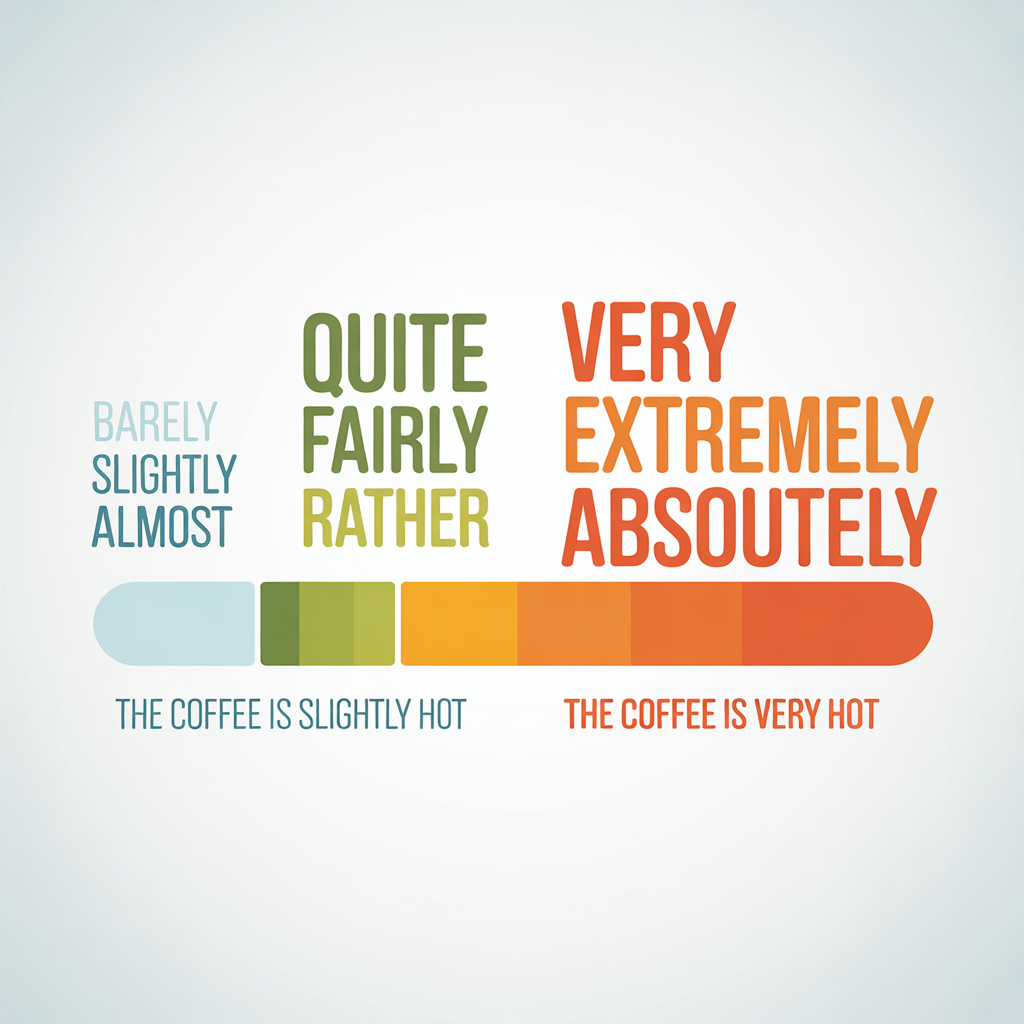
Think of degree adverbs as a volume dial. They can turn the strength of a description all the way up, dial it back to a whisper, or land it somewhere in the middle.
- “The coffee is hot.” — No degree adverb. Neutral statement.
- “The coffee is scalding hot.” — Degree adverb (scalding) cranks the intensity up.
- “The coffee is slightly hot.” — Degree adverb (slightly) turns the volume down.
Notice how the core meaning stays the same, but the degree adverb changes your understanding of reality.
Where Do Degree Adverbs Come From?
Degree adverbs have deep roots in English. Many of the most common ones — very, quite, rather, so — have been part of the language for centuries. The word very, for example, originally meant “truly” or “genuinely” (from the Old French verai), and over time it softened into a general intensifier. This evolution is common: words that once carried strong literal meaning gradually become grammatical tools for expressing degree.
Today, new degree adverbs continue to emerge through informal speech and internet culture — words like insanely, ridiculously, and super now function as everyday degree adverbs in casual English.
How Degree Adverbs Work in a Sentence
To understand how degree adverbs function, it helps to look at what they can and cannot modify.
1. Degree Adverbs Modifying Adjectives
This is the most common use. A degree adverb placed before an adjective amplifies or reduces its meaning.
- She was incredibly talented.
- The results were almost perfect.
- His explanation was barely comprehensible.
- The room was fairly clean.
In each case, the degree adverb (in bold) sits directly in front of the adjective and changes the listener’s perception of that quality.
2. Degree Adverbs Modifying Other Adverbs
Degree adverbs can also modify other adverbs, stacking one on top of the other to add precision.
- She finished the test surprisingly quickly.
- He spoke too softly to be heard.
- They arrived remarkably early.
Here, the degree adverb modifies the manner or time adverb, telling us how quickly, how softly, or how early.
3. Degree Adverbs Modifying Verbs
This is less common but still valid. Some degree adverbs can directly modify a verb to show intensity of action.
- I completely forgot about the meeting.
- She barely slept last night.
- He almost fell off the ladder.
Note that not all degree adverbs can do this — very, for instance, typically cannot modify a verb directly (you would not say “I very forgot”). This is an important grammatical distinction.
4. Degree Adverbs Modifying Determiners and Pronouns (Less Common)
In some constructions, degree adverbs can appear before determiners or pronouns.
- Almost everyone agreed.
- Nearly all the students passed.
Types of Degree Adverbs: A Spectrum of Intensity
Linguists typically organize degree adverbs into three broad groups based on the level of intensity they express.
Amplifiers (High Degree)
Amplifiers intensify the meaning of the word they modify, pushing it upward on the scale. They are sometimes called boosters.
| Degree Adverb | Example Sentence |
|---|---|
| very | The exam was very difficult. |
| extremely | The price was extremely high. |
| incredibly | She was incredibly kind. |
| absolutely | The view was absolutely stunning. |
| terribly | He was terribly worried. |
| remarkably | The child was remarkably patient. |
| utterly | The plan was utterly flawed. |
Approximators and Mid-Scale Modifiers
These degree adverbs suggest a moderate or approximate level of intensity — not too much, not too little. They are also called compromisers.
| Degree Adverb | Example Sentence |
|---|---|
| quite | The movie was quite good. |
| fairly | The road was fairly wide. |
| rather | The speech was rather long. |
| pretty | It was pretty cold outside. |
| somewhat | He seemed somewhat confused. |
| moderately | The task was moderately challenging. |
Downtoners (Low Degree)
Downtoners reduce or weaken the quality of the word they modify. They pull the meaning downward on the scale.
| Degree Adverb | Example Sentence |
|---|---|
| slightly | The soup was slightly too salty. |
| barely | She could barely hear him. |
| scarcely | There was scarcely any food left. |
| hardly | He hardly noticed the change. |
| almost | The project is almost complete. |
| nearly | She was nearly finished. |
Degree Adverbs vs. Other Types of Adverbs
English has many kinds of adverbs, and it is easy to get them mixed up. Here is a quick comparison:
- Manner adverbs answer “How?” — She sang beautifully.
- Time adverbs answer “When?” — He arrived yesterday.
- Place adverbs answer “Where?” — They went outside.
- Frequency adverbs answer “How often?” — She always wakes up early.
- Degree adverbs answer “To what extent?” — It was extremely cold.
The key question to identify a degree adverb is: “Does this word tell us the intensity or extent of another word?” If yes, it is a degree adverb.
Gradable vs. Non-Gradable Adjectives: A Critical Distinction
Not all adjectives work equally well with degree adverbs. This is one of the most nuanced aspects of the topic.
Gradable Adjectives
These adjectives exist on a scale and can logically be intensified or reduced. Most ordinary adjectives fall into this category.
- hot → slightly hot, very hot, extremely hot
- happy → somewhat happy, fairly happy, incredibly happy
- expensive → quite expensive, very expensive, outrageously expensive
Non-Gradable (Absolute) Adjectives
Some adjectives represent an absolute state — something is either true or it is not. Technically, these cannot be graded, though informal usage often breaks this rule.
- dead — something is dead or it is not. Saying “very dead” is logically odd.
- perfect — perfection is absolute. “Very perfect” is technically incorrect.
- unique — something is either one-of-a-kind or it is not. “Quite unique” is redundant.
- pregnant — you cannot be “slightly pregnant.”
That said, absolute degree adverbs like absolutely, completely, and utterly are often paired with non-gradable adjectives for emphasis, and this is widely accepted in practice:
- “The silence was absolutely perfect.”
- “The situation is completely impossible.”
The Role of “Very” — And Why You Might Want to Use It Less
Very is perhaps the most well-known degree adverb in English. It is enormously useful, especially for language learners, because it works with almost any gradable adjective. However, writers and language experts often caution against overusing it for one key reason: it adds emphasis without adding specificity.
Compare these pairs:
- “He was very tired” vs. “He was exhausted“
- “It was very cold” vs. “It was freezing“
- “She was very happy” vs. “She was elated“
In each case, replacing “very + adjective” with a stronger single adjective makes the writing more vivid and precise. This is not a grammar rule — it is a style preference, especially relevant for academic and professional writing. In everyday conversation, “very” is perfectly natural and appropriate.
Degree Adverbs in Academic and Formal Writing
In academic English, the choice of degree adverb matters greatly. Overstating or understating a claim can affect your credibility.
- Hedging language uses downtoners to qualify claims: “The results are somewhat inconclusive.” This shows academic caution.
- Boosters are used to assert confidence: “The evidence strongly suggests a correlation.”
Choosing the right degree adverb helps you strike the appropriate tone — neither overly cautious nor recklessly assertive.
Common Mistakes with Degree Adverbs
Even advanced English speakers make errors with degree adverbs. Here are some of the most frequent ones:
1. Using “very” with absolute adjectives
❌ “The solution was very unique.”
✅ “The solution was truly unique” or simply “The solution was unique.”
2. Confusing “very” and “much”
Very modifies adjectives and adverbs, while much typically modifies verbs and comparative adjectives.
❌ “I very appreciate your help.”
✅ “I greatly appreciate your help.” or “I appreciate your help very much.”
3. Double intensifiers
In informal speech this is common, but in formal writing it is considered redundant.
❌ “It was very extremely cold.”
✅ “It was extremely cold.”
4. Wrong placement
Degree adverbs typically come directly before the word they modify.
❌ “She was tired very.”
✅ “She was very tired.”
Degree Adverbs Across Different Varieties of English
It is worth noting that the same degree adverb can carry different connotations depending on where English is spoken.
- “Quite” in American English usually means “very” (“That’s quite impressive” = very impressive). In British English, “quite” before a non-gradable adjective can mean “completely” (“quite right”), while before a gradable adjective it can mean “fairly” or “moderately.”
- “Rather” tends to be more common in British English as a softener and can sound formal or old-fashioned in American contexts.
- “Pretty” as an intensifier (“pretty good”) is very common in American English and increasingly accepted globally in informal contexts.
Being aware of these regional differences helps you choose degree adverbs that match your audience and context.
Practical Tips for Using Degree Adverbs Effectively
- Match the adverb to the register. Use extremely in formal writing; use super in casual speech.
- Avoid repetition. If you use very ten times in a paragraph, vary it with highly, remarkably, or particularly.
- Use downtoners for diplomacy. “Your suggestion is slightly impractical” is kinder and more professional than “Your suggestion is completely wrong.”
- Be precise. Ask yourself: does the degree adverb actually add meaningful information, or is it just filler?
- Consider your adjective first. Sometimes, choosing a stronger adjective removes the need for an intensifier altogether.
Quick Reference: Most Common Degree Adverbs at a Glance
- High intensity: very, extremely, incredibly, absolutely, completely, utterly, terribly, awfully, remarkably, enormously, highly, deeply
- Moderate intensity: quite, fairly, rather, pretty, somewhat, moderately, reasonably, relatively
- Low intensity / limit: slightly, barely, hardly, scarcely, nearly, almost, just
Conclusion
A degree adverb is one of those small but powerful elements of English grammar that shapes how we perceive and communicate the world around us. By telling us how much or to what extent something is true, these words add precision, nuance, and emotional weight to our language. Whether you are boosting a claim with absolutely, softening a critique with slightly, or landing somewhere in the middle with fairly, mastering degree adverbs will make you a more confident and effective communicator in English.
The next time you write or speak, pay attention to the degree adverbs you reach for. You might be surprised at how much a single word can change the entire feel of a sentence.
Frequently Asked Questions (FAQs)
Is “very” always a degree adverb?
Yes, in modern English, very almost exclusively functions as a degree adverb. It modifies adjectives and other adverbs to amplify their meaning. It cannot usually modify verbs directly.
What is the difference between a degree adverb and an intensifier?
The terms are often used interchangeably, but technically intensifier refers specifically to degree adverbs that amplify (boost) meaning upward. Degree adverb is the broader term that includes words that reduce or moderate meaning as well (like slightly or barely).
Can an adjective function as a degree adverb?
Occasionally, yes. In informal English, words like dead (“dead tired”), flat (“flat broke”), and stone (“stone cold”) function as degree adverbs, even though they are primarily adjectives or nouns. These are idiomatic expressions rather than standard grammar.
Are degree adverbs important for English learners?
Absolutely. Degree adverbs are among the most frequently used words in spoken and written English. Mastering them helps learners express subtle differences in meaning, sound more natural, and avoid common grammar mistakes.
Can “so” be a degree adverb?
Yes. When used before an adjective or adverb to express intensity, so functions as a degree adverb. For example: “The food was so delicious” or “She ran so quickly.” It is especially common in informal and spoken English.