
When you say something is the best, the tallest, or the most interesting, you are already using superlative adjectives — probably without even thinking about it. These powerful little words do one specific job: they take a quality and push it to its absolute limit. Understanding superlative adjectives is one of the most practical steps you can take toward speaking and writing English with greater confidence and precision.
What Is a Superlative Adjective?
A superlative adjective is a form of an adjective used to express the highest (or lowest) degree of a quality among three or more things. It signals that one item in a group stands out above — or below — all the others in a particular characteristic.
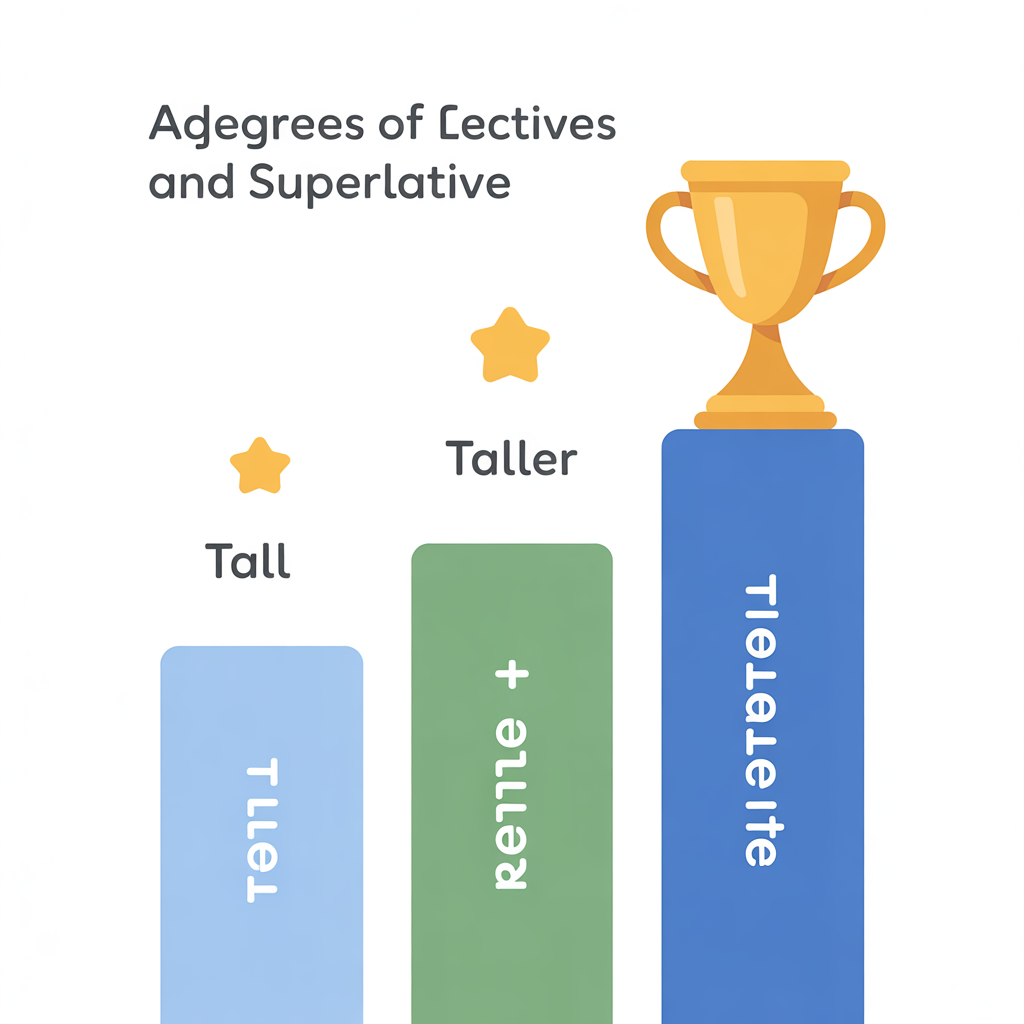
Think of adjectives as existing on a three-step scale:
- Positive degree: Describes a quality without comparison. (“She is tall.”)
- Comparative degree: Compares two things. (“She is taller than her sister.”)
- Superlative degree: Identifies the extreme within a group of three or more. (“She is the tallest student in the class.”)
The superlative degree answers the question: Which one is the most or least [quality] of all?
In English, superlative adjectives almost always appear with the definite article “the” — because there can only be one ultimate extreme in any group. You would not say “a tallest mountain”; you say “the tallest mountain.”
How to Form Superlative Adjectives
The way you form a superlative adjective depends on the length and structure of the base adjective. There are three main rules to follow.
Rule 1: Short Adjectives (One Syllable) — Add “-est”
For most single-syllable adjectives, simply add -est to the end of the word and place “the” before it.
- fast → the fastest
- cold → the coldest
- bright → the brightest
- long → the longest
- new → the newest
Spelling adjustments to watch for:
- Adjectives ending in a silent “e”: Just add -st.
wide → the widest | large → the largest - Adjectives ending in consonant-vowel-consonant (CVC): Double the final consonant before adding -est.
big → the biggest | hot → the hottest | thin → the thinnest - Adjectives ending in “y” (with a consonant before it): Change y to i, then add -est.
dry → the driest | shy → the shyest
Rule 2: Two-Syllable Adjectives — It Depends
Two-syllable adjectives follow different patterns depending on their endings.
- Ending in “-y”: Change y to i and add -est.
happy → the happiest | funny → the funniest | busy → the busiest | early → the earliest - Ending in “-er”, “-le”, “-ow”, or “-some”: You can typically add -est.
clever → the cleverest | simple → the simplest | narrow → the narrowest | handsome → the handsomest - Other two-syllable adjectives: Use “the most” before the adjective.
careful → the most careful | eager → the most eager | modern → the most modern
Note: Some two-syllable adjectives, especially those ending in “-y,” can also use “most” in informal speech without being considered wrong. But the “-est” form is generally preferred.
Rule 3: Long Adjectives (Three or More Syllables) — Use “the most” or “the least”
For longer adjectives, never add “-est.” Instead, place “the most” (for the highest degree) or “the least” (for the lowest degree) in front of the adjective.
- beautiful → the most beautiful
- expensive → the most expensive
- important → the most important
- comfortable → the most comfortable
- interesting → the most interesting / the least interesting
Irregular Superlative Adjectives
A handful of very common adjectives do not follow any of the above rules. Their superlative forms are completely irregular — meaning they change their root word entirely. You simply have to memorize these.
| Positive | Comparative | Superlative |
|---|---|---|
| good | better | the best |
| bad | worse | the worst |
| far | farther / further | the farthest / the furthest |
| little | less | the least |
| much / many | more | the most |
| old | older / elder | the oldest / the eldest |
These irregular forms appear constantly in everyday English, so getting comfortable with them early will make a big difference in your fluency.
How to Use Superlative Adjectives in a Sentence
Using a superlative adjective correctly requires more than just knowing the form. Placement and context matter too.
Basic Structure
The standard pattern is:
Subject + verb + the + superlative adjective + noun (+ in/of + group)
- Mount Everest is the highest mountain in the world.
- This is the most delicious cake I have ever eaten.
- He is the fastest runner on the team.
Using “In” vs. “Of”
After a superlative, English uses either “in” or “of” to define the group. The choice follows a simple logic:
- Use “in” with singular nouns referring to a place, organization, or period of time.
She is the most talented designer in the company.
It was the hottest day in July. - Use “of” with plural nouns or a stated number of items.
He scored the highest marks of all the students.
It was the worst of the three options.
Superlative Adjectives Without a Noun
Sometimes the noun is understood from context and can be dropped, leaving the superlative adjective to stand on its own as a predicate.
- “Which trail is the longest?” — “The northern trail is the longest.”
- “All three films were great, but the second one was the best.”
Real-World Examples of Superlative Adjectives
Seeing superlative adjectives in varied, real-life contexts helps lock in your understanding. Here are examples across different situations:
In Everyday Conversation
- “That was the worst traffic I have ever seen.”
- “She’s the kindest person I know.”
- “This is the most comfortable chair in the house.”
In Academic or Formal Writing
- “Carbon dioxide is the most significant greenhouse gas contributing to climate change.”
- “The 2008 financial crisis was one of the most severe economic downturns in modern history.”
In Advertising and Marketing
- “Try the freshest ingredients, delivered straight to your door.”
- “Experience the most luxurious stay of your life.”
In Literature and Storytelling
- “It was the best of times, it was the worst of times.” — Charles Dickens, A Tale of Two Cities
Common Mistakes with Superlative Adjectives
Even advanced English learners make predictable errors with superlatives. Here are the most frequent ones — and how to avoid them.
Mistake 1: Doubling the Superlative
Never use both -est and most together. This is a redundant double superlative.
- ❌ She is the most tallest girl in school.
- ✅ She is the tallest girl in school.
Mistake 2: Forgetting “the”
In most cases, superlative adjectives require the definite article “the.” Omitting it sounds unnatural.
- ❌ He is best player on the field.
- ✅ He is the best player on the field.
Mistake 3: Using a Superlative for Only Two Things
When comparing exactly two things, use the comparative form (e.g., -er or more), not the superlative.
- ❌ Between the two candidates, she is the most qualified.
- ✅ Between the two candidates, she is more qualified.
Mistake 4: Applying Superlatives to Absolute Adjectives
Some adjectives already represent an absolute state and logically cannot have a superlative. Words like unique, perfect, dead, infinite, and complete describe all-or-nothing conditions.
- ❌ This painting is the most unique in the gallery.
- ✅ This painting is unique. (or: the most distinctive)
Mistake 5: Wrong Spelling Rules
Forgetting to double the final consonant or change “y” to “i” leads to spelling errors.
- ❌ the bigest → ✅ the biggest
- ❌ the happyest → ✅ the happiest
Superlative Adjectives vs. Comparative Adjectives: What’s the Difference?
This is a point of confusion for many learners. The key distinction is simple:
- Comparative adjectives compare two things and use forms like -er, more, or less. They answer: Which is better/bigger/more interesting of the two?
- Superlative adjectives compare three or more things and identify the extreme. They answer: Which is the best/biggest/most interesting of all?
| Positive | Comparative | Superlative |
|---|---|---|
| small | smaller (than) | the smallest |
| exciting | more exciting (than) | the most exciting |
| good | better (than) | the best |
| difficult | more difficult (than) | the most difficult |
A quick test: if you are comparing just two things, reach for the comparative. If you are picking the champion out of a whole group, use the superlative.
Special Cases and Advanced Usage
Superlatives with Possessive Adjectives
In informal or spoken English, a possessive pronoun can sometimes replace “the” before a superlative.
- “She put her best effort into the project.”
- “It was my worst nightmare.”
Superlatives in Relative Clauses
Superlatives frequently pair with relative clauses using that (or, less formally, who). The verb in these clauses is typically in the present perfect or simple past.
- “That is the most inspiring speech that I have ever heard.”
- “It was the strangest thing that happened all year.”
“One of the + Superlative”
When you want to acknowledge that something ranks extremely high without claiming it is singularly number one, use “one of the + superlative + plural noun.”
- “Tokyo is one of the most exciting cities in the world.”
- “She is one of the best athletes the country has ever produced.”
Adverbs in Superlative Form
Superlative forms apply to adverbs too, following the same basic rules. When modifying a verb rather than a noun, “the” is sometimes optional.
- “He works (the) hardest of everyone on the crew.”
- “She sings the most beautifully of all the performers.”
Quick Reference: Superlative Adjective Formation Summary
- 1 syllable: Add -est (fast → the fastest)
- 1 syllable ending in CVC: Double consonant + -est (big → the biggest)
- 1 syllable ending in silent “e”: Add -st (wide → the widest)
- 2 syllables ending in “-y”: Change to -iest (happy → the happiest)
- 2 syllables (other endings): Use the most or -est depending on the word
- 3+ syllables: Use the most or the least
- Irregular: Memorize individually (good → the best, bad → the worst)
Why Superlative Adjectives Matter in English
Superlative adjectives are not just a grammar exercise — they are a fundamental tool for meaningful communication. They help you:
- Give opinions and make recommendations — “This is the most reliable brand on the market.”
- Describe records and achievements — “It was the hottest summer on record.”
- Tell stories compellingly — “It was the darkest night of his life.”
- Write persuasive content — “The fastest, safest, and most affordable option available.”
- Make comparisons in everyday life — “Which is the cheapest flight?”
Mastering superlatives allows you to express extremes, draw clear conclusions, and speak with a confidence that vague language simply cannot achieve.
Conclusion
A superlative adjective expresses the highest or lowest degree of a quality within a group of three or more. You form it by adding -est to short adjectives, placing the most or the least before longer ones, and memorizing a small set of irregular forms. Always pair it with the definite article “the” in most contexts, reserve it for comparisons involving three or more items, and avoid the trap of doubling up forms.
Once you internalize these rules, superlative adjectives become second nature — and your English will sound not just correct, but genuinely expressive and authoritative. Whether you are writing an essay, crafting a product description, or simply chatting with a friend, superlatives give your language the power to name what stands out from the rest.
Frequently Asked Questions
What is an example of a superlative adjective?
“The highest,” “the most beautiful,” and “the worst” are all examples of superlative adjectives. They each identify one extreme within a group — the highest peak, the most beautiful sunset, the worst outcome.
What is the difference between a comparative and a superlative adjective?
A comparative adjective compares two things (e.g., “taller than”), while a superlative adjective identifies the extreme among three or more things (e.g., “the tallest of all”). Comparatives use -er or more; superlatives use -est or the most.
Do superlative adjectives always use “the”?
In most standard uses, yes. The definite article “the” is required because a superlative identifies one unique extreme. However, when a possessive adjective (my, his, her, our) is used, “the” is replaced — for example, “her best work” or “my worst fear.”
What are irregular superlative adjectives?
Irregular superlatives do not follow standard spelling rules. The most important ones are: good → the best, bad → the worst, far → the farthest/furthest, little → the least, and much/many → the most.
Can you use a superlative adjective to compare only two things?
Technically, no — the superlative is intended for groups of three or more. When comparing exactly two things, it is grammatically preferred to use the comparative form. That said, in informal everyday speech, the superlative is sometimes used for two things, though careful writers avoid it.
What is “the least” as a superlative?
“The least” is the downward superlative — it identifies the lowest degree of a quality in a group. For example: “This is the least expensive option on the menu.” It works as the opposite of “the most.”